Primary Care Market Revenue, Trends, and Strategic Insights by 2035
Primary Care Market Size
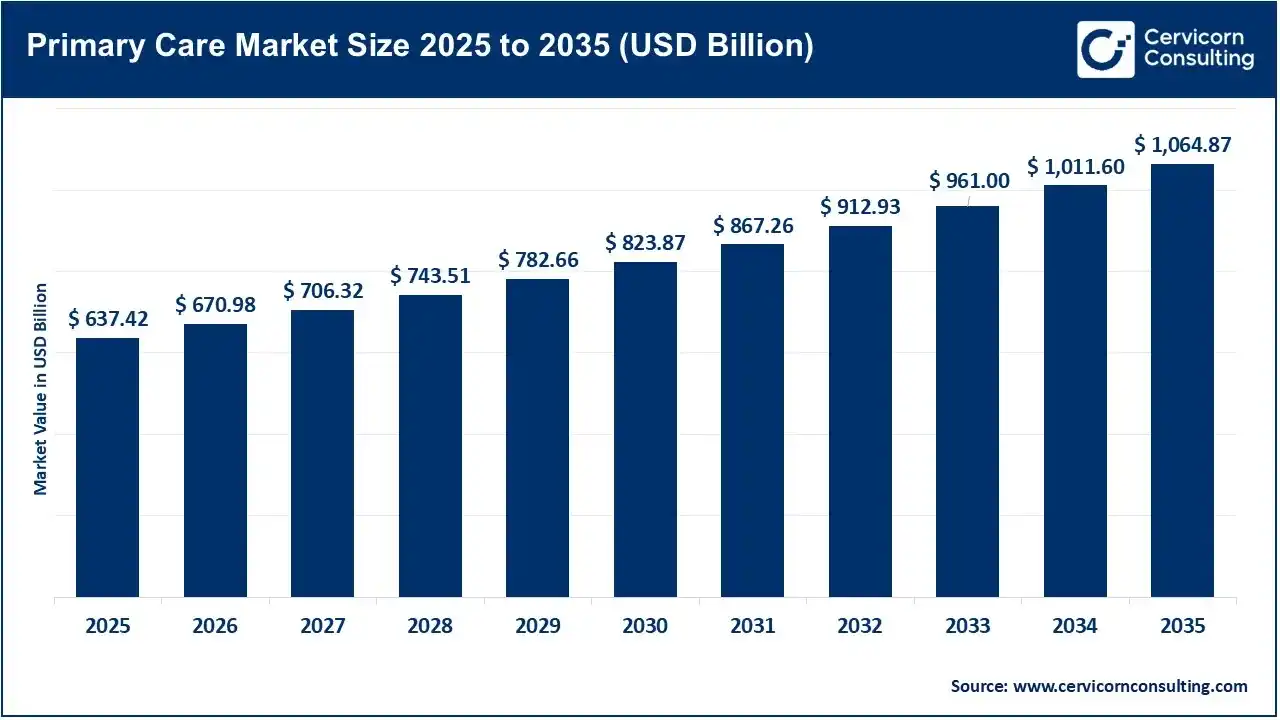
The global primary care market was valued at approximately USD 637.42 billion in 2025 and is projected to reach around USD 1,064.87 billion by 2035, expanding at a CAGR of approximately 5.3% during the forecast period.
Primary Care Market Growth Factors
The global primary care market is being driven by the rising prevalence of chronic diseases, population ageing, growing demand for preventive healthcare, increasing healthcare expenditure, shortages of hospital capacity, expansion of value-based care, and rapid adoption of telehealth and digital health technologies. The growing incidence of diabetes, cardiovascular diseases, respiratory disorders, obesity and other long-term conditions is increasing demand for continuous monitoring, early diagnosis and medication management at the primary-care level.
At the same time, governments and healthcare systems are attempting to shift care away from expensive hospitals toward community-based and preventive models. The World Health Organization identifies primary health care as the foundation for universal health coverage and notes that it can improve access, equity, efficiency and resilience across health systems. Ageing populations are also creating greater demand for regular consultations, geriatric care, screening, vaccination and chronic disease management.
In parallel, digital consultation platforms, remote monitoring, electronic health records, AI-supported clinical decision tools and home-based services are expanding the reach of primary care, particularly in underserved and rural communities. These structural changes are supporting continued investment in primary care infrastructure and service delivery worldwide.
What Is the Primary Care Market?
The primary care market encompasses healthcare services that represent the first and most accessible point of contact between patients and the healthcare system. It includes services delivered by general practitioners, family physicians, internists, pediatricians, nurses, community health workers, primary care clinics, outpatient centers, retail clinics, telehealth providers and other frontline healthcare professionals.
Primary care generally covers health promotion, disease prevention, diagnosis, treatment, chronic disease management, vaccination, screening, routine monitoring and referrals to specialist or hospital care. The WHO distinguishes primary care from the broader concept of primary health care. Primary care is a core process involving first-contact and continuing clinical services, while primary health care is a broader whole-of-society approach that also incorporates public health functions, multisectoral policies and community empowerment.
Commercially, the market includes traditional physician practices as well as institutional providers, payer-owned clinics, retail healthcare providers, direct primary care models, virtual-first providers and technology-enabled care platforms.
Get a Free Sample: https://www.cervicornconsulting.com/sample/3011
Why Is Primary Care Important?
Primary care is important because it provides the front door to healthcare. It enables patients to access medical advice and treatment before conditions become severe, while also establishing long-term relationships between patients and healthcare professionals.
Strong primary care systems can reduce unnecessary hospital visits, support earlier disease detection and improve management of chronic conditions. The WHO identifies five core functions of primary care: first-contact accessibility, continuity, coordination, comprehensiveness and people-centredness.
Primary care is particularly important as chronic diseases become more prevalent. Instead of managing conditions only after complications develop, primary care providers can monitor blood pressure, blood glucose, cholesterol, weight, mental health and other risk factors on an ongoing basis.
It also contributes to healthcare affordability. Preventive interventions and early treatment can reduce the need for more complex and expensive procedures. WHO estimates that scaling up primary healthcare interventions across low- and middle-income countries could save 60 million lives and increase average life expectancy by 3.7 years by 2030.
Leading Companies in the Primary Care Healthcare Ecosystem
The companies below are major pharmaceutical organizations that contribute to the broader primary-care ecosystem through medicines, vaccines, diagnostics, chronic disease therapies and healthcare access initiatives. They are not direct measures of primary-care service providers, and their reported corporate revenues should not be interpreted as primary-care market revenue. Primary-care-specific market shares for these companies are generally not separately disclosed.
| Company | Specialization | Key Focus Areas | Notable Features | 2025 Revenue | Primary Care Market Share | Global Presence |
|---|---|---|---|---|---|---|
| Pfizer Inc. | Innovative pharmaceuticals and vaccines | Vaccines, cardiovascular/metabolic diseases, infectious diseases, inflammation, oncology | Large medicine and vaccine portfolio; major global manufacturing and access programs | USD 62.6 billion | Not separately disclosed | Products supplied across approximately 200 countries and territories |
| Daiichi Sankyo Company, Limited | Innovative pharmaceuticals | Oncology, cardiovascular disease, thrombosis, rare diseases and immune disorders | Strong ADC capabilities and global partnerships | JPY 2.123 trillion | Not separately disclosed | Presence in more than 20 countries |
| AstraZeneca plc | Biopharmaceuticals | Cardiovascular, renal and metabolic disease, respiratory disease, oncology and rare disease | Broad therapy portfolio spanning primary and specialty care | USD 58.7 billion | Not separately disclosed | Products sold in more than 125 countries |
| F. Hoffmann-La Roche Ltd. | Pharmaceuticals and diagnostics | Oncology, immunology, neuroscience, cardiovascular/metabolic disease and diagnostics | Integrated medicines and diagnostics model | CHF 61.5 billion | Not separately disclosed | Medicines and diagnostics reach more than 100 countries |
| Gilead Sciences, Inc. | Biopharmaceuticals | Virology, oncology and inflammation | Strong HIV/HBV portfolio and global access programs | USD 29.4 billion | Not separately disclosed | Operations across more than 35 countries; access partnerships extend further |
Pfizer reported USD 62.6 billion in 2025 revenue and supplies medicines and vaccines to approximately 200 countries and territories.
Daiichi Sankyo reported JPY 2.123 trillion in FY2025 revenue. Its strategic portfolio includes oncology products and antibody-drug conjugates, while the company has maintained a presence in more than 20 countries.
AstraZeneca generated USD 58.7 billion in 2025 total revenue, representing 9% growth at actual exchange rates. Its portfolio spans primary care, specialty care and rare diseases, with products sold in more than 125 countries.
Roche generated CHF 61.5 billion in 2025 group sales, comprising CHF 47.7 billion in pharmaceutical sales and CHF 13.8 billion in diagnostics sales. Roche describes itself as a provider of medicines and diagnostics in more than 100 countries.
Gilead recorded USD 29.4 billion in 2025 revenue, with HIV products generating USD 20.8 billion in product sales. The company operates across more than 35 countries and uses licensing and partnerships to extend access to medicines in resource-limited markets.
Leading Trends and Their Impact on the Primary Care Market
1. Digital and Virtual Primary Care
Telemedicine and virtual consultations are transforming how patients interact with primary care providers. Patients can increasingly receive consultations, prescription support, follow-up care and chronic disease monitoring without visiting a physical clinic.
This is particularly valuable in rural and remote areas where physician shortages and geographic barriers limit access. Digital platforms also help providers manage appointment scheduling, electronic records, remote monitoring and patient communication.
2. AI-Enabled Primary Care
Artificial intelligence is becoming an important supporting technology for primary care. AI can help clinicians identify high-risk patients, analyze medical records, support diagnostic decisions, automate documentation and prioritize patients who require follow-up.
The impact is potentially significant because primary care providers manage large patient populations and extensive amounts of clinical information. AI-enabled workflows can reduce administrative workloads while allowing clinicians to devote more time to patient interaction.
3. Shift Toward Preventive Care
Healthcare systems are moving from reactive treatment toward prevention and early intervention. Screening for hypertension, diabetes, cancers and cardiovascular risks is increasingly being incorporated into primary-care workflows.
This trend supports demand for diagnostic testing, vaccination, lifestyle counselling, nutrition services and regular health assessments.
4. Value-Based Care
Traditional fee-for-service models are increasingly being supplemented by value-based arrangements that reward quality, outcomes and coordinated care. In the U.S., CMS launched the ACO Primary Care Flex Model in January 2025, providing prospective primary-care payments and greater financial flexibility to participating accountable care organizations.
This model can encourage providers to invest in prevention, care coordination and chronic disease management rather than relying solely on visit volume.
5. Home-Based and Community-Based Care
Primary care is increasingly moving closer to patients’ homes. Home visits, community health workers, mobile clinics and remote monitoring can expand access for older adults, patients with mobility limitations and underserved populations.
This trend is especially relevant in emerging economies where centralized hospital infrastructure cannot adequately serve dispersed populations.
6. Integrated Multidisciplinary Care
Primary care is evolving from a physician-centric model toward multidisciplinary teams involving physicians, nurses, pharmacists, nutritionists, mental health professionals, physiotherapists, community health workers and social care professionals.
The UK’s Primary Care Networks demonstrate this approach by connecting GP practices with community, mental health, social care, pharmacy, hospital and voluntary services.
7. Chronic Disease Management
The growing burden of chronic conditions is increasing demand for long-term primary care. Diabetes, hypertension, obesity, cardiovascular disease and respiratory disorders require repeated consultations, medication management and lifestyle interventions.
As populations age, the importance of continuous primary care is expected to increase further.
Successful Examples of Primary Care Around the World
India’s Ayushman Arogya Mandirs
India’s Ayushman Arogya Mandir (AAM) program represents one of the world’s largest efforts to expand comprehensive primary healthcare at the community level. The initiative is designed to provide preventive, promotive, curative, rehabilitative and palliative services closer to communities.
The program has expanded beyond maternal and child health to include noncommunicable disease screening and management, mental health, oral health, eye and ENT services, elderly care, essential medicines and diagnostics. As of August 21, 2026, the official AAM dashboard reported 186,934 functional Ayushman Arogya Mandirs across different facility categories.
The program illustrates how governments can combine physical infrastructure, community health workers, digital consultation and preventive services to expand primary-care access.
UK’s Primary Care Networks
England’s Primary Care Networks (PCNs) bring groups of GP practices together to provide coordinated services for local populations. NHS England reports approximately 1,250 PCNs, with more than 99% of general practices participating.
The model enables smaller practices to share workforce and resources while integrating primary care with pharmacy, mental health, community services and social care.
For 2025/26, NHS England increased funding across the core practice contract and Network Contract DES by £889 million, taking the estimated combined contract value to £13.176 billion.
Rwanda’s Community-Based Primary Care
Rwanda provides another important example of community-oriented primary care. The country has expanded health posts and community health workers to bring essential services closer to rural communities.
WHO reported that the average travel time to the nearest health facility had fallen substantially, while health posts helped connect community health workers with health centres and hospitals.
The approach demonstrates how decentralized infrastructure can address geographical barriers where physician and hospital capacity is limited.
Australia’s Medicare Urgent Care Clinics
Australia’s Medicare Urgent Care Clinics provide an intermediate option between traditional general practice and hospital emergency departments. The program has become an important component of Australia’s broader primary and community care strategy.
By June 2026, Australia had 137 operational Medicare Urgent Care Clinics, and the network had recorded approximately 3 million presentations since its first clinics opened in June 2023.
The model shows how governments can expand community-based urgent care while reducing pressure on hospital emergency departments.
Global Regional Analysis of the Primary Care Market
North America
North America represents one of the most developed primary care markets, supported by high healthcare spending, extensive insurance coverage, advanced healthcare infrastructure and rapid adoption of digital health.
The United States is particularly important because primary care is increasingly integrated with accountable care organizations, value-based reimbursement, retail clinics and virtual healthcare. Providers are expanding preventive services and chronic disease management as payers place greater emphasis on outcomes and total healthcare costs.
Government policy is also supporting transformation. CMS’s ACO PC Flex program, launched in 2025, provides a prospective payment mechanism intended to increase primary-care funding and encourage proactive, team-based and patient-centered care.
Canada’s publicly funded healthcare system also places primary care at the centre of healthcare access, although physician shortages, rural access and appointment availability remain important challenges.
Market impact: North America is likely to remain a major innovation hub for virtual primary care, AI-supported clinical workflows, value-based reimbursement, retail clinics and direct primary care models.
Europe
Europe has strong public healthcare systems and an established primary-care infrastructure, but ageing populations, workforce shortages and increasing chronic disease prevalence are creating pressure on general practice.
The European Commission reports that only about one in five doctors in the EU is a general practitioner, while more than one-third of European adults reported a long-standing illness or health problem in 2024.
European governments are therefore focusing on integrated care, workforce development, digital health and preventive healthcare. The EU’s broader health policy framework includes initiatives such as the European Health Data Space, Pharmaceutical Strategy for Europe and Europe’s Beating Cancer Plan, which can indirectly strengthen primary-care capabilities through better data sharing, prevention and earlier diagnosis.
In the UK, PCNs and the 2025/26 GP contract are strengthening community-based and digitally enabled primary care.
Market impact: Europe’s primary-care market is increasingly oriented toward integrated care, population health management, digital records, preventive services and multidisciplinary delivery.
Asia-Pacific
Asia-Pacific offers substantial long-term growth potential because of its enormous population, rapid urbanization, rising healthcare spending, ageing demographics and increasing chronic disease burden.
India is a major example. Through Ayushman Bharat and Ayushman Arogya Mandirs, the government is expanding comprehensive primary care with services covering NCDs, maternal and child health, mental health, oral health, eye care, elderly care and teleconsultation.
Japan’s ageing population is increasing demand for chronic disease management, home-based care and geriatric services. China is also expanding community-level healthcare infrastructure and digital health capabilities.
Australia combines established general practice with newer community-based models. Its Medicare Urgent Care Clinics have expanded access to free urgent treatment outside traditional GP and emergency department pathways.
Market impact: Asia-Pacific is positioned for strong expansion in community clinics, telehealth, preventive care, digital diagnostics and home-based primary care.
Latin America
Latin America’s primary-care development is strongly influenced by universal health coverage initiatives and public healthcare systems. Brazil’s Family Health Strategy has been designed to reorganize primary care around multidisciplinary teams serving defined communities.
The model emphasizes household registration, community-level diagnosis, long-term care and proactive management of health problems.
Countries across the region are also investing in telehealth and decentralized healthcare services to address geographic disparities between major cities and rural populations.
Market impact: Growth is likely to come from expansion of community health services, digital consultation, chronic disease screening and public-private partnerships.
Middle East & Africa
The Middle East and Africa represent diverse primary-care environments, ranging from highly developed healthcare systems in Gulf countries to resource-constrained systems in parts of sub-Saharan Africa.
In lower-resource markets, the biggest opportunity is often improving basic access through community health workers, primary health centres, mobile healthcare and affordable diagnostics.
Rwanda provides a strong example of this approach. Its health-post strategy has brought essential healthcare closer to communities, while community health workers provide frontline services and connect patients with health centres and hospitals.
In the Middle East, governments are investing in healthcare modernization, digital health, preventive medicine and private-sector participation. Gulf countries are increasingly using digital platforms and integrated health systems to improve access and population health management.
Market impact: The region’s primary-care market will be shaped by health infrastructure investment, workforce development, digital healthcare, community-based services and efforts to improve universal health coverage.
Government Initiatives and Policies Shaping the Primary Care Market
Government policies are among the strongest forces influencing the future of primary care because public financing, reimbursement structures and national health strategies determine how healthcare services are delivered.
United States – Value-Based Primary Care
The U.S. is moving toward payment models that give primary-care organizations more predictable funding and incentives to improve outcomes. The ACO Primary Care Flex Model is designed to strengthen primary care through prospective payments, team-based delivery and greater emphasis on preventive and coordinated care.
United Kingdom – GP Contract and Primary Care Networks
England’s 2025/26 GP contract increased funding by £889 million and emphasized prevention, digital access and shifting more care from secondary settings into the community.
The Network Contract DES further supports PCNs and multidisciplinary primary-care delivery.
India – Ayushman Bharat
India’s Ayushman Arogya Mandir initiative aims to provide comprehensive primary healthcare that is universal and free at the point of use, while expanding services beyond conventional maternal and child health programs.
The government’s model includes screening and management of noncommunicable diseases, mental health, oral health, elderly care, rehabilitation and palliative services.
Australia – Strengthening Medicare
Australia is making Medicare Urgent Care Clinics a permanent part of the health system. The 2026–27 Budget committed additional funding to support the program, while the government reported that approximately three million Australians had already used the clinics since their introduction.
Europe – Integrated and Resilient Primary Care
European healthcare reforms increasingly focus on workforce shortages, integrated care and patient-centred service delivery. The European Commission has highlighted the need to transform primary care into more resilient foundations for healthcare systems amid ageing populations and increasing chronic disease.
Global – WHO Universal Health Coverage Framework
At the global level, WHO continues to promote primary health care as the foundation for universal health coverage. Its framework emphasizes integrated services, multisectoral action and community empowerment.
The policy direction is significant for the market because governments are increasingly shifting resources toward prevention, early diagnosis, community-based services and coordinated chronic-care management. This creates opportunities for primary-care providers, pharmaceutical companies, diagnostic businesses, digital health companies and healthcare technology vendors to participate in an expanding and increasingly technology-enabled healthcare ecosystem.
To Get Detailed Overview, Contact Us: https://www.cervicornconsulting.com/contact-us
Read Report: Antibody Drug Conjugate (ADC) Market Revenue, Trends, and Strategic Insights by 2035