E-Commerce Packaging Market Revenue, Trends, and Strategic Insights by 2035
E-Commerce Packaging Market Size
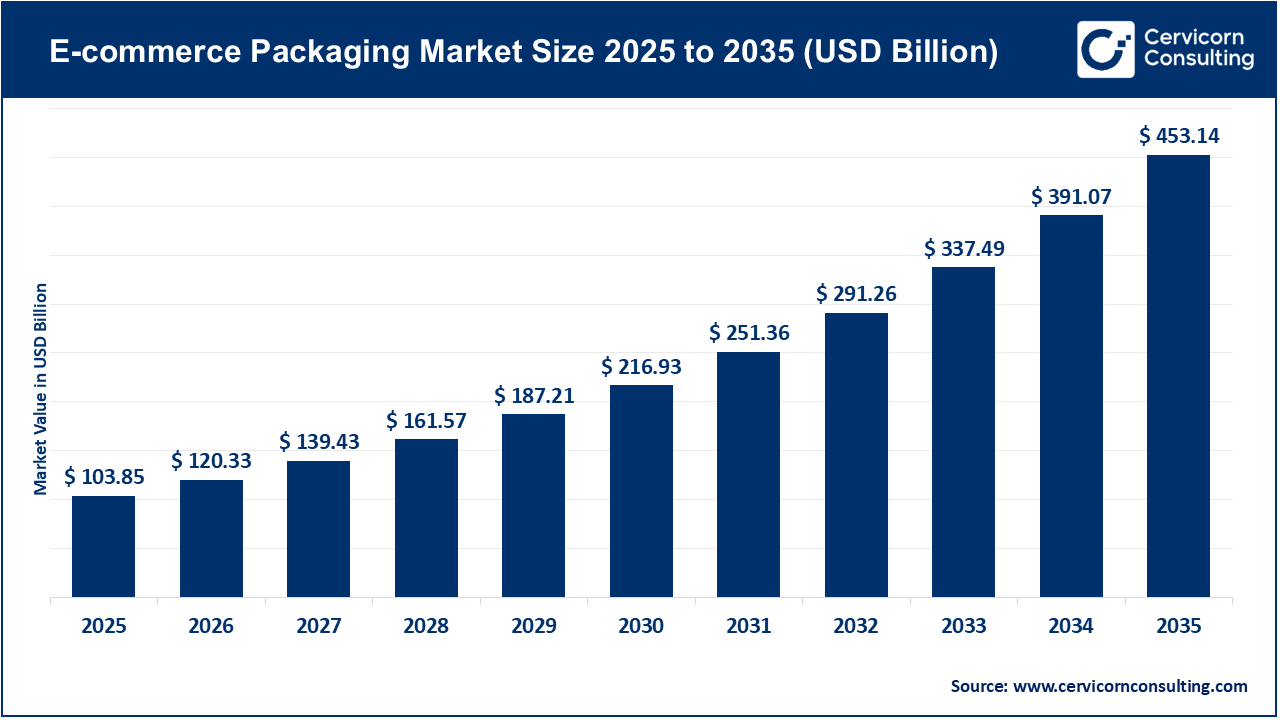
The global e-commerce packaging market size was worth USD 103.85 billion in 2025 and is anticipated to expand to around USD 453.14 billion by 2035, registering a compound annual growth rate (CAGR) of 15.9% from 2026 to 2035.
What Is the E-Commerce Packaging Market?
The e-commerce packaging market encompasses all packaging solutions specifically designed for products sold and distributed through online retail channels. These solutions include corrugated boxes, flexible mailers, protective cushioning materials, rigid containers, labels, tapes, and specialized packaging formats that ensure safe, cost-efficient, and visually appealing delivery of goods to end consumers. Unlike traditional retail packaging, e-commerce packaging must withstand longer transit times, multiple handling points, and last-mile delivery challenges while maintaining product integrity and customer satisfaction.
As online retail continues to expand across categories such as electronics, apparel, food, pharmaceuticals, and personal care, packaging has evolved into a strategic component of the e-commerce value chain. It now serves not only as a protective layer but also as a tool for sustainability compliance, operational efficiency, and brand storytelling through enhanced unboxing experiences.
E-Commerce Packaging Market Growth Factors
The growth of the e-commerce packaging market is driven by the rapid expansion of global online retail, increasing internet and smartphone penetration, and changing consumer shopping behaviors favoring convenience and home delivery; rising demand for sustainable, recyclable, and lightweight packaging solutions as brands respond to environmental concerns and regulatory pressure; advancements in automated and smart packaging technologies that improve fulfillment efficiency and reduce material waste; and the growing emphasis on premium branding and customer experience through customized and visually engaging packaging, all of which collectively accelerate market adoption and long-term expansion.
Get a Free Sample: https://www.cervicornconsulting.com/sample/2878
Why the E-Commerce Packaging Market Is Important
The importance of the e-commerce packaging market lies in its direct impact on logistics performance, customer satisfaction, sustainability goals, and brand perception.
First, packaging plays a critical role in protecting products during transit, reducing damage, returns, and associated costs. Second, optimized packaging designs help companies lower shipping costs by minimizing weight and unused space. Third, with governments and consumers demanding environmentally responsible practices, packaging has become a key driver of sustainability compliance, encouraging recyclable, compostable, and reusable materials. Finally, packaging serves as a brand touchpoint, where creative design and thoughtful presentation enhance the unboxing experience and foster brand loyalty in an increasingly competitive e-commerce landscape.
Key Companies in the E-Commerce Packaging Market
Amcor plc
Company Overview:
Amcor plc is one of the world’s largest packaging companies, providing flexible and rigid packaging solutions across food, beverage, healthcare, personal care, and consumer goods sectors, with a strong presence in e-commerce packaging.
Specialization:
Flexible packaging films, rigid containers, specialty cartons, and closures designed for durability, lightweight shipping, and sustainability.
Key Focus Areas:
- Sustainable and recyclable packaging solutions
- Lightweight materials to reduce shipping emissions
- Flexible packaging optimized for e-commerce logistics
- Innovation through material science and design
Notable Features:
Amcor is recognized for its strong commitment to sustainability, including ambitious goals to make all packaging recyclable or reusable. The company invests heavily in material innovation to balance protection, cost efficiency, and environmental responsibility.
2024 Revenue:
Approximately USD 15 billion.
Market Share:
Amcor holds a significant share of the global e-commerce packaging market, supported by its diversified product portfolio and global manufacturing network.
Global Presence:
Operations in more than 40 countries across North America, Europe, Asia-Pacific, Latin America, and the Middle East.
Sealed Air
Company Overview:
Sealed Air is a global leader in protective packaging solutions and is best known for pioneering cushioning technologies widely used in e-commerce fulfillment.
Specialization:
Protective packaging systems, air pillows, foam packaging, bubble cushioning, and automated packaging solutions.
Key Focus Areas:
- Damage prevention for shipped goods
- Packaging automation for fulfillment centers
- Lightweight protective solutions
- Operational efficiency for high-volume e-commerce
Notable Features:
Sealed Air integrates advanced automation and smart packaging systems that reduce material usage while improving packing speed and consistency. Its protective solutions are especially critical for electronics, healthcare products, and fragile goods.
2024 Revenue:
Approximately USD 5.4 billion.
Market Share:
The company holds a strong position in protective e-commerce packaging, particularly in North America and Asia-Pacific.
Global Presence:
Operations spanning more than 100 countries with extensive manufacturing and distribution networks.
Berry Global, Inc.
Company Overview:
Berry Global is a major manufacturer of plastic and engineered packaging solutions serving consumer, industrial, and healthcare markets, with a strong footprint in e-commerce packaging applications.
Specialization:
Flexible plastic packaging, engineered materials, films, bags, and specialty containers.
Key Focus Areas:
- Durable packaging for consumer and industrial e-commerce
- Material innovation and lightweight plastics
- Packaging solutions for high-volume online retail
Notable Features:
Berry Global’s strength lies in its ability to supply large-scale, durable, and versatile packaging materials that meet the demanding logistics requirements of e-commerce distribution.
2024 Revenue:
Approximately USD 12–13 billion prior to strategic consolidation activities.
Market Share:
Berry Global maintains a substantial share in plastic-based e-commerce packaging solutions.
Global Presence:
Manufacturing and operations across more than 30 countries worldwide.
Alpha Packaging
Company Overview:
Alpha Packaging is a specialized packaging company focused on rigid plastic containers primarily serving cosmetics, personal care, food, and pharmaceutical brands.
Specialization:
Rigid plastic bottles, jars, and custom containers tailored for premium and niche e-commerce brands.
Key Focus Areas:
- Custom packaging for brand differentiation
- High-quality rigid packaging for online retail
- Secure packaging for liquid and sensitive products
Notable Features:
Alpha Packaging is valued for its design-driven approach, enabling e-commerce brands to combine visual appeal with functional durability, particularly in beauty and wellness segments.
2024 Revenue:
Privately held; estimated in the hundreds of millions USD range.
Market Share:
Smaller global share compared to multinational competitors, but strong niche positioning.
Global Presence:
Primarily North America with expanding international reach through partnerships.
CCL Industries
Company Overview:
CCL Industries is a global leader in specialty packaging and labeling solutions, serving a wide range of consumer and industrial markets, including e-commerce.
Specialization:
Labels, specialty films, containers, and innovative packaging solutions that support branding and traceability.
Key Focus Areas:
- Branding and product identification
- Smart labeling and traceability solutions
- Specialty packaging for consumer goods
Notable Features:
CCL Industries excels in combining packaging with branding and information delivery, making it particularly valuable for e-commerce companies focused on brand recognition and compliance.
2024 Revenue:
Approximately USD 5.5 billion.
Market Share:
Strong presence in specialty packaging and labeling within the e-commerce ecosystem.
Global Presence:
Over 150 production facilities across North America, Europe, Asia-Pacific, and emerging markets.
Leading Trends and Their Impact on the Market
Sustainability-Driven Packaging Innovation
Growing environmental awareness has accelerated the shift toward recyclable, biodegradable, and paper-based packaging. Companies are reducing plastic content, introducing mono-material designs, and adopting circular economy principles to meet regulatory and consumer expectations.
Automation and Right-Sized Packaging
Advanced automation technologies allow e-commerce fulfillment centers to create right-sized packages tailored to individual orders, reducing excess material, lowering shipping costs, and improving operational efficiency.
Smart and Interactive Packaging
QR codes, RFID tags, and digital tracking features are increasingly embedded in packaging to enhance traceability, reduce theft, and improve customer engagement through digital experiences.
Growth of Protective and Corrugated Packaging
Corrugated boxes and protective cushioning materials continue to dominate due to their durability, recyclability, and adaptability across product categories, especially electronics and fragile goods.
Successful E-Commerce Packaging Examples Around the World
In North America, large online retailers have adopted automated packaging systems that optimize box size, reduce waste, and accelerate order fulfillment. These systems have significantly lowered shipping costs and improved sustainability metrics.
In Asia-Pacific, leading e-commerce platforms have transitioned from plastic packaging to corrugated and paper-based solutions, aligning with regional sustainability initiatives while supporting massive order volumes.
In Europe, brands emphasize minimalistic, recyclable packaging designs that comply with strict environmental regulations while maintaining premium brand aesthetics.
In Australia, e-commerce companies have eliminated single-use plastic mailers, replacing them with recyclable paper-based alternatives to meet national sustainability goals.
Global Regional Analysis and Government Initiatives
Asia-Pacific
Asia-Pacific dominates the global e-commerce packaging market due to rapid urbanization, expanding middle-class populations, and explosive growth in online retail. Governments across the region promote sustainable packaging through plastic reduction mandates and recycling initiatives.
North America
North America benefits from advanced logistics infrastructure and widespread adoption of automation. Government policies increasingly support waste reduction, recycled content usage, and sustainable packaging innovation.
Europe
Europe is heavily influenced by strict environmental regulations that mandate recyclable materials and reduced packaging waste. These policies drive innovation in biodegradable and circular packaging solutions.
Latin America, Middle East, and Africa
These regions are emerging markets for e-commerce packaging, supported by expanding digital commerce, improving logistics infrastructure, and government initiatives focused on economic diversification and sustainability.
To Get Detailed Overview, Contact Us: https://www.cervicornconsulting.com/contact-us
Read Report: Green Technology and Sustainability Market Revenue, Trends, and Strategic Insights by 2035