Skincare Market Growth Drivers, Trends, Key Players and Regional Insights by 2035
Skincare Market Size
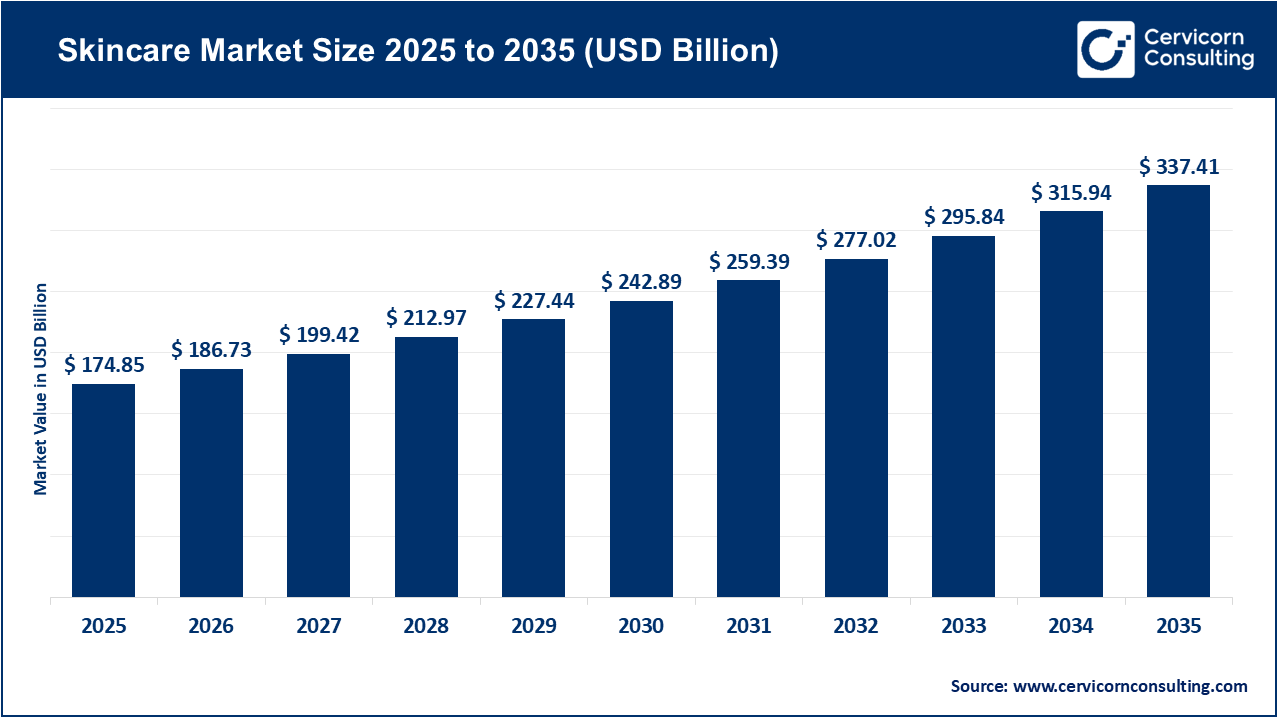
The global skincare market size was worth USD 174.85 billion in 2025 and is anticipated to expand to around USD 337.41 billion by 2035, registering a compound annual growth rate (CAGR) of 6.8% from 2026 to 2035.
Skincare Market — Growth Factors
The skincare market is expanding due to rising disposable incomes, rapid urbanization, and the growing middle class in emerging economies; increasing awareness about the importance of skin health and appearance, amplified by digital platforms and social media; advancements in ingredient science and cosmetic biotechnology involving peptides, probiotics, stabilized retinoids, and botanical actives; the surge of e-commerce, social commerce, and direct-to-consumer models that accelerate brand visibility and innovation cycles; aging populations in developed countries driving demand for anti-aging solutions, while Gen Z fuels interest in preventative and clean beauty.
Regulatory emphasis on safety and transparency that encourages reformulation and more eco-friendly packaging; increasing collaborations between dermatologists and beauty brands; the popularity of hybrid skincare–makeup products; and the rise of personalized skincare supported by AI diagnostics and at-home devices, all fostering both premiumization and mass-market growth simultaneously.
Get a Free Sample: https://www.cervicornconsulting.com/sample/2829
What Is the Skincare Market?
The skincare market encompasses all products, technologies, and services designed to cleanse, treat, protect, and enhance the health and appearance of the skin. This includes everyday cosmetic items such as cleansers, toners, moisturizers, serums, sunscreens, exfoliators, and masks, as well as specialized solutions like anti-aging treatments, acne medications, whitening/brightening formulas, and sensitive-skin products.
The sector extends beyond topical products to include dermatology-grade solutions, OTC treatments, beauty devices like LED masks and microcurrent tools, and professional services such as facials and chemical peels. With the rise of personalized skincare and diagnostic tools, the category now includes data-driven formulations, subscription-based treatments, and biotech-enhanced ingredients. The market spans mass, masstige, and luxury segments, making it one of the most diverse and inclusive industries within personal care.
Why the Skincare Market Is Important
Skincare is an essential part of global consumer behavior, influencing not only beauty routines but also health, confidence, and psychological well-being. Economically, the sector drives billions in annual revenue, supports consumer goods companies, retailers, ingredient suppliers, dermatology clinics, and a rapidly growing ecosystem of startups. Medically, skincare products contribute to preventing and managing common dermatological issues such as acne, hyperpigmentation, dryness, eczema, and sun damage. S
ocially, skin health plays a major role in personal image and self-esteem. The sector is also important for innovation, as advances in dermatological science, biotechnology, and consumer diagnostics often begin in skincare before extending into adjacent fields. Finally, skincare products have one of the highest consumer loyalty rates, making this market strategically significant for brands seeking long-term engagement.
Top Companies in the Global Skincare Market
(Company, Specialization, Key Focus Areas, Notable Features, 2024 Revenue Context, Market Share, Global Presence)
1. Johnson & Johnson
Specialization: Consumer health, OTC medicines, baby care, wound care, and dermatology-focused skincare products.
Key Focus Areas: Dermatologist-trusted products, clinical-grade formulations, pharmacy distribution, and skin health research.
Notable Features: Strong medical and clinical heritage; trusted by healthcare professionals globally; robust distribution channels in pharmacies and hospitals.
2024 Revenue: Johnson & Johnson reported strong company-level revenues across its consumer health and medical categories in 2024.
Market Share: Holds a significant share in global mass-market skincare and dermo-care segments.
Global Presence: Operations in over 60 countries with a strong footprint across North America, Europe, and fast-expanding Asian markets.
2. L’Oréal S.A.
Specialization: World’s largest beauty company with mass, luxury, professional, and dermatological skincare brands.
Key Focus Areas: Dermocosmetics, luxury skincare, R&D-driven innovation, dermatology partnerships, and sustainable beauty.
Notable Features: One of the industry’s strongest R&D capabilities; highly successful dermatological beauty division; leadership in biotech-driven actives and sustainable packaging.
2024 Revenue: L’Oréal’s dermatological beauty division crossed notable milestones with strong double-digit global growth.
Market Share: Consistently ranks as the global leader in beauty and skincare, holding one of the largest market shares worldwide.
Global Presence: Sells in over 150 countries with advanced manufacturing, R&D hubs, and omni-channel retail capabilities.
3. Procter & Gamble Co. (P&G)
Specialization: Consumer goods with strong presence in beauty, grooming, and healthcare.
Key Focus Areas: Mass-market skincare, dermatology-informed OTC products, innovation in formulations, and advanced retail partnerships.
Notable Features: Strong brand-building, innovation scale, and consumer trust across categories such as moisturizers, cleansers, and targeted dermatological solutions.
2024 Revenue: P&G’s beauty and healthcare segments contributed significantly to its overall 2024 performance.
Market Share: Holds substantial market share in global mass beauty and skincare categories.
Global Presence: Presence in over 180 countries with highly optimized supply chains.
4. Colgate-Palmolive Company
Specialization: Oral care, personal care, home care, and select skincare products.
Key Focus Areas: Mass personal care, hygiene-oriented skincare, dermatology-tested body care, and emerging market expansion.
Notable Features: Very strong distribution in emerging markets; stable performance in personal care; consistent focus on affordability and accessibility.
2024 Revenue: Colgate-Palmolive posted solid 2024 organic growth across its global categories.
Market Share: Holds important positions in mass-market body care and hygiene-driven skincare.
Global Presence: Extensive presence across Latin America, Asia-Pacific, Africa, and North America.
5. Estée Lauder Companies Inc.
Specialization: Prestige skincare and cosmetics, with leading luxury brands such as La Mer, Clinique, Estée Lauder, and Origins.
Key Focus Areas: Premium anti-aging, ingredient innovation, prestige retail, travel retail, and data-driven marketing.
Notable Features: Strongest global portfolio of luxury skincare brands; leader in innovation for anti-aging and premium actives.
2024 Revenue: Reported total net sales of USD 15.61 billion for fiscal year ending June 2024, with skincare as one of its largest categories.
Market Share: One of the world’s leading companies in prestige skincare; dominant in travel retail and luxury.
Global Presence: Extensive footprint in North America, Europe, Asia-Pacific (notably China), Middle East, and global airports.
Leading Trends and Their Impact on the Market
1. Clinicalization of Skincare
Evidence-based claims and dermatologist-backed solutions are now industry standards.
Impact: Stronger premiumization and demand for scientific validation.
2. AI-Driven Personalization
AI skin analysis, virtual dermatology, and DNA-based diagnostics are mainstream.
Impact: Higher customer retention, subscription models, and more precise treatment outcomes.
3. Sustainability and “Clean Beauty”
Consumers want clean-label ingredients, eco-friendly packaging, and cruelty-free products.
Impact: Reformulations, refillable packaging, and sustainability-driven R&D.
4. Biotech-Based Ingredients
Peptides, probiotics, fermented extracts, and lab-grown botanicals are transforming formulations.
Impact: Faster innovation cycles and increased demand for ingredient transparency.
5. Hybrid Makeup–Skincare Products
Tinted sunscreens, skincare-infused foundations, and barrier-protecting primers are trending.
Impact: Broader audience reach and new product categories.
6. Social Commerce & Influencer-Driven Buying
Live shopping, TikTok skincare trends, and creator-led brands dominate.
Impact: Rapid viral growth for new launches but also quick product lifecycle turnover.
7. At-Home Skincare Devices
LED masks, microcurrent devices, dermaplaning tools, and RF devices are popular.
Impact: Expands premium skincare without clinic visits.
Successful Examples of Skincare Models Around the World
K-Beauty (South Korea)
Revolutionized global skincare with multi-step routines, sheet masks, fermented essences, and glass-skin trends.
Global Impact: Major influence on product innovation, packaging, and marketing worldwide.
French Pharmacy Skincare
Brands focusing on dermocosmetics have gained global trust through clinical testing and dermatologist endorsements.
Global Impact: Made evidence-based skincare accessible globally.
Indie Disruptor Brands
Brands offering simple, transparent formulations at affordable prices have reshaped consumer expectations.
Global Impact: Encouraged ingredient literacy and minimalist skincare routines.
Luxury Skincare Houses
Premium brands have popularized high-end anti-aging, premium actives, and ritual-based skincare.
Global Impact: Strong role in premiumization and travel-retail growth.
Global Regional Analysis With Government Initiatives & Policies
Asia-Pacific
Asia-Pacific is the fastest-growing and often the largest skincare market. China, South Korea, Japan, and India lead demand due to urbanization, rising incomes, and beauty-forward culture.
Government Influence:
- China’s updated cosmetics regulations encourage safety and innovation.
- India’s manufacturing incentives support local cosmetic production.
- South Korea invests heavily in biotech beauty and R&D.
Impact: Rapid product innovation, regional brand dominance, and strong cross-border e-commerce.
North America
A mature but high-value market driven by premium skincare, clean beauty, and cosmetic dermatology.
Government Influence:
- FDA governs product safety, claims, and sunscreen regulations.
- State-level transparency laws strengthen ingredient disclosure.
Impact: High consumer trust, strong clinical skincare demand, and innovation-led competition.
Europe & United Kingdom
A sophisticated market with the strictest cosmetic regulations globally.
Government Influence:
- Strong EU cosmetics regulation ensures safety, banned ingredients lists, and claim verification.
- EU sustainability policies accelerate recyclable and refillable packaging adoption.
Impact: High standards, premiumization, and increased compliance costs for brands.
Latin America
Emerging demand driven by growing middle-class consumers and hot, humid climates favoring skincare use.
Government Influence:
- Local production incentives support domestic brands.
- Simplified cosmetic registration in some countries promotes quicker product launches.
Impact: Robust demand for mass skincare and body care products.
Middle East & Africa
Markets range from highly premiumized Gulf regions to cost-sensitive African markets.
Government Influence:
- Gulf nations invest in luxury retail infrastructure and tourism, boosting premium skincare sales.
- African markets focus on affordability and basic skincare products.
Impact: Strong segmentation between luxury and mass categories.
To Get Detailed Overview, Contact Us: https://www.cervicornconsulting.com/contact-us
Read Report: Material Handling Equipment Market Growth Drivers, Trends, Key Players and Regional Insights by 2035