800G Optical Transceiver Market: Where Should Companies Invest as AI Networking Demand Accelerates?
800G Optical Transceiver Market: How Should Companies Prepare for the Next Phase of AI Network Expansion?
The rapid expansion of artificial intelligence (AI), cloud computing, and high-performance data centers is increasing the need for faster, higher-capacity optical connectivity. As AI workloads require servers and accelerators to exchange large volumes of data with minimal latency, network infrastructure is becoming a critical factor in data center performance. This shift is strengthening demand for 800G optical transceivers, which support high-bandwidth connections across data center networks.
However, the transition to 800G is not simply a matter of replacing existing optical modules with faster alternatives. Data center operators, network equipment manufacturers, optical component suppliers, and investors must evaluate deployment costs, power consumption, interoperability, thermal performance, and the pace at which next-generation infrastructure will be adopted.
800G Optical Transceiver Market: Growth Outlook and Business Implications
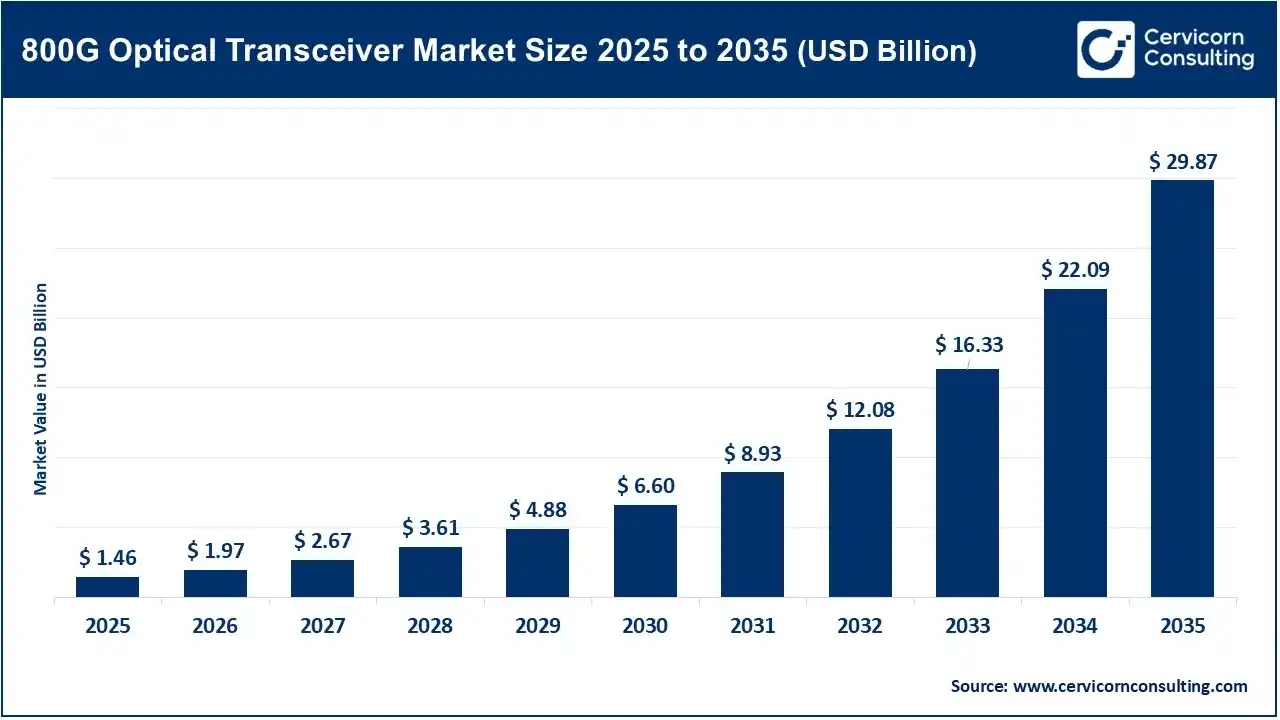
The global 800G optical transceiver market was valued at approximately USD 1.46 billion in 2025. It is forecast to increase from USD 1.97 billion in 2026 to nearly USD 29.87 billion by 2035, representing a compound annual growth rate (CAGR) of 35.2% between 2026 and 2035.
This projected expansion reflects the growing importance of high-speed optical connectivity in AI infrastructure, hyperscale data centers, and cloud networking. For manufacturers and technology investors, the opportunity extends beyond selling higher-speed modules. It also includes developing products that meet the power, thermal, reliability, and integration requirements of increasingly dense computing environments.
For data center operators, however, market growth does not automatically justify an immediate transition to 800G across every network layer. Deployment decisions depend on bandwidth utilization, existing switch infrastructure, application requirements, equipment compatibility, and the expected cost of upgrading.
Why AI Infrastructure Is Accelerating Demand for 800G Connectivity
AI training and inference place substantial demands on network infrastructure. Distributed computing systems must move data between GPUs, accelerators, storage systems, and networking equipment. As clusters expand, network bottlenecks can limit overall system utilization even when computing capacity is available.
800G optical transceivers can help address these requirements by supporting higher data rates per optical link. They can also enable network designers to increase aggregate bandwidth without relying exclusively on a proportional increase in the number of physical connections.
This creates several commercial considerations for companies operating across the data center ecosystem.
For hyperscale operators, the priority is to balance network performance with total cost of ownership. Higher-speed links may reduce the number of connections needed for a given bandwidth target, but the business case depends on module prices, power consumption, cooling requirements, switch compatibility, and network architecture.
For optical transceiver manufacturers, AI-related demand creates opportunities to expand production capacity and develop differentiated products. Yet aggressive capacity expansion can expose manufacturers to underutilization risk if customer deployments are delayed or demand shifts toward newer optical technologies.
For network equipment suppliers, interoperability and system-level performance become important differentiators. Transceiver performance must be evaluated alongside switches, optical fiber infrastructure, thermal design, and the operational requirements of the target network.
Get a Free Sample: https://www.cervicornconsulting.com/sample/3060
Which Deployment Decisions Matter Most for 800G Adoption?
The commercial case for 800G varies by application. Companies should distinguish between immediate deployment opportunities and infrastructure upgrades that may become necessary as network traffic grows.
1. Evaluate the Upgrade from 400G to 800G
Organizations already operating 400G infrastructure must determine whether moving to 800G improves capacity economics enough to justify the investment. The decision should consider current port utilization, projected traffic growth, equipment refresh cycles, and the cost of upgrading supporting infrastructure.
An 800G deployment may be attractive where network demand is increasing rapidly, particularly in large AI clusters and hyperscale environments. In less demanding applications, existing 400G equipment may remain commercially appropriate for longer.
The practical question is not simply which technology offers a higher data rate, but when the performance improvement produces measurable operational or financial value.
2. Select Optical Form Factors According to Network Architecture
Different transceiver form factors and optical configurations serve different deployment requirements. OSFP and QSFP-DD are relevant 800G module form factors, while SR8, DR8, and FR4 describe optical interface approaches associated with different reach and connectivity requirements.
Short-reach multimode connections, parallel single-mode links, and longer-reach single-mode configurations should not be treated as interchangeable choices. Reach, fiber availability, connector design, port density, power consumption, and installation complexity can all affect total deployment cost.
For equipment manufacturers and data center operators, product selection should therefore be based on the target network architecture rather than data rate alone.
3. Assess Power Consumption and Thermal Constraints
Higher-bandwidth networking increases the importance of power efficiency. Optical modules operate within systems that already face significant electrical and cooling demands, particularly in dense AI data centers.
A module with attractive purchase pricing may not provide the best long-term economics if it requires more power or creates additional thermal-management challenges. Buyers should evaluate energy consumption per unit of transmitted data, thermal performance under sustained workloads, and compatibility with switch-level cooling requirements.
For manufacturers, improvements in optical engine design, integration, and power efficiency can become meaningful competitive advantages as operators seek to manage infrastructure costs.
Supply-Chain Capacity and Technology Choices Could Reshape Competition
Rapid demand growth can create opportunities for suppliers, but it can also increase exposure to component shortages, manufacturing bottlenecks, and pricing pressure.
800G optical transceivers depend on a broader ecosystem that includes optical components, lasers, photonic devices, digital signal processors, packaging technologies, printed circuit boards, and thermal-management solutions. Constraints in any critical part of this chain can affect production schedules and delivery commitments.
Manufacturers considering capacity expansion should assess customer commitments, component availability, production yields, qualification timelines, and the risk of technology transitions. Building capacity based solely on market growth projections may create financial pressure if demand timing or product specifications change.
Buyers should similarly consider supplier concentration, lead times, quality consistency, and second-source availability. A lower-cost module may provide limited commercial value if inconsistent supply disrupts a major network deployment.
800G Versus 1.6T: How Should Companies Manage the Transition?
The emergence of 1.6T optical connectivity introduces an important planning question: should companies invest heavily in 800G or prepare for the next speed generation?
The answer depends on deployment timing and the expected life of the infrastructure. 800G can serve as a practical capacity upgrade for networks where the technology is qualified, commercially available, and aligned with current switch platforms. Meanwhile, 1.6T may become relevant for newer systems with higher bandwidth requirements and compatible supporting infrastructure.
For transceiver manufacturers, this transition creates a product-roadmap challenge. Investment decisions must balance near-term demand for 800G with engineering, qualification, and manufacturing requirements for future generations. Overcommitting resources to a single product category can increase exposure to inventory obsolescence or changing customer preferences.
For buyers, procurement decisions should consider platform compatibility, expected network growth, upgrade frequency, and the cost of maintaining multiple generations of equipment. A staged deployment strategy may help organizations capture near-term performance improvements while preserving flexibility for subsequent upgrades.
What Should Companies Track Before Investing in the 800G Market?
Market growth is only one input into a commercial decision. Companies evaluating expansion, procurement, or market entry should also monitor several operational indicators:
- Customer deployment schedules: Distinguish announced AI infrastructure investments from confirmed orders and actual equipment installations.
- Pricing and gross margins: Track whether increasing shipment volumes translate into sustainable profitability or intensify competition.
- Manufacturing yields and component availability: Assess the ability to deliver qualified products at scale and within customer timelines.
- Power and thermal performance: Compare module-level specifications with performance in the intended network environment.
- Technology qualification: Monitor customer acceptance, interoperability testing, and readiness for deployment across different platforms.
- Product transition risk: Evaluate how the development of 1.6T connectivity could influence future demand, pricing, and investment priorities for 800G.
These indicators can help manufacturers distinguish between a growing addressable market and a commercially attractive business opportunity. They can also help buyers identify the appropriate timing and scope of network upgrades.
Conclusion: Turning 800G Market Growth into Sustainable Business Value
The 800G optical transceiver market is positioned for substantial expansion as AI infrastructure, hyperscale computing, and cloud networking increase demand for high-speed data transmission. Yet the companies most likely to benefit will not necessarily be those that expand capacity or adopt new modules the fastest.
Long-term performance will depend on aligning investment with customer demand, controlling manufacturing costs, ensuring reliable supply, and delivering products that meet increasingly demanding bandwidth and energy-efficiency requirements. For data center operators, the priority is to establish when 800G delivers sufficient performance and economic benefits to justify deployment. For manufacturers and investors, it is to identify sustainable demand, defensible product differentiation, and the right timing for capacity expansion.
The central business decision is therefore how to scale optical connectivity in step with real infrastructure requirements while preserving flexibility for the next generation of networking technology.
To Get Detailed Overview, Contact Us: https://www.cervicornconsulting.com/contact-us
Read Report: Industrial Valves Market: Where Should Manufacturers Invest to Capture High-Value Demand Across Industries?