


xEV power chips are moving to 800 V and beyond — what changes for automakers and semiconductor suppliers?
The next phase of vehicle electrification is changing the role of power semiconductors.
As electric vehicles move toward higher-voltage architectures, faster charging and greater power density, automakers are no longer evaluating power chips only on switching performance or unit cost. Semiconductor selection increasingly affects vehicle range, charging time, thermal management, inverter efficiency, system size and overall powertrain economics.
This is creating a more complex competitive environment across silicon IGBTs, MOSFETs, silicon carbide (SiC) devices, gallium nitride (GaN) technologies and integrated power modules.
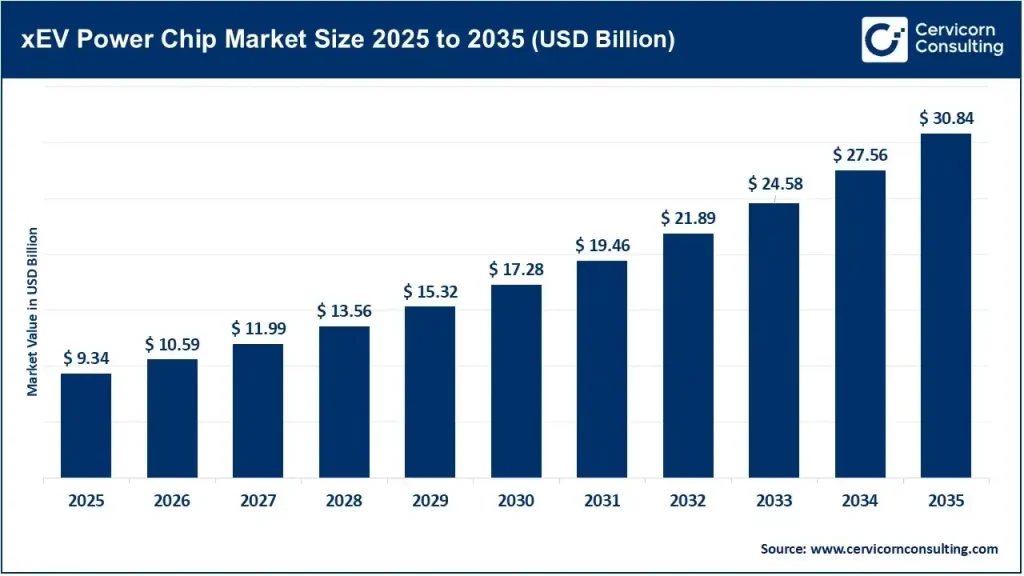
The global xEV power chip market was valued at USD 9.34 billion in 2025 and is projected to reach nearly USD 30.84 billion by 2035, expanding at a 12.6% CAGR from 2026 to 2035.
The important question for the industry is therefore not simply how quickly the market is growing, but which power-chip technologies and architectures will capture the next generation of xEV platforms.
800 V architectures are changing semiconductor requirements
The move from conventional 400 V systems toward 800 V and, increasingly, 1,000 V architectures is one of the most important changes affecting automotive power electronics.
Higher voltage can enable faster charging and lower current for a given power level. But it also places greater demands on switching devices, insulation, thermal management, gate drivers, packaging and system reliability.
This is already visible in traction-inverter deployments. TrendForce reported that global EV traction-inverter installations reached approximately 9.65 million units in Q4 2025, while installations using systems above 550 V increased 38% year over year to around 1.39 million units.
For semiconductor suppliers, this creates a shift in the purchasing discussion. Automotive customers increasingly need power devices that can deliver higher voltage and switching efficiency without adding excessive thermal or packaging complexity.
That is strengthening the position of wide-bandgap technologies, particularly SiC, in high-voltage applications.
Get a Free Sample: https://www.cervicornconsulting.com/sample/3050
SiC adoption is becoming a platform decision
Silicon carbide is moving beyond being an alternative semiconductor material and increasingly becoming part of the architecture strategy for high-voltage EVs.
SiC MOSFETs can support high-voltage switching with lower energy losses and high-temperature operation, making them particularly relevant to traction inverters, onboard chargers and other high-power conversion systems. Cervicorn estimates that SiC penetration in xEV applications could increase from 19.2% in 2024 to 24.4% in 2026 and 47.7% by 2029.
However, higher technical performance does not automatically translate into higher adoption.
Manufacturing complexity and cost remain significant considerations. SiC requires specialized substrates, epitaxy, fabrication and packaging processes, while automotive applications add stringent qualification and reliability requirements.
This creates a strategic trade-off for automakers:
How much efficiency and power density justifies the additional semiconductor cost?
The answer can vary substantially by vehicle segment, battery size, driving range, charging requirements and target price.
The economics of power chips are becoming as important as performance
The xEV power-chip value chain extends from substrate and wafer production through epitaxy, device fabrication, packaging and testing.
Cervicorn’s analysis indicates that SiC substrate manufacturing, epitaxy and automotive-grade device production remain important cost layers, particularly as manufacturers transition toward larger wafer formats.
At the same time, the industry is facing a different challenge from the capacity shortages seen during earlier semiconductor cycles.
Large investments in SiC capacity have created concerns around utilization and near-term supply-demand balance. Cervicorn’s market analysis estimates that 2025 SiC utilization was approximately 50% for upstream processing and 70% for device manufacturing, creating pressure on manufacturers to improve yields and manufacturing economics.
For semiconductor companies, therefore, expanding capacity alone may not be enough.
The competitive advantage could increasingly come from:
- Higher wafer yields
- Larger wafer diameters
- Lower defect rates
- Vertical integration
- Efficient automotive-grade packaging
- Long-term OEM relationships
- Lower cost per delivered power module
This changes where investment decisions need to be made across the value chain.
GaN has a different opportunity
While SiC is gaining momentum in high-voltage drivetrain applications, GaN is developing around a different set of requirements.
Its high switching frequency, compact form factor and efficiency characteristics make it attractive for selected applications such as onboard chargers and DC-DC converters.
The distinction matters because the future xEV power-chip market is unlikely to become a simple competition between silicon, SiC and GaN.
Instead, different semiconductor technologies may coexist according to voltage, switching frequency, power level, thermal requirements, vehicle architecture and cost targets.
Cervicorn identifies increasing GaN adoption, higher power density and integration of multiple power functions as important trends shaping the market.
For suppliers, this means technology roadmaps need to be aligned with specific automotive applications rather than treating electrification as a single semiconductor opportunity.
Traction inverters remain the strategic center
The traction inverter is particularly important because it directly determines how efficiently battery power is converted into motor operation.
Cervicorn estimates that traction inverters represented 32% of the xEV power-chip market in 2025, making them the largest application segment.
As vehicle manufacturers pursue greater range and efficiency, inverter performance becomes increasingly connected to the economics of the entire vehicle.
A semiconductor improvement that reduces power losses can potentially influence:
battery utilization → thermal load → cooling requirements → vehicle efficiency → driving range → charging performance
This is why automotive semiconductor decisions are increasingly being made at the system level rather than solely at the component level.
Supply-chain localization is becoming another competitive factor
Power-chip strategy is also being influenced by semiconductor manufacturing geography.
Cervicorn estimates that Asia-Pacific accounted for 42% of the xEV power-chip market in 2025, supported by its EV manufacturing base, semiconductor ecosystem and growing investment in advanced power technologies.
At the same time, semiconductor localization is becoming a strategic priority in North America, Europe and India.
Recent developments reinforce this direction. In 2026, Infineon opened its €5 billion Smart Power Fab in Dresden, expanding advanced power-semiconductor manufacturing capacity for automotive and industrial applications.
India is also attracting new semiconductor investment. At Semicon India 2026, the government reported $11–12 billion of investment proposals across semiconductor equipment, materials, gases, chemicals and substrates.
For automotive companies, regional semiconductor capacity can become relevant not only for cost, but also for supply continuity and exposure to geopolitical disruptions.
Automotive power-semiconductor competition is becoming more concentrated around capability
The competitive landscape is moving beyond simply having an automotive-qualified product.
Companies such as Infineon Technologies, STMicroelectronics, onsemi, Wolfspeed, ROHM and other semiconductor suppliers are competing across different combinations of silicon, SiC, GaN, power modules, packaging and manufacturing capacity.
TechInsights’ 2025 automotive power-semiconductor analysis estimated industry revenue at approximately $13.2 billion, with Infineon leading the market. It also highlighted the divergence between weakening conventional IGBT/MOSFET segments, resilient SiC demand and emerging GaN opportunities.
This suggests that market leadership will increasingly depend on the ability to combine technology performance, manufacturing economics, capacity availability and automotive customer relationships.
What should automotive and semiconductor companies watch next?
The next phase of xEV power-chip competition is likely to be shaped by several interconnected decisions.
For automakers, the focus will be on selecting the right semiconductor technology for each vehicle architecture while controlling system-level cost and thermal complexity.
For semiconductor manufacturers, the priority will be improving SiC economics, scaling larger wafers, strengthening packaging capabilities and identifying where GaN can deliver differentiated value.
For suppliers across the value chain, substrate availability, manufacturing yields, regional capacity and long-term automotive contracts could become as important as chip performance.
The transition toward 800 V and 1,000 V vehicles therefore represents more than a voltage upgrade. It is reshaping the economics and competitive structure of automotive power electronics.
The companies best positioned for the next stage of xEV growth will likely be those that can connect semiconductor technology with vehicle architecture, manufacturing economics and supply-chain strategy.
Market perspective
Cervicorn Consulting estimates the global xEV power chip market will increase from USD 9.34 billion in 2025 to nearly USD 30.84 billion by 2035, at a 12.6% CAGR. The market covers power MOSFETs, IGBTs, power diodes and rectifiers, power-management ICs and integrated power modules across BEV, PHEV, HEV and FCEV applications.
For companies assessing semiconductor sourcing, SiC/GaN adoption, 800 V vehicle platforms, power-module manufacturing or regional supply-chain opportunities, the underlying market segmentation is becoming increasingly important.
To Get Detailed Overview, Contact Us: https://www.cervicornconsulting.com/contact-us
Read Report: Automated EV battery swapping: Can faster energy replenishment solve fleet downtime?