


Automated EV battery swapping: Can faster energy replenishment solve EV fleet downtime?
The growth of electric mobility is creating a problem that goes beyond vehicle sales: how quickly can an electric vehicle return to operation after its battery is depleted?
For private EV users, charging time may be manageable. For delivery vehicles, taxis, shared mobility fleets, commercial two- and three-wheelers, and logistics operators, however, every minute spent waiting for energy can reduce vehicle utilization.
This is creating interest in automated EV battery swapping, where depleted batteries are mechanically removed and replaced with charged batteries rather than recharging the battery inside the vehicle.
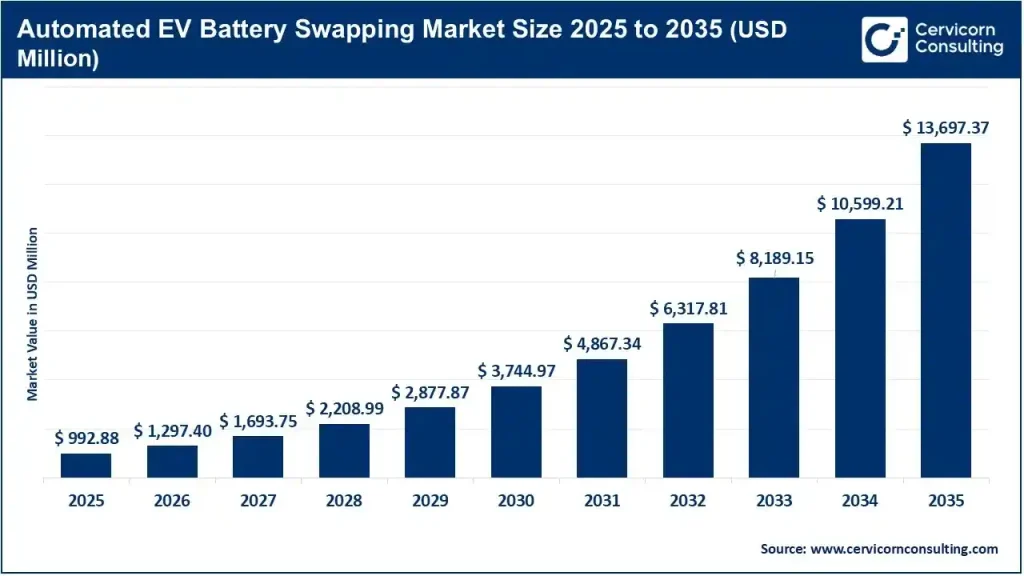
The global automated EV battery swapping market was valued at USD 992.88 million in 2025 and is projected to reach USD 13.70 billion by 2035, expanding at a 29.9% CAGR from 2026 to 2035.
The important question is no longer simply whether battery swapping is faster than conventional charging. The larger question is whether standardization, automation, battery inventory, station utilization, and network economics can develop quickly enough to make swapping commercially scalable.
Why charging speed is becoming an operational issue
EV charging infrastructure is expanding, but faster charging does not automatically eliminate downtime.
A fleet operator has to consider the entire operating cycle: vehicle availability, charging queues, electricity capacity, parking requirements, battery health, driver utilization, and the number of vehicles that can be served simultaneously.
Battery swapping changes this model.
Instead of waiting for the vehicle’s battery to recharge, the depleted unit can be exchanged for a charged battery. This can be particularly relevant for vehicles that operate for long hours and generate revenue based on utilization.
India’s Council on Energy, Environment and Water, IBSA and CII noted in a 2026 report that battery swapping can reduce vehicle downtime and support high-utilization applications, while Battery-as-a-Service models can reduce the upfront cost associated with battery ownership.
This helps explain why swapping is attracting attention from commercial mobility operators rather than being treated only as an alternative charging technology.
For detailed market sizing, segmentation and regional analysis, readers can request the automated EV battery swapping market sample report from Cervicorn Consulting.
Automation changes the economics of battery swapping
Traditional battery swapping can require manual handling, which introduces labor requirements and limits station throughput.
Automated swapping attempts to address this through robotics, sensors, software, battery identification and connected station management.
The objective is not simply to make a swap faster. It is to create a repeatable and controlled process that can manage battery inventory, identify compatible batteries, monitor battery condition and coordinate charging and swapping operations.
In March 2026, India’s Technology Development Board and Department of Science & Technology supported InfinityX Innovations for the commercialization and scale-up of automated, IoT-enabled battery-swapping stations. The company’s technology is designed to complete a battery replacement in under 40 seconds, with a focus on commercial and last-mile mobility applications.
This illustrates an important shift: automation is increasingly being considered as an infrastructure technology rather than simply a convenience feature.
The strongest use case may be high-utilization fleets
The economics of swapping become easier to understand when vehicle downtime has a direct financial cost.
Delivery riders, logistics fleets, shared mobility vehicles and other commercial operators may need vehicles available for much of the day. A conventional charging session can take the vehicle out of service, while a battery swap can potentially return it to operation much faster.
India provides an interesting example.
Yuma Energy, which operates a battery-swapping network for electric two- and three-wheelers, reported more than 60 million swaps and approximately 100,000 batteries deployed across its network by August 2026. The company operated more than 400 stations and was expanding its network as demand from electric mobility and delivery fleets increased.
The investment environment is also developing. Magna committed an additional $35 million to Yuma, while Yuma planned to use the capital to expand its swapping infrastructure and increase its battery fleet.
Battery Smart also received a follow-on investment from responsAbility in July 2026, taking total committed capital from the investor to more than $50 million across multiple transactions.
These developments suggest that investors are increasingly examining battery swapping through the lens of fleet utilization and infrastructure economics, rather than only EV adoption.
Standardization remains one of the biggest barriers
Automation cannot solve an interoperability problem on its own.
Different EV manufacturers can use batteries with different dimensions, capacities, connectors, cooling systems, chemistries and battery-management architectures. A swapping station designed around one battery architecture may therefore have limited compatibility with another vehicle platform.
This creates a network-effect problem.
If vehicle manufacturers do not adopt compatible battery formats, station operators may need to maintain separate battery inventories. That increases capital requirements and reduces the potential utilization of each station.
The International Energy Agency’s 2026 Global EV Outlook highlights an important distinction: swapping for two- and three-wheelers is becoming more geographically diversified, including markets such as India and Indonesia, while passenger-car and truck swapping remains more concentrated, particularly in China.
For automated swapping to expand beyond closed networks, standardized battery architectures and interoperability could therefore become as important as robotics and station automation.
China is moving toward larger-scale standardization
China continues to provide some of the clearest examples of battery-swapping infrastructure at scale.
In May 2026, CATL launched a standardized battery-swapping system for light electric trucks in partnership with logistics company DST in China’s Greater Bay Area. The fully automated system was designed to complete a battery exchange in approximately two minutes.
More recently, NIO and Geely announced a strategic partnership covering battery swapping and charging infrastructure. Geely agreed to acquire a 30% stake in NIO Power, while the companies said they would work on unified swapping standards and vehicle models. NIO said its objective is to operate 10,000 battery-swap stations by 2030.
The significance of these developments extends beyond individual companies. They point toward a broader industry question:
Can battery swapping move from proprietary networks toward shared infrastructure?
If interoperability improves, the same station network could potentially serve more vehicles, increasing utilization and improving the economics of infrastructure investment.
India is developing a different swapping opportunity
India’s battery-swapping opportunity is closely connected to electric two-wheelers, three-wheelers and commercial mobility.
These vehicles typically have smaller battery packs than passenger cars or trucks, which can reduce the physical and financial requirements for swapping infrastructure.
The IEA estimates that a two-wheeler swapping station equipped with 30 batteries of 3 kWh each would require substantially less battery inventory investment than a passenger-car swapping station.
This makes high-utilization two- and three-wheeler applications particularly relevant for emerging swapping networks.
Infrastructure is also expanding into transportation hubs. In 2026, Southern Railway’s Chennai division awarded 21 contracts for battery-swapping facilities at suburban and MRTS railway stations, targeting commuters, delivery personnel and other EV users.
The combination of dense urban mobility, delivery fleets and smaller battery packs could therefore create a different scaling pathway for India than the passenger-car-focused models being developed elsewhere.
The business model matters as much as the technology
Automated swapping is not simply an equipment market.
The commercial model can determine whether a station achieves sufficient utilization to justify its investment.
The automated EV battery swapping market includes models such as:
- Pay-per-swap
- Subscription-based services
- Battery leasing
- Battery-as-a-Service
- Hybrid or bundled models
Battery-as-a-Service is particularly important because it separates the vehicle from battery ownership.
Instead of purchasing the entire battery upfront, an EV user or fleet can pay for access to charged batteries. This can potentially reduce vehicle acquisition costs while shifting battery management and replacement responsibilities toward the network operator.
However, the model also introduces new questions around battery ownership, residual value, degradation, warranties and battery-health management.
Battery health could become a competitive differentiator
A swapping network may circulate the same battery across multiple vehicles and users. That makes real-time battery-health monitoring critical.
A sophisticated network needs to know:
- Which batteries are available?
- What is their state of charge?
- What is their state of health?
- Which vehicle platforms can use them?
- Where should batteries be charged?
- When should a battery be removed from active circulation?
- How should battery inventory be distributed across stations?
This is where IoT, battery-management systems, cloud software and AI-enabled analytics can become increasingly important.
The value proposition of an automated station could therefore move beyond mechanical swapping toward a digitally managed energy network.
Infrastructure cost remains a major constraint
The faster swapping experience comes with an infrastructure trade-off.
An automated station requires more than a robotic mechanism. Operators may need land, charging equipment, grid connections, software, robotic systems, spare components and an inventory of charged batteries.
The batteries themselves can represent a significant portion of the capital requirement.
The challenge becomes especially important during the early stages of network development, when station utilization may be low.
An operator may need to build infrastructure and maintain battery inventory before sufficient vehicle density exists to generate high utilization.
This creates a classic infrastructure scaling problem: demand needs infrastructure, but infrastructure also needs sufficient demand.
The next phase may focus on network utilization
As the technology matures, the key industry metric may increasingly shift from swap speed to network utilization.
A station capable of completing a swap in 40 seconds has limited commercial value if it serves only a small number of vehicles each day.
Conversely, a slightly slower system operating at high utilization may generate stronger economics.
This makes station location, fleet density, battery inventory optimization and demand forecasting critical components of the market.
For fleet operators, the relevant calculation is also broader than charging time.
It includes:
Vehicle downtime + battery cost + station access + battery inventory + energy cost + maintenance + network coverage = total swapping economics.
That is why automated battery swapping should increasingly be evaluated as an integrated infrastructure model rather than as a standalone hardware technology.
Where the market could develop next
Several applications are likely to remain important as automated swapping networks expand:
Commercial two- and three-wheelers: High daily utilization and relatively compact batteries make these vehicles suitable for swapping networks.
Last-mile delivery: Reduced downtime can be particularly valuable where vehicles operate for extended periods.
Passenger EVs: Standardized battery platforms could support automated swapping, particularly in markets where infrastructure networks reach sufficient density.
Electric trucks: Automated systems are beginning to move into logistics applications, although battery size, station infrastructure and vehicle standardization create additional challenges.
Fleet-dedicated networks: Closed networks can avoid some interoperability challenges because vehicles and batteries are controlled by a single operator or ecosystem.
The Cervicorn Consulting market analysis identifies closed/fleet-dedicated networks as a leading network model in 2025, reflecting the operational advantages of controlled battery access and predictable fleet demand.
What companies need to monitor
For automakers, battery manufacturers, infrastructure providers and fleet operators, the automated EV battery swapping market is developing across several interconnected dimensions.
The most important questions are not limited to market size.
They include:
- Which vehicle segments can generate sufficient station utilization?
- Will battery standards become interoperable across manufacturers?
- Which markets can support commercially viable swapping networks?
- How quickly will Battery-as-a-Service models gain adoption?
- What level of automation produces the strongest station economics?
- How will battery health and degradation be managed across shared inventories?
- Can swapping networks integrate with existing charging infrastructure and electricity systems?
- Which partnerships between OEMs, battery companies, fleet operators and infrastructure providers can create scalable ecosystems?
These questions are becoming more relevant as capital flows into battery-swapping infrastructure and as EV fleets place greater emphasis on uptime.
The market is moving from faster swaps to smarter networks
Automated EV battery swapping is often described as a solution to charging time. But the industry’s longer-term development is likely to depend on something broader: how efficiently an entire battery network can operate.
Automation can reduce manual intervention. IoT can provide real-time visibility. Battery-management systems can monitor battery health. AI and software can optimize inventory and station utilization. Standardization can improve compatibility.
Together, these technologies could turn battery swapping into a more integrated energy and mobility infrastructure model.
At the same time, high capital requirements, battery standardization, interoperability, safety, battery ownership and network utilization remain significant challenges.
With the global market projected to expand from USD 1.30 billion in 2026 to nearly USD 13.70 billion by 2035, understanding where the infrastructure economics work — and where they do not — will become increasingly important for companies participating in the EV ecosystem.
To Get Detailed Overview, Contact Us: https://www.cervicornconsulting.com/contact-us
Read Report: How On-Grid Battery Energy Storage Systems Are Solving the Grid Flexibility Challenge