


Wire and Cable Market Size
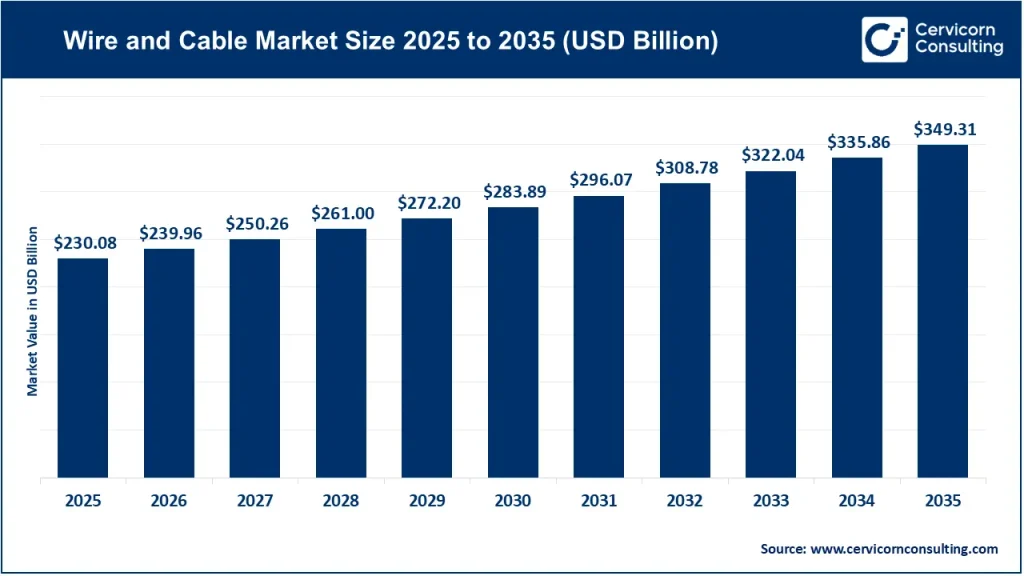
The global wire and cable market was valued at approximately USD 230.08 billion in 2025 and is projected to reach USD 349.31 billion by 2035, expanding at a CAGR of 4.26% during the forecast period.
What Is the Wire and Cable Market?
The wire and cable market encompasses the manufacturing, distribution, and installation of products designed to transmit electrical power, signals, and data. Wires generally consist of one or more conductive strands, while cables typically combine multiple conductors with insulation, shielding, protective layers, and other components according to their application.
The market includes a broad range of products, such as low-voltage, medium-voltage, and high-voltage power cables; overhead conductors; underground cables; submarine cables; optical-fiber cables; communication cables; coaxial cables; automotive wires and harnesses; industrial cables; building wires; and specialty cables.
Copper and aluminum remain the principal conductive materials, while polymers and other insulating materials provide electrical isolation and mechanical protection. Cable design varies substantially according to operating voltage, temperature, environmental exposure, flexibility, transmission capacity, fire resistance, and installation conditions.
Demand therefore comes from multiple industries rather than one end-use sector. Utilities require transmission and distribution cables, construction companies need building wires, telecommunications operators purchase fiber-optic cables, automakers use wiring harnesses and high-voltage cables, offshore wind projects require subsea export cables, and data centers increasingly depend on high-performance power and connectivity infrastructure.
Get a Free Sample: https://www.cervicornconsulting.com/sample/2721
Why Is the Wire and Cable Market Important?
Wire and cable products form the physical infrastructure connecting electricity generation, transmission, distribution, buildings, machines, vehicles, communication networks, and digital systems. Without reliable cabling, renewable power cannot efficiently reach consumers, data centers cannot operate, electric vehicles cannot receive or distribute electrical power, and telecommunications networks cannot deliver high-speed connectivity.
The importance of cables is increasing as electricity systems become more decentralized. Solar and wind farms are frequently located far from major consumption centers, requiring extensive transmission networks and increasingly sophisticated HVDC and subsea cable systems. The European Commission estimates that around €584 billion of investment is required in European electricity grids through 2030, while cross-border transmission capacity needs to increase substantially.
The market is also strategically important for digital infrastructure. Data centers, artificial-intelligence computing facilities, cloud platforms, 5G networks, and fiber-to-the-home infrastructure require large quantities of power and communication cables. As a result, wire and cable manufacturers increasingly serve both the traditional power industry and the digital economy.
Wire and Cable Market Competitive Landscape
The industry includes global manufacturers with different areas of specialization. Some companies focus strongly on energy transmission and distribution, while others have greater exposure to telecommunications, automotive wiring, optical fiber, industrial applications, or specialty cables.
| Company | Specialization | Key Focus Areas | Notable Features | 2025 Revenue | Indicative Market Share* | Global Presence |
|---|---|---|---|---|---|---|
| Hengtong Optic-Electric Co Ltd. | Power and optical communications | Optical fiber, smart grids, marine energy, new energy | Strong Chinese manufacturing base and international expansion | RMB 66.85 billion | ~4.1% | China and international markets |
| Prysmian Group | Energy and telecom cables | Transmission, power grids, electrification, digital solutions | Major global cable supplier and HV/submarine expertise | €19.65 billion | ~9.3% | Europe, North America, Latin America, Asia and other markets |
| Sumitomo Electric Industries, Ltd. | Electrical and communication systems | Automotive, energy, telecommunications, electronics | Diversified advanced-materials and electrical technology portfolio | JPY 5,110.2 billion | ~14.8%** | Japan, Americas, China, Asia and Europe |
| Furukawa Electric Co., Ltd. | Optical fiber, energy and automotive products | Data centers, communications, power cables, automotive components | Strong photonics and advanced-material capabilities | JPY 1,307.6 billion | ~3.8%** | Japan and international markets |
| LEONI AG | Automotive wiring and energy/data management | Wiring systems, automotive cables, vehicle electronics | Major automotive wiring-system supplier | €3.9 billion | ~1.7% | 23 countries |
*Indicative market-share calculations are based on reported company-level 2025 revenue against the approximately USD 229.09 billion global wire and cable market and should not be interpreted as audited cable-segment market shares.
**Sumitomo Electric and Furukawa Electric have highly diversified businesses, so total corporate revenue is not directly comparable with wire-and-cable market revenue.
Hengtong Optic-Electric reported RMB 66.85 billion in 2025 revenue, representing year-on-year growth of approximately 11.45%. Its businesses include optical communications, smart grids, marine energy, and industrial/new-energy applications.
Prysmian is one of the most important global cable companies, with FY2025 revenue of €19.65 billion, compared with €17.03 billion in 2024. The company benefited from transmission, power-grid modernization, electrification, and digital-solutions demand. Its 2025 adjusted EBITDA reached €2.398 billion, demonstrating the strength of its higher-value cable and infrastructure portfolio.
Sumitomo Electric reported JPY 5,110.2 billion in FY2025 net sales, with operations spanning Japan, the Americas, China, other Asian markets, and Europe. Its diversified portfolio provides exposure to automotive, communications, energy, and electronics applications.
Furukawa Electric generated JPY 1,307.6 billion in FY2025 consolidated net sales, with growth supported by data-center-related products, optical-fiber cables, automotive components, and higher copper prices.
LEONI generated approximately €3.9 billion in consolidated sales in 2025, excluding its former Automotive Cable Solutions division, and operates across 23 countries with approximately 95,000 employees. Its core positioning is energy and data management for automotive applications.
Leading Trends and Their Impact on the Wire and Cable Market
1. Grid Modernization
Aging transmission and distribution networks are creating replacement demand for medium- and high-voltage cables. Utilities are investing in underground networks, smart-grid equipment, higher-capacity transmission corridors, and resilient distribution systems.
This trend is particularly significant in mature economies where electricity infrastructure constructed decades ago requires modernization. It is also accelerating in emerging economies where new distribution networks must support urbanization and industrialization.
2. Renewable Energy Expansion
Solar and wind installations are increasing demand for cables at generation sites as well as transmission infrastructure. Offshore wind is particularly cable-intensive because electricity must travel from turbines to offshore substations and then to onshore grids through subsea export cables.
The growth of renewable generation is therefore shifting demand toward higher-capacity, specialized, long-distance cable systems.
3. HVDC and Submarine Cables
HVDC technology is increasingly important for transferring large amounts of electricity over long distances with lower transmission losses. It is also essential for connecting offshore renewable-energy projects and interconnecting national electricity grids.
The European Union’s grid policy specifically identifies strengthening supply chains for technologies including HVDC cables and substations as an important priority.
4. Electric Vehicle Electrification
The transition from internal-combustion engines to electric vehicles is creating new demand for high-voltage cables, lightweight wiring harnesses, battery connections, charging infrastructure cables, and specialized electrical components.
Automotive cable suppliers are consequently moving beyond conventional wiring toward high-voltage systems, data communication, lightweight aluminum solutions, and components suitable for software-defined vehicles.
5. Data Centers and Artificial Intelligence
AI workloads are driving rapid expansion of high-density data centers. These facilities require extensive electrical distribution systems, high-capacity power connections, optical fiber, copper connectivity, and specialized cabling.
The data-center trend is already benefiting companies such as Furukawa Electric, which reported higher sales of data-center-related products including optical-fiber cables.
6. Smart and Digitally Managed Cables
Cable manufacturers are increasingly integrating monitoring technologies into infrastructure. Sensors, temperature monitoring, fault detection, fiber-optic sensing, and digital asset-management platforms can help utilities identify faults and optimize maintenance.
The shift from reactive maintenance to predictive maintenance can extend asset life while reducing outages.
7. Lightweight and Sustainable Cable Technologies
Automotive and aerospace customers increasingly demand lighter components to improve energy efficiency. Aluminum conductors can reduce weight in certain applications, while recyclable materials and low-smoke, halogen-free insulation are becoming increasingly relevant in buildings and infrastructure.
Sustainability is also encouraging cable producers to improve material efficiency, recycling, and lifecycle management.
Successful Examples of the Wire and Cable Market Around the World
European Grid and Offshore Wind Development
Europe provides one of the clearest examples of how energy-transition policies can stimulate cable demand. The EU’s Grid Action Plan emphasizes grid expansion, modernization, renewable integration, cross-border transmission, financing, permitting, and supply-chain strengthening. The European Commission’s subsequent Grid Package also focuses on faster grid development and improved planning.
Offshore wind projects require large quantities of submarine inter-array and export cables, while cross-border electricity interconnectors create additional demand for HVDC cable systems. This has strengthened the position of major European cable manufacturers.
India’s Distribution Modernization
India is another important example. The government’s Revamped Distribution Sector Scheme (RDSS) has an outlay of approximately Rs. 3,03,758 crore for FY2021-22 through FY2025-26. The program aims to improve distribution reliability and reduce aggregate technical and commercial losses.
The program directly creates demand for distribution infrastructure, including replacement of old conductors, low-tension aerial-bunched cables, transformers, substations, underground cabling, and other network improvements. Government information indicates that infrastructure works under RDSS include replacement of old or damaged conductors and deployment of LT aerial-bunched cables.
China’s Long-Distance Power Transmission
China has developed large-scale electricity transmission corridors connecting major renewable-generation regions with consumption centers. Its west-to-east transmission system demonstrates the role of large transmission networks in integrating geographically dispersed generation.
In 2025, China Southern Power Grid transmitted more than 261 billion kWh through west-to-east transmission corridors, highlighting the scale of infrastructure required to move electricity across large distances.
The expansion of renewable generation and ultra-high-voltage infrastructure creates substantial opportunities for high-capacity conductors, transmission cables, grid components, and associated equipment.
North American Grid Modernization
The United States is experiencing increasing investment requirements for electricity transmission and distribution as renewable generation, electric vehicles, manufacturing facilities, and data centers place additional pressure on the grid.
The market opportunity extends beyond conventional power cables to include underground transmission, high-voltage systems, utility distribution cables, data-center power infrastructure, and specialized cables for industrial facilities.
Prysmian’s 2025 results illustrate this trend: the company reported strong performance in Power Grid and Transmission, with North America and Europe contributing significantly to growth.
Global Regional Analysis
North America
North America represents a high-value market driven by grid modernization, data-center expansion, renewable-energy development, electrification, and replacement of aging infrastructure.
The United States is particularly important because of increasing electricity demand from AI data centers, manufacturing facilities, battery plants, electric vehicles, and renewable-energy projects. Cable manufacturers are responding by expanding production capacity and strengthening domestic supply chains.
Canada also offers opportunities through electricity interconnection projects, renewable-energy development, and infrastructure modernization.
The region is shifting from a traditional replacement-driven cable market toward a capacity-expansion market, where large transmission projects, underground systems, data centers, and electrification infrastructure create new demand.
Europe
Europe remains one of the world’s most technologically advanced wire and cable markets. Renewable-energy targets, offshore wind development, interconnection projects, electric mobility, smart grids, and aging infrastructure are major growth drivers.
The European Commission estimates that electricity consumption could rise by around 60% by 2030, while significant portions of existing distribution infrastructure are already more than 40 years old. The EU’s Grid Action Plan therefore emphasizes modernization, digitalization, renewable integration, financing, faster permitting, and supply-chain resilience.
Europe’s strong presence in submarine and HVDC cable technology also gives regional manufacturers opportunities in offshore wind and cross-border interconnector projects.
Asia-Pacific
Asia-Pacific is a major growth engine for the wire and cable market, with the regional market estimated at USD 85.47 billion in 2025.
China, India, Japan, South Korea, and Southeast Asian economies are investing in power generation, transmission, telecommunications, industrial infrastructure, transportation, and renewable energy.
China benefits from large-scale electricity transmission and renewable-energy infrastructure, while India is expanding electricity distribution, urban infrastructure, railways, renewable-energy capacity, and industrial manufacturing.
Japan is emphasizing grid resilience, offshore wind, advanced electrical infrastructure, and next-generation energy systems. Its mature industrial ecosystem also supports demand for high-performance automotive, electronics, and telecommunications cables.
Latin America
Latin America offers long-term opportunities through renewable-energy development, electricity-grid expansion, mining, infrastructure modernization, telecommunications, and urbanization.
Countries such as Brazil, Chile, Mexico, Colombia, and Argentina are investing in electricity generation and transmission infrastructure. Renewable-energy resources are often located far from major population centers, increasing the need for transmission lines and specialized cables.
The expansion of solar and wind power is particularly important in Brazil and Chile, where new generation capacity requires grid reinforcement and interconnection.
Middle East & Africa
The Middle East and Africa represent emerging opportunities driven by electrification, industrial development, renewable-energy projects, smart cities, oil and gas infrastructure, data centers, and cross-border power interconnections.
Gulf countries are investing heavily in renewable energy, large infrastructure projects, industrial diversification, and digital infrastructure. These investments support demand for high-performance power and communication cables.
African markets have significant long-term potential because electrification rates remain uneven and many countries require substantial investments in transmission and distribution infrastructure. New solar, wind, hydropower, and interconnection projects can stimulate demand for medium- and high-voltage cables.
Government Initiatives and Policies Shaping the Market
Government policy is becoming one of the strongest structural influences on the wire and cable industry because electricity infrastructure requires long-term capital investment and regulatory coordination.
European Union: The EU Grid Action Plan and European Grids Package prioritize grid modernization, renewable integration, cross-border transmission, faster permitting, investment mechanisms, and stronger grid supply chains. The European Commission has also highlighted anticipatory investment so networks can be prepared for future electricity demand rather than only responding after capacity constraints emerge.
India: The RDSS is supporting distribution-system modernization through infrastructure upgrades, conductor replacement, aerial-bunched cables, underground cabling, transformer upgrades, and smart-grid-related improvements. The scheme’s stated objective is to improve the quality and reliability of electricity distribution while improving the financial and operational performance of utilities.
China: China’s clean-energy and grid-development policies support renewable integration, transmission infrastructure, energy storage, and coordinated power-source-grid-load development. Its national carbon-peaking strategy emphasizes strengthening the electricity system and accelerating the integration of renewable energy with the grid.
Japan: Japan’s energy-transition policies support offshore wind, next-generation solar, and infrastructure investment, creating opportunities for advanced power cables and grid technologies. Government-supported offshore-wind development is particularly relevant because subsea power cables are essential for connecting offshore generation to land-based networks.
United States: Federal and state-level investment in transmission, grid resilience, renewable-energy integration, electric-vehicle infrastructure, and industrial electrification is increasing the addressable market for power and specialty cables. The focus is increasingly shifting toward expanding transmission capacity and improving resilience alongside the replacement of aging assets.
Market Outlook and Emerging Opportunities
The next stage of wire and cable market development will increasingly revolve around electricity infrastructure, renewable integration, digitalization, and transportation electrification. Traditional low- and medium-voltage applications will remain important, but higher-value opportunities are emerging in HVDC transmission, submarine cables, offshore wind, data-center infrastructure, EV high-voltage systems, smart-grid technologies, and advanced communication networks.
Manufacturers with broad geographic footprints and advanced manufacturing capabilities are likely to benefit from the diversification of demand. Companies are also increasingly investing in localized production to reduce supply-chain risks associated with copper, aluminum, polymers, energy costs, logistics, and geopolitical disruptions.
The market is consequently moving from a commodity-oriented model toward a more technology-intensive infrastructure market. High-voltage performance, installation capability, reliability, lifecycle cost, digital monitoring, environmental performance, and project execution are becoming increasingly important purchasing criteria. As governments and utilities accelerate investments in resilient grids, renewable-energy transmission, electrification, and digital infrastructure, these structural changes are expected to continue shaping the global wire and cable market through the next decade.
To Get Detailed Overview, Contact Us: https://www.cervicornconsulting.com/contact-us
Read Report: Fast Fashion Market Revenue, Trends, and Strategic Insights by 2035