


Table of Contents
ToggleFast Fashion Market Overview
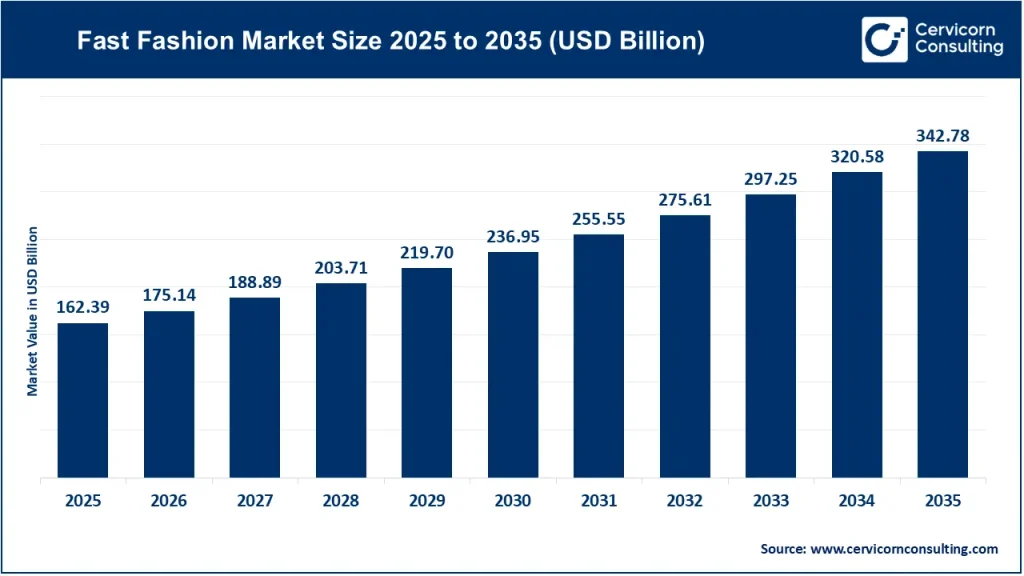
The global fast fashion market was valued at approximately USD 162.76 billion in 2025 and is projected to reach USD 342.78 billion by 2035, expanding at a CAGR of 7.76% from 2026 to 2035.
Fast fashion has evolved from a store-focused retail concept into a highly digital, data-driven ecosystem. Traditional brands such as Zara and H&M continue to compete through rapid design and merchandising cycles, while digital-first players such as SHEIN have pushed the industry toward ultra-fast fashion based on real-time consumer data, social media trends, small-batch manufacturing, and highly responsive supply chains. At the same time, growing concerns about textile waste, carbon emissions, labor practices, water consumption, and unsold inventory are forcing companies to rethink the conventional high-volume model.
Fast Fashion Market Growth Factors
The growth of the fast fashion market is being supported by rising disposable incomes, expanding urban populations, a large young consumer base, increasing social media influence, rapid fashion-cycle turnover, affordable apparel prices, expanding e-commerce penetration, mobile shopping, influencer marketing, international retail expansion, and improvements in supply-chain technology. Gen Z and millennials are particularly important because they frequently discover new styles through social platforms and expect brands to respond quickly to emerging trends. The growing popularity of short-form video platforms has further accelerated trend cycles, allowing a fashion aesthetic to move from social media to commercial products within a very short period. At the same time, artificial intelligence, predictive analytics, automated inventory management, and customer-data platforms enable retailers to identify demand patterns and reduce the time between design, manufacturing, and retail.
E-commerce is another major growth factor because online-first companies can reach consumers across countries without building extensive physical-store networks. SHEIN demonstrates this model particularly strongly, with its digital platform and data-driven supply chain enabling rapid product testing and global distribution. Meanwhile, established retailers are combining physical stores with mobile applications, click-and-collect services, localized assortments, and integrated online-offline inventories. Growing demand for affordable clothing also supports the sector during periods of economic uncertainty, although increasing environmental regulation and consumer awareness are pushing companies toward recycled materials, resale, repair, and circular business models.
What Is the Fast Fashion Market?
The fast fashion market refers to the ecosystem of companies that rapidly design, manufacture, distribute, and sell affordable apparel inspired by current fashion trends. Unlike traditional fashion businesses that typically operate around seasonal collections, fast fashion companies can introduce new products continuously or within compressed production cycles.
The model is built around speed, affordability, variety, and responsiveness. Retailers monitor fashion shows, social media, search behavior, customer preferences, competitor activity, and sales data to identify emerging trends. These insights are then translated into commercially viable products and distributed through physical stores, websites, mobile applications, and third-party marketplaces.
Fast fashion covers women’s, men’s, and children’s clothing, including dresses, tops, shirts, jeans, trousers, skirts, jackets, activewear, accessories, footwear, and other fashion products. The market increasingly overlaps with ultra-fast fashion, where digital-first retailers use highly automated data systems and extremely short product-development cycles.
Get a Free Sample: https://www.cervicornconsulting.com/sample/2718
Why Is the Fast Fashion Market Important?
The fast fashion market is important because it has fundamentally changed how consumers purchase clothing and how fashion companies manage product development and supply chains.
First, it has democratized fashion by making trend-oriented clothing accessible to a much broader consumer base. Customers who previously had limited access to runway-inspired styles can now purchase similar designs at relatively low prices.
Second, the industry creates significant economic activity across design, textile manufacturing, garment production, logistics, retail, e-commerce, marketing, warehousing, and technology.
Third, fast fashion has become an important testing ground for advanced retail technologies. Companies increasingly use AI-based demand forecasting, customer analytics, automated replenishment, recommendation engines, virtual shopping experiences, and digital inventory systems.
However, the industry’s importance also comes with environmental and social responsibilities. The European Commission notes that consumers in the EU discard approximately 5 million tonnes of clothing annually, while only around 1% of clothing material is recycled into new clothing. These figures highlight why the future of fast fashion increasingly depends on circularity, durability, recycling, and responsible production.
Leading Fast Fashion Companies
| Company | Specialization | Key Focus Areas | Notable Features | 2025 Revenue | Market Share* | Global Presence |
|---|---|---|---|---|---|---|
| Zara (Inditex S.A.) | Trend-responsive apparel | Speed, design, integrated retail | Vertically coordinated supply chain, strong stores + e-commerce | €28.05B Zara/Zara Home sales | Major global player | Worldwide |
| H&M Group | Affordable fashion and lifestyle apparel | Value, fashion, omnichannel retail | Multi-brand portfolio, sustainability programs | SEK 200B group net sales | Major global player | ~3,000 stores in 81 markets |
| SHEIN | Digital-first ultra-fast fashion | AI/data, social commerce, low prices | On-demand production, small-batch testing | ~US$41.85B | Major online fast-fashion player | ~160 markets |
| Uniqlo (Fast Retailing Co., Ltd.) | Functional everyday apparel | LifeWear, quality, technology | Functional fabrics, global store network | ¥2.94T Uniqlo sales | Major global apparel player | 2,519 stores worldwide |
| Forever 21 | Trend-oriented affordable fashion | Youth fashion, value retail | Mall-based heritage + licensed global model | Not separately disclosed | Smaller/declining player | International brand presence |
Zara’s 2025 sales, including Zara Home, reached approximately €28.05 billion, making it the largest brand within Inditex. Inditex’s total group revenue was €39.9 billion in 2025.
H&M Group generated approximately SEK 200 billion in net sales in 2025 and operated around 3,000 stores across 81 markets, demonstrating the scale of its international retail network.
SHEIN represents a different business model. Its digital-first structure eliminates much of the traditional store infrastructure and relies heavily on consumer data, social commerce, and highly flexible supplier networks. Recent reporting based on its Hong Kong listing documents indicates that SHEIN generated approximately US$41.85 billion in revenue in 2025, serving hundreds of millions of customers globally.
Uniqlo’s parent company Fast Retailing reported ¥3.4005 trillion in consolidated revenue in FY2025, while the UNIQLO business itself generated ¥2.9363 trillion in sales and operated 2,519 stores worldwide.
Forever 21 represents a contrasting example. Once one of the strongest youth-focused fast-fashion chains, the company has faced intense competition from digital-native businesses. Its U.S. operator entered bankruptcy proceedings again in 2025 and planned to close roughly 200 stores, highlighting the difficulty traditional mall-based fast-fashion businesses face against online competitors.
Leading Trends and Their Impact
1. Social Commerce and Influencer-Led Fashion
Social media has become one of the most powerful trend-generation mechanisms in fast fashion. Instagram, TikTok, YouTube, and other platforms allow consumers to discover new styles immediately.
Impact: Retailers can identify viral trends faster, launch relevant products quickly, and use creators to generate demand. However, this also accelerates consumption cycles and can increase overproduction.
2. AI-Powered Demand Forecasting
Artificial intelligence is increasingly being integrated into fashion forecasting, inventory management, recommendation systems, pricing, and product development.
Impact: AI can help companies predict demand more accurately, reduce excess inventory, improve personalization, and shorten product-development cycles. Research into AI-supported fashion forecasting also identifies the potential to reduce waste by better matching production with expected demand.
3. Ultra-Fast Fashion
Digital-first businesses are pushing the industry beyond traditional fast fashion. New products can be tested in small quantities and expanded when consumer response is strong.
Impact: This model reduces the risk of producing large volumes of untested designs but increases SKU turnover and can encourage even more frequent purchases.
4. Sustainable and Circular Fashion
Environmental concerns are reshaping the sector. Brands are introducing recycled fibers, clothing collection programs, repair services, resale platforms, and more durable product lines.
Impact: Sustainability is becoming a competitive differentiator while also becoming a regulatory requirement. Recent initiatives from Zara, Uniqlo, H&M, and other brands demonstrate increasing investment in repair and aftercare services.
5. Omnichannel Retail
Fast-fashion companies increasingly connect stores, websites, applications, warehouses, and social platforms into a single customer journey.
Impact: Consumers can discover products online, check store inventory, purchase through mobile applications, and collect or return products through physical locations. This improves convenience and helps retailers use inventory more efficiently.
6. Personalization and Localization
Global brands are increasingly adapting products and marketing to regional preferences, climate conditions, cultural aesthetics, and local purchasing behavior.
Impact: Localization improves conversion rates and reduces the risk of carrying unsuitable inventory across different markets.
Successful Examples of Fast Fashion Around the World
Zara – Spain and Global Markets
Zara is one of the strongest examples of the traditional fast-fashion model. Its competitive advantage comes from combining trend responsiveness, product design, logistics, stores, and digital channels. Rather than depending exclusively on long seasonal cycles, Zara continuously adjusts its assortment according to customer response.
Inditex reported €39.9 billion in group revenue in 2025, while Zara and Zara Home generated more than €28 billion. The company also invested substantially in store upgrades and digital platforms, demonstrating how physical retail and digital commerce are becoming increasingly integrated.
SHEIN – China and Global E-Commerce
SHEIN has become one of the most important examples of ultra-fast fashion. Its business model is built around digital customer engagement, large-scale data analysis, small initial production runs, supplier flexibility, and rapid product testing.
The company has demonstrated how a fashion retailer can achieve global scale without relying on a conventional network of thousands of physical stores. Its expansion also illustrates how social media and mobile commerce can become core components of fashion retail rather than simply marketing channels.
Uniqlo – Japan and International Expansion
Uniqlo provides another successful model, although its strategy differs from classic trend-driven fast fashion. Its LifeWear concept focuses on functional, everyday clothing and technical materials.
Fast Retailing reported ¥2.9363 trillion in UNIQLO sales and 2,519 stores worldwide in FY2025. The company’s international growth demonstrates that affordability can be combined with functional design and product consistency.
H&M – Sweden and Global Markets
H&M successfully scaled fast fashion internationally through affordable collections, extensive retail coverage, digital commerce, and a broad brand portfolio.
Its 2025 performance included approximately SEK 200 billion in group net sales and around 3,000 stores across 81 markets.
Forever 21 – United States
Forever 21 played an important role in bringing low-priced, trend-focused clothing into American shopping malls. Its historical success illustrates the power of youth-oriented fashion and affordable pricing. However, its more recent difficulties also demonstrate the structural challenges facing mall-based retailers as online-first businesses capture younger consumers.
Global Regional Analysis
North America
North America remains one of the most important fast-fashion markets because of its high purchasing power, extensive retail infrastructure, strong e-commerce adoption, and large consumer base.
The U.S. market is experiencing particularly strong competition between traditional retailers and digital-first companies. Zara, H&M, Uniqlo, SHEIN, and other brands compete through different combinations of price, assortment, physical retail, digital engagement, and brand positioning.
The region is also becoming increasingly important for sustainability discussions. Consumers and policymakers are placing greater emphasis on textile waste, product durability, supply-chain transparency, and responsible sourcing.
The competitive landscape is simultaneously being influenced by trade policies and customs rules. For digital-first brands relying heavily on direct-to-consumer shipments, changes in small-parcel trade rules can materially affect pricing and logistics economics.
Europe
Europe has historically been one of the most developed fast-fashion regions, with major companies such as Zara and H&M originating from Spain and Sweden. The region benefits from dense urban populations, established fashion culture, high internet penetration, and sophisticated retail infrastructure.
However, Europe is also becoming one of the most regulated fashion markets. The European Union’s Sustainable and Circular Textiles Strategy seeks to ensure that textile products become more durable, repairable, recyclable, and increasingly made from recycled fibers. The strategy also promotes digital product passports, extended producer responsibility, repair and reuse, and action against microplastic release.
This regulatory direction could significantly alter fast fashion. Companies may need to redesign garments, document material composition, improve traceability, manage unsold inventory differently, and invest more heavily in recycling infrastructure.
Asia Pacific
Asia Pacific represented approximately 34.73% of the global fast fashion market in 2025, making it the largest regional market.
The region benefits from a huge consumer population, expanding middle classes, strong manufacturing capabilities, rapidly growing e-commerce, and high smartphone penetration.
China remains a crucial production and consumption hub, while Japan is home to Uniqlo and several influential apparel companies. India, Southeast Asia, South Korea, and other emerging economies are increasingly important growth markets as urbanization and disposable incomes rise.
India is particularly significant because it combines a large domestic consumer market with a strong textile and garment manufacturing ecosystem. Government initiatives are aimed at strengthening domestic production and global competitiveness. The PM MITRA scheme has approved seven integrated textile parks designed to consolidate spinning, weaving, processing, garment manufacturing, logistics, and other activities within integrated industrial ecosystems.
Latin America
Latin America offers considerable growth potential because of its young population, urbanization, growing digital commerce, and expanding middle-income consumer base.
Brazil is the most significant regional market, while Mexico benefits from its proximity to the United States and integrated North American supply chains. International fast-fashion brands can expand through shopping centers, marketplaces, mobile commerce, and localized digital campaigns.
However, inflation, currency fluctuations, import costs, and economic volatility can influence consumer spending and retail expansion.
Middle East & Africa
The Middle East and Africa represent emerging opportunities for fast-fashion retailers. Gulf countries have strong purchasing power, modern shopping malls, high digital adoption, and significant international tourism.
Africa presents a longer-term growth opportunity because of population expansion, urbanization, and increasing smartphone penetration. However, infrastructure limitations, import costs, fragmented retail systems, and different consumer preferences can make market expansion more complex.
Local fashion preferences also create opportunities for brands that can adapt products to regional cultures rather than relying solely on standardized global collections.
Government Initiatives and Policies Shaping the Fast Fashion Market
Government policies are increasingly influencing the fast-fashion value chain, particularly in Europe and major textile-producing economies.
European Union – Sustainable and Circular Textiles Strategy
The EU’s textile strategy is one of the most important policy frameworks affecting fast fashion. Its 2030 vision includes durable, repairable, recyclable textiles, greater use of recycled fibers, reduced hazardous substances, improved social and environmental standards, and expanded reuse and repair services.
The strategy also includes measures related to Digital Product Passports, extended producer responsibility, microplastics, textile-waste exports, green claims, and ecodesign requirements.
These policies can increase compliance costs for fast-fashion companies but simultaneously create opportunities for textile recycling, sustainable materials, repair services, resale platforms, and circular supply chains.
India – PM MITRA and Textile Manufacturing Policies
India is strengthening its textile manufacturing ecosystem through initiatives such as PM MITRA, the Production Linked Incentive scheme, the National Technical Textiles Mission, SAMARTH, and other textile-development programs.
The government approved seven PM MITRA parks with a total scheme outlay of ₹4,445 crore for 2021–22 to 2027–28. These parks are intended to create integrated textile ecosystems and reduce logistics and production inefficiencies.
For fast-fashion companies, such infrastructure can improve access to manufacturing capacity, shorten supply chains, support export competitiveness, and enable greater production flexibility.
India – PLI Scheme for Textiles
India’s textile PLI program focuses particularly on man-made fiber apparel, fabrics, and technical textiles. Subsequent modifications have sought to make participation more accessible by adjusting investment and turnover requirements.
This is particularly relevant to fast fashion because synthetic and man-made fibers play an important role in affordable apparel production.
Sustainability and Circularity Regulations
Governments worldwide are increasingly moving toward policies that make producers more responsible for products after sale. Extended producer responsibility, recycling requirements, eco-design rules, product traceability, and restrictions on textile waste exports could become increasingly important.
For fast-fashion companies, these regulations are likely to encourage investments in recycling technologies, recycled fibers, garment take-back programs, product durability, repair infrastructure, and supply-chain traceability.
The shift is already visible among leading brands. Repair programs and sewing initiatives are expanding across the fashion industry as retailers attempt to address consumer sustainability expectations and extend garment lifetimes.
The Strategic Direction of the Fast Fashion Market
The fast fashion market is moving toward a more technologically advanced and highly segmented competitive environment. Traditional players are strengthening omnichannel retail and sustainability programs, while digital-native companies are competing through speed, data, low prices, and social commerce.
At the same time, regulation is making the old model of simply producing more garments at lower prices increasingly difficult. The next phase of market development is therefore likely to combine rapid trend responsiveness with AI-powered forecasting, localized production, digital product passports, recycled materials, repair, resale, textile recycling, and more transparent supply chains.
For brands, the central challenge will be balancing speed and affordability with durability and environmental responsibility. For manufacturers, opportunities are expanding around automated production, recycled fibers, flexible manufacturing, nearshoring, and digital supply-chain management. For retailers, the strongest competitive advantage may increasingly come from the ability to connect consumer data with efficient production while reducing unsold inventory and waste.
The scale of the market provides substantial opportunities, but the competitive landscape is becoming more demanding. With the global market projected to expand from USD 162.76 billion in 2025 to USD 388.56 billion by 2034, fast fashion is likely to remain a major force in global apparel retail while undergoing a significant transition toward digitalization, personalization, and circularity.
To Get Detailed Overview, Contact Us: https://www.cervicornconsulting.com/contact-us
Read Report: Blade Battery Market Revenue, Trends, and Strategic Insights by 2035