


Web3 Gaming Market: Where Should Companies Invest to Build Sustainable Gaming Businesses?
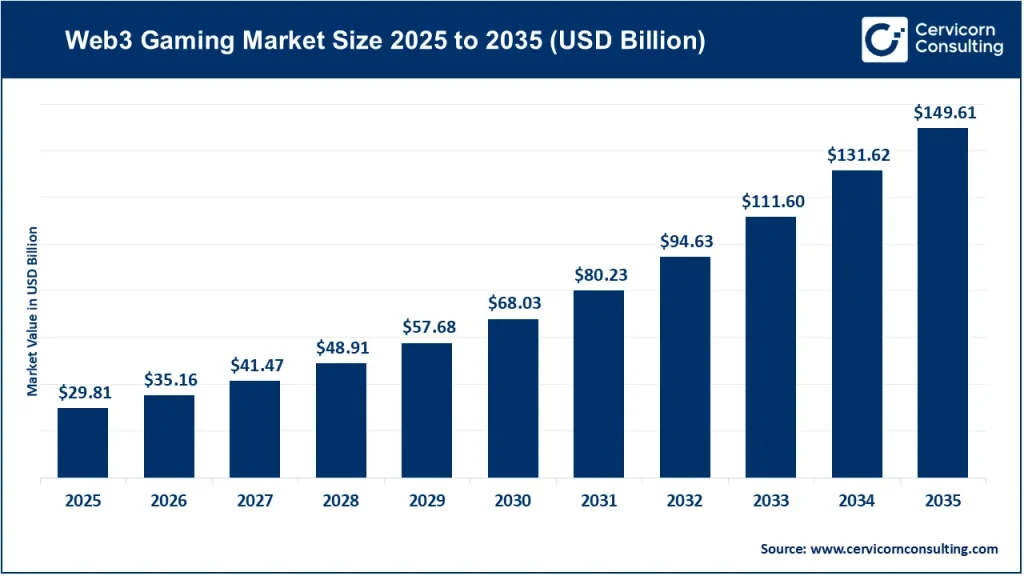
The global Web3 gaming market is projected to grow from USD 29.81 billion in 2025 to USD 149.61 billion by 2035, expanding at a CAGR of 17.51%. However, for game developers, publishers, blockchain infrastructure providers and investors, the commercial opportunity depends on more than market growth. The critical question is which business models can retain players, generate recurring revenue and sustain digital economies beyond initial user acquisition.
Web3 gaming combines traditional gaming with blockchain-based digital ownership, tokenized assets, decentralized marketplaces and, in some cases, player participation in virtual economies. As the industry evolves, companies must decide how much blockchain functionality to integrate, which platforms to prioritize and how to balance player experience with monetization.
Why Is Web3 Gaming Moving Beyond Play-to-Earn?
Early blockchain games attracted attention through play-to-earn (P2E) models, where players could earn tokens or trade non-fungible tokens (NFTs) through gameplay. However, projects that rely heavily on financial incentives face a fundamental challenge: users may leave when rewards decline or the value of in-game assets falls.
Industry activity reflects this pressure. DappRadar reported an average of 4.66 million daily unique active wallets in blockchain gaming during Q3 2025, down 4.4% quarter over quarter. Its Q2 2025 analysis also documented more than 300 gaming decentralized applications that became inactive during the quarter, although inactivity does not necessarily mean every project permanently shut down. These developments highlight the importance of distinguishing wallet activity from genuine player engagement and long-term commercial performance.
For businesses, this creates three strategic priorities:
- Gameplay before financial incentives: Games need compelling mechanics, progression, competitive features and regular content updates to encourage repeat participation.
- Sustainable monetization: Revenue should increasingly reflect in-game purchases, subscriptions, cosmetics, marketplace activity and other models that do not depend entirely on token appreciation.
- Selective blockchain integration: Developers should introduce blockchain functionality where it improves ownership, trading, interoperability or community participation rather than adding complexity without a clear player benefit.
The opportunity is shifting from simply attracting users with rewards toward building games that players continue to use even when token prices fluctuate.
Get a Free Sample: https://www.cervicornconsulting.com/sample/2794
Which Web3 Gaming Segments Offer the Strongest Commercial Potential?
The market encompasses multiple business models, technologies and distribution channels. Their commercial attractiveness varies according to development costs, user acquisition requirements, infrastructure needs and monetization potential.
1. Mobile Web3 Gaming: Reach Versus Onboarding Friction
Mobile gaming offers access to a broad audience, particularly in markets where smartphones are the primary gaming device. Integrating blockchain features into mobile titles could expand the addressable audience for digital collectibles, player-owned assets and social gaming economies.
However, wallet creation, transaction fees, recovery procedures and unfamiliar cryptocurrency terminology can discourage mainstream players. App-store requirements and regional digital-asset regulations can also influence distribution and monetization.
Companies evaluating mobile Web3 games should assess:
- Player conversion rates before and after wallet creation.
- Retention among blockchain users versus conventional players.
- Revenue per active user, including non-token purchases.
- Transaction costs and the impact of blockchain activity on gameplay.
- Distribution restrictions across target markets.
The commercial priority should be to minimize onboarding friction and make blockchain functionality optional where possible.
2. Free-to-Play Models: A Route to Broader Adoption
Free-to-play (F2P) games can reduce the initial barrier to entry by allowing users to experience gameplay without purchasing tokens or NFTs. Blockchain-based features can then support optional asset ownership, cosmetic purchases, trading or community rewards.
For publishers, the main decision is whether blockchain features improve engagement and lifetime value compared with a conventional F2P model. A larger number of wallets does not automatically translate into higher revenue.
Before scaling investment, companies should test whether blockchain integration improves conversion, repeat purchases, retention or community participation enough to justify additional development and compliance costs.
3. Play-to-Earn and Tokenized Economies: Designing for Long-Term Viability
P2E remains relevant for companies exploring player incentives and digital economies, particularly in markets with active gaming and crypto communities. Nevertheless, token-based rewards can create inflationary pressure if the supply of rewards consistently exceeds genuine demand.
A sustainable model requires a clear relationship between token issuance, player spending, asset utility and the economic value generated by the game.
Business leaders should evaluate:
- The proportion of token demand generated by actual gameplay rather than speculation.
- Reward issuance relative to token sinks, including crafting, upgrades and other in-game spending.
- The concentration of assets and tokens among large holders.
- Player activity when rewards are reduced.
- Liquidity, treasury exposure and the financial implications of token-price volatility.
Tokenomics should be assessed as part of the game’s operating model, not as a substitute for product-market fit.
4. Blockchain Infrastructure and Gaming-as-a-Service
The opportunity extends beyond individual game titles. Studios may require scalable blockchain networks, software development kits, wallet infrastructure, asset marketplaces, analytics, security audits and transaction-processing services.
These supporting businesses can serve multiple games rather than depending on the commercial success of a single title. However, their prospects depend on developer adoption, recurring usage, integration costs and competition among infrastructure providers.
Infrastructure companies should examine developer retention, revenue per integrated game, transaction volumes, customer acquisition costs and dependence on a small number of major clients. Studios, meanwhile, should compare the total cost of ownership across available blockchain ecosystems rather than selecting a network solely on transaction speed or headline fees.
How Should Companies Select a Blockchain and Technology Stack?
Blockchain selection affects transaction costs, security, user experience, development complexity and future portability. A technically capable network may still be commercially unsuitable if its ecosystem lacks relevant tools, developer support or access to the target audience.
Before committing to a blockchain, decision-makers should compare the following factors:
- Performance: Can the network support the expected transaction volume and latency requirements without disrupting gameplay?
- Economics: What are the direct transaction costs, integration expenses and infrastructure costs at realistic usage levels?
- Security: What are the smart-contract risks, audit requirements, bridge dependencies and incident-response capabilities?
- Developer ecosystem: Are suitable development tools, marketplaces, wallet integrations and technical partners available?
- Interoperability: Can assets and identities be transferred or recognized across relevant applications, subject to technical and commercial restrictions?
- Commercial independence: How exposed is the game to changes in network fees, incentives, governance or third-party infrastructure?
A practical approach is to separate gameplay-critical systems from blockchain settlement wherever appropriate. High-frequency game actions may be better handled off-chain, while ownership records and selected transactions can be recorded on-chain. The appropriate architecture depends on the game genre, security requirements and economic design.
What Should Investors and Publishers Measure Before Scaling?
Web3 gaming companies often report wallet counts, NFT transactions and token activity. These metrics can help describe ecosystem usage, but they are insufficient on their own to establish business viability.
Investment and expansion decisions should combine conventional gaming indicators with blockchain-specific measures.
| Decision area | Metrics to evaluate | Why it matters |
|---|---|---|
| Player retention | Day 1, Day 7 and Day 30 retention; session frequency | Indicates whether gameplay sustains interest |
| Monetization | Average revenue per paying user; conversion rate; lifetime value | Tests the ability to generate recurring revenue |
| Acquisition economics | Cost per retained player; payback period | Shows whether growth is financially viable |
| Game economy | Token issuance, spending, liquidity and asset concentration | Identifies inflation and economic dependency risks |
| Technology | Transaction cost, latency, uptime and security incidents | Measures infrastructure suitability |
| Financial resilience | Operating runway, revenue concentration and development costs | Helps determine funding requirements and downside exposure |
For example, a game with high initial wallet registrations but weak Day 30 retention may have an acquisition problem rather than a technology problem. A game with strong retention but low payer conversion may require changes to its monetization design. These situations call for different investments, even if both titles report similar wallet activity.
Publishers should therefore use cohort analysis, scenario modelling and milestone-based funding to assess whether additional spending is likely to improve sustainable performance.
Where Could Regional Opportunities Emerge?
Regional expansion decisions should reflect gaming preferences, payment infrastructure, digital-asset regulation, distribution channels and the availability of local development partners.
North America offers opportunities for publishers, technology providers and studios seeking access to established gaming businesses, investors and blockchain infrastructure. However, regulatory treatment of digital assets, platform policies and acquisition costs can materially influence profitability.
Asia-Pacific merits evaluation because of its diverse mobile gaming audiences, established game-development ecosystems and varying levels of digital-asset adoption. Companies should avoid treating the region as a single market: localization, payment preferences, platform access and regulatory requirements differ considerably between countries.
Emerging gaming markets, including parts of Southeast Asia, Latin America and Africa, may provide opportunities for mobile-first distribution and community-led growth. Yet lower average spending in some user segments, currency volatility, payment limitations and varying levels of crypto familiarity can affect monetization.
For market entry, businesses should compare addressable paying audiences, acquisition costs, local competition, regulatory feasibility and distribution partnerships—not just the total number of gamers or cryptocurrency users.
What Risks Could Change Web3 Gaming Investment Decisions?
Several risks can affect both operating performance and long-term valuations.
Regulatory uncertainty: Rules governing tokens, NFTs, consumer protection, taxation, advertising and financial services vary by jurisdiction. Companies need a market-specific compliance assessment before introducing tradable assets or reward mechanisms.
Cybersecurity exposure: Smart-contract vulnerabilities, compromised wallets, phishing and marketplace fraud can result in financial losses and reputational damage. Security budgets should account for audits, monitoring, incident response and ongoing maintenance.
Uncertain player demand: Blockchain functionality may not improve gameplay or willingness to pay. Companies should validate user demand through controlled pilots before committing to large-scale integrations.
Token and liquidity volatility: Asset prices can influence player incentives, treasury balances and perceived rewards. Financial models should test scenarios involving lower token prices, reduced trading volumes and weaker external demand.
Development and operating costs: High-quality game production, blockchain integration, security and ongoing content development require capital. Delays or weak retention can extend the time required to recover these costs.
The strongest investment cases are those that remain commercially credible under conservative assumptions, rather than depending on rapid token appreciation or uninterrupted growth in speculative activity.
A Practical Decision Framework for Web3 Gaming Companies
Before approving a new game, infrastructure investment or geographic expansion, leadership teams should address five questions:
- What business problem does blockchain solve? Establish a measurable advantage over a conventional gaming model.
- Who is the paying customer? Distinguish players, publishers, advertisers, marketplace users and enterprise customers.
- What drives recurring demand? Identify the gameplay, services or asset utility that sustains engagement after promotional incentives decline.
- What is the break-even pathway? Model development expenditure, acquisition costs, recurring revenue, infrastructure fees and downside scenarios.
- What evidence justifies scaling? Define retention, monetization, security and operating milestones before expanding the budget.
These questions can help companies separate attractive technology demonstrations from commercially scalable opportunities.
Outlook: Sustainable Gaming Economics Will Determine the Next Phase
The Web3 gaming market presents opportunities across mobile games, free-to-play titles, tokenized economies, digital asset marketplaces and blockchain infrastructure. However, growth forecasts should not be interpreted as evidence that every segment, platform or business model will generate attractive returns.
For developers and publishers, the priority is to build games that retain players independently of token incentives. For infrastructure providers, the focus should be recurring developer adoption and cost-effective services. For investors, the central test is whether a company’s engagement, monetization and operating economics can support long-term growth.
The key investment decision is not whether to enter Web3 gaming, but which part of the ecosystem offers a defensible commercial advantage—and what evidence is needed before committing capital.
Market sizing, segment-level forecasts, competitive benchmarking and regional analysis can help companies compare these opportunities, prioritize target markets and identify the business models best aligned with their growth strategies.
To Get Detailed Overview, Contact Us: https://www.cervicornconsulting.com/contact-us
Read Report: Ferro Alloys Market: Where Should Companies Invest as Steel Demand, Energy Costs and Raw Material Risks Evolve?