


Ferro Alloys Market: Where Should Companies Invest as Steel Production and Material Requirements Evolve?
The ferro alloys industry is entering a period in which production efficiency, raw material security and product quality are becoming as important as capacity expansion. As steel manufacturers expand production and develop higher-performance steel grades, ferro alloy producers must determine which products offer the strongest demand potential, where input costs can be controlled and which markets justify additional investment.
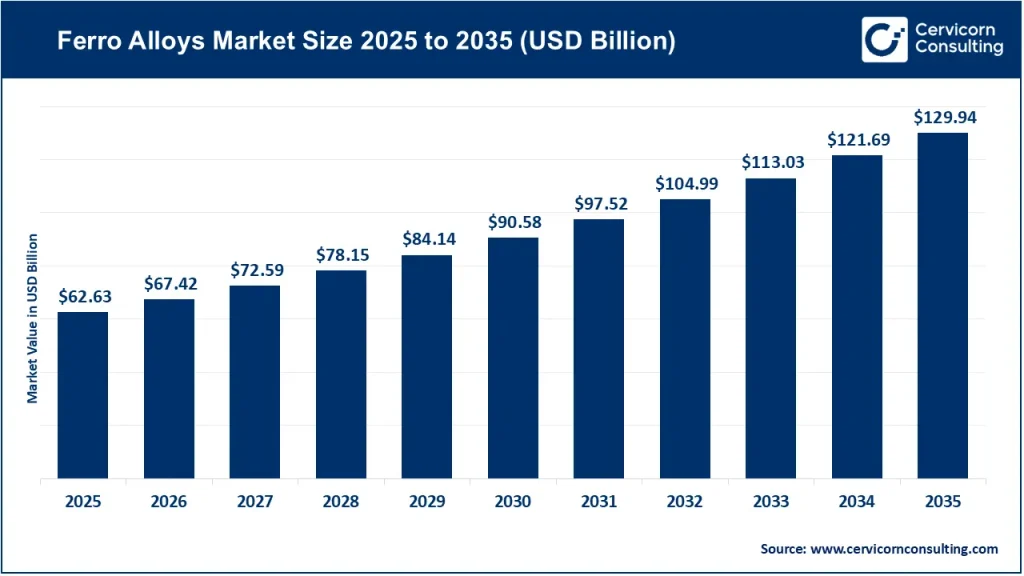
The global ferro alloys market was valued at USD 62.63 billion in 2025 and is projected to reach USD 129.94 billion by 2035, growing at a CAGR of 7.57% from 2026 to 2035. Asia-Pacific accounted for 61.3% of market revenue in 2024, reflecting the region’s importance to global steel production and industrial development.
However, market growth alone does not determine investment returns. For producers, the more important questions concern product mix, power costs, raw material sourcing, capacity utilisation and access to steelmakers with consistent procurement requirements.
1. Steel Capacity Expansion Is Creating New Demand Opportunities
Steel production remains the primary demand driver for ferro alloys, which are used to improve properties such as strength, hardness, toughness and corrosion resistance. Demand from construction, automotive manufacturing, industrial machinery, railways and energy infrastructure therefore influences purchasing requirements across the ferro alloys value chain.
India illustrates the scale of the opportunity. The Ministry of Steel reported that domestic crude steelmaking capacity reached approximately 220 million tonnes per annum in FY 2025–26, with the country continuing to pursue its 300-million-tonne capacity target for 2030. Separately, the government’s May 2026 update reported finished steel consumption growth of 8.7% during April–May 2026 compared with the corresponding period a year earlier.
These developments support the long-term demand outlook for alloying materials, although actual ferro alloy procurement will depend on steel production volumes, operating rates, product specifications and inventory levels.
For businesses evaluating expansion, the decision is not simply whether to add furnace capacity. It is whether the proposed capacity aligns with regional steelmaking projects, contracted demand and the requirements of specific steel grades.
What companies should evaluate:
- Which steel producers are expanding capacity or introducing specialised steel grades?
- Which ferro alloy products are required by their planned production routes?
- Can existing facilities increase output before new furnaces are commissioned?
- Would proximity to steel clusters, ports or raw material sources improve delivered cost?
These questions help distinguish demand growth that can support profitable expansion from growth that may result in excess capacity.
Get a Free Sample: https://www.cervicornconsulting.com/sample/2784
2. Electricity and Ore Costs Are Central to Competitiveness
For ferro alloy manufacturers, rising sales volumes do not necessarily translate into stronger margins. Electricity tariffs, ore prices, furnace efficiency and material recovery can materially affect production economics.
A September 2026 assessment by CRISIL Ratings highlighted that electricity and manganese ore together account for nearly two-thirds of production costs in the manganese alloy segment. Producing one tonne of manganese alloy typically requires approximately 3,000–4,000 units of electricity. CRISIL also estimated industry capital expenditure of ₹4,000–5,000 crore for the fiscal year, with investments increasingly directed towards productivity and efficiency rather than capacity expansion alone.
This changes how manufacturers should assess investment priorities. A furnace upgrade that reduces electricity consumption per tonne or improves recovery may provide more durable value than additional capacity operating at a cost disadvantage.
Companies should compare investments across several operational measures:
- Energy intensity: Electricity consumed per tonne of saleable alloy.
- Recovery rates: The proportion of valuable elements retained in the final product.
- Furnace utilisation: Actual output relative to practical production capacity.
- Raw material efficiency: Ore consumption, grade variability and process losses.
- Power security: Exposure to grid tariffs, interruptions and contractual price changes.
Captive power, energy-efficient furnaces, process automation and selective backward integration may improve competitiveness where the economics support them. Each option should be assessed against capital expenditure, operating savings and payback periods rather than adopted as a universal strategy.
3. Which Ferro Alloy Segments Offer the Strongest Strategic Opportunities?
Investment priorities differ by alloy type because each product serves different metallurgical requirements and end markets.
Ferro manganese and silico manganese
Manganese alloys are important inputs for steel strength, hardness and deoxidation. Their prospects are closely linked to construction steel, infrastructure projects, machinery and broader steel production.
For producers, the key decision is whether to compete through scale and cost efficiency in standard grades or develop a product portfolio tailored to customers with more specific composition and quality requirements.
Ferro chrome
Ferro chrome is closely associated with stainless steel production, where chromium contributes to corrosion resistance. Producers should monitor stainless steel output, chromite availability, power costs and export-market competitiveness before committing to additional capacity.
Access to suitable ore and the ability to maintain consistent alloy specifications can be as important as nominal production capacity.
Ferro silicon
Ferro silicon is used in steelmaking and foundry applications, including deoxidation and silicon alloying. Demand assessment should consider steel production methods, foundry activity, electrical steel requirements and the specifications of individual customers.
Producers may need to evaluate whether their existing equipment and raw material sourcing can support the quality and consistency expected in target applications.
Specialty ferro alloys
Ferro vanadium, ferro molybdenum, ferro titanium and other specialty alloys serve selected applications in high-performance steel, machinery, energy and aerospace-related industries.
These segments may offer opportunities for differentiation, but they require careful assessment of addressable demand, technical qualification requirements, customer concentration and raw material availability. Smaller market size does not automatically mean higher profitability.
For investors and manufacturers, the appropriate comparison is expected margin, capital intensity, market accessibility and supply risk by alloy type, rather than growth rates alone.
4. Raw Material Security Could Determine Future Market Position
Ferro alloy production depends on the availability and quality of inputs such as manganese ore, chromite, nickel-bearing materials and silicon. Dependence on imported materials can expose producers to international price movements, freight costs, currency fluctuations and supply disruptions.
India’s industry is already highlighting this issue. At the International Ferro Alloys Conference in September 2026, the Indian Ferro Alloy Producers’ Association called for faster development of domestic manganese and chromium resources, commercially viable mining arrangements and competitive electricity costs. Industry data reported at the conference also indicated that Indian manganese ore imports rose 27% year-on-year to 4.03 million tonnes in the first half of 2026.
For procurement teams, this reinforces the importance of evaluating suppliers beyond quoted prices. Ore grade, consistency, delivery reliability, logistics and the ability to fulfil contracted volumes can all influence total procurement cost.
For producers, potential strategies include diversifying suppliers, negotiating longer-term contracts, maintaining appropriate inventory buffers and evaluating backward integration where commercially viable. Companies considering overseas expansion should also assess mining and processing regulations, infrastructure access and political and trade risks.
5. Low-Carbon Steelmaking Is Changing Long-Term Investment Considerations
Steelmakers face increasing pressure to improve energy efficiency, reduce emissions and meet customer sustainability expectations. These changes may influence ferro alloy sourcing, production technology and supplier qualification over time.
Ferro alloy producers should assess the emissions associated with electricity consumption, furnace operations, raw material processing and logistics. Access to lower-carbon electricity, energy-efficient equipment, process monitoring and better material recovery may support both operating efficiency and environmental performance.
However, investment decisions require a clear view of customer requirements and the cost of compliance. Before investing in lower-emission production technologies, companies should determine whether target customers require verified emissions data, product-level carbon information or specific sustainability certifications.
The strategic opportunity is to identify where measurable improvements in energy use and emissions can strengthen supplier competitiveness without creating an unsustainable cost burden.
6. Export Expansion Requires a Delivered-Cost Advantage
Export markets can offer additional demand for ferro alloy producers, but international expansion requires more than identifying countries with growing steel output.
Companies need to compare domestic and export realisations after accounting for freight, port handling, duties, financing costs, currency exposure and customer qualification. They should also consider trade restrictions, local competition and the availability of alternative suppliers.
India’s established production base and export activity provide a foundation for international growth. Nevertheless, a larger export opportunity does not guarantee better margins if electricity and raw material costs are high or logistics reduce the price advantage.
A practical market-entry assessment should identify target countries, likely buyer segments, import dependence, competing suppliers, product specifications and achievable selling prices. Producers can then prioritise markets where their cost structure and product capabilities create a defensible advantage.
7. Where Should Companies Prioritise Capital Allocation?
For ferro alloy manufacturers, steel producers, procurement leaders and investors, the most useful investment framework combines demand visibility with cost competitiveness and execution risk.
| Investment priority | What companies should assess | Decision objective |
|---|---|---|
| Capacity expansion | Customer commitments, utilisation and regional steel growth | Avoid excess capacity |
| Energy efficiency | Electricity intensity, furnace performance and payback | Reduce cost per tonne |
| Raw material security | Ore quality, supplier concentration and import exposure | Improve supply resilience |
| Product diversification | Alloy-specific demand, specifications and margins | Strengthen product mix |
| Export development | Delivered cost, trade conditions and buyer access | Identify viable export markets |
| Lower-emission production | Customer requirements, energy sources and compliance costs | Protect long-term competitiveness |
| Automation and process control | Recovery rates, downtime, quality consistency and maintenance | Improve operating performance |
The order of investment will vary by company. A producer with high electricity costs may benefit more from efficiency upgrades than capacity expansion, while a supplier with secure power and raw materials may have a stronger case for increasing output. A specialty alloy producer may instead prioritise customer qualification and product development.
Conclusion: Growth Will Depend on the Quality of Investment Decisions
The ferro alloys market is positioned for long-term expansion as steel production, infrastructure development and specialised material requirements evolve. Cervicorn Consulting estimates that the global market could reach USD 121.69 billion by 2034, but the ability to capture that opportunity will depend on how effectively companies manage energy costs, raw material security, product quality and market access.
For manufacturers, the priority is to identify investments that improve cost competitiveness and align capacity with verifiable demand. For steelmakers and procurement teams, supplier reliability, specification consistency and total delivered cost should remain central to sourcing decisions. For investors, the quality of cash flows, capital discipline and exposure to input-cost volatility deserve as much attention as headline market growth.
The central strategic question is not simply how quickly the ferro alloys market will grow, but which producers and product segments will be best positioned to convert that growth into sustainable returns.
To Get Detailed Overview, Contact Us: https://www.cervicornconsulting.com/contact-us
Read Report: Hybrid Mesh Firewall Market: What Should Enterprises Evaluate Before Modernizing Distributed Network Security?