


Table of Contents
ToggleVideo Games Market Size
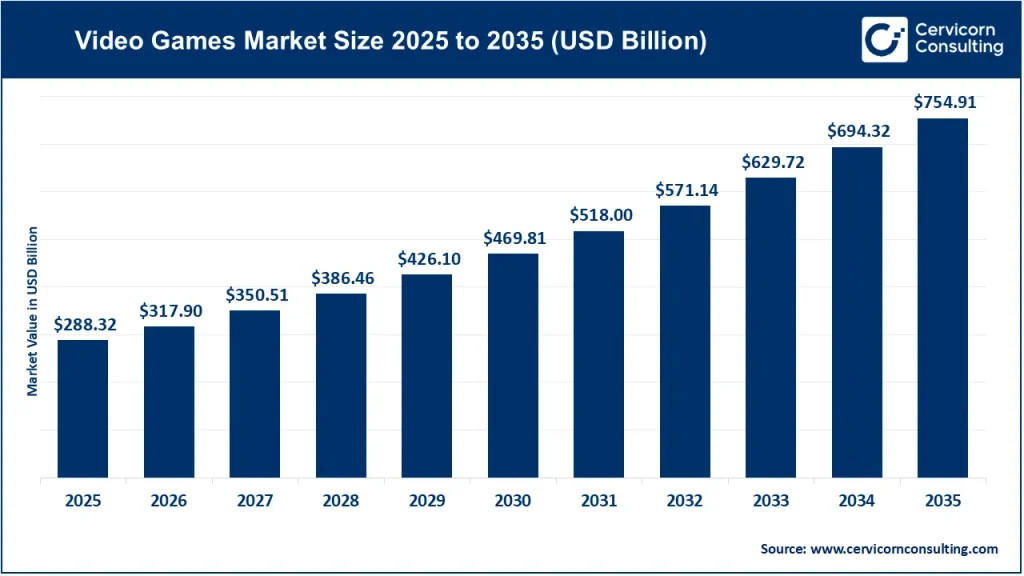
The global video games market was valued at approximately USD 288.32 billion in 2025 and is projected to reach nearly USD 754.91 billion by 2035, growing at a CAGR of 10.1%.
What is the Video Games Market?
The video games market encompasses the global ecosystem involved in the development, publishing, distribution, monetization, and consumption of digital games across consoles, PCs, mobile devices, cloud platforms, virtual reality (VR), and augmented reality (AR) systems. The market includes game developers, publishers, hardware manufacturers, streaming platforms, esports organizations, subscription services, digital storefronts, and in-game advertising providers.
Over the past decade, the industry has transformed from a product-centric business into a live-service digital entertainment ecosystem driven by downloadable content (DLC), subscriptions, in-game purchases, cloud gaming, and cross-platform experiences. With billions of gamers worldwide and increasing investments in artificial intelligence, immersive technologies, and online multiplayer infrastructure, the video games market has become one of the fastest-growing segments within the global media and entertainment industry.
Video Games Market Growth Factors
The video games market is experiencing strong growth due to the rapid expansion of smartphone adoption, increasing internet penetration, rising popularity of esports and live streaming, widespread adoption of digital game distribution platforms, and continuous advancements in cloud gaming technologies. The integration of artificial intelligence into game development is enabling more realistic gameplay, personalized gaming experiences, and intelligent NPC behavior, while virtual reality and augmented reality continue expanding immersive entertainment opportunities. Subscription-based gaming services such as Xbox Game Pass and PlayStation Plus are changing consumer purchasing behavior by improving access to extensive gaming libraries. Cross-platform gaming has significantly increased user engagement by allowing players across consoles, PCs, and mobile devices to interact seamlessly.
Additionally, growing investments in gaming infrastructure, increasing disposable income among younger demographics, the emergence of creator economies, and expanding monetization through in-game purchases, battle passes, and downloadable content continue supporting long-term industry growth. The rapid adoption of 5G networks and cloud infrastructure is further reducing hardware limitations, making high-quality gaming accessible across multiple devices.
Get a Free Sample: https://www.cervicornconsulting.com/sample/2552
Why is the Video Games Market Important?
The video games market has evolved beyond entertainment to become a significant contributor to the global digital economy. Its importance extends across multiple sectors:
1. Economic Contribution
The gaming industry generates billions of dollars annually while supporting software development, semiconductor manufacturing, digital payments, cloud computing, advertising, and creative industries.
2. Technology Innovation
Gaming frequently drives innovation in artificial intelligence, graphics processing units (GPUs), virtual reality, cloud computing, networking technologies, and user interface design.
3. Employment Generation
The industry creates employment opportunities across game design, programming, animation, cybersecurity, music production, esports management, digital marketing, and streaming content creation.
4. Digital Transformation
Gaming accelerates digital adoption through online marketplaces, subscription services, cloud infrastructure, and digital payment ecosystems.
5. Cultural Influence
Video games have become mainstream cultural products influencing movies, music, education, sports, and social interaction through virtual communities.
6. Education and Enterprise Applications
Gamification principles originally developed for entertainment are increasingly being applied to education, healthcare, employee training, military simulation, and enterprise collaboration.
Competitive Landscape
The video games industry remains highly competitive, with global technology companies, game publishers, console manufacturers, and mobile gaming leaders investing heavily in intellectual property, live-service games, cloud gaming, and artificial intelligence.
| Company | Specialization | Key Focus Areas | Notable Features | 2025 Revenue* | Estimated Market Share | Global Presence |
|---|---|---|---|---|---|---|
| Tencent Holdings Limited | Mobile & Online Gaming | Mobile games, PC games, esports, cloud gaming | Honor of Kings, PUBG Mobile, Riot Games, Supercell investments | Approx. US$107 Billion (total company revenue) | Largest global gaming company by gaming revenue | Asia-Pacific, Europe, North America, Latin America |
| Nintendo of America Inc. | Console Gaming | Hardware, first-party game development | Switch ecosystem, Mario, Zelda, Pokémon | Parent company continues strong hardware and software sales in FY2025 | Leading console publisher | Worldwide |
| Activision Blizzard, Inc. | AAA Gaming Publisher | Console, PC, mobile games | Call of Duty, Diablo, World of Warcraft, Candy Crush | Operates under Microsoft following acquisition | Major AAA publisher | Global |
| Electronic Arts Inc. | Sports & Live Services | Sports gaming, online multiplayer, live services | EA Sports FC, Madden NFL, Apex Legends | US$7.46 Billion FY2025 revenue | Strong position in sports gaming | Worldwide |
| Microsoft Corporation | Gaming Platform & Cloud | Xbox, Game Pass, cloud gaming, game publishing | Xbox ecosystem, Activision Blizzard acquisition, Azure Cloud | US$281.7 Billion total company revenue (gaming is a major segment) | Leading cloud gaming ecosystem | Global |
Leading Trends Transforming the Video Games Market
1. Cloud Gaming Expansion
Cloud gaming is rapidly reducing dependence on expensive gaming hardware. Services such as Xbox Cloud Gaming allow users to stream AAA titles directly through internet-connected devices.
Impact
- Expands gaming accessibility
- Reduces hardware costs
- Supports subscription revenue
- Accelerates digital game distribution
2. Artificial Intelligence in Game Development
AI is increasingly being integrated into procedural content generation, character behavior, adaptive storytelling, voice interaction, quality assurance testing, and game balancing.
Impact
- Faster development cycles
- Improved player personalization
- Enhanced realism
- Reduced production costs
3. Cross-Platform Gaming
Developers are prioritizing seamless gameplay across PC, console, and mobile ecosystems.
Impact
- Higher player retention
- Larger multiplayer communities
- Increased engagement
- Improved monetization opportunities
4. Subscription Gaming Services
Subscription models continue replacing traditional one-time purchases.
Examples include:
- Xbox Game Pass
- PlayStation Plus
- Nintendo Switch Online
Impact
- Predictable recurring revenue
- Higher consumer affordability
- Greater game discovery
- Longer customer lifetime value
5. Esports Growth
Competitive gaming has evolved into a billion-dollar ecosystem supported by sponsorships, media rights, tournaments, and streaming platforms.
Impact
- Expands professional gaming
- Attracts advertising investments
- Increases community engagement
- Supports publisher revenue diversification
6. Live-Service Gaming
Modern games increasingly operate as continuously evolving platforms rather than standalone products.
Examples include:
- Seasonal updates
- Battle passes
- Downloadable content
- Cosmetic purchases
- Community events
Impact
- Higher recurring revenue
- Stronger customer retention
- Longer game life cycles
7. Virtual Reality and Mixed Reality
VR and mixed reality technologies continue improving immersion across gaming experiences.
Impact
- Premium gaming experiences
- New hardware opportunities
- Expansion into education and simulation
- Growth of immersive entertainment
Successful Examples of the Video Games Market Around the World
Fortnite (Epic Games)
Fortnite transformed free-to-play gaming through cosmetic purchases, live concerts, seasonal events, and cross-platform compatibility. The title demonstrated how continuous content updates can sustain player engagement for years.
Minecraft (Microsoft)
Minecraft remains one of the world’s most successful sandbox games by encouraging creativity, education, multiplayer collaboration, and user-generated content across multiple platforms.
PUBG Mobile (Tencent)
PUBG Mobile established one of the world’s largest mobile gaming communities, particularly across Asia, the Middle East, and emerging markets.
Pokémon Franchise (Nintendo)
Pokémon represents one of gaming’s strongest intellectual properties, combining console gaming, mobile gaming, animation, merchandising, and global events into a highly diversified entertainment ecosystem.
Call of Duty (Activision Blizzard)
Call of Duty continues setting benchmarks for AAA game production through annual releases, Warzone integration, esports competitions, and premium live-service monetization.
League of Legends (Riot Games)
League of Legends has become a global esports phenomenon supported by international tournaments, streaming communities, and expanding multimedia franchises.
Global Regional Analysis
North America
North America remains one of the largest gaming markets globally due to strong purchasing power, advanced internet infrastructure, high console penetration, and substantial investments in game development.
Market Drivers
- Mature gaming ecosystem
- Strong cloud infrastructure
- High adoption of subscription services
- Large esports audience
- Significant venture capital investment
Government Initiatives and Policies
Governments across the United States and Canada continue supporting digital innovation through investments in broadband expansion, technology research, artificial intelligence initiatives, and STEM education. Tax incentives offered by several Canadian provinces have helped attract major international game development studios, strengthening regional competitiveness. Policies promoting digital infrastructure and intellectual property protection also support long-term industry growth.
Europe
Europe hosts numerous globally recognized game developers and benefits from strong digital infrastructure and growing esports participation.
Market Drivers
- Growing indie game development
- High digital distribution adoption
- Increasing cloud gaming usage
- Strong consumer spending
Government Initiatives and Policies
European governments encourage innovation through digital economy programs, research funding, startup support, and intellectual property regulations. The European Union’s Digital Strategy encourages digital transformation while privacy regulations such as GDPR continue shaping responsible player data management. Several countries also provide tax relief and production incentives for creative industries, including game development.
Asia-Pacific
Asia-Pacific represents the world’s largest gaming region, driven by China, Japan, South Korea, and India.
Market Drivers
- Massive mobile gaming population
- Rapid smartphone adoption
- Strong esports ecosystem
- Expanding digital payments
- Growing cloud infrastructure
Government Initiatives and Policies
Governments across Asia-Pacific are investing in 5G deployment, semiconductor manufacturing, AI development, and digital economy expansion. Japan continues supporting creative industries and interactive entertainment exports, while South Korea promotes esports and digital content through dedicated industry programs. China maintains regulatory oversight while continuing investments in domestic technology capabilities and digital infrastructure, influencing game approvals and market dynamics. India’s Digital India initiative and expanding broadband connectivity are also creating favorable conditions for mobile gaming growth.
Latin America
Latin America is emerging as a fast-growing gaming market due to increasing smartphone ownership and affordable internet access.
Market Drivers
- Mobile-first gaming
- Young demographic profile
- Growing esports participation
- Digital payment expansion
Government Initiatives and Policies
Governments across Brazil, Mexico, and other Latin American countries continue investing in digital connectivity, broadband expansion, startup ecosystems, and fintech development. These initiatives improve access to online gaming platforms while supporting digital commerce and local game development.
Middle East & Africa
The Middle East and Africa are becoming attractive gaming markets due to rapid digital transformation and growing investments in technology infrastructure.
Market Drivers
- Expanding youth population
- Increasing smartphone penetration
- Government-led digital transformation
- Rising cloud adoption
- Growing esports investments
Government Initiatives and Policies
Countries including Saudi Arabia and the United Arab Emirates are investing heavily in gaming, esports, digital entertainment, and technology innovation as part of broader economic diversification strategies. National digital transformation programs encourage international publishers, esports tournaments, gaming studios, and technology partnerships. Investments in smart cities, high-speed connectivity, and innovation hubs are expected to strengthen regional gaming ecosystems over the coming years.
To Get Detailed Overview, Contact Us: https://www.cervicornconsulting.com/contact-us
Read Report: Injection Pen Market Revenue, Trends, and Strategic Insights by 2035