


Table of Contents
ToggleInjection Pen Market Size
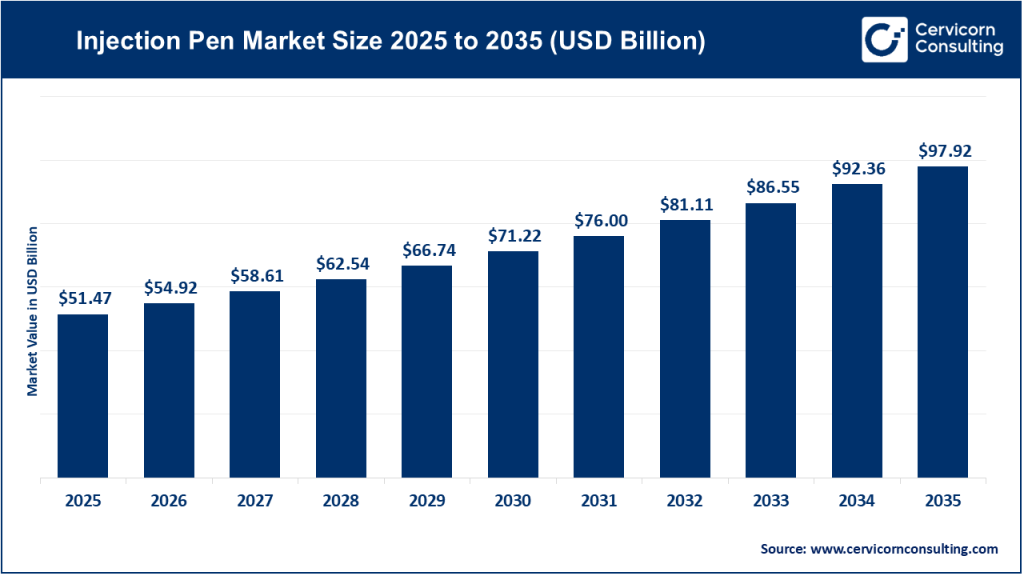
The global injection pen market was valued at approximately USD 51.47 billion in 2025 and is projected to reach nearly USD 97.92 billion by 2035, growing at a CAGR of 6.64%.
Injection Pen Market Growth Factors
The global injection pen market is experiencing remarkable growth due to the increasing prevalence of chronic diseases such as diabetes, obesity, rheumatoid arthritis, multiple sclerosis, osteoporosis, and growth hormone deficiencies. Rising demand for self-administered drug delivery systems, increasing awareness regarding home healthcare, technological advancements in smart injection pens, growing adoption of biologics and biosimilars, expanding aging population, favorable reimbursement policies in developed economies, and continuous product innovations by pharmaceutical and medical device manufacturers are significantly accelerating market expansion.
Furthermore, increasing healthcare expenditure, supportive government initiatives promoting chronic disease management, improved patient compliance through user-friendly devices, and the rapid commercialization of GLP-1 receptor agonists for obesity and diabetes treatment are creating substantial opportunities for manufacturers.
Get a Free Sample: https://www.cervicornconsulting.com/sample/2651
What is the Injection Pen Market?
The injection pen market comprises medical devices designed to simplify the administration of injectable medications. These pen-shaped devices provide patients with a convenient, accurate, and less intimidating alternative to traditional syringes.
Injection pens are widely used for delivering:
- Insulin
- GLP-1 receptor agonists
- Growth hormones
- Fertility medications
- Autoimmune disease biologics
- Osteoporosis treatments
- Multiple sclerosis therapies
Injection pens generally fall into two categories:
- Disposable injection pens
- Reusable injection pens
Modern devices include digital dose memory, Bluetooth connectivity, automated injection assistance, and ergonomic designs that significantly improve patient adherence.
Healthcare providers increasingly recommend injection pens because they reduce dosing errors, simplify administration, and improve treatment compliance.
Why is the Injection Pen Market Important?
Injection pens have transformed chronic disease management worldwide.
Their importance stems from several advantages:
Improved Patient Compliance
Simple operation encourages patients to adhere to prescribed therapies.
Better Dose Accuracy
Pre-calibrated dosing minimizes medication errors.
Home-Based Treatment
Patients can self-administer medications without frequent hospital visits.
Reduced Needle Anxiety
Ergonomic design and hidden needles reduce fear among users.
Enhanced Treatment Outcomes
Better adherence often translates into improved disease control.
Healthcare Cost Reduction
Reduced hospitalization and outpatient visits lower overall healthcare expenditures.
Support for Personalized Medicine
Injection pens enable individualized dosing schedules for biologic therapies.
Major Companies Driving the Injection Pen Market
| Company | Specialization | Key Focus Areas | Notable Features | Estimated 2025 Revenue* | Approximate Injection Pen Market Position | Global Presence |
|---|---|---|---|---|---|---|
| Novo Nordisk | Diabetes and obesity therapies | Insulin pens, GLP-1 delivery systems | FlexPen®, FlexTouch®, once-weekly insulin innovations | DKK 309.1 billion | Global market leader in insulin pens | 170+ countries |
| Eli Lilly | Diabetes and obesity | Insulin delivery, GLP-1 injectable pens | KwikPen®, Mounjaro®, Zepbound® | Over USD 45 billion (company revenue, FY2025) | Leading obesity and diabetes pen manufacturer | 120+ countries |
| Sanofi | Diabetes and specialty care | Insulin pens and biologics | SoloStar® platform | Approximately EUR 40+ billion (company revenue, 2025) | Strong insulin pen portfolio | 100+ countries |
| Merck | Specialty therapeutics | Fertility, endocrinology, biologics | Precision injection systems | Approximately USD 65+ billion (company revenue, 2025) | Strong niche presence | 140+ countries |
| Ypsomed | Drug delivery devices | Pen platforms, autoinjectors, contract manufacturing | YpsoPen®, YpsoMate® | CHF 731 million | Leading device manufacturer for pharmaceutical partners | Europe, North America, Asia-Pacific |
Leading Trends Transforming the Injection Pen Market
1. Smart Connected Injection Pens
Digital health integration is reshaping patient care.
Features include:
- Bluetooth connectivity
- Smartphone applications
- Dose reminders
- Automatic dose recording
- Cloud-based physician monitoring
Impact:
- Improved adherence
- Better treatment monitoring
- Reduced medication errors
2. Rising GLP-1 Drug Adoption
Demand for obesity treatments is dramatically increasing.
Popular products include:
- Ozempic
- Wegovy
- Mounjaro
- Zepbound
These therapies rely heavily on user-friendly injection pens, driving unprecedented manufacturing demand.
3. Expansion of Home Healthcare
Healthcare systems increasingly encourage home-based treatment.
Injection pens support:
- Reduced hospital dependency
- Remote patient management
- Telemedicine integration
4. Growth of Biologic Medicines
Biologic drugs often require injectable administration.
Injection pens simplify delivery for:
- Rheumatoid arthritis
- Psoriasis
- Crohn’s disease
- Multiple sclerosis
5. Sustainable Device Development
Manufacturers are investing in:
- Reusable pens
- Eco-friendly plastics
- Lower carbon manufacturing
- Reduced packaging waste
Environmental sustainability has become a competitive differentiator.
6. Human-Centered Design
Manufacturers now emphasize:
- Easier grip
- Larger dose displays
- Audible clicks
- Lower injection force
- Improved usability for elderly patients
Successful Examples of the Injection Pen Market Around the World
Novo Nordisk FlexTouch
FlexTouch revolutionized insulin delivery through:
- Automatic dose setting
- Minimal injection force
- Improved dosing accuracy
- High patient satisfaction
Millions of diabetic patients worldwide now rely on this platform.
Eli Lilly KwikPen
KwikPen became one of the most widely prescribed insulin delivery systems.
Success factors include:
- Easy handling
- Reliable dosing
- Compact size
- Broad global availability
Sanofi SoloStar
SoloStar has become one of Europe’s most successful disposable insulin pens.
Benefits include:
- Large dose window
- Smooth injection
- Accurate insulin delivery
Ypsomed YpsoPen Platform
Ypsomed collaborates with numerous pharmaceutical companies by providing customized pen delivery systems.
Advantages include:
- Platform flexibility
- Fast commercialization
- Patient-friendly design
- Support for biologics
Fertility Injection Pens
Fertility clinics worldwide increasingly use injection pens for hormone therapies because they improve dosing precision while reducing patient anxiety during IVF treatments.
Global Regional Analysis
North America
North America dominates the injection pen market due to:
- High diabetes prevalence
- Large obesity patient population
- Advanced healthcare infrastructure
- Strong reimbursement systems
- Early technology adoption
The United States accounts for the largest regional market owing to widespread use of insulin and GLP-1 therapies.
Government Initiatives
- Support for diabetes prevention and management programs.
- Regulatory pathways that encourage innovation in drug-device combination products.
- Public investments in chronic disease awareness and digital health initiatives.
These policies promote broader access to advanced injection devices.
Europe
Europe represents one of the most mature injection pen markets.
Growth drivers include:
- Aging population
- Universal healthcare systems
- High biologic drug adoption
- Strong pharmaceutical manufacturing base
Countries leading adoption include:
- Germany
- France
- United Kingdom
- Italy
- Nordic countries
Government Policies
European governments support:
- Universal diabetes management
- Reimbursement for self-injection devices
- Medical device innovation
- Sustainability initiatives promoting reusable devices
The European regulatory framework also encourages high standards for device safety and performance.
Asia-Pacific
Asia-Pacific is projected to witness the fastest market growth.
Growth is driven by:
- Rising diabetes prevalence
- Increasing obesity rates
- Growing middle-class population
- Expanding healthcare access
- Local pharmaceutical manufacturing
Major markets include:
- China
- India
- Japan
- South Korea
- Australia
Government Initiatives
Governments across the region are:
- Expanding national diabetes screening programs.
- Increasing investments in healthcare infrastructure.
- Supporting domestic pharmaceutical manufacturing.
- Encouraging adoption of advanced medical devices through regulatory reforms.
India, for example, continues to expand access to innovative insulin therapies, including the recent launch of once-weekly insulin pen products.
Latin America
Latin America is steadily expanding its injection pen adoption.
Key growth factors:
- Improving healthcare infrastructure
- Rising diabetes incidence
- Government-supported insulin access
- Expansion of private healthcare
Brazil and Mexico remain the region’s largest markets.
Government Support
Health ministries increasingly support:
- Diabetes education
- Affordable insulin programs
- Expanded reimbursement coverage
- Public procurement of chronic disease therapies
Middle East & Africa
The Middle East and Africa present significant long-term opportunities.
Growth drivers include:
- Rapid urbanization
- Increasing diabetes prevalence
- Healthcare modernization
- Government investment in chronic disease care
Countries such as Saudi Arabia, the UAE, and South Africa are expanding access to advanced injectable therapies.
Government Policies
Regional governments are:
- Investing in national healthcare transformation strategies.
- Expanding insurance coverage.
- Building specialized diabetes centers.
- Encouraging adoption of innovative medical technologies.
Future Opportunities in the Injection Pen Market
Several high-growth opportunities are expected to shape the next decade:
- AI-enabled smart injection pens with predictive adherence monitoring.
- Integration of injection devices with wearable health technologies and digital ecosystems.
- Expansion of reusable and environmentally sustainable pen platforms.
- Broader adoption of injectable therapies for obesity and metabolic disorders.
- Growth in biosimilars requiring compatible delivery systems.
- Increased demand for customized drug-device combination products.
- Rising investment in contract manufacturing partnerships between pharmaceutical companies and specialized device developers.
- Pen technologies optimized for pediatric and geriatric populations.
- Improved connectivity with telemedicine platforms for remote care.
- Expansion into emerging economies through localized manufacturing and government-supported chronic disease programs.
As chronic diseases continue to rise globally and healthcare shifts toward patient-centric, home-based care, injection pens are expected to remain a cornerstone of modern drug delivery, supported by innovation in digital health, biologics, and advanced device engineering.
To Get Detailed Overview, Contact Us: https://www.cervicornconsulting.com/contact-us
Read Report: Infectious Disease Diagnostics Market Revenue, Trends, and Strategic Insights by 2035