


Table of Contents
ToggleTelehealth 2.0 Market Size and Growth Outlook
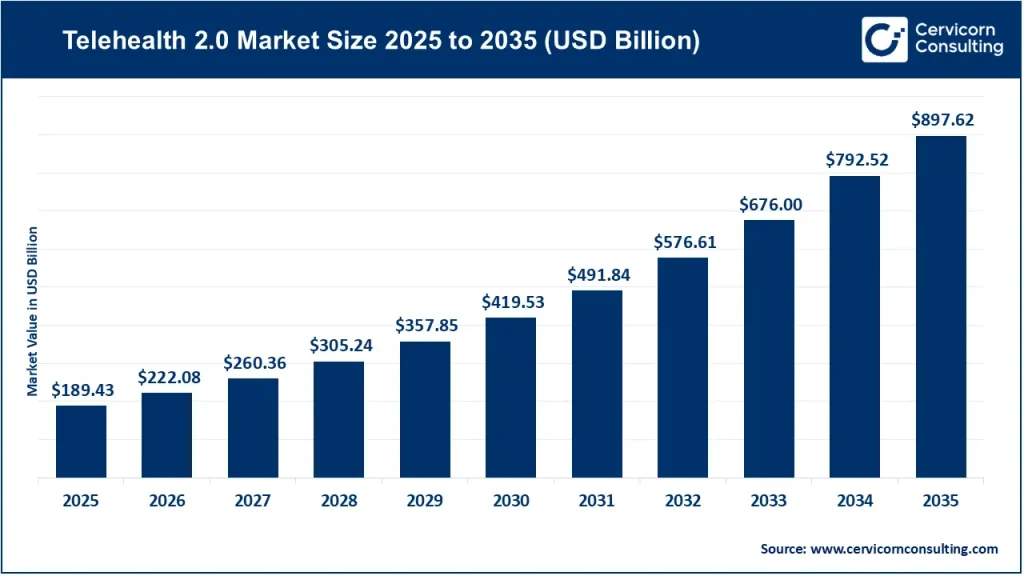
The global telehealth 2.0 market was valued at approximately USD 189.43 billion in 2025 and is projected to reach around USD 897.62 billion by 2035, expanding at a 16.83% CAGR from 2026 to 2035. Telehealth 2.0 represents the next stage of digital healthcare, moving beyond basic video consultations toward integrated virtual-care ecosystems that combine teleconsultation, remote patient monitoring, artificial intelligence, connected medical devices, predictive analytics, digital therapeutics, electronic health records, and interoperable healthcare platforms.
Telehealth 2.0 Market Growth Factors
The growth of the Telehealth 2.0 market is being driven by rising demand for convenient and accessible healthcare, increasing healthcare expenditure, shortages of physicians and specialists, growing chronic disease prevalence, aging populations, expansion of remote patient monitoring, wider adoption of wearable and connected medical devices, improved broadband and smartphone penetration, increasing use of artificial intelligence in clinical workflows, and the transition from episodic virtual consultations toward continuous and hybrid care models; healthcare providers and payers are increasingly deploying AI-powered triage, virtual assistants, predictive analytics, remote diagnostics, connected devices, and digital care pathways to improve patient outcomes while reducing avoidable hospital visits, while governments are strengthening digital-health infrastructure and reimbursement frameworks, creating favorable conditions for scalable virtual-care services.
Get a Free Sample: http://cervicornconsulting.com/sample/2760
What Is the Telehealth 2.0 Market?
Telehealth 2.0 is the evolution of conventional telemedicine into a connected, intelligent and continuous healthcare delivery model. Traditional telehealth largely focused on replacing an in-person consultation with a telephone or video appointment. Telehealth 2.0 expands that model by connecting patients, clinicians, healthcare organizations, payers, medical devices and digital platforms within a broader healthcare ecosystem.
The model can combine video and audio consultations with remote patient monitoring (RPM), wearable sensors, AI-assisted clinical decision support, digital therapeutics, electronic prescriptions, health records, virtual nursing, remote diagnostics and automated patient engagement. This creates a more continuous relationship between patients and healthcare providers rather than limiting digital care to individual appointments.
The distinction is particularly important for chronic diseases. A patient with diabetes, hypertension, cardiovascular disease or respiratory conditions can potentially share relevant health data remotely, receive alerts when measurements move outside predefined thresholds, communicate with clinicians and obtain follow-up care without repeatedly visiting a hospital.
The World Health Organization also distinguishes telemedicine from the broader telehealth ecosystem, noting that telehealth can encompass remote monitoring, diagnostics, health education and administrative functions in addition to virtual clinical consultations.
Why Is Telehealth 2.0 Important?
Telehealth 2.0 is important because healthcare systems are increasingly expected to provide accessible, personalized, affordable and continuous care. Conventional healthcare infrastructure can struggle with physician shortages, long waiting times, geographic barriers and rising operational costs. Digital platforms can help extend specialist expertise to underserved populations while enabling healthcare organizations to monitor patients outside hospitals.
Another major advantage is the shift toward proactive healthcare. Instead of waiting for a patient to become sufficiently ill to require an appointment or hospital visit, remote monitoring and predictive analytics can identify changes in health conditions earlier. Telehealth 2.0 can therefore support prevention, early intervention and chronic disease management.
It is also strategically important for healthcare providers because hybrid models allow organizations to combine physical facilities with digital services. This can help hospitals manage capacity, support post-discharge monitoring and provide follow-up consultations remotely.
Leading Companies in the Telehealth 2.0 Market
Teladoc Health
Company: Teladoc Health
Specialization: Virtual primary care, chronic care, mental health, expert medical services and connected care
Key Focus Areas: Integrated virtual care, AI-enabled healthcare, chronic disease management, mental health and hospital-connected care
Notable Features: Large employer and payer network, 24/7 virtual access, integrated care platform and connected-care solutions
2025 Revenue: USD 2.53 billion
Market Share: Estimated 15% in the broader virtual healthcare aggregation platform segment
Global Presence: United States and international markets
Teladoc Health remains one of the most prominent companies in the virtual-care ecosystem. Its Integrated Care business includes preventive care, primary care, urgent care, mental healthcare, chronic care and expert medical services. In 2025, the company completed 17.1 million telehealth visits, while its Integrated Care services were available to more than 100 million members through employers and insurers. Teladoc reported total 2025 revenue of approximately USD 2.53 billion, including USD 458.2 million from international markets.
Its business model also demonstrates how Telehealth 2.0 is evolving beyond individual video appointments. Teladoc combines access-based virtual services with healthcare technology, data analytics, AI and connected-care solutions for hospitals and health systems.
Amwell
Company: Amwell
Specialization: Technology-enabled healthcare and virtual-care infrastructure
Key Focus Areas: SaaS healthcare platforms, payer and health-system integration, virtual visits, behavioral health and AI-enabled clinical programs
Notable Features: White-label platform capabilities, third-party clinical program ecosystem and enterprise integration
2025 Revenue: USD 249.3 million
Market Share: Estimated 12% in the broader virtual healthcare aggregation platform segment
Global Presence: Primarily North America with enterprise and technology partnerships
Amwell has increasingly repositioned itself from a conventional telehealth provider toward a technology-enabled healthcare platform. In 2025, the company generated USD 249.3 million in revenue, including USD 132.4 million in subscription revenue, and recorded approximately 4.5 million visits.
The company’s platform strategy is particularly relevant to Telehealth 2.0 because it allows healthcare organizations to integrate clinical programs and third-party solutions while maintaining a unified digital experience. Its partnership with the U.S. Defense Health Agency was also an important 2025 deployment.
MDLIVE
Company: MDLIVE, part of Evernorth/Cigna
Specialization: Virtual urgent care, primary care and behavioral health
Key Focus Areas: Insurer-integrated virtual care, employer healthcare programs, behavioral health and on-demand medical services
Notable Features: Integration with payer ecosystems and broad virtual-care access
2025 Revenue: Not separately disclosed publicly
Market Share: Estimated 9% in the broader virtual healthcare aggregation platform segment
Global Presence: Primarily United States
MDLIVE represents the growing importance of payer-integrated telehealth. Its position within Evernorth/Cigna allows virtual care to be incorporated into broader health-benefit and insurance ecosystems. Rather than operating only as a standalone consumer platform, its model emphasizes integration with health plans, employers and healthcare networks.
This approach is significant for Telehealth 2.0 because future growth is likely to depend increasingly on interoperability with existing healthcare financing and delivery systems.
Doctor on Demand
Company: Doctor on Demand, part of Included Health
Specialization: Virtual primary care, behavioral health and specialty care
Key Focus Areas: Employer-sponsored healthcare, integrated virtual and in-person care, mental health and primary care
Notable Features: Digital-first healthcare experience and integration with broader healthcare navigation
2025 Revenue: Not separately disclosed publicly
Market Share: Estimated 10% in the broader virtual healthcare aggregation platform segment
Global Presence: Primarily United States
Doctor on Demand became part of Included Health, reflecting the industry’s consolidation around broader integrated-care models. Its significance within Telehealth 2.0 comes from the convergence of virtual primary care, behavioral health, specialty services and healthcare navigation.
The business model demonstrates that the next generation of telehealth is increasingly about care orchestration, rather than simply arranging video calls between doctors and patients.
HealthTap
Company: HealthTap
Specialization: Virtual primary care, digital health information and physician access
Key Focus Areas: Online consultations, primary care, patient engagement and digital health services
Notable Features: Consumer-oriented virtual healthcare experience and digital physician access
2025 Revenue: Not publicly disclosed
Market Share: Estimated 8% in the broader virtual healthcare aggregation platform segment
Global Presence: Primarily United States
HealthTap focuses on connecting patients with physicians through digital healthcare services. Its consumer-centric model reflects the continuing importance of convenient access and patient engagement in Telehealth 2.0.
Note: The market-share figures above are estimates from a broader virtual healthcare aggregation platform competitive analysis rather than audited Telehealth 2.0-specific shares; privately held companies also do not generally disclose standalone revenue figures.
Leading Trends and Their Impact on the Telehealth 2.0 Market
AI-Powered Virtual Healthcare
Artificial intelligence is becoming one of the most important technologies in Telehealth 2.0. AI can support symptom assessment, patient triage, clinical documentation, appointment management, personalized recommendations and predictive risk analysis.
For providers, AI can reduce administrative workloads and help clinicians process large quantities of patient information. For patients, AI-enabled interfaces can improve responsiveness and personalization. However, clinical governance, transparency and human oversight remain critical when AI is used in healthcare decision-making.
Remote Patient Monitoring
RPM is moving telehealth from episodic consultations to continuous care. Connected blood-pressure monitors, glucose meters, pulse oximeters, wearable ECG devices and other sensors can provide clinicians with health information outside traditional healthcare settings.
The impact is particularly significant in chronic disease management, where repeated measurements can help healthcare teams identify deterioration earlier and adjust treatment or recommend in-person evaluation when necessary.
Hybrid Care Models
Hybrid care is becoming a central Telehealth 2.0 model. Instead of replacing physical healthcare entirely, digital services complement hospitals, clinics and physician practices.
A patient may begin with a virtual consultation, complete diagnostic testing at a physical facility, receive treatment remotely and then participate in digital follow-up. This model can create a more flexible healthcare journey while retaining face-to-face care when physical examination or procedures are required.
Virtual Hospitals and Hospital-at-Home
Virtual wards are extending Telehealth 2.0 into higher-acuity care. NHS England defines virtual wards as models that allow selected patients who would otherwise require hospitalization to receive acute care, remote monitoring and treatment at home. Technology can collect vital signs and transmit information to clinical teams through centralized dashboards.
This trend can reduce pressure on hospital beds and support earlier discharge while enabling continued monitoring.
Interoperability and Connected Health Data
Telehealth 2.0 depends heavily on the ability to exchange health information between platforms. Fragmented systems can prevent clinicians from obtaining complete patient histories and limit the effectiveness of digital healthcare.
The European Health Data Space is a major example of government-led efforts to create stronger interoperability and cross-border health-data exchange. The regulation entered into force in March 2025 and is designed to improve individuals’ access to and control over electronic health data while establishing common frameworks for interoperability.
Personalized and Preventive Care
Telehealth platforms are increasingly using patient-generated data, clinical histories and analytics to personalize care. This can enable targeted interventions based on individual health risks rather than applying identical pathways to every patient.
The long-term impact could be a shift from reactive healthcare toward predictive, preventive and personalized healthcare delivery.
Successful Examples of Telehealth 2.0 Around the World
India – eSanjeevani
India’s eSanjeevani is one of the strongest examples of population-scale digital healthcare. The government-developed platform supports both doctor-to-doctor and patient-to-doctor consultations and was designed to overcome geographical and specialist-access barriers.
As of August 16, 2026, eSanjeevani had facilitated more than 493 million consultations, with more than 240,000 healthcare providers onboarded and more than 141,000 spokes supported by over 19,000 hubs. The platform also incorporates features such as electronic prescriptions, health-record sharing, follow-up consultations and AI-enabled clinical decision support.
This makes eSanjeevani a particularly relevant Telehealth 2.0 example because it combines virtual consultation with digital infrastructure, clinical information and large-scale healthcare coordination.
United Kingdom – NHS Virtual Wards
The NHS has developed virtual wards to enable selected patients to receive hospital-level or acute care at home. These services can use apps, connected devices and remote monitoring to collect patient information, while clinical teams monitor patients through dashboards.
The NHS reported that virtual wards helped avoid approximately 9,000 hospital admissions in South East England over one year, illustrating how remote monitoring can move beyond routine consultations into higher-value clinical care.
United States – Integrated Virtual Care
The United States has developed a highly commercialized Telehealth 2.0 ecosystem involving providers, insurers, employers, hospitals and technology companies. Teladoc, Amwell and insurer-linked platforms demonstrate the transition toward integrated digital healthcare.
The U.S. policy environment is also supporting continued access. Federal policy has extended several Medicare telehealth flexibilities through December 31, 2027, including home-based Medicare telehealth for certain non-behavioral health services and broader originating-site flexibility.
Australia – Medicare Telehealth
Australia provides another important example of institutionalized telehealth. Expanded telehealth services introduced during the pandemic became an ongoing part of Medicare from January 2022. The Australian government describes telehealth as an important component of its universal healthcare system, particularly for people living in rural and remote locations.
Global Regional Analysis
North America
North America is expected to remain the leading regional market for Telehealth 2.0, supported by advanced healthcare infrastructure, high digital-health adoption, extensive health-insurance networks, strong technology investment and established virtual-care companies.
The United States has a particularly mature ecosystem combining providers, payers, employers, technology companies and hospitals. The continuation of Medicare telehealth flexibilities is supporting market development, while temporary prescribing flexibility for controlled medications has also been extended through the end of 2026 as permanent rules are developed.
The region is increasingly shifting toward AI-assisted care, remote patient monitoring, virtual behavioral health, chronic disease management and hybrid healthcare.
Europe
Europe is moving toward a more interconnected digital-health ecosystem. The European Health Data Space (EHDS) is particularly significant because it establishes a common framework for electronic health data exchange and interoperability across EU countries.
The regulation entered into force on March 26, 2025, with implementation taking place in stages. Key elements concerning the exchange of priority health data are scheduled for application beginning in 2029.
European healthcare systems are also investing in telemedicine, remote monitoring, virtual hospitals and digitally enabled primary care. The WHO European Region has identified telemedicine as an important component of modern health-system transformation.
Asia Pacific
Asia Pacific is emerging as one of the fastest-growing regions because of its large population, increasing smartphone penetration, improving internet connectivity, growing healthcare needs and substantial investments in digital infrastructure.
India represents one of the strongest growth markets through eSanjeevani and the Ayushman Bharat Digital Mission. Government policy has emphasized the use of digital platforms to improve healthcare accessibility, particularly in rural and underserved areas. As of November 2025, India’s government reported more than 430 million eSanjeevani consultations, with services operating across all states and Union Territories.
China, Japan, South Korea, Australia and Southeast Asian countries are also expanding digital healthcare infrastructure, although regulatory environments and reimbursement models vary significantly.
Latin America
Latin America offers significant potential because of uneven distribution of healthcare professionals and medical infrastructure across urban and rural areas. Telehealth can reduce geographic barriers while expanding access to specialists.
The region is expected to see increasing deployment of mobile health platforms, remote consultations, digital primary care and remote monitoring. However, connectivity gaps, healthcare-system fragmentation, regulatory differences and affordability remain important considerations.
Middle East & Africa
The Middle East and Africa represent emerging opportunities for Telehealth 2.0. Governments and healthcare organizations are investing in digital-health infrastructure to address specialist shortages and improve access to healthcare outside major urban centers.
In the Middle East, national digital-transformation programs and technologically advanced healthcare systems are supporting virtual consultations and remote monitoring. In Africa, mobile healthcare platforms and telemedicine can be particularly valuable for communities where conventional healthcare infrastructure is limited.
Government Initiatives and Policies Shaping the Market
Government policies are becoming a major factor determining the speed and structure of Telehealth 2.0 adoption. In the United States, Medicare telehealth policies have extended several virtual-care flexibilities through 2027, supporting continued access for eligible patients and providers.
In India, the government’s Telemedicine Practice Guidelines provide a framework covering physician-patient relationships, consent, treatment, medical records, privacy, security and continuity of care. The country has also developed eSanjeevani as a national telemedicine platform and is integrating digital-health infrastructure through the Ayushman Bharat Digital Mission.
In the European Union, the European Health Data Space is creating common standards for health-data access, interoperability and cross-border exchange. This is especially important for Telehealth 2.0 because advanced virtual-care systems require reliable access to patient information across healthcare settings.
In the United Kingdom, NHS virtual-ward programs are institutionalizing remote monitoring and hospital-at-home models. NHS guidance emphasizes technology-enabled monitoring, remote consultation and connections between patients and clinical teams.
In Australia, telehealth became an ongoing component of Medicare after expanded services introduced during the COVID-19 period were retained permanently from January 2022.
Overall, these initiatives demonstrate a broader shift in government policy from viewing telehealth as an emergency alternative to recognizing it as core healthcare infrastructure. The next stage of the market will increasingly depend on reimbursement, interoperability, data privacy, cybersecurity, AI governance and standards that allow virtual and physical healthcare systems to operate as one connected ecosystem.
To Get Detailed Overview, Contact Us: https://www.cervicornconsulting.com/contact-us
Read Report: Aesthetic Injectables Market Revenue, Trends, and Strategic Insights by 2035