


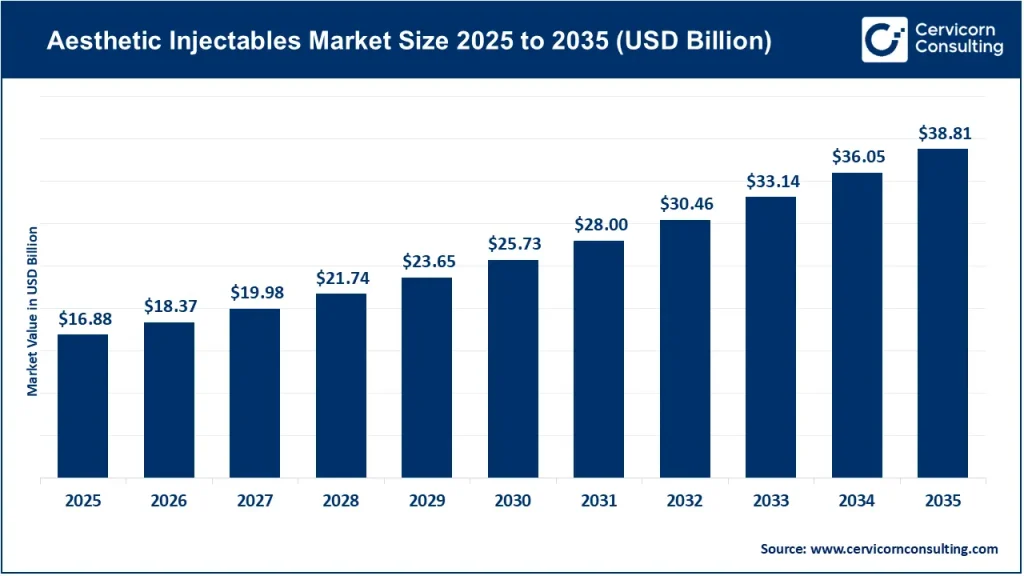
Aesthetic Injectables Market Size
The global aesthetic injectables market was valued at approximately USD 16.88 billion in 2025 and is projected to reach USD 38.81 billion by 2035, representing a 8.68% CAGR from 2026 to 2035.
What is the aesthetic injectables market?
The aesthetic injectables market encompasses injectable products used primarily to improve facial appearance, restore lost volume, soften wrinkles, enhance facial contours and improve skin quality. The major product categories include botulinum toxin-based neuromodulators, hyaluronic acid dermal fillers, calcium hydroxylapatite, poly-L-lactic acid (PLLA), polymethylmethacrylate (PMMA), and emerging biostimulatory or regenerative injectables.
Botulinum toxin products temporarily reduce muscle activity and are commonly used for facial lines such as forehead lines, frown lines and crow’s feet. Dermal fillers, in contrast, add volume or create a smoother or fuller appearance. The U.S. FDA classifies dermal fillers as medical devices and emphasizes that they should be administered by appropriately trained, licensed healthcare professionals.
The market is therefore broader than conventional “anti-wrinkle injections.” It increasingly includes comprehensive facial-aesthetic treatment strategies combining neuromodulators, fillers and biostimulators to achieve individualized outcomes.
In 2025, botulinum toxin represented the largest product segment in one major industry estimate, accounting for 44.5% of market revenue, while medical spas represented 42.8% of end-use revenue. North America held approximately 40.1% of global revenue, while Asia Pacific was identified as the fastest-growing regional market.
Get a Free Sample: https://www.cervicornconsulting.com/sample/2771
Why is the aesthetic injectables market important?
The importance of aesthetic injectables extends across consumers, healthcare providers, manufacturers and investors. For consumers, injectables provide a less invasive alternative to surgical procedures, often with relatively short treatment times and limited disruption to daily activities. The availability of temporary products also allows patients to adjust treatment over time rather than committing to permanent changes.
For healthcare providers, aesthetic injectables have become an important component of dermatology, plastic surgery and medical-spa practices. The growing diversity of products enables physicians to create treatment plans based on facial anatomy, age-related volume changes, skin quality and individual aesthetic preferences.
For manufacturers, the market represents a high-value innovation opportunity. Product differentiation is increasingly based on duration, onset, tissue integration, formulation characteristics, ease of injection, patient comfort and clinical evidence. The FDA, for example, recognizes multiple filler materials including hyaluronic acid, calcium hydroxylapatite and PLLA, demonstrating the breadth of technologies available to practitioners.
Leading companies in the aesthetic injectables market
AbbVie Inc.
Specialization: Medical aesthetics, pharmaceuticals and neuroscience.
Key Focus Areas: Allergan Aesthetics, Botox Cosmetic, Juvéderm dermal fillers, facial rejuvenation and professional aesthetics.
Notable Features: AbbVie has one of the industry’s strongest aesthetic portfolios through Allergan Aesthetics. Botox Cosmetic and Juvéderm provide the company with exposure to both neuromodulators and dermal fillers, enabling combination-treatment strategies.
2025 Revenue: AbbVie reported USD 61.16 billion in total 2025 revenue. Its global aesthetics portfolio generated USD 4.86 billion, including USD 2.602 billion from Botox Cosmetic and USD 993 million from the Juvéderm Collection.
Market Share: AbbVie/Allergan Aesthetics was estimated to hold more than 23% of the global aesthetic injectables market in 2025, making it the leading company in the cited Global Market Insights assessment.
Global Presence: The company operates internationally across North America, Europe, Asia-Pacific, Latin America and other markets through its global pharmaceutical and aesthetics infrastructure.
Galderma S.A.
Specialization: Dermatology and medical aesthetics.
Key Focus Areas: Restylane fillers, Sculptra biostimulators, Dysport neuromodulator and next-generation injectable technologies.
Notable Features: Galderma has developed a highly focused medical-aesthetics portfolio covering neuromodulators, fillers and biostimulators. Its strategy increasingly emphasizes natural-looking outcomes, product innovation, clinical evidence and geographic expansion.
2025 Revenue: Galderma generated USD 5.207 billion in total net sales in 2025, while its Injectable Aesthetics business generated USD 2.572 billion, up 11.5% year over year at constant currency.
Market Share: Galderma was identified as the second-largest company with approximately 21% market share in one 2026 industry estimate.
Global Presence: Galderma has a broad international footprint, with strong positions in the United States, Europe, Asia-Pacific, China, Latin America and other emerging markets. Its 2025 performance was supported by geographic expansion, including the launch of Sculptra in China.
Merz Pharmaceuticals GmbH & Co. KGaA
Specialization: Medical aesthetics, neuroscience and healthcare.
Key Focus Areas: Xeomin, Belotero, Radiesse, aesthetic dermatology and professional education.
Notable Features: Merz Aesthetics is a dedicated medical-aesthetics business with a portfolio spanning injectables, devices and skincare. Its injectable portfolio combines neuromodulators, dermal fillers and biostimulatory solutions. The company also places strong emphasis on healthcare-professional education.
2025 Revenue: Merz is privately held and does not disclose a directly comparable public-company 2025 aesthetic-injectables revenue figure. The Merz Group reported revenue of more than €2.2 billion in its most recently disclosed fiscal year, covering its broader businesses rather than aesthetics alone.
Market Share: Merz is among the four major companies collectively accounting for approximately 60% of the global aesthetic injectables market according to Global Market Insights.
Global Presence: Merz has a direct presence in 28 countries, while its products and businesses reach international markets through a wider distribution network.
Ipsen Pharma
Specialization: Specialty-care pharmaceuticals and neuroscience.
Key Focus Areas: Dysport, botulinum toxin aesthetics, therapeutic neuroscience and next-generation aesthetic neurotoxins.
Notable Features: Ipsen’s Dysport has established positions in both therapeutic and aesthetic applications. The company is also developing IPN10200, a next-generation aesthetic neurotoxin designed to provide a longer duration of action. Phase II results reported in 2025 supported progression toward Phase III development.
2025 Revenue: Ipsen reported €3.676 billion in total 2025 sales. Dysport total sales reached approximately €728 million, while Dysport Aesthetics generated approximately €409 million based on the company’s full-year regional reporting.
Market Share: Ipsen is one of the four major companies collectively contributing to the approximately 60% share held by the leading players identified by Global Market Insights.
Global Presence: Ipsen serves North America, Europe and Rest-of-World markets. Dysport aesthetics growth in 2025 was supported particularly by North America and Rest-of-World markets.
Revance Therapeutics, Inc.
Specialization: Aesthetic and therapeutic injectables.
Key Focus Areas: DAXXIFY, RHA Collection dermal fillers and injectable aesthetics.
Notable Features: Revance has differentiated itself through DAXXIFY, a peptide-formulated botulinum toxin. The company reported distribution of its one-millionth DAXXIFY vial in the United States in September 2025, approximately three years after FDA approval.
2025 Revenue: A standalone 2025 revenue figure is not directly comparable because Revance became part of AbbVie’s aesthetics organization following its acquisition. Consequently, Revance’s products should increasingly be evaluated within AbbVie’s broader aesthetics portfolio rather than as an independent public-company revenue stream.
Market Share: Revance remains a smaller challenger compared with AbbVie, Galderma and Merz, but DAXXIFY has strengthened its position in the U.S. neuromodulator segment.
Global Presence: The company’s principal commercial strength has historically been the United States, with international expansion supported by its product portfolio and partnerships.
Leading trends and their impact
Shift toward natural-looking results
Consumers are increasingly moving away from visibly overfilled or highly altered appearances. Providers are therefore using smaller quantities, anatomical mapping and combination treatments to achieve subtle improvements. This trend benefits manufacturers capable of demonstrating predictable, natural-looking outcomes.
Growth of biostimulators
Biostimulators such as PLLA-based products are gaining attention because they focus on gradual improvements in collagen production and skin quality rather than simply adding volume. Galderma reported double-digit growth for its biostimulator business in 2025, with Sculptra benefiting from continued expansion and its launch in China.
Longer-lasting neuromodulators
Treatment longevity is becoming an important competitive differentiator. Patients and providers increasingly value products that can maintain results for longer periods. Ipsen’s IPN10200 development program and Galderma’s next-generation Relfydess illustrate the industry’s movement toward differentiated duration and formulation technologies.
Preventive aesthetics
Aesthetic treatments are increasingly being adopted by younger adults seeking to manage early signs of aging. This broadens the addressable customer base beyond traditional older demographics and supports recurring treatment demand.
Medical-spa expansion
Medical spas are becoming an increasingly important channel for injectable treatments. Grand View Research estimates that MedSpas accounted for 42.8% of aesthetic injectable revenue in 2025.
Greater emphasis on safety and practitioner training
As the market expands, regulators are placing greater emphasis on licensed practitioners, approved products, appropriate injection sites and post-market surveillance. This raises compliance requirements but can also favor established manufacturers with strong clinical evidence and professional education programs.
Successful examples of the aesthetic injectables market around the world
United States: Botox and Juvéderm ecosystem
The United States remains the industry’s most commercially developed market. AbbVie’s Botox Cosmetic and Juvéderm demonstrate the advantages of combining neuromodulator and filler portfolios. In 2025, Botox Cosmetic generated USD 2.602 billion globally, while the Juvéderm Collection generated USD 993 million.
The U.S. also demonstrates how differentiated products can enter an established market. DAXXIFY’s one-million-vial distribution milestone highlights the opportunity for newer neuromodulators to challenge established products.
China: rapid expansion of injectable aesthetics
China represents an important growth market for premium aesthetic injectables. Galderma’s launch of Sculptra in China in 2025 illustrates how international companies are targeting the country’s growing demand for advanced aesthetic treatments.
South Korea: innovation and manufacturing
South Korea has become a significant center for botulinum toxin innovation and manufacturing. Research published in 2026 identified 15 Korean manufacturers and 19 registered botulinum toxin products, illustrating the country’s increasingly competitive role in the global neuromodulator landscape.
Brazil: large aesthetic market with increasing regulatory scrutiny
Brazil is a major aesthetics market, but its experience also demonstrates the importance of regulatory controls. ANVISA states that injectable aesthetic products should be registered as medicines or medical devices rather than cosmetics. In 2026, the agency specifically warned that dermal fillers used outside approved anatomical indications or volumes can increase the risk of serious complications.
Global regional analysis
North America
North America is currently the largest regional market, accounting for approximately 40.1% of global aesthetic injectable revenue in 2025 in the Grand View Research estimate.
The region benefits from high consumer awareness, developed dermatology and plastic-surgery infrastructure, high healthcare spending, established medical-spa networks and the presence of leading manufacturers such as AbbVie and Revance. The United States is particularly important because of its mature regulatory framework and large population of consumers seeking minimally invasive aesthetic procedures.
Government initiatives and policies: The U.S. FDA regulates dermal fillers as medical devices and has established product-specific approval requirements. The agency advises patients to use licensed healthcare providers and warns against unapproved products, self-injection and needle-free filler devices.
These policies reinforce product authentication, professional training and evidence-based treatment practices.
Europe
Europe represents another major market, supported by established dermatology practices, medical-aesthetics clinics and high consumer awareness. Countries such as Germany, the UK, France and Italy are important markets.
The regulatory environment is particularly significant because dermal fillers can fall under the European Medical Device Regulation framework. The European Commission’s guidance identifies dermal fillers as products subject to medical-device regulatory considerations, while recent EU-funded testing of hyaluronic-acid fillers highlighted the importance of market surveillance and consumer safety.
The European regulatory focus on conformity, clinical evidence and post-market surveillance may increase compliance costs while simultaneously strengthening consumer confidence.
Asia Pacific
Asia Pacific is projected to be the fastest-growing regional market. Rising disposable incomes, expanding urban populations, increasing beauty awareness and the popularity of aesthetic medicine are supporting demand across China, Japan, South Korea, India and Southeast Asia.
South Korea is particularly influential because of its strong domestic aesthetics industry and growing number of botulinum toxin manufacturers. China represents a major commercial opportunity for global brands, while Japan combines an aging population with strong demand for minimally invasive procedures.
Government initiatives and policies: China regulates medical devices through the National Medical Products Administration and related medical-device registration and manufacturing frameworks. The NMPA’s regulatory system includes formal provisions for medical-device registration, manufacturing supervision and distribution.
South Korea’s MFDS maintains regulatory frameworks for medical products and cosmetics, while dermal fillers are subject to medical-device requirements. Recent regulatory literature identifies dermal fillers as high-risk Class IV products in Korea, requiring clinical evidence to establish safety and effectiveness.
Latin America
Latin America is an important emerging region, with Brazil standing out because of its large aesthetic-procedure ecosystem. Growing aesthetic awareness, social-media influence and the development of specialized clinics support market expansion.
However, regulatory oversight is becoming more prominent. Brazil’s ANVISA has emphasized that injectable aesthetic products cannot simply be classified as cosmetics. The agency also prohibits compounding pharmacies from manufacturing intradermal fillers and requires relevant products to be appropriately registered.
This regulatory tightening is likely to favor established manufacturers that can demonstrate product quality, traceability and compliance.
Middle East and Africa
The Middle East is emerging as an attractive market for premium aesthetic treatments, supported by medical tourism, high disposable incomes and investments in private healthcare. The UAE and Saudi Arabia are particularly important markets for premium dermatology and aesthetic services.
Africa remains comparatively underpenetrated but offers long-term opportunities as healthcare infrastructure improves and aesthetic awareness expands. Market participants are likely to focus initially on major metropolitan centers and private dermatology networks.
Government initiatives and policies shaping the market
Government policy is becoming an increasingly important competitive factor in aesthetic injectables. In the United States, FDA approval and labeling requirements determine which products can legally be marketed and for which indications. The FDA also actively warns consumers about counterfeit or unapproved fillers.
In the European Union, the Medical Device Regulation framework and market-surveillance activities are increasing the focus on safety, conformity and post-market monitoring. The European Commission’s 2025 filler-testing campaign demonstrated that regulatory surveillance extends beyond product authorization to real-world product quality.
In Brazil, ANVISA has strengthened controls around injectable fillers, including restrictions on compounding and warnings against using fillers outside approved indications.
In China, medical-device registration and manufacturing/distribution supervision provide the regulatory foundation for aesthetic injectable products.
In South Korea, MFDS oversight and medical-device classification are important barriers to entry while simultaneously supporting quality assurance. Dermal fillers classified as high-risk devices require evidence supporting safety and effectiveness.
Overall, regulatory policies are pushing the aesthetic injectables industry toward clinically validated products, qualified practitioners, stronger traceability, appropriate labeling, post-market surveillance and controlled distribution. This environment is likely to benefit companies with substantial R&D capabilities, regulatory expertise, global manufacturing networks and established relationships with healthcare professionals.
To Get Detailed Overview, Contact Us: https://www.cervicornconsulting.com/contact-us
Read Report: Energy Transition Market Revenue, Trends, and Strategic Insights by 2035