


Specialty Care Market Overview
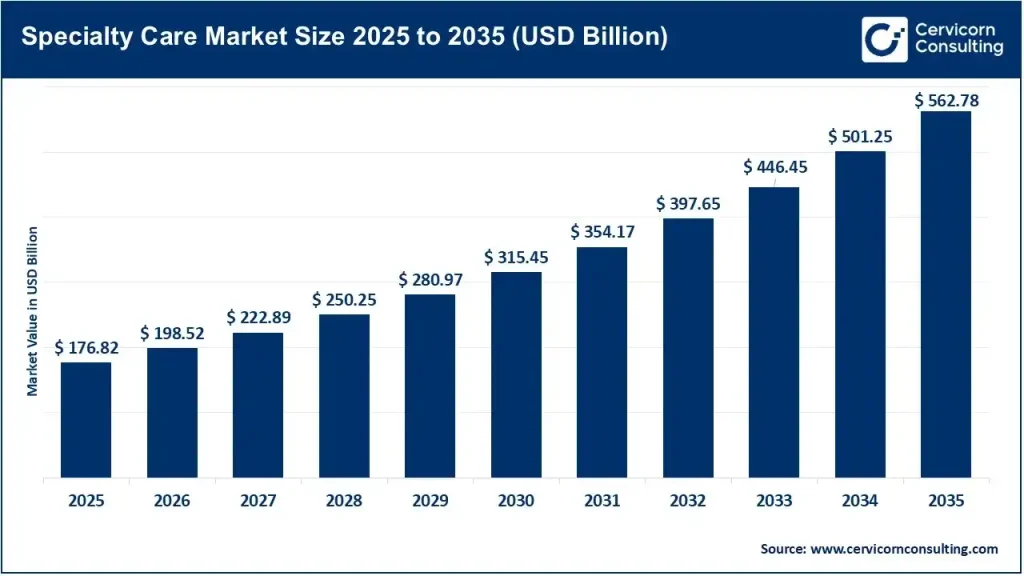
The global specialty care market was valued at approximately USD 176.82 billion in 2025 and is projected to reach USD 562.78 billion by 2035, expanding at a CAGR of 12.8% during the forecast period.
What Is the Specialty Care Market?
The specialty care market encompasses healthcare services delivered by physicians, hospitals, clinics, and healthcare networks with advanced expertise in a particular medical discipline or patient population. Specialty care is typically accessed after a primary-care assessment or referral, although direct access is available for certain services in some healthcare systems.
Specialty care can include outpatient consultations, inpatient treatment, minimally invasive procedures, complex surgeries, cancer treatment, advanced imaging, rehabilitation, chronic disease management, organ transplantation, fertility treatment, and specialized pediatric or geriatric services.
The market is increasingly moving away from the traditional model of isolated specialist consultations toward integrated care pathways. Under this model, patients may receive diagnosis, laboratory testing, imaging, specialist consultation, surgery, rehabilitation, pharmacy services, remote monitoring, and follow-up through a connected healthcare network.
This evolution is particularly important for diseases requiring multidisciplinary treatment. Cancer care, for example, may involve oncologists, radiologists, surgeons, pathologists, genetic counselors, pharmacists, and rehabilitation specialists. Similarly, complex cardiovascular cases can require cardiologists, cardiac surgeons, imaging specialists, anesthesiologists, rehabilitation teams, and long-term disease-management programs.
Get a Free Sample: https://www.cervicornconsulting.com/sample/3005
Specialty Care Market Growth Factors
The specialty care market is being driven by an aging global population, rising incidence of chronic and noncommunicable diseases, increasing cancer and cardiovascular disease burden, greater demand for minimally invasive and robotic procedures, technological advances in diagnostics and medical imaging, growing adoption of precision medicine and personalized therapies, expansion of health insurance coverage, increasing healthcare expenditure, rising patient awareness, improved access to specialist consultations through telemedicine, growth of outpatient specialty centers, expansion of medical tourism, increasing investment in advanced hospitals and specialty clinics, healthcare-provider consolidation, value-based care initiatives, and government programs designed to expand access to complex medical services.
The growing use of artificial intelligence, remote patient monitoring, electronic health records, clinical decision-support systems, and digital diagnostics is also improving specialist productivity and enabling complex care to be delivered beyond traditional hospital settings. At the same time, the increasing prevalence of multimorbidity means that patients frequently require several specialists, encouraging healthcare organizations to build multidisciplinary and coordinated care models.
Why Is Specialty Care Important?
Specialty care is important because many diseases cannot be effectively managed through general medical services alone. Complex illnesses require specialized knowledge, advanced diagnostic equipment, experienced clinical teams, and sophisticated treatment protocols.
1. Management of Complex Diseases
Specialists have advanced expertise in diseases that require highly specific treatment. Oncology, neurology, cardiology, transplant medicine, and interventional radiology are examples where specialist intervention can substantially influence clinical outcomes.
2. Earlier and More Accurate Diagnosis
Specialty centers generally have access to advanced diagnostic technologies, specialized laboratories, molecular testing, imaging equipment, and multidisciplinary clinical expertise. These capabilities can support earlier identification of complex conditions.
3. Advanced Treatment
Specialty hospitals and centers provide procedures that may not be available in general hospitals, including robotic surgery, complex cardiac interventions, organ transplantation, proton therapy, advanced neurosurgery, and precision oncology.
4. Better Care Coordination
Integrated specialty-care systems can connect specialists with primary-care physicians, pharmacies, laboratories, rehabilitation providers, and digital health platforms. This reduces fragmentation and can improve continuity of care.
5. Support for Aging Populations
As populations age, demand increases for orthopedic, cardiovascular, neurological, ophthalmological, oncology, renal, and rehabilitation services. Specialty care is therefore becoming increasingly important to healthcare planning.
Leading Companies in the Specialty Care Market
| Company | Specialization | Key Focus Areas | Notable Features | 2025 Revenue | Market Share | Global Presence |
|---|---|---|---|---|---|---|
| UnitedHealth Group Incorporated | Integrated healthcare, insurance and health services | Specialty physician services, Optum Health, analytics, pharmacy, value-based care | Combines payer and healthcare-service capabilities; serves 148 million people through its businesses | $447.6 billion | Specialty-care-only share not publicly disclosed | Primarily U.S., with international capabilities and partnerships |
| HCA Healthcare, Inc. | Hospital and specialty healthcare services | Surgery, oncology, cardiology, neurosciences, women’s care, emergency and outpatient services | Large hospital network with extensive specialist infrastructure | $75.6 billion | Specialty-care-only share not publicly disclosed | Primarily United States and United Kingdom |
| Mayo Clinic | Academic medicine and specialty healthcare | Oncology, cardiology, neurology, transplant, orthopedics, complex diseases | Integrated clinical practice, research and medical education | ~$21.5 billion | Specialty-care-only share not publicly disclosed | U.S. campuses with substantial international patient reach |
| Cleveland Clinic | Academic medical center and specialty care | Cardiology, cardiac surgery, neurology, oncology, orthopedics, transplant | Major international specialty-care network and academic research system | ~$18 billion operating revenue | Specialty-care-only share not publicly disclosed | U.S., Abu Dhabi, London and other international locations |
| Kaiser Permanente | Integrated health plan and healthcare delivery | Specialty medicine, chronic disease management, hospital services, digital care | Integrated payer-provider model with coordinated care | $127.7 billion combined Kaiser Permanente/Risant Health operating revenue | Specialty-care-only share not publicly disclosed | Primarily United States |
Note: The reported revenues are total organizational or consolidated revenues, not specialty-care revenues. A standardized market-share denominator for the global specialty care market is not publicly available, so company-specific specialty-care market shares cannot be reliably calculated without proprietary segment-level data. UnitedHealth Group reported $447.6 billion in 2025 consolidated revenue. HCA Healthcare reported $75.6 billion in 2025 revenue and operated 190 hospitals at year-end. Mayo Clinic reported approximately $21.5 billion in 2025 revenue. Cleveland Clinic generated about $18 billion in 2025 operating revenue and nearly 16 million global patient encounters. Kaiser Permanente and Risant Health reported combined 2025 operating revenue of $127.7 billion and nearly 13.1 million members.
Leading Trends and Their Impact on the Specialty Care Market
Artificial Intelligence and Clinical Decision Support
AI is becoming increasingly important in specialty medicine. Imaging-heavy disciplines such as radiology, cardiology, pathology, oncology, and neurology can benefit from AI-assisted interpretation, risk prediction, patient stratification, and workflow automation.
The impact is twofold. First, AI can improve specialist productivity by reducing repetitive administrative and diagnostic tasks. Second, it can support earlier identification of patients who require specialist intervention.
Growth of Precision Medicine
Precision medicine is changing specialty care by enabling physicians to tailor treatment according to genetic, molecular, clinical, and lifestyle characteristics.
Oncology is a major beneficiary because molecular profiling can help identify appropriate targeted therapies. Similar approaches are emerging in cardiology, neurology, rare diseases, immunology, and reproductive medicine.
Expansion of Outpatient Specialty Centers
Healthcare providers are increasingly moving appropriate procedures away from traditional inpatient hospitals. Ambulatory surgery centers, specialty clinics, imaging centers, infusion centers, and outpatient rehabilitation facilities can offer more convenient care while potentially reducing costs.
This trend is encouraging healthcare companies to invest in distributed specialty networks rather than relying exclusively on large hospitals.
Tele-specialty and Virtual Care
Telemedicine is expanding access to specialists, particularly for patients in rural and underserved regions. Virtual consultations can be combined with remote monitoring, wearable devices, digital diagnostics, and electronic health records.
The European Union’s cancer strategy, for example, is supporting stronger digital capabilities in cancer centers, including telemedicine and remote monitoring through initiatives such as eCAN Plus.
Value-Based Specialty Care
Healthcare systems are increasingly linking reimbursement to outcomes, quality, patient experience, and cost efficiency rather than simply the volume of services delivered.
This is encouraging providers to focus on reducing avoidable readmissions, improving treatment adherence, coordinating care, and monitoring patients after procedures.
Robotic and Minimally Invasive Procedures
Robotic surgery and advanced minimally invasive technologies are becoming increasingly important in orthopedics, urology, gynecology, cardiovascular medicine, and general surgery.
These technologies can support precision, smaller incisions, shorter hospital stays, and faster recovery for appropriately selected patients.
Hospital and Healthcare Consolidation
Large healthcare organizations are expanding through acquisitions, physician-group partnerships, specialty networks, and integrated delivery models. Consolidation can provide greater access to capital, technology, specialist talent, and coordinated care infrastructure.
However, it can also create concerns around market concentration, pricing, workforce competition, and access.
Medical Tourism and International Specialty Centers
Patients increasingly travel internationally for complex procedures, particularly when specialized expertise, advanced technology, shorter waiting times, or lower treatment costs are available.
This has encouraged healthcare organizations in the Middle East and Asia to develop international specialty hospitals and medical-tourism ecosystems.
Successful Examples of Specialty Care Market Around the World
Mayo Clinic – United States
Mayo Clinic represents one of the strongest examples of an integrated specialty-care model. Its system brings clinical care, research, and medical education together, with physicians working across disciplines to manage complex cases. Its major campuses in Minnesota, Arizona, and Florida provide advanced specialty services, while its international reputation attracts patients seeking complex diagnosis and treatment. Mayo Clinic reported approximately $21.5 billion in 2025 revenue, demonstrating the scale of an academic specialty-care organization.
Cleveland Clinic – United States and International Markets
Cleveland Clinic has built a globally recognized specialty-care model, particularly around cardiovascular medicine, cardiac surgery, neurology, oncology, orthopedics, and transplant services. Its international operations demonstrate how specialized clinical expertise can be exported through international partnerships and purpose-built medical centers. Cleveland Clinic reported approximately $18 billion in 2025 operating revenue and nearly 16 million global patient encounters.
Kaiser Permanente – United States
Kaiser Permanente demonstrates the potential of an integrated payer-provider model. Its health plan, hospitals, medical offices, and physician organizations operate within a coordinated system designed around population health and value-based care. In 2025, Kaiser Permanente and Risant Health reported $127.7 billion in combined operating revenue and nearly 13.1 million members.
HCA Healthcare – United States
HCA Healthcare demonstrates the scale-driven hospital-network approach to specialty care. Its extensive hospital and outpatient infrastructure provides access to numerous specialty services, including cardiovascular care, oncology, surgery, neurosciences, women’s services, and orthopedics. HCA reported $75.6 billion in 2025 revenue and more than 3.9 million equivalent admissions on a same-facility basis during the year.
Saudi Arabia – Virtual Specialty Care
Saudi Arabia provides an emerging example of how digital infrastructure can expand specialist access across geographically dispersed populations. Under Vision 2030’s Health Sector Transformation Program, the country’s Seha Virtual Hospital network expanded to 241 connected healthcare facilities and more than 365,000 beneficiaries, supporting access to specialized care through digital connectivity.
China – National and Regional Medical Centers
China’s Healthy China 2030 strategy explicitly promotes national and regional medical centers, clinical key specialty groups, stronger medical-resource sharing, and improved access to diagnosis and treatment for critical and difficult diseases. This approach is intended to distribute high-quality specialty capabilities beyond China’s largest metropolitan hospitals.
Global Regional Analysis
North America
North America remains one of the most mature specialty-care markets because of high healthcare expenditure, advanced medical infrastructure, extensive specialist networks, strong pharmaceutical and medical-device ecosystems, and high adoption of advanced procedures.
The United States dominates regional specialty care because of its large private healthcare sector, academic medical centers, hospital systems, specialty physician groups, and extensive investment in biotechnology and medical technology.
Major providers such as UnitedHealth Group, HCA Healthcare, Mayo Clinic, Cleveland Clinic, and Kaiser Permanente are supporting market development through integrated networks, specialty hospitals, outpatient facilities, digital healthcare, and value-based care.
The shift toward outpatient procedures is particularly important. Healthcare providers are investing in ambulatory centers and specialty clinics that can deliver selected procedures outside traditional hospitals.
Europe
Europe has a highly developed specialty-care ecosystem supported by universal or near-universal health coverage, national health systems, specialist hospitals, academic medical centers, and public healthcare investment.
Cancer care is an especially important policy priority. The European Commission’s EU Cancer Plan supports improved access to cancer medicines, specialist workforce development, and stronger digital capabilities in cancer centers. More than 100 cancer centers are participating in an inter-specialty training program supported by the plan.
European specialty-care growth is also being shaped by population aging, rising cancer prevalence, cardiovascular disease, neurological disorders, and demand for advanced diagnostics.
The major challenge is balancing increasing demand for specialist services with constrained healthcare budgets, workforce shortages, and uneven access between countries and regions.
Asia-Pacific
Asia-Pacific is one of the most promising regions for specialty care because of its large population, rapid urbanization, rising healthcare expenditure, growing middle class, expanding private hospitals, and increasing demand for advanced medical services.
India is developing specialty-care capacity through a combination of public programs, private hospitals, digital healthcare, and medical-tourism infrastructure. Under Ayushman Bharat PM-JAY, India’s Health Package Master had expanded to 1,961 procedures across 27 medical specialties by 2025, demonstrating the increasing integration of specialty services into publicly supported healthcare coverage.
Japan’s aging population supports demand for cardiology, oncology, orthopedics, rehabilitation, ophthalmology, neurology, and geriatric specialty services.
China’s Healthy China 2030 strategy specifically calls for national medical centers, regional medical centers, and clinical specialty groups while encouraging better distribution of advanced healthcare resources.
Australia has a mature specialist-care system funded through Medicare and public hospital arrangements. In 2022–23, Medicare-subsidized referred specialist consultations represented approximately AUD 5.3 billion in spending. However, specialist affordability and waiting times remain important challenges.
Latin America
Latin America’s specialty-care market is developing through a combination of public healthcare systems, private hospitals, health insurance, specialist networks, and medical tourism.
Brazil represents the largest healthcare opportunity in the region. Its Sistema Único de Saúde (SUS) provides universal public healthcare, creating a broad platform for specialist services while private healthcare providers serve patients seeking additional capacity and faster access.
Specialty-care development is influenced by unequal distribution of specialists, infrastructure gaps, waiting times, and differences between metropolitan and rural areas. Digital health and telemedicine can help overcome some geographic limitations by connecting regional patients with specialists in major urban centers.
Middle East & Africa
The Middle East is becoming increasingly important for advanced specialty healthcare. Governments in the Gulf region are investing heavily in hospital infrastructure, digital health, medical tourism, specialist centers, and public-private partnerships.
Saudi Arabia’s Vision 2030 is a particularly important driver. Its Health Sector Transformation Program focuses on improving healthcare access, efficiency, prevention, digital transformation, and integrated care. In 2025, primary healthcare coverage reached 97.5% of population clusters, while the Seha Virtual Hospital network expanded specialist access through hundreds of connected facilities.
The United Arab Emirates is also building international specialty-care capacity through major academic and private hospitals, including Cleveland Clinic Abu Dhabi.
Africa presents significant long-term potential but continues to face shortages of specialist physicians, advanced equipment, hospital infrastructure, and healthcare financing. Regional centers of excellence, public-private partnerships, telemedicine, and international healthcare collaborations can play an important role in improving specialty-care access.
Government Initiatives and Policies Shaping the Specialty Care Market
United States
U.S. specialty care is strongly influenced by Medicare, Medicaid, private insurance, value-based care arrangements, accountable care organizations, reimbursement policies, and health-information interoperability requirements.
The growth of value-based reimbursement is particularly important because it encourages providers to demonstrate measurable outcomes rather than relying entirely on fee-for-service volume.
European Union
The EU Cancer Plan is a major specialty-care policy initiative. It supports cancer prevention, early diagnosis, treatment access, specialist workforce development, cancer-center collaboration, and digital health capabilities. The program’s emphasis on inter-specialty training and telemedicine is particularly relevant to the development of modern specialty-care networks.
India
India’s Ayushman Bharat ecosystem is expanding financial protection and healthcare access. PM-JAY’s expansion of packages across 27 specialties demonstrates the government’s focus on making advanced medical treatment accessible to broader population groups.
Digital-health initiatives and the development of Ayushman Arogya Mandirs are also supporting the broader referral pathway from community-level healthcare to higher-level specialty services.
China
China’s Healthy China 2030 strategy is one of the most significant long-term healthcare policies affecting specialty care in Asia. It promotes integrated healthcare systems, national and regional medical centers, clinical specialty groups, resource sharing, hierarchical diagnosis and treatment, and stronger collaboration between primary-care institutions and specialist hospitals.
The policy also encourages digital healthcare, personalized health management, medical tourism, advanced diagnostics, medical-device innovation, and specialized healthcare-service development.
Saudi Arabia
Saudi Arabia’s Vision 2030 and Health Sector Transformation Program are reshaping specialty care through healthcare privatization, digital transformation, integrated care, public-private partnerships, and investments in healthcare infrastructure. The expansion of Seha Virtual Hospital illustrates how digital platforms can extend specialist expertise to facilities across the country.
Australia
Australia’s Medicare system continues to influence specialist-care access and affordability. Specialist consultations generally require referrals for Medicare benefits, while public hospitals and government-funded programs provide additional specialist services. Government policy is increasingly focused on improving primary-care access and reducing pressure on the broader healthcare system.
Future Direction of the Specialty Care Market
The specialty care market is moving toward a more connected, technology-enabled, multidisciplinary, and patient-centered model. Instead of specialty care being concentrated entirely within large hospitals, services are increasingly distributed across academic medical centers, specialty hospitals, ambulatory surgery centers, outpatient clinics, diagnostic centers, home healthcare, and virtual platforms.
AI-enabled diagnostics, precision medicine, robotic surgery, remote monitoring, virtual specialist consultations, digital therapeutics, advanced imaging, genomic testing, and data-driven clinical decision support are expected to become increasingly embedded into specialty-care workflows.
At the same time, healthcare organizations will increasingly compete on clinical outcomes, specialist expertise, patient experience, accessibility, and the ability to coordinate complex treatment pathways. The organizations best positioned for long-term growth are likely to be those capable of combining highly specialized clinical expertise with digital infrastructure, multidisciplinary teams, strong referral networks, advanced technology, and sustainable reimbursement models.
To Get Detailed Overview, Contact Us: https://www.cervicornconsulting.com/contact-us
Read Report: Electronic Pipettes Market Revenue, Trends, and Strategic Insights by 2035