


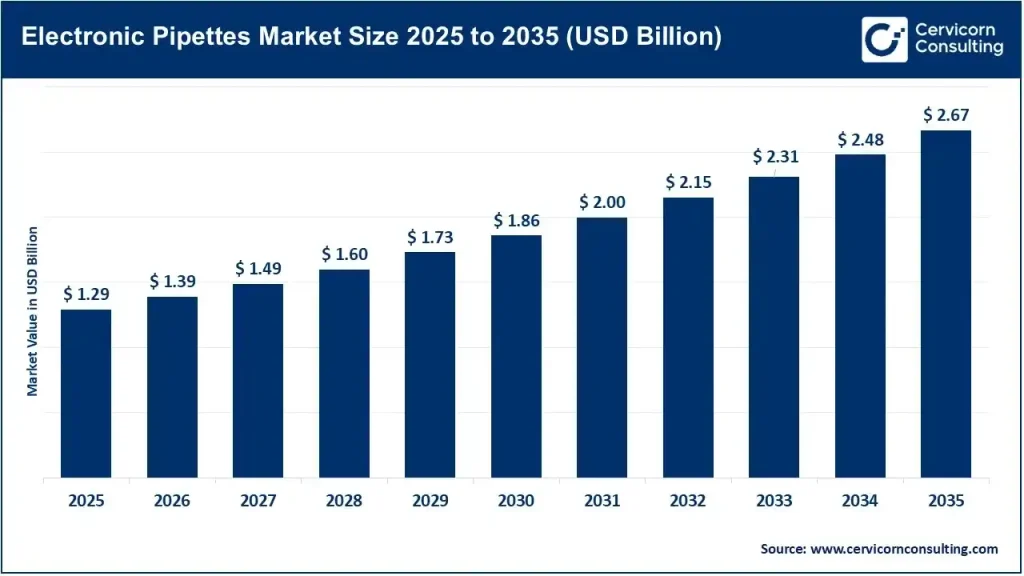
Electronic Pipettes Market Size
The global electronic pipettes market was valued at approximately USD 1.29 billion in 2025 and is projected to reach USD 2.67 billion by 2035, expanding at a CAGR of 7.5% during the forecast period.
Electronic Pipettes Market Growth Factors
The electronic pipettes market is expanding as laboratories increasingly prioritize precision, repeatability, ergonomics, workflow standardization, and automation in liquid-handling operations. Demand is being supported by the rapid growth of pharmaceutical and biotechnology research, increasing adoption of molecular diagnostics, expanding genomics and proteomics applications, rising high-throughput screening activities, and the need to process large numbers of samples with lower operator variability. Electronic pipettes reduce the physical effort associated with repetitive pipetting while enabling programmable dispensing, electronic tip ejection, multichannel operation, adjustable speeds, and workflow-specific protocols. The integration of Bluetooth connectivity, mobile applications, cloud-based protocol management, and laboratory information systems is further strengthening their value in digitally enabled laboratories.
At the same time, growing awareness of repetitive strain injuries among laboratory personnel is encouraging organizations to replace conventional mechanical pipettes with ergonomically designed electronic alternatives. The expansion of automated and semi-automated laboratory workflows is another major growth factor, as electronic pipettes can serve as an intermediate technology between manual pipetting and fully automated liquid-handling platforms. Emerging biomanufacturing hubs in Asia-Pacific, investments in research infrastructure across North America and Europe, and government support for biotechnology, diagnostics, drug discovery, and life sciences are also creating a favorable environment for market expansion.
What Is the Electronic Pipettes Market?
The electronic pipettes market refers to the global industry involved in the development, manufacturing, distribution, and use of electrically powered pipetting instruments designed to aspirate, dispense, mix, transfer, and repeatedly handle liquid samples with greater consistency and reduced manual effort.
Unlike traditional mechanical pipettes, electronic pipettes use a motor-driven mechanism controlled through electronic interfaces. Users can select liquid-handling modes, volumes, speeds, dispensing patterns, and other parameters through digital controls. Depending on the design, electronic pipettes can be configured as single-channel, multichannel, adjustable tip-spacing, or high-throughput systems.
Modern products increasingly include programmable protocols, touchscreens, Bluetooth connectivity, mobile applications, calibration reminders, electronic tip ejection, and compatibility with laboratory automation systems. For example, Thermo Scientific’s E1-ClipTip electronic pipettes support programmable operation and Bluetooth-enabled workflow management, while Sartorius’ Picus 2 connects with its pipetting application for sample-preparation workflows.
Electronic pipettes are used extensively in pharmaceutical and biotechnology companies, academic and research institutions, diagnostic laboratories, hospitals, contract research organizations, food and beverage testing laboratories, environmental laboratories, and industrial quality-control facilities.
Get a Free Sample: https://www.cervicornconsulting.com/sample/3003
Why Are Electronic Pipettes Important?
Electronic pipettes are important because liquid handling is one of the most frequently repeated activities in laboratory environments, and even small inconsistencies can affect experimental outcomes.
Improved accuracy and repeatability
Electronic control minimizes variation caused by differences in operator technique. This is particularly important for PCR, DNA extraction, ELISA, cell-based assays, dilution series, sequencing workflows, and other procedures requiring precise liquid volumes. Sartorius highlights the ability of Picus 2 electronic pipettes to provide reliable and repeatable results while reducing variance compared with traditional pipettes.
Reduced operator fatigue
Repeated manual pipetting can place stress on the hand, wrist, and thumb. Electronic operation reduces the physical force required for aspiration, dispensing, and tip ejection. This makes electronic pipettes especially valuable in laboratories where technicians process hundreds or thousands of samples per day.
Higher productivity
Multichannel electronic pipettes can simultaneously process multiple wells, significantly increasing throughput. Thermo Fisher’s E1-ClipTip portfolio, for example, includes 8-, 12-, and 16-channel configurations designed for 96- and 384-well microplate workflows.
Better workflow standardization
Programmable operating modes allow laboratories to establish standardized protocols. This can reduce user-to-user variation and make training easier, especially in pharmaceutical, clinical, and regulated laboratory environments.
Bridge toward laboratory automation
Electronic pipettes also provide an accessible step toward automation. Laboratories that are not ready to invest in complete robotic liquid-handling systems can use programmable electronic pipettes to automate repetitive processes while retaining human control.
Major Companies in the Electronic Pipettes Market
| Company | Specialization | Key Focus Areas | Notable Features | 2025 Revenue* | Market Share | Global Presence |
|---|---|---|---|---|---|---|
| Thermo Fisher Scientific Inc. | Life-science instruments, laboratory products and services | Liquid handling, biopharma, diagnostics, research | E1-ClipTip Bluetooth, programmable protocols, multichannel systems | $44.56 billion | Not separately disclosed | Global; strong North America, Europe and Asia-Pacific presence |
| Eppendorf SE | Liquid and sample handling, laboratory instruments | Pipettes, consumables, automation, cell biology | Xplorer plus, programmable electronic pipetting, broad volume range | €924 million | Not separately disclosed | Subsidiaries in 30 countries; production/R&D in Europe, Asia and North America |
| Sartorius AG | Life-science and biopharmaceutical technologies | Liquid handling, bioprocessing, drug development | Picus 2, Bluetooth connectivity, mobile-app workflows | €3.54 billion | Not separately disclosed | 60+ countries/locations |
| Gilson Incorporated | Liquid handling, purification and automation | Pipettes, automated liquid handling, sample preparation | PIPETMAN M96, touchscreen, 96-channel operation | Not publicly disclosed | Not separately disclosed | Americas, Europe, Middle East, Africa and Asia-Pacific |
| INTEGRA Biosciences AG | Pipetting and laboratory automation | Electronic pipettes, multichannel systems, automation | VIAFLO, VOYAGER, MINI 96, VIAFLO 96/384 | Not publicly disclosed | Not separately disclosed | North America, Europe, Asia, Oceania and worldwide distribution |
Thermo Fisher reported full-year 2025 revenue of $44.56 billion, up 4% from 2024. Eppendorf reported €924.0 million in 2025 revenue and invested €60.9 million in research and development. Sartorius generated €3.5381 billion in 2025 sales revenue.
Electronic-pipette-specific revenue and market share are generally not reported separately by these diversified private and public companies. Therefore, assigning precise company shares without a proprietary market dataset could be misleading.
Thermo Fisher Scientific
Thermo Fisher is one of the most diversified suppliers in the laboratory technology ecosystem. Its electronic pipette portfolio includes the E1-ClipTip family, covering single-channel and multichannel applications.
The E1-ClipTip Bluetooth range includes electronic tip ejection, programmable operation, and Bluetooth connectivity. Its My Pipette Creator application enables users to create and share pipetting protocols. The product family also includes adjustable tip-spacing configurations for transfers across different laboratory formats.
The company’s scale across laboratory products, diagnostics, biopharma services, and research technologies gives it an important advantage in cross-selling liquid-handling products to established laboratory customers.
Eppendorf SE
Eppendorf has a particularly strong brand position in liquid and sample handling. Its Xplorer plus electronic pipette supports single- and multichannel configurations, with volume ranges extending from 0.5 μL to 10,000 μL depending on the configuration. It offers multiple pipetting modes, programmable operation, electronic controls, and compatibility with third-party consumables.
Eppendorf operates production and R&D facilities in Europe, Asia, and North America and maintains subsidiaries in 30 countries. Its 2025 strategy also placed greater emphasis on liquid and sample handling, automation, consumables, and cell biology.
Sartorius AG
Sartorius combines electronic pipetting with broader biopharmaceutical and laboratory workflows. Its Picus 2 platform provides single-channel, 8-channel, and 12-channel models, with single-channel instruments covering volumes from 0.5 μL to 10,000 μL. Bluetooth connectivity enables integration with the Sartorius Pipetting mobile application.
This connectivity is important because laboratories are increasingly moving from standalone instruments toward digitally connected workflows.
Gilson Incorporated
Gilson has a long-standing specialization in liquid handling, purification, extraction, pipettes, and automation. The company’s PIPETMAN brand remains an important part of its liquid-handling portfolio.
A notable recent development is the PIPETMAN M96, a 96-channel motorized electronic pipette launched in 2025. It is designed for high-throughput 96- and 384-well workflows and incorporates touchscreen controls, guided protocols, ergonomic features, and standard laboratory compatibility.
Gilson maintains sales and service capabilities across North and South America, Europe, the Middle East, Africa, and Asia-Pacific through local teams and distribution partners.
INTEGRA Biosciences AG
INTEGRA focuses heavily on pipetting productivity and laboratory automation. Its portfolio includes VIAFLO, VOYAGER, MINI 96, VIAFLO 96, VIAFLO 384, ASSIST, and ASSIST PLUS platforms. The company offers electronic handheld pipettes ranging from conventional multichannel configurations to high-throughput 96- and 384-channel platforms.
INTEGRA operates manufacturing and engineering activities in Switzerland and the United States and maintains sales and support operations across North America, Europe, Asia, and Oceania. Its products are also distributed through international partners.
Leading Trends and Their Impact on the Electronic Pipettes Market
1. Bluetooth and Connected Pipetting
Connectivity is becoming one of the most important trends. Electronic pipettes are evolving from standalone instruments into connected laboratory devices.
Bluetooth-enabled products can connect with mobile applications or software platforms, enabling protocol configuration, workflow management, software updates, and greater consistency.
Impact: Connectivity increases the attractiveness of electronic pipettes for digitally mature laboratories and creates opportunities for vendors to build recurring software, service, and workflow-management ecosystems.
2. Growth of Multichannel Pipetting
High-throughput research increasingly requires simultaneous processing of multiple wells. Eight-, 12-, 16-, 24-, 96-, and 384-channel systems are therefore gaining attention.
Impact: Multichannel systems allow laboratories to process more samples in less time, supporting demand from genomics, drug discovery, PCR, cell biology, and screening applications.
3. Integration With Laboratory Automation
Electronic pipettes increasingly function as intermediate automation technologies. Instead of completely replacing human operators, laboratories can automate specific repetitive steps.
Impact: This expands the addressable market among small and medium-sized laboratories that may not have the budget, space, or technical capabilities required for fully automated liquid-handling robots.
4. Ergonomics and Worker Safety
Laboratory managers are increasingly concerned about repetitive strain and operator fatigue. Electronic pipettes address this problem through motorized aspiration and dispensing, soft-touch controls, lightweight designs, and electronic tip ejection.
Impact: Ergonomic benefits can accelerate replacement cycles and increase adoption in laboratories with intensive pipetting workloads.
5. Application-Specific Programming
Modern electronic pipettes provide multiple modes for repetitive dispensing, mixing, serial dilution, titration, and microplate workflows.
Impact: Programmability improves reproducibility and enables laboratories to standardize experimental procedures across users.
6. High-Throughput Life Sciences
Drug discovery, next-generation sequencing, molecular diagnostics, cell-based research, and biopharmaceutical development increasingly require high sample volumes.
Impact: The demand for faster sample preparation supports higher-value electronic multichannel and semi-automated pipetting systems.
Successful Examples of the Electronic Pipettes Market Around the World
Several commercial product platforms demonstrate how electronic pipetting is evolving globally.
Thermo Fisher E1-ClipTip
The E1-ClipTip demonstrates the transition toward connected, programmable pipetting. Its Bluetooth versions combine electronic operation with protocol management and multichannel configurations for microplate workflows.
Eppendorf Xplorer plus
The Xplorer plus illustrates the premium electronic pipette model, combining extensive volume coverage, programmable modes, electronic operation, and multichannel configurations.
Sartorius Picus 2
Picus 2 represents the connected electronic-pipette approach. Its Bluetooth functionality and mobile application are designed to make sample-preparation workflows easier to configure and standardize.
Gilson PIPETMAN M96
Gilson’s M96 illustrates the growing market for portable, semi-automated high-throughput pipetting. Launched in June 2025, the system was designed to give laboratories a simpler pathway from manual pipetting toward greater automation.
INTEGRA VIAFLO and VIAFLO 96/384
INTEGRA’s range demonstrates how electronic pipettes can span from handheld multichannel instruments to high-throughput platforms. The company’s portfolio includes 24-, 96-, and 384-channel handheld electronic pipettes as well as automated systems.
Global Regional Analysis
North America
North America remains one of the most technologically advanced markets for electronic pipettes because of its large pharmaceutical, biotechnology, academic research, diagnostics, and clinical laboratory base. The United States hosts numerous major pharmaceutical and biotechnology companies, research universities, contract research organizations, and laboratory technology manufacturers.
The region’s emphasis on laboratory automation, precision medicine, genomics, cell and gene therapy, and biopharmaceutical manufacturing supports demand for sophisticated liquid-handling technologies.
Government-funded biomedical research also indirectly supports the market because research institutions require modern laboratory infrastructure. Canada’s Biomanufacturing and Life Sciences Strategy is another important regional catalyst. The Canadian government committed more than $2.2 billion over seven years under Budget 2021 to strengthen life sciences, biomanufacturing, research systems, infrastructure, and pandemic preparedness.
In 2024, Canada additionally announced nearly $574 million for 19 projects at 14 research institutions through the Canada Biomedical Research Fund and Biosciences Research Infrastructure Fund. These investments can increase demand for laboratory instruments, including advanced liquid-handling systems.
Europe
Europe represents another major electronic-pipette market because of its established pharmaceutical industry, strong academic research infrastructure, biotechnology clusters, and stringent emphasis on laboratory quality.
Germany is particularly important because it is home to Eppendorf and Sartorius, while Switzerland hosts INTEGRA. The UK, France, the Netherlands, and other European markets also maintain strong life-sciences ecosystems.
Government policy is supporting the broader research environment. Horizon Europe, the European Union’s principal research and innovation program, has an indicative funding amount of €93.5 billion for 2021–2027 following the program’s midterm review. Its health cluster supports research involving health technologies, diagnostics, disease prevention, personalized medicine, and digital health.
The European focus on advanced manufacturing, digital technologies, artificial intelligence, and robotics under Horizon Europe’s industrial cluster also creates an environment favorable to laboratory automation and connected liquid handling.
The United Kingdom is separately strengthening its life-sciences ecosystem. Its Life Sciences Sector Plan, published in 2025 and updated in 2026, aims to drive research and development, investment, advanced manufacturing, and health innovation, with an ambition to position the UK as Europe’s leading life-sciences economy by 2030.
Asia-Pacific
Asia-Pacific is expected to remain one of the most attractive growth regions because of expanding pharmaceutical manufacturing, biotechnology investment, diagnostics, academic research, and laboratory infrastructure.
China, Japan, South Korea, India, Singapore, and Australia are developing stronger life-science ecosystems. Eppendorf, for example, operates facilities and commercial operations across China, India, Japan, South Korea, Southeast Asia, and Australia. Sartorius also maintains a broad Asian presence and identifies China, India, Japan, and South Korea among its important global locations.
India is particularly important because of the government’s BioE3 policy. Approved in 2024, the Biotechnology for Economy, Environment and Employment (BioE3) Policy supports innovation-driven R&D, entrepreneurship, biomanufacturing and Bio-AI hubs, biofoundries, commercialization, and workforce development.
These initiatives can increase demand for precision laboratory instruments as India expands biotechnology research, biomanufacturing, diagnostics, and pharmaceutical capabilities.
China is also promoting advanced industries and biopharmaceutical development. Beijing’s 2025 action plan, for example, calls for greater opening of the biopharmaceutical sector and development of high-standard biopharmaceutical infrastructure.
Latin America
Latin America offers emerging opportunities for electronic pipette manufacturers as pharmaceutical production, clinical diagnostics, agricultural biotechnology, food testing, and university research expand.
Brazil and Mexico are particularly important because of their larger laboratory and pharmaceutical ecosystems. Growth in molecular diagnostics and research infrastructure can support demand for electronic pipettes, especially multichannel products used for PCR, ELISA, sample preparation, and microplate workflows.
However, market penetration can be influenced by equipment costs, import duties, currency fluctuations, laboratory budgets, and the availability of technical service networks. Consequently, manufacturers that provide localized distribution, calibration, training, and maintenance services can gain an advantage.
Middle East & Africa
The Middle East & Africa represents an emerging market with opportunities tied to healthcare modernization, pharmaceutical manufacturing, biotechnology, clinical diagnostics, and academic research.
Countries such as Saudi Arabia, the United Arab Emirates, South Africa, and other regional economies are investing in healthcare infrastructure and scientific capabilities. Electronic pipettes can benefit from these investments because laboratories require accurate and repeatable liquid handling for molecular diagnostics, research, pharmaceutical quality control, and biotechnology applications.
The major challenge is uneven laboratory infrastructure across countries. Vendors therefore have opportunities to develop distributor networks, localized service programs, training centers, and cost-effective electronic models.
Government Initiatives and Policies Shaping the Electronic Pipettes Market
Government policy generally affects electronic pipettes indirectly rather than through dedicated pipette-specific regulations. Funding for biomedical research, biotechnology, diagnostics, pharmaceutical manufacturing, laboratory infrastructure, and advanced manufacturing creates the underlying demand for laboratory equipment.
United States and Canada: Biomedical research funding, biomanufacturing programs, clinical research, and laboratory infrastructure investment support instrument purchasing. Canada’s Biomanufacturing and Life Sciences Strategy is particularly relevant because it combines research infrastructure, talent development, clinical trials, innovation, and domestic biomanufacturing capacity.
European Union: Horizon Europe supports health research, health technologies, digital solutions, personalized medicine, and research infrastructure. Its multiannual work programs provide a sustained funding framework for scientific research and technology development.
United Kingdom: The Life Sciences Sector Plan focuses on R&D, investment, advanced manufacturing, and health innovation, strengthening the country’s broader laboratory technology ecosystem.
India: The BioE3 policy supports high-performance biomanufacturing, Bio-AI hubs, biofoundries, R&D, entrepreneurship, commercialization, and skilled workforce development. These initiatives can accelerate purchases of laboratory equipment required by biotechnology and biomanufacturing facilities.
China: National and regional efforts to expand biopharmaceutical and advanced technology industries are strengthening the country’s laboratory and manufacturing ecosystem. Beijing’s 2025 advanced-industry action plan specifically promotes the development and opening of the biopharmaceutical industry.
Overall, these policies create a favorable demand environment for electronic pipettes by expanding the number and sophistication of laboratories that require precise, repeatable, digitally enabled liquid handling.
To Get Detailed Overview, Contact Us: https://www.cervicornconsulting.com/contact-us
Read Report: Cell Culture Market Revenue, Trends, and Strategic Insights by 2035