


Why Governments and Businesses Are Investing in Sovereign AI to Regain Control of Data and AI Infrastructure
Artificial intelligence is becoming embedded in government services, financial systems, healthcare, defense, manufacturing, telecommunications, and critical infrastructure. But as organizations move more sensitive workloads onto AI platforms, a fundamental problem is becoming harder to ignore: who actually controls the infrastructure, data, models, and platforms on which that AI depends?
An organization may use an advanced AI model without owning the underlying computing infrastructure. Its data may be processed through an external cloud provider, its model may be developed in another country, and its AI workloads may depend on foreign hardware, software, or cloud platforms. For ordinary applications, this dependency may be manageable. For government databases, defense intelligence, healthcare records, financial information, industrial intellectual property, or critical infrastructure, it can create a much more significant strategic concern.
This is the problem driving the Sovereign AI Market.
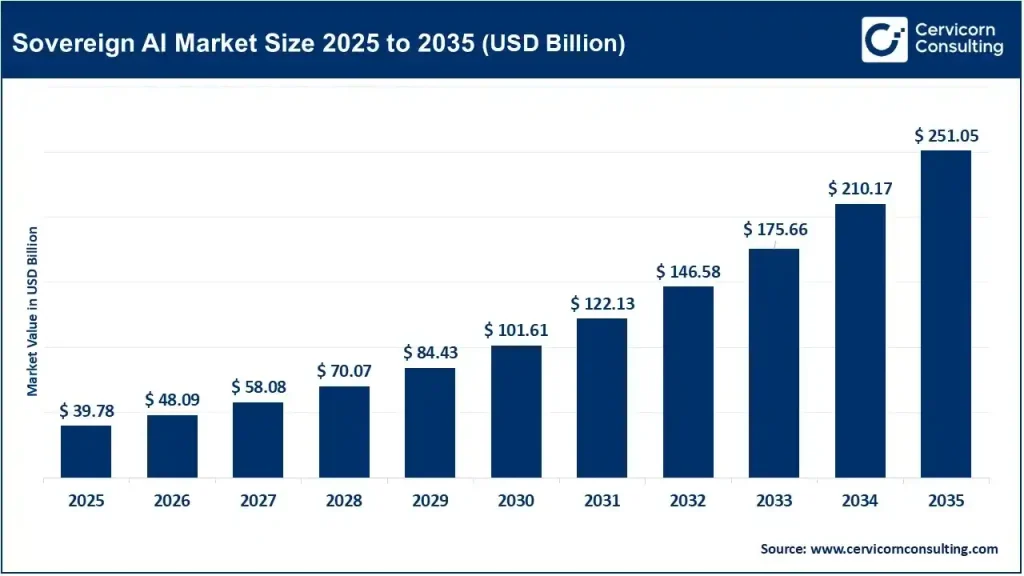
The global sovereign AI market was valued at USD 39.78 billion in 2025 and is estimated to reach USD 48.09 billion in 2026, before expanding to approximately USD 252.05 billion by 2035, representing a 20.2% CAGR from 2026 to 2035.
The opportunity is therefore not simply about building another category of AI software. It is about developing the infrastructure, models, platforms, governance systems, and computing capacity required to give countries and organizations greater control over strategically important AI capabilities.
The AI control problem is becoming a business problem
The rapid adoption of cloud computing and generative AI has made sophisticated AI capabilities accessible without requiring every organization to build its own infrastructure. However, this convenience can create dependencies.
Sensitive information may cross borders to reach external infrastructure. Organizations may have limited visibility into how models are trained, updated, monitored, or governed. Enterprises can become dependent on external cloud providers for computing capacity, while governments may depend on foreign technology companies for foundational AI capabilities.
The concern becomes particularly important when AI is used for national security, public services, healthcare, financial transactions, industrial automation, or critical infrastructure.
The underlying issue can be viewed as a chain:
Data → Infrastructure → Computing → Models → Platforms → Operations
If an organization does not control enough of this chain, its ability to determine where data resides, how AI systems operate, which models are used, and how the technology evolves can be limited.
That creates demand for AI sovereignty.
Why conventional AI infrastructure creates a sovereignty challenge
Traditional AI infrastructure often relies on combinations of public cloud, external foundation models, third-party software, foreign hardware, and globally distributed data centers. These architectures provide scale and flexibility, but they do not necessarily provide the degree of control required for sensitive workloads.
Data residency is one issue. Governments and regulated enterprises may require sensitive information to remain within specific geographic or legal boundaries. Cross-border data movement can introduce additional compliance and cybersecurity considerations.
Infrastructure dependency is another concern. Training and operating advanced AI models requires enormous computing resources, including GPUs, accelerators, servers, networking equipment, storage, and high-performance data centers. Organizations that cannot access sufficient domestic or controlled computing capacity may remain dependent on external infrastructure.
Model governance presents another challenge. Organizations may want to understand where a model was developed, what datasets influence it, how it can be modified, where inference takes place, and whether it can be adapted to local regulations, languages, and operational requirements.
Sovereign AI attempts to address these problems by increasing control across the AI technology stack.
How Sovereign AI solves the control problem
Sovereign AI refers to AI ecosystems designed to provide greater national, organizational, or institutional control over critical AI capabilities. Rather than focusing only on data localization, sovereign AI can encompass infrastructure, computing resources, models, platforms, governance, security, and operations.
The market can therefore be understood through five sovereignty architectures.
Data sovereignty: keeping sensitive information under control
Problem: Sensitive government, healthcare, financial, or enterprise data may be processed outside the required jurisdiction.
Solution: Sovereign data environments keep data within controlled geographic, regulatory, and operational boundaries.
Benefit: Organizations gain greater control over data residency, access, privacy, and compliance.
Infrastructure sovereignty: controlling the computing foundation
Problem: AI requires large-scale computing resources, creating dependence on external data centers, cloud providers, and hardware ecosystems.
Solution: Organizations and governments invest in domestic or controlled AI data centers, GPU clusters, servers, networking systems, and AI computing infrastructure.
Benefit: Greater control over availability, security, capacity, and strategic AI workloads.
Infrastructure sovereignty represented approximately 34% of the Sovereign AI Market in 2025, highlighting how important the physical computing layer has become.
Model sovereignty: developing AI suited to local requirements
Problem: Foreign foundation models may not adequately reflect local languages, regulations, cultural context, datasets, or national priorities.
Solution: Governments and enterprises develop, customize, host, or control sovereign AI models.
Benefit: Greater control over model behavior, customization, data, and deployment.
Model sovereignty is projected to be the fastest-growing architecture, with its market share increasing from 18% in 2025 to 23.1% by 2035.
Platform and operational sovereignty: controlling deployment
Problem: Even when data and models are controlled, organizations may remain dependent on external platforms for deployment, monitoring, governance, and operations.
Solution: Sovereign AI platforms provide controlled environments for model management, security, governance, monitoring, and deployment.
Benefit: Organizations can establish consistent AI policies and operational controls.
End-to-end sovereignty: controlling the complete AI stack
Problem: Controlling only one layer does not eliminate dependency elsewhere.
Solution: End-to-end sovereignty combines data, infrastructure, models, platforms, security, and operations.
Benefit: Governments and strategic industries gain a more integrated AI ecosystem.
Why the Sovereign AI Market is expanding so quickly
The Sovereign AI Market is expanding because the risks associated with AI dependency are increasing at the same time that AI adoption is accelerating. Generative AI is increasing demand for computing infrastructure, while governments and enterprises are becoming more focused on data privacy, cybersecurity, national security, regulatory compliance, and control over strategically important information. At the same time, countries want domestic computing capacity, local foundation models, regional-language AI, and infrastructure that can support public-sector digital transformation without creating excessive dependence on external platforms. Government investment in AI infrastructure is therefore moving beyond experimentation toward long-term national computing capacity, while businesses are increasingly considering sovereign cloud, localized models, private AI environments, and AI governance systems. These forces collectively create demand across hardware, software, cloud, data centers, cybersecurity, AI services, and consulting.
2026: Sovereign AI is moving from policy discussion to infrastructure investment
The next phase of sovereign AI is increasingly physical.
Governments and technology companies are investing in AI data centers, sovereign cloud environments, AI factories, AI gigafactories, domestic computing clusters, accelerators, and local foundation models. The objective is shifting from simply accessing AI to building the infrastructure required to operate AI at scale.
Developments involving companies such as NVIDIA, Microsoft, HCLTech, L&T, IBM, BharatGen, NxtGen, Sarvam, and AMD illustrate the breadth of this ecosystem. The roles vary: some companies provide accelerators and computing infrastructure, others provide cloud and enterprise platforms, while emerging organizations focus on domestic AI models and localized AI capabilities.
This distinction is commercially important. Sovereign AI does not represent one product category. It represents an ecosystem.
The technology stack behind sovereign AI
At the hardware layer, AI sovereignty depends on GPUs, CPUs, AI accelerators, servers, networking equipment, storage, and high-performance computing. These components determine whether countries and organizations can build sufficient domestic AI capacity.
At the software layer, AI platforms, model management, data-management systems, governance tools, cybersecurity, and model monitoring provide operational control.
Sovereign cloud connects these layers by providing cloud capabilities while addressing requirements around data residency, security, compliance, and infrastructure control.
Local AI models represent another critical layer. Countries with multiple languages or specific regulatory environments may require models trained or adapted for their own linguistic, cultural, legal, and institutional requirements.
AI data centers bring everything together. Without sufficient domestic computing capacity, model sovereignty can remain theoretical. The availability of secure, energy-efficient, high-performance AI data centers is therefore becoming a critical part of national AI infrastructure.
Companies are building different pieces of the sovereignty ecosystem
The competitive landscape includes hardware manufacturers, cloud providers, enterprise technology companies, infrastructure providers, cybersecurity companies, and AI-model developers.
| Company | Primary role in the ecosystem | Sovereign AI contribution |
|---|---|---|
| NVIDIA | AI accelerators and infrastructure | GPUs, networking and AI computing infrastructure |
| Microsoft | Cloud and enterprise AI | Azure, sovereign cloud capabilities and enterprise AI |
| Amazon Web Services | Cloud infrastructure | Cloud computing, AI services and infrastructure |
| Google Cloud | Cloud and AI platforms | AI infrastructure, cloud and model capabilities |
| IBM | Enterprise AI and governance | AI platforms, data, governance and regulated-industry solutions |
| Oracle | Enterprise cloud infrastructure | Cloud infrastructure and AI computing for enterprises |
| HPE | Servers and enterprise infrastructure | High-performance computing and AI infrastructure |
| Dell Technologies | Servers and infrastructure | AI servers, data-center infrastructure and enterprise deployment |
| Cisco | Networking and security | AI networking, security and infrastructure connectivity |
| Intel | Processors and computing | CPUs and AI computing infrastructure |
| AMD | CPUs and AI accelerators | AI accelerators and high-performance computing |
| Lenovo | Enterprise hardware | AI servers, infrastructure and computing systems |
| Alibaba Cloud | Cloud infrastructure | Cloud and AI capabilities across Asian markets |
| Huawei | ICT and AI infrastructure | Computing, cloud and AI infrastructure |
| SAP | Enterprise software | Enterprise data, applications and AI integration |
| Atos | Digital infrastructure and services | HPC, cybersecurity and sovereign digital infrastructure |
| G42 | AI and infrastructure | AI infrastructure, cloud and regional AI development |
| Mistral AI | Foundation models | European AI-model development and localization |
Company-specific Sovereign AI revenue and market share are not publicly disclosed for many of these companies, so their broader corporate revenue should not be interpreted as sovereign-AI-specific revenue.
The more useful way to evaluate these companies is by asking which part of the sovereignty problem they solve: computing, cloud, models, networking, cybersecurity, data management, governance, or infrastructure.
Where governments and businesses are putting their money
Investment is increasingly moving toward assets that provide long-term control.
AI data centers are one of the most visible areas because large-scale models require substantial computing capacity. AI factories and gigafactories extend this concept by creating dedicated environments for training, inference, experimentation, and deployment.
Domestic semiconductor capacity is another strategic area. Countries that depend entirely on imported accelerators and processors remain exposed to supply-chain constraints. Consequently, AI sovereignty increasingly intersects with semiconductor strategies.
Sovereign cloud is also attracting investment because it combines cloud economics with requirements for jurisdictional control.
At the model layer, governments and businesses are supporting local foundation models and regional-language systems. Public-private partnerships can accelerate this development by combining government demand with private-sector technology, infrastructure, and engineering capabilities.
The result is a fundamental shift from using AI toward controlling critical parts of the AI stack.
Where the biggest commercial opportunities are emerging
The sovereignty problem creates opportunities across the technology value chain.
Sovereign cloud providers can serve organizations that require cloud scalability without surrendering control over sensitive workloads.
AI data centers can benefit from rising demand for localized computing capacity, while infrastructure companies can provide servers, networking, cooling, storage, and power systems.
AI accelerator and hardware companies can benefit as governments and enterprises seek greater control over compute availability.
Local foundation-model developers can build models optimized for national languages, datasets, regulations, and business requirements.
AI governance and cybersecurity companies can address model risk, compliance, monitoring, access control, and security requirements.
Data-management platforms can help organizations establish controlled data pipelines for AI workloads.
Consulting and infrastructure-service companies can help enterprises determine which workloads require sovereign deployment and how to build appropriate architectures.
The opportunities also extend vertically. Healthcare organizations need greater control over patient and clinical information. Financial institutions must manage sensitive financial data and regulatory requirements. Defense organizations require secure environments for intelligence and national-security workloads. Manufacturers need to protect industrial data and intellectual property. Energy, transportation, telecommunications, and other critical-infrastructure operators may require greater control over AI systems that influence essential operations.
What does it take to enter the Sovereign AI Market?
Sovereign AI is difficult to enter because it is not simply a software market.
A company may need access to AI hardware, data-center infrastructure, energy, specialized talent, cybersecurity capabilities, model-development expertise, cloud infrastructure, and regulatory knowledge.
Government procurement can also create longer sales cycles than conventional enterprise software. Local partnerships may be essential, particularly where national regulations or infrastructure ownership requirements influence procurement.
Semiconductor supply chains represent another challenge. Even companies that develop excellent AI software can remain dependent on external processors, networking equipment, and computing infrastructure.
For market entrants, the central question is therefore not simply “What AI product can we sell?” It is:
“Which sovereignty problem can we solve better than existing infrastructure providers?”
That distinction can determine whether a company becomes another AI application vendor or an important component of a sovereign AI ecosystem.
How governments are addressing the sovereignty problem
North America
North American strategies increasingly emphasize domestic AI infrastructure, computing capacity, semiconductor development, data protection, government AI adoption, and national-security requirements. The underlying objective is to maintain access to advanced computing and AI capabilities while protecting strategically sensitive information.
Europe
Europe is developing a broader technology-sovereignty ecosystem through initiatives involving AI Factories, AI Gigafactories, AI.grids, cloud infrastructure, semiconductor capabilities, and shared AI computing resources.
The problem being addressed is strategic dependence on infrastructure and technology outside Europe. The response is to strengthen European computing, cloud, semiconductor, and AI capabilities so organizations can access advanced AI within a more controlled ecosystem.
Asia-Pacific
India, China, Japan, South Korea, Singapore, and Australia are pursuing different approaches to domestic AI capabilities.
India is emphasizing national AI infrastructure, local models, multilingual AI, government-backed computing access, and public-private collaboration. China has a strong domestic technology ecosystem and continues to develop local AI and computing capabilities. Japan and South Korea combine advanced industrial technology with AI and semiconductor development, while Singapore emphasizes trusted digital infrastructure and governance. Australia is developing AI capabilities alongside broader digital and infrastructure strategies.
Across the region, the common problem is the need for greater control over data, infrastructure, models, and strategic AI capabilities.
Middle East & Africa
Investment in data centers, sovereign cloud, government digital transformation, and national AI ecosystems is creating new opportunities across the Middle East and Africa. Governments are increasingly treating AI infrastructure as part of broader digital-development strategies.
Latin America
Latin American markets are developing opportunities around government AI adoption, data governance, digital infrastructure, localized AI capabilities, and sovereign cloud. The opportunity is particularly relevant for public-sector and regulated workloads that require stronger control over data and AI operations.
Real-world development is demonstrating what sovereign AI means
The emerging ecosystem shows that sovereign AI can take different forms.
A country may build a domestic AI data center to secure computing capacity. Another may develop a foundation model trained for local languages. A government may establish a sovereign cloud environment for sensitive public-sector workloads. A technology company may build an AI factory combining accelerators, networking, storage, and model infrastructure.
India’s AI ecosystem provides an important example of this broader movement. The IndiaAI ecosystem is driving demand for domestic compute, indigenous model development, multilingual AI, and broader AI infrastructure. Cervicorn’s related AI infrastructure research identifies plans involving 38,000+ GPUs and highlights the development of sovereign AI capabilities and domestic model ecosystems.
The European AI Factory approach demonstrates another model: shared infrastructure designed to increase access to advanced computing and strengthen regional AI capabilities.
These examples demonstrate that sovereign AI is not one standardized architecture. It is a strategic approach adapted to each country’s infrastructure, regulatory environment, technology ecosystem, and national priorities.
The trends reshaping the next phase of Sovereign AI
The market is moving in several connected directions.
Sovereign cloud is expanding because organizations want cloud scalability without compromising control.
Local foundation models are gaining importance as governments and enterprises seek models adapted to local languages and requirements.
AI infrastructure is becoming localized because computing capacity is now strategically important.
AI data-center investment is accelerating because sovereign models are meaningless without sufficient compute.
Government AI adoption is increasing, creating demand for secure and governed deployment environments.
Regional-language AI is becoming commercially important, particularly in multilingual countries.
AI governance and cybersecurity are becoming infrastructure requirements, rather than optional enterprise features.
Open-source models are also influencing sovereignty strategies, because they can provide greater customization and deployment flexibility.
These trends are reflected in the market’s changing structure. Hardware accounted for approximately 49% of the market in 2025, showing the importance of physical infrastructure, while software is projected to increase from 34% to 40% by 2035, indicating growing demand for platforms, governance, model management, and operational control.
Who needs Sovereign AI most?
The strongest demand comes from organizations where AI intersects with sensitive information or strategic infrastructure.
Government and public services need control over citizen information, government databases, and public-sector AI. This segment represented approximately 23% of the market in 2025.
Defense and national security require secure AI environments for intelligence, surveillance, analysis, and sensitive information, representing approximately 18% of the market in 2025.
Healthcare faces sovereignty challenges around patient records, medical data, clinical AI, and regulatory compliance.
Financial services require controlled environments for financial data, fraud detection, risk management, and regulatory processes.
Critical infrastructure operators need secure AI for energy, transportation, telecommunications, and other essential systems.
Manufacturers increasingly need to protect industrial datasets, proprietary processes, intellectual property, and operational AI systems.
Why Sovereign AI matters to businesses
Sovereign AI is moving beyond government policy because enterprises face many of the same problems.
A healthcare company needs to control patient information. A manufacturer needs to protect industrial data. A bank needs to meet regulatory requirements. A telecommunications company needs secure infrastructure. A technology company may need to determine where customer data is processed and which models are permitted.
This changes technology procurement.
Organizations will increasingly have to evaluate AI vendors not only on model performance and price, but also on data control, deployment location, security, governance, infrastructure ownership, regulatory compliance, localization, and long-term dependency.
For cloud providers, this creates demand for sovereign cloud offerings. For semiconductor companies, it creates demand for domestic or diversified supply chains. For cybersecurity companies, it creates new requirements around AI-specific security. For data-center operators, it creates demand for AI-ready capacity. For investors, it creates opportunities across the physical and software layers supporting sovereign AI.
The opportunity ahead: from data localization to end-to-end AI strategy
The most important change in the Sovereign AI Market is that sovereignty is expanding beyond the question of where data is stored.
The emerging requirement is broader:
Who controls the data? Who controls the infrastructure? Who provides the compute? Who controls the model? Who governs deployment? Who operates the platform?
As governments and businesses answer these questions, sovereign cloud, domestic AI computing, local foundation models, AI data centers, governance software, cybersecurity, and public-private partnerships are becoming interconnected parts of the same market.
For companies entering the space, the opportunity will depend on identifying a specific dependency and solving it: insufficient domestic compute, lack of localized models, inadequate governance, limited cloud control, cybersecurity exposure, or fragmented AI infrastructure.
For investors and technology providers, the important signals to monitor will include government AI infrastructure budgets, GPU and accelerator availability, AI data-center construction, sovereign cloud contracts, local foundation-model deployments, semiconductor investments, public-private partnerships, and regulations affecting data and AI deployment.
The direction of the market is therefore increasingly clear: the AI race is no longer only about building better models. It is also about building the infrastructure and institutional capabilities required to control how those models are developed, deployed, governed, and operated.
That is the problem Sovereign AI is designed to solve—and it is why the market is evolving from a data-localization requirement into a much broader strategy for AI infrastructure, technology control, national capability, and commercial opportunity.
To Get Detailed Overview, Contact Us: https://www.cervicornconsulting.com/contact-us
Read Report: Power SiC Market Revenue, Trends, and Strategic Insights by 2035