


Table of Contents
TogglePower SiC Market Size
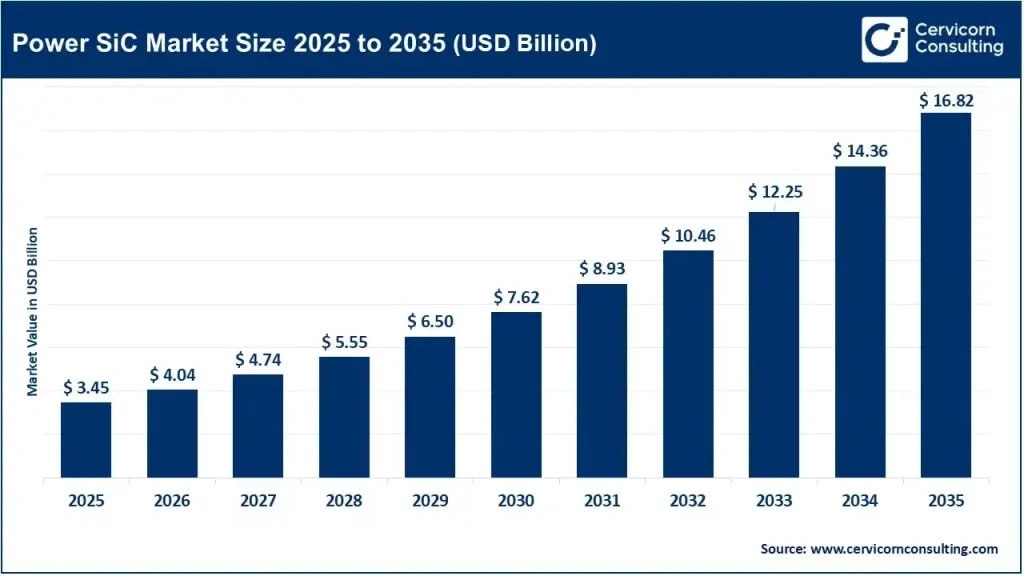
The global power SiC market size was valued at USD 3.45 billion in 2025 and is projected to reach USD 16.82 billion by 2035, representing a 17.2% CAGR.
Power SiC market growth factors
The power silicon carbide (SiC) market is expanding as automotive, renewable-energy, industrial, data-center, and power-grid applications increasingly require higher efficiency, higher voltage handling, faster switching, and greater power density than conventional silicon devices can provide. The transition toward electric vehicles is one of the strongest demand drivers because SiC MOSFETs and modules can reduce switching and conduction losses in traction inverters, onboard chargers, and DC/DC converters, helping manufacturers improve vehicle range, charging performance, thermal management, and packaging efficiency. SiC is also gaining adoption in solar inverters, battery energy-storage systems, industrial motor drives, uninterruptible power supplies, charging infrastructure, and high-power data-center systems.
Manufacturers are simultaneously investing in larger 200-mm wafer manufacturing, vertically integrated substrate-to-device supply chains, improved MOSFET structures, advanced packaging, and lower-cost production. Government semiconductor policies are another important catalyst, with the U.S. CHIPS and Science Act, European Chips Act, China’s semiconductor policies, and India’s semiconductor programs supporting domestic manufacturing and supply-chain resilience.
At the same time, increasing competition and wafer oversupply in some portions of the supply chain are creating price pressure, encouraging companies to improve manufacturing yields, cost structures, and device performance. TrendForce reported that global N-type SiC substrate revenue declined 9% in 2024 to $1.04 billion amid weaker automotive and industrial demand, pricing pressure, and competition, while also identifying strong longer-term application potential.
Get a Free Sample: https://www.cervicornconsulting.com/sample/3041
What is the power SiC market?
The power SiC market comprises semiconductor materials, wafers, MOSFETs, Schottky barrier diodes, power modules, and related components manufactured using silicon carbide for high-power electrical applications. Silicon carbide is a wide-bandgap semiconductor with properties that allow power devices to operate at higher voltages, temperatures, and switching frequencies than many conventional silicon technologies.
Power SiC devices are particularly valuable where electrical losses, thermal management, size, weight, and efficiency are critical. STMicroelectronics, for example, describes SiC as enabling higher system efficiency, faster switching, lower losses, improved thermal management, and smaller and lighter power designs. Its SiC portfolio spans devices from 650 V to 2,200 V, while its SiC technology can support junction temperatures up to 200°C, subject to package limitations.
The market therefore extends beyond semiconductor components themselves. It includes the upstream supply chain for SiC substrates and epitaxial wafers, wafer fabrication, device manufacturing, packaging, testing, power modules, and system-level applications.
Why is the power SiC market important?
Power SiC is important because power conversion efficiency increasingly determines the performance and economics of electrified systems. In an EV, for example, reducing semiconductor losses can contribute to longer driving range, improved thermal performance, smaller cooling systems, and faster charging. In renewable-energy systems, efficient power conversion can increase the amount of generated electricity delivered to the grid or stored in batteries.
SiC is also relevant to the development of higher-voltage architectures. As EV battery systems move toward 800 V and beyond, conventional silicon-based power devices face increasing efficiency and thermal-management challenges. SiC’s high breakdown field and thermal capabilities make it well suited to high-voltage switching.
The technology is also expanding into industrial automation, robotics, solar power, energy storage, server power supplies, and AI infrastructure. STMicroelectronics identifies EVs, solar inverters, energy storage, industrial motor drives, and power supplies as major SiC application areas.
Leading companies in the power SiC market
Infineon Technologies AG
Specialization: Power semiconductors, automotive semiconductors, wide-bandgap technologies, SiC MOSFETs and modules.
Key Focus Areas: Electric mobility, renewable energy, industrial power conversion, automotive powertrains, onboard chargers, DC/DC converters, and high-efficiency power supplies.
Notable Features: Infineon’s CoolSiC™ portfolio incorporates advanced trench-gate technology designed to reduce on-resistance, chip size, conduction losses, and switching losses. In February 2026, Infineon announced that its CoolSiC MOSFETs had been selected for Toyota’s new bZ4X, where they are used in the onboard charger and DC/DC converter.
2025 Revenue: Infineon generated €14.662 billion in FY2025.
Market Share: Infineon does not separately disclose a current global power-SiC revenue share in the cited financial information. Its broader reference semiconductor market share was 5.3% in 2024, while its overall semiconductor market share was 2.4%.
Global Presence: Headquartered in Germany, Infineon operates a global manufacturing, R&D, sales, and customer-support network serving automotive, industrial, energy, communications, and consumer markets.
STMicroelectronics N.V.
Specialization: SiC MOSFETs, SiC diodes, power modules, automotive power electronics, and integrated semiconductor manufacturing.
Key Focus Areas: EV traction inverters, onboard chargers, DC/DC converters, solar inverters, energy storage, industrial motor drives, and power supplies.
Notable Features: ST has been developing SiC technology for more than 25 years and introduced its first SiC diodes in 2004 and SiC MOSFETs in 2009. Its Catania, Italy, operations are being expanded into a Silicon Carbide Campus incorporating substrate, device, packaging, and testing capabilities.
2025 Revenue: ST reported $11.80 billion in FY2025 net revenue.
Market Share: ST describes itself as a market leader in SiC power MOSFETs, but a standalone 2025 percentage share is not disclosed in the cited company material.
Global Presence: ST operates globally with major manufacturing and technology locations across Europe and Asia and supplies automotive, industrial, consumer, and infrastructure customers worldwide.
Wolfspeed, Inc.
Specialization: SiC materials, SiC wafers, power devices, MOSFETs, and vertically integrated SiC manufacturing.
Key Focus Areas: Electric vehicles, renewable energy, industrial power, grid infrastructure, and high-voltage power conversion.
Notable Features: Wolfspeed has historically differentiated itself through vertical integration across SiC materials and devices. In 2025 company materials, it reported producing approximately 40% of total SiC wafers globally in 2024 and described itself as a leading pure-play SiC company.
2025 Revenue: Wolfspeed reported approximately $758 million in FY2025 consolidated revenue from continuing operations.
Market Share: Company materials reported approximately 40% of total SiC wafers produced globally in 2024; this is a wafer-production metric rather than total power-SiC device market share.
Global Presence: Wolfspeed has major U.S. SiC manufacturing operations and serves customers across automotive, industrial, energy, and semiconductor markets. Its 200-mm manufacturing strategy is intended to improve production scale and cost competitiveness.
onsemi
Specialization: Intelligent power and sensing technologies, SiC MOSFETs, SiC modules, automotive power electronics, and vertically integrated SiC supply chains.
Key Focus Areas: EV traction inverters, onboard chargers, energy infrastructure, industrial power, renewable energy, and high-efficiency power conversion.
Notable Features: onsemi’s EliteSiC platform includes SiC MOSFETs and power modules designed for high-efficiency automotive and industrial applications. Its vertically integrated supply strategy is intended to improve supply security and support high-volume EV programs.
2025 Revenue: onsemi generated approximately $6.0 billion in FY2025 revenue, with automotive and industrial markets accounting for almost 80% of total revenue.
Market Share: A standalone 2025 global power-SiC percentage is not separately disclosed in the cited financial information.
Global Presence: Headquartered in Arizona, U.S., onsemi serves customers across automotive, industrial, aerospace, defense, energy, and data-center markets worldwide.
ROHM Co., Ltd.
Specialization: SiC MOSFETs, SiC Schottky barrier diodes, power modules, discrete semiconductors, and power electronics.
Key Focus Areas: EVs, hybrid vehicles, industrial equipment, renewable energy, power supplies, and high-power applications.
Notable Features: ROHM has invested heavily in SiC technology and is advancing fifth-generation SiC MOSFETs and 8-inch wafer production. Its TRCDRIVE pack™ SiC modules entered mass production in 2024 and have been adopted by several EV manufacturers.
2025 Revenue: ROHM reported ¥448.4 billion in total sales for the fiscal year ending March 2025. Its discrete semiconductor devices generated ¥187.0 billion.
Market Share: ROHM reported a 3.0% share of the worldwide power-device market in 2024; this is the overall power-device market and should not be interpreted as its standalone SiC share.
Global Presence: ROHM is headquartered in Japan and operates manufacturing, development, and sales activities across Japan, Asia, Europe, and North America.
Leading trends and their impact on the power SiC market
1. 800-V electric vehicle architectures
The transition from conventional EV electrical architectures toward 800-V systems is strengthening the role of SiC. Higher voltage can enable faster charging and lower current for a given power level, while SiC helps manage switching losses efficiently.
onsemi’s EliteSiC module, for example, has been selected for the Kia EV6 GT traction inverter, converting power from the vehicle’s 800-V battery system. The company reported that the technology could improve EV range by approximately 5% in that application.
2. Expansion of 200-mm SiC manufacturing
The industry is moving from 150-mm toward 200-mm wafers to increase the number of usable dies per wafer and potentially lower manufacturing costs. ST is developing 200-mm SiC manufacturing capabilities in Catania, while ROHM has begun shipping mass-produced 8-inch wafer samples for certification.
3. Vertical integration
Control over substrates, epitaxy, wafer fabrication, packaging, and testing is becoming strategically important. Vertical integration can improve supply security, manufacturing consistency, technology control, and cost management.
4. SiC beyond passenger EVs
Although EVs remain a major application, SiC adoption is expanding into solar inverters, battery storage, charging infrastructure, industrial drives, robotics, data centers, and grid equipment. The expansion diversifies demand and creates additional opportunities as electricity consumption rises from electrification and AI infrastructure. ST, for example, identifies industrial motors, robots, factory automation, server power supplies, and solar conversion among its SiC applications.
5. Increasing price competition
The rapid expansion of SiC manufacturing capacity has created periods of oversupply and price pressure. TrendForce reported a 9% decline in global N-type SiC substrate revenue in 2024, highlighting the mismatch between near-term demand and expanding supply capacity.
This is encouraging manufacturers to focus on larger wafers, better yields, improved device structures, and manufacturing automation to reduce cost per device.
6. Advanced packaging
Power density increasingly depends not only on the semiconductor die but also on packaging. Low-inductance interconnects, thermal-management solutions, compact modules, and improved reliability are becoming important differentiators in automotive and industrial SiC systems.
Successful examples of the power SiC market around the world
Toyota’s adoption of Infineon CoolSiC in Japan
Toyota’s new bZ4X uses Infineon’s CoolSiC MOSFETs in its onboard charger and DC/DC converter. According to Infineon, the devices are intended to contribute to lower losses, improved thermal performance, higher efficiency, and charging/range improvements.
This illustrates the movement of SiC from premium power-electronics applications toward broader-volume EV platforms.
Kia EV6 GT and onsemi EliteSiC
The Kia EV6 GT provides another example of SiC integration. onsemi’s EliteSiC power modules are used in the traction inverter to convert the 800-V battery output into AC power for the rear axle. The company reported benefits in power-conversion efficiency, inverter size and weight, and vehicle range.
STMicroelectronics’ Catania SiC ecosystem
Italy is becoming an important SiC manufacturing location through STMicroelectronics’ investment in an integrated SiC campus. The planned ecosystem combines 200-mm SiC device production with substrate manufacturing, packaging, and testing. The European Commission identifies ST’s Catania SiC projects as part of the European Chips Act framework.
Wolfspeed’s U.S. 200-mm manufacturing strategy
Wolfspeed’s U.S. manufacturing strategy demonstrates the importance of domestic SiC capacity. Its Mohawk Valley Fab in New York represents a major 200-mm SiC device manufacturing project, while its materials operations provide upstream supply. The company has also been supported by U.S. semiconductor industrial-policy initiatives.
Global regional analysis and government initiatives
North America
North America is a major power-SiC development center because of strong EV investment, renewable-energy deployment, data-center growth, and semiconductor supply-chain policies.
The U.S. CHIPS and Science Act created a $52 billion investment framework for strengthening domestic semiconductor manufacturing and R&D. The U.S. government has specifically supported SiC manufacturing and research. In July 2026, the Department of Commerce announced up to $225 million in CHIPS funding for Bosch’s planned $2 billion SiC facility in Roseville, California.
The U.S. also announced a $250 million CHIPS R&D award to I-Pulse in June 2026 to advance novel SiC semiconductor technologies for high-temperature, high-current and high-voltage applications.
Wolfspeed’s U.S. expansion has similarly been associated with CHIPS-related incentives. A 2025 policy analysis documented a $750 million proposed CHIPS grant supporting Wolfspeed’s SiC manufacturing projects in North Carolina and New York.
These initiatives are encouraging domestic capacity while reducing dependence on geographically concentrated semiconductor supply chains.
Europe
Europe has a particularly strong position in automotive and industrial power electronics. Germany, Italy, France, and other European markets are investing in semiconductor manufacturing as part of the European Chips Act.
The European Commission reports that approved State-aid decisions under the Chips Act represent more than €32 billion in combined public and private investment across first-of-a-kind semiconductor facilities. Projects include STMicroelectronics’ SiC wafer and SiC device investments in Catania and onsemi’s SiC device investment in Rožnov, Czechia.
ST’s Italian investment is especially relevant because an integrated 8-inch SiC value chain can strengthen European supply security. The European Commission has identified the project as part of efforts to increase semiconductor manufacturing capacity and resilience.
The broader European Chips Act seeks to strengthen Europe’s semiconductor ecosystem, attract manufacturing investment, support advanced technologies, and reduce strategic dependencies.
Asia-Pacific
Asia-Pacific remains central to the power-SiC industry because of its large EV manufacturing base, electronics ecosystem, semiconductor manufacturing capabilities, and strong industrial demand.
Japan
Japan is home to major SiC companies and power-electronics manufacturers, including ROHM. Japanese manufacturers are investing in next-generation SiC MOSFETs, larger wafers, automotive power modules, and integrated supply chains. ROHM’s 8-inch SiC wafer strategy demonstrates the regional emphasis on improving production economics and scaling manufacturing.
China
China is rapidly expanding its wide-bandgap semiconductor ecosystem. The country’s policy framework has identified SiC and other wide-bandgap technologies as strategically important areas. A U.S.-China Economic and Security Review Commission report noted that China’s 14th Five-Year Plan established a goal of leading technological breakthroughs in wide-bandgap semiconductors and that government support has contributed to expansion of domestic SiC capabilities.
China’s semiconductor policies also provide tax incentives and support for qualifying integrated-circuit enterprises, projects, materials, and manufacturing activities. A March 2025 government notice continued implementation of qualifying semiconductor tax policies.
South Korea
South Korea benefits from its globally significant automotive and electronics industries. SiC demand is being supported by EV platforms, high-voltage power electronics, charging infrastructure, and industrial applications. The adoption of onsemi’s EliteSiC modules in Hyundai Motor Group and Kia’s high-performance EV programs illustrates the commercial integration of SiC into South Korean electric mobility.
India
India represents an emerging opportunity as domestic semiconductor manufacturing, EV adoption, renewable energy, and power infrastructure expand. The India Semiconductor Mission (ISM) is designed to establish a semiconductor and display ecosystem and position India as a global hub for electronics manufacturing and design.
Government-backed semiconductor projects and incentives can support domestic capabilities across manufacturing, packaging, materials, and semiconductor design. As Indian EV production, solar installations, battery storage, charging infrastructure, and industrial electrification expand, demand for efficient power semiconductors—including SiC—is expected to receive increasing attention.
Middle East, Latin America and other emerging markets
Emerging markets are becoming relevant to power SiC primarily through renewable-energy deployment, grid modernization, EV adoption, and industrial electrification. Solar and energy-storage installations require efficient high-voltage conversion systems, creating opportunities for SiC devices in inverters and power-management equipment.
The expansion of charging infrastructure is another potential demand catalyst. As countries invest in fast-charging networks, the need for compact and efficient high-power conversion equipment increases, creating additional applications for SiC MOSFETs and modules.
Overall, regional competition is increasingly centered not simply on SiC device sales but on control of the complete value chain, including raw materials, substrates, epitaxy, 200-mm wafer manufacturing, device fabrication, packaging, module integration, and application-specific engineering. Government incentives in the U.S., Europe, China, India, Japan, and other semiconductor-producing regions are consequently becoming an important structural factor shaping the global power SiC market.
To Get Detailed Overview, Contact Us: https://www.cervicornconsulting.com/contact-us
Read Report: Industrial Automation and Control Systems Market Revenue, Trends, and Strategic Insights by 2035