


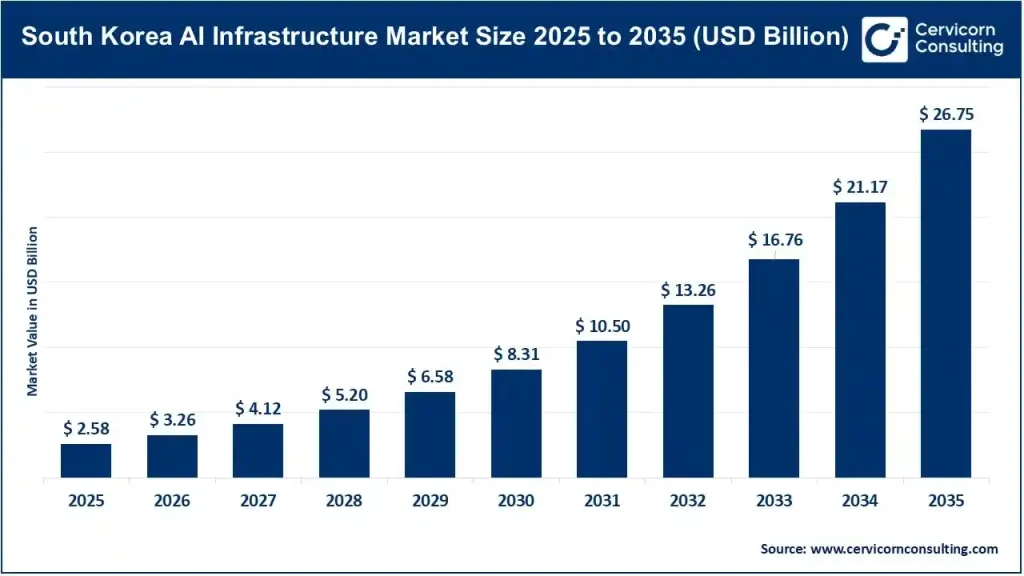
South Korea AI Infrastructure Market Size
The South Korea AI infrastructure market was valued at approximately USD 2.58 billion in 2025 and is projected to reach USD 26.75 billion by 2035, expanding at a CAGR of 26.35% during the forecast period.
South Korea AI Infrastructure Market Growth Factors
The South Korea AI infrastructure market is expanding rapidly as enterprises, cloud providers, semiconductor manufacturers, telecommunications companies, and government agencies increase investments in GPUs, AI servers, high-bandwidth memory (HBM), cloud computing, data centers, high-performance computing, networking, and AI-optimized software. The country’s strong semiconductor ecosystem, led by Samsung Electronics and SK hynix, gives it a strategic advantage in supplying the memory technologies required by AI accelerators, while NAVER Cloud, SK Telecom, and Samsung SDS are expanding AI cloud, GPU-as-a-Service (GPUaaS), data-center, and enterprise AI capabilities. South Korea’s advanced 5G connectivity, high digital adoption, manufacturing base, and concentration of technology companies are also creating strong demand for AI computing.
Government support is another major catalyst: South Korea has been expanding national GPU capacity, supporting domestic AI semiconductors, establishing a National AI Computing Center, and encouraging private investment in AI data centers. In October 2025, NVIDIA announced plans involving more than 260,000 GPUs across South Korean government and industrial AI factories, potentially increasing the country’s installed AI GPU capacity from about 65,000 to more than 300,000 units. More recently, government plans have targeted approximately 50,000 GPUs for the national AI computing ecosystem and an 8.4 GW AI data-center buildout, demonstrating how infrastructure investment is shifting from individual projects toward a national-scale AI ecosystem.
Get a Free Sample: https://www.cervicornconsulting.com/sample/3006
What Is the South Korea AI Infrastructure Market?
The South Korea AI infrastructure market refers to the ecosystem of physical and digital technologies required to develop, train, deploy, operate, and scale artificial intelligence applications in the country.
It includes several interconnected layers:
- AI computing hardware: GPUs, CPUs, AI accelerators, NPUs, servers, storage systems, and HBM.
- AI data centers: facilities designed to support high-density AI workloads, including advanced cooling, power management, networking, and high-performance computing.
- Cloud infrastructure: public, private, and hybrid cloud platforms providing scalable AI computing resources.
- Networking infrastructure: high-speed connectivity, data-center interconnects, 5G, and emerging AI networking technologies.
- AI software infrastructure: orchestration platforms, model-development tools, AI frameworks, containerized workloads, and GPU management systems.
- Edge AI infrastructure: computing resources deployed closer to users, factories, vehicles, telecom networks, and connected devices.
- Enterprise AI infrastructure: systems that allow companies to integrate generative AI, machine learning, digital twins, robotics, and AI agents into business operations.
The market is therefore broader than the AI software market. It represents the underlying computing, memory, cloud, networking, and data-center foundation that enables AI applications.
Why Is South Korea AI Infrastructure Important?
AI infrastructure is becoming strategically important because artificial intelligence requires enormous computing power and specialized hardware.
South Korea is particularly well positioned because it combines semiconductor manufacturing, cloud computing, telecommunications, consumer electronics, automotive manufacturing, robotics, and industrial production within one economy.
1. Semiconductor leadership
AI accelerators require high-speed memory, particularly HBM. SK hynix and Samsung Electronics are among the world’s most important memory suppliers. SK hynix reported KRW 97.15 trillion in 2025 revenue, with record profitability driven by AI memory and HBM demand.
IDC data cited in SK hynix’s filings show that the company held 63.2% of global HBM revenue market share in 2025 and 34.8% of global DRAM revenue share.
2. AI sovereignty
Dependence on foreign cloud and computing infrastructure can create strategic risks involving data security, technology access, and supply-chain resilience. South Korea is therefore developing sovereign AI infrastructure that can support Korean-language models and industry-specific AI applications.
3. Industrial AI
South Korea has enormous manufacturing capabilities in semiconductors, automobiles, electronics, shipbuilding, batteries, and machinery. AI infrastructure allows these industries to deploy digital twins, predictive maintenance, computer vision, robotics, autonomous systems, and AI agents.
4. Economic competitiveness
AI infrastructure investment generates demand for semiconductors, servers, power systems, cooling equipment, cloud services, networking, software, construction, and engineering. This creates a broader technology investment cycle.
5. Global AI positioning
South Korea is attempting to become not only an AI consumer but also a global supplier of AI infrastructure, particularly memory, AI factories, cloud computing, industrial AI, and robotics.
Leading Companies in the South Korea AI Infrastructure Market
| Company | Specialization | Key Focus Areas | Notable Features | 2025 Revenue | Market Share / Position |
|---|---|---|---|---|---|
| Samsung Electronics | Semiconductors, memory, AI manufacturing infrastructure | HBM, DRAM, AI chips, AI factories, semiconductor manufacturing | Planning AI factory with 50,000+ NVIDIA GPUs; digital twins for fabs | KRW 333.6T | 34.0% global DRAM share in 2025; major global HBM supplier |
| SK hynix | Memory semiconductors and HBM | HBM3E/HBM4, DRAM, AI memory, AI semiconductor manufacturing | Global HBM leader; AI-focused production expansion | KRW 97.15T | 63.2% global HBM revenue share in 2025; 34.8% DRAM share |
| NAVER Cloud | AI cloud and sovereign AI | GPUaaS, LLMs, cloud, AI data centers, digital twins | Planning approximately 60,000 NVIDIA GPUs under Korea’s AI-factory initiative | NAVER KRW 12.04T | AI/cloud infrastructure share not separately disclosed; major domestic AI-cloud provider |
| SK Telecom | Telecom, AI data centers, AI cloud | AIDC, AI-RAN, sovereign AI, industrial cloud | AIDC revenue reached KRW 519.9B in 2025 | KRW 17.10T | AIDC revenue +34.9% YoY in 2025 |
| Samsung SDS | Enterprise cloud and AI infrastructure | GPUaaS, Samsung Cloud Platform, HPC, enterprise AI | AI full-stack strategy spanning infrastructure, platforms and solutions | KRW 13.93T | Cloud revenue KRW 2.68T; AI infrastructure share not separately disclosed |
Note: Company revenue figures represent total company revenue unless a segment is specifically identified. AI-infrastructure-specific market shares are generally not publicly disclosed; therefore, the table uses relevant global infrastructure indicators such as DRAM/HBM share or reported AI/data-center revenue where available rather than presenting unsupported estimates.
Samsung Electronics
Samsung Electronics is one of the most important companies in South Korea’s AI infrastructure ecosystem because it operates across memory semiconductors, logic chips, foundry, advanced manufacturing, smartphones, consumer electronics, and AI-enabled devices.
The company generated KRW 333.6 trillion in revenue in 2025, its highest annual revenue at the time. Its semiconductor business benefited significantly from AI-related memory demand.
Samsung is also moving toward AI-native manufacturing. In collaboration with NVIDIA, it announced an AI semiconductor factory using more than 50,000 NVIDIA GPUs. The infrastructure is designed to integrate AI throughout semiconductor manufacturing, from design and process optimization to equipment, production, and quality control.
SK hynix
SK hynix has emerged as one of the most strategically important AI infrastructure companies because HBM is fundamental to modern AI accelerators.
The company recorded KRW 97.1467 trillion in 2025 revenue, while operating profit reached KRW 47.2063 trillion.
Its HBM leadership is particularly significant. IDC data cited in company filings indicate a 63.2% global HBM revenue share in 2025.
SK hynix is also integrating AI into its own manufacturing. Through its NVIDIA partnership, the company is developing semiconductor-fab digital twins and AI-powered agents while expanding AI infrastructure for chip design and production.
NAVER Cloud
NAVER Cloud represents the software, cloud, and sovereign-AI side of South Korea’s infrastructure ecosystem.
NAVER reported KRW 12.035 trillion in consolidated revenue in 2025, while its Enterprise business generated KRW 587.8 billion. NAVER said Enterprise growth was supported by new GPUaaS revenue, Saudi super-app activities, and digital-twin projects.
NAVER Cloud is particularly significant for Korean-language AI and enterprise applications. Its activities include GPUaaS, large language models, AI data centers, sovereign AI, and industry-specific AI projects. In 2025, NAVER was included in NVIDIA’s South Korean AI infrastructure initiative, with plans for approximately 60,000 GPUs.
SK Telecom
SK Telecom is transitioning from being primarily a telecommunications company toward becoming an AI infrastructure and AI transformation provider.
Its 2025 consolidated revenue was KRW 17.0992 trillion, while AI data-center revenue reached KRW 519.9 billion, increasing 34.9% year over year. Growth was supported by higher utilization at the Gasan and Yangju facilities and the acquisition of the Pangyo data center.
The company is also developing AI infrastructure through partnerships with AWS and SK Group affiliates. Its planned Ulsan data center is intended to support an AWS AI Zone and form part of SK Telecom’s broader AI infrastructure strategy.
Samsung SDS
Samsung SDS is positioned around enterprise cloud, AI infrastructure, GPUaaS, managed services, and AI-enabled business applications.
The company recorded KRW 13.93 trillion in 2025 revenue, while cloud revenue reached KRW 2.6802 trillion, increasing 15.4% year over year. Growth was driven by Samsung Cloud Platform, GPUaaS, generative AI services, high-performance computing, and cloud networking.
Samsung SDS is also pursuing an AI full-stack strategy covering infrastructure, platforms, and enterprise solutions. It has indicated plans to expand GPUaaS and AI data-center services while supporting government and enterprise generative-AI projects.
Leading Trends and Their Impact
Generative AI Is Driving GPU Demand
The explosive adoption of generative AI is the largest structural driver of infrastructure investment. Training large language models requires large GPU clusters, while inference requires scalable computing resources capable of handling millions of AI interactions.
For South Korea, this translates into demand for GPUs, HBM, AI servers, networking equipment, cloud platforms, storage, and advanced cooling.
HBM Is Becoming Strategic Infrastructure
Traditional DRAM is no longer sufficient for the most demanding AI workloads. HBM provides much greater memory bandwidth and is increasingly integrated with AI accelerators.
This makes South Korea’s memory manufacturers strategically important to the global AI supply chain. SK hynix’s 63.2% HBM revenue share in 2025 demonstrates the country’s importance in this segment.
AI Factories Are Transforming Manufacturing
The next phase of AI infrastructure is moving beyond data centers into factories.
Samsung’s 50,000-plus-GPU AI factory illustrates how AI infrastructure can be integrated directly into industrial operations. Digital twins, AI-powered simulation, predictive maintenance, computer vision, autonomous equipment, and robotics can improve production efficiency.
Sovereign AI Is Gaining Importance
South Korea is investing in domestic computing capacity and Korean AI models to reduce dependence on overseas infrastructure.
This is particularly relevant for government, finance, healthcare, defense-related applications, and industries handling sensitive information.
AI Data Centers Are Becoming Larger and More Specialized
AI workloads require much higher power density than traditional data-center workloads. Consequently, South Korean data-center developers are investing in high-density racks, GPU clusters, liquid cooling, advanced networking, and increased power capacity.
The broader South Korean data-center market was estimated at approximately USD 1.65 billion in 2025, with IT and telecom representing 49.1% of revenue, while hyperscale deployments are expected to grow rapidly.
AI and 5G Are Converging
Telecommunications infrastructure is increasingly becoming part of AI infrastructure. AI-RAN, edge computing, intelligent networks, and distributed AI processing can move workloads closer to users and connected devices.
This creates opportunities for SK Telecom and other Korean telecommunications companies to become AI infrastructure providers rather than simply connectivity providers.
Physical AI and Robotics
South Korea’s manufacturing base creates an ideal environment for physical AI. AI-enabled robots, autonomous vehicles, smart factories, drones, and intelligent industrial equipment require both centralized and edge computing.
The government has identified physical AI as a strategic priority, including demonstrations and commercialization across factories, robotics, autonomous vehicles, shipbuilding, appliances, drones, and semiconductors.
Successful Examples of the South Korea AI Infrastructure Market Around the World
Samsung’s AI Manufacturing Model
Samsung’s AI factory is potentially one of the most significant examples of South Korean AI infrastructure innovation. By combining semiconductor manufacturing expertise with NVIDIA GPUs, CUDA technologies, digital twins, and simulation, Samsung is attempting to create an AI-native manufacturing environment.
The company reported that GPU-accelerated computational lithography and technology computer-aided design simulations can achieve substantial performance improvements, while digital twins can support predictive maintenance and production optimization.
The model has international relevance because semiconductor manufacturers worldwide are looking for ways to apply AI to increasingly complex manufacturing processes.
SK hynix and the Global HBM Supply Chain
SK hynix’s HBM business is another successful example. HBM produced in South Korea is incorporated into AI accelerator ecosystems serving global cloud companies and AI developers.
With 63.2% global HBM revenue share in 2025 according to IDC data cited by SK hynix, the company has become a critical supplier to the international AI computing industry.
This demonstrates that South Korea’s AI infrastructure opportunity extends far beyond domestic data centers: Korean companies can supply foundational components used in AI infrastructure worldwide.
NAVER’s Sovereign AI and Cloud Approach
NAVER Cloud demonstrates how domestic cloud providers can build AI infrastructure tailored to local language, data, and industry requirements.
Its work in GPUaaS, sovereign AI, digital twins, and industry-specific AI models provides a potential template for countries that want domestic alternatives to global hyperscalers.
NAVER has also expanded AI-related projects internationally, including initiatives involving Thailand, Morocco, Saudi Arabia, and Japan.
SK Telecom’s AI Data-Center Strategy
SK Telecom is developing an AI infrastructure model that combines telecommunications, cloud, data centers, AI models, and enterprise solutions.
Its AIDC business generated KRW 519.9 billion in 2025, showing that AI infrastructure is becoming a meaningful commercial business for telecommunications companies.
The company’s planned AI infrastructure expansion with AWS demonstrates how Korean companies can combine domestic industrial capabilities with international cloud technology.
NVIDIA’s Korean AI Factory Ecosystem
One of the most ambitious examples is the broader NVIDIA-led Korean AI factory initiative announced in 2025. The initiative involved the South Korean government, Samsung, SK Group, Hyundai Motor Group, NAVER Cloud, and other organizations.
NVIDIA announced plans involving more than 260,000 GPUs across the ecosystem. Samsung, SK, and Hyundai each planned AI factories with up to 50,000 GPUs, while NAVER Cloud planned approximately 60,000 GPUs.
If implemented at scale, the initiative could transform South Korea from a major AI hardware supplier into one of the world’s largest integrated AI infrastructure and industrial-AI ecosystems.
Government Initiatives and Policies Shaping the Market
South Korea’s government is treating AI infrastructure as a strategic national capability rather than simply another technology market.
AI G3 Strategy
The government has previously established an ambition to make South Korea one of the world’s top three AI powers. Its AI strategy included expanding advanced GPU capacity by more than 15 times by 2030, developing a National AI Computing Center, commercializing domestic AI semiconductors, and encouraging private investment.
National AI Computing Infrastructure
The government has been expanding access to advanced GPUs through public-private collaboration. An implementation plan targeted 18,000 advanced GPUs by the first half of 2026, including 10,000 through a National AI Computing Center-related public-private initiative and 8,000 through the country’s sixth supercomputer.
The strategy also seeks to increase the proportion of domestic AI chips in the National AI Computing Center to 50% by 2030.
2025 AI Supplementary Budget
In May 2025, South Korea approved a KRW 1.9067 trillion supplementary AI budget. The plan included KRW 1.6341 trillion for securing 10,000 advanced GPUs, KRW 213.6 billion for world-class AI model development, KRW 49.4 billion for domestic AI semiconductor commercialization, and KRW 10 billion for a global AI challenge.
Expansion of National GPU Capacity
Government plans have subsequently moved toward much larger infrastructure commitments. The Ministry of Science and ICT outlined plans for an additional 15,000 advanced GPUs, bringing the cumulative target to approximately 37,000 units, alongside the establishment of a National AI Computing Center and development of AI network technologies.
AI Data-Center Development
South Korea is also developing policies aimed at accelerating AI data-center construction. Government plans call for 8.4 GW of AI data-center capacity, with approximately KRW 550 trillion in investment including mobilized private capital, with groundbreaking targeted for the first half of 2028 and phased operations beginning in 2029.
Tax and Investment Incentives
Government policy has also focused on encouraging private AI infrastructure investment through tax benefits, electricity supply support, site allocation, and strategic technology incentives. AI has been designated as a national strategic technology, supporting preferential tax deductions for qualifying AI research, development, and infrastructure investments.
AI Data-Center Legislation
South Korea has also moved toward dedicated legislation for AI data centers. Government progress reports in 2026 referenced the enactment of an AI Data Center Industry Promotion Special Act, intended to support timely construction, operation, and investment attraction for AI data-center infrastructure.
Future Market Outlook
South Korea’s AI infrastructure market is entering a phase in which infrastructure scale will become as important as AI model development. The country’s competitive advantage comes from the combination of world-leading memory semiconductor manufacturers, large technology conglomerates, advanced telecommunications networks, sophisticated manufacturing capabilities, domestic cloud providers, and strong government support.
The next stage is likely to involve increasingly integrated infrastructure. AI data centers will connect with semiconductor supply chains, renewable and nuclear power systems, high-speed networks, cloud platforms, robotics, and industrial facilities. The emergence of AI factories will also change how infrastructure investments are measured, as computing capacity becomes embedded directly into production environments.
For semiconductor companies, HBM and AI memory will remain critical. For cloud providers, GPUaaS and sovereign AI will create new revenue opportunities. For telecommunications companies, AI data centers, edge computing, and AI-RAN can provide new growth engines. For enterprise IT companies such as Samsung SDS, the opportunity will increasingly involve connecting infrastructure with AI platforms and business applications.
The scale of announced investment indicates that South Korea is seeking to build an AI ecosystem that covers the entire technology stack—from memory and semiconductors to GPUs, servers, data centers, cloud platforms, networking, industrial AI, and robotics. With government policy reinforcing private-sector investment, South Korea is positioning AI infrastructure as a core pillar of its long-term digital and industrial competitiveness.
To Get Detailed Overview, Contact Us: https://www.cervicornconsulting.com/contact-us
Read Report: Operational Technology (OT) Cybersecurity Market Revenue, Trends, and Strategic Insights by 2035