


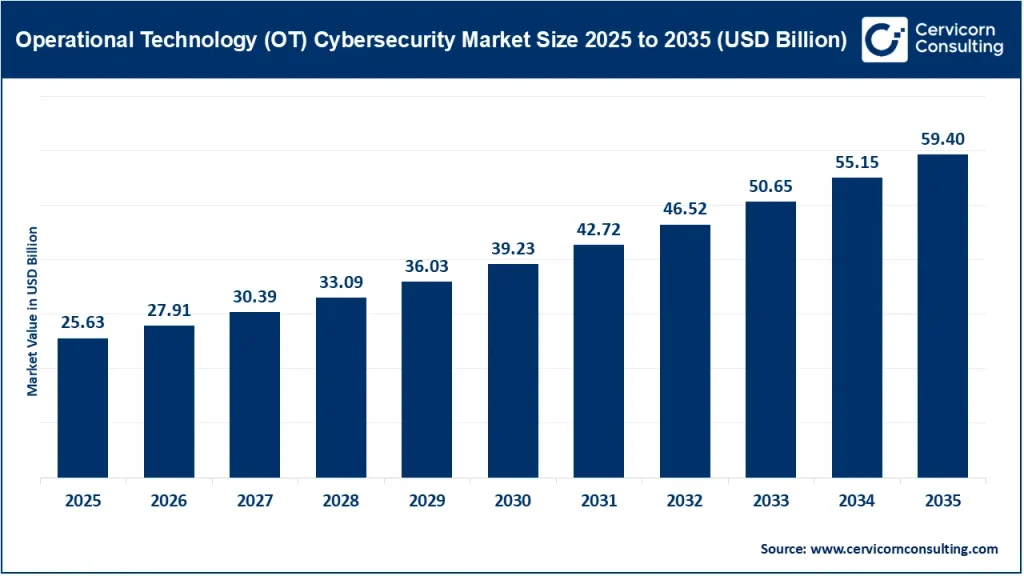
Operational Technology (OT) Cybersecurity Market Size
The global operational technology (OT) cybersecurity market was valued at USD 25.63 billion in 2025, forecasting it to reach USD 59.40 billion by 2035 at an 8.77% CAGR.
Operational Technology (OT) Cybersecurity Market Growth Factors
The operational technology cybersecurity market is growing because of the increasing convergence of IT and OT environments, rapid industrial automation, expansion of Industry 4.0 initiatives, rising deployment of connected industrial devices, growing use of remote monitoring and maintenance, increasing ransomware and nation-state threats against critical infrastructure, stricter cybersecurity regulations, and the need to protect industrial operations from downtime and physical disruption. Traditional OT environments were frequently isolated from corporate networks, but modern factories, power grids, pipelines, water systems, transportation networks, and process industries increasingly depend on interconnected digital infrastructure, expanding the attack surface.
At the same time, aging industrial control systems, legacy programmable logic controllers, insufficient asset visibility, weak authentication, limited patching windows, and shortages of specialized OT cybersecurity professionals create additional vulnerabilities. Regulatory initiatives such as the European Union’s NIS2 Directive, U.S. critical-infrastructure cybersecurity programs, NIST OT guidance, and sector-specific requirements are also encouraging organizations to increase spending on asset inventory, network segmentation, monitoring, incident response, vulnerability management, and zero-trust security.
Get a Free Sample: https://www.cervicornconsulting.com/sample/2719
What Is the Operational Technology (OT) Cybersecurity Market?
Operational technology cybersecurity refers to technologies, products, services, and processes designed to protect systems that monitor or control physical processes. These systems include industrial control systems (ICS), supervisory control and data acquisition (SCADA), distributed control systems (DCS), programmable logic controllers (PLCs), remote terminal units (RTUs), industrial networks, human-machine interfaces (HMIs), industrial IoT devices, building automation systems, and other cyber-physical systems.
According to NIST, OT includes programmable systems and devices that interact with the physical environment or manage devices that interact with the physical environment. NIST SP 800-82 Rev. 3 specifically addresses the unique performance, reliability, and safety requirements of OT environments and identifies threats, vulnerabilities, architectures, and recommended safeguards.
The OT cybersecurity market therefore covers solutions such as industrial firewalls, intrusion detection and prevention systems, secure remote access, endpoint protection, network monitoring, vulnerability management, identity and access management, security information and event management, threat intelligence, security analytics, incident response, managed security services, and specialized OT security platforms.
Unlike conventional IT cybersecurity, OT security must balance confidentiality, integrity, availability, safety, reliability, and operational continuity. An action that is acceptable in an IT environment—such as automatically restarting or patching a system—could disrupt a production line or create safety risks in an industrial environment. Consequently, OT cybersecurity solutions must understand industrial protocols, asset behavior, process dependencies, and operational constraints.
Why Is OT Cybersecurity Important?
OT cybersecurity is important because cyberattacks against operational environments can produce consequences extending far beyond data loss. A successful attack against an industrial control system can interrupt electricity generation, stop manufacturing production, disrupt water treatment, interfere with transportation, compromise oil and gas infrastructure, or affect other essential services.
The increasing convergence between IT and OT is one of the most important factors. Industrial organizations increasingly use enterprise analytics, cloud computing, remote access, connected sensors, digital twins, artificial intelligence, and predictive maintenance. These technologies improve productivity and visibility but also create additional pathways into industrial environments.
OT systems can also remain operational for decades, making modernization difficult. Some industrial assets were designed before cybersecurity became a major engineering requirement. Replacing them may require substantial capital expenditure or lengthy production shutdowns. Consequently, organizations increasingly require passive monitoring, network segmentation, compensating controls, secure remote access, and behavioral detection technologies that can protect legacy environments without disrupting operations.
Government agencies are also emphasizing OT visibility and resilience. CISA’s Cybersecurity Performance Goals provide prioritized security practices for critical infrastructure operators and explicitly address both IT and OT environments.
Leading Companies in the Operational Technology (OT) Cybersecurity Market
| Company | Specialization | Key Focus Areas | Notable Features | 2025 Revenue | OT Market Share | Global Presence |
|---|---|---|---|---|---|---|
| Cisco Systems, Inc. | Networking and cybersecurity | Network segmentation, industrial networking, visibility, secure access | Strong networking ecosystem and integration of security with network infrastructure | USD 56.7B | OT-specific share not publicly disclosed; major global vendor | Worldwide |
| Palo Alto Networks, Inc. | Cybersecurity platforms | Industrial firewalls, OT visibility, segmentation, threat prevention, SOC integration | Next-generation security platform and advanced threat intelligence | USD 9.2B | OT-specific share not publicly disclosed; major global vendor | Worldwide |
| Fortinet, Inc. | Network and unified cybersecurity | OT firewalls, segmentation, secure access, SASE, SecOps | FortiGate industrial security capabilities and broad networking-security integration | USD 6.80B | OT-specific share not publicly disclosed; major global vendor | Worldwide |
| Check Point Software Technologies Ltd. | Network, cloud and endpoint security | Industrial network protection, threat prevention, secure access | Multi-layer security architecture and centralized management | USD 2.73B | OT-specific share not publicly disclosed; established global vendor | Worldwide |
| IBM Corporation | Security software, services and consulting | OT risk management, SOC, threat intelligence, incident response | AI-enabled security, consulting capabilities and enterprise integration | Company-wide revenue; see 2025 Annual Report | OT-specific share not publicly disclosed | Worldwide |
*Note: OT-specific revenue and market-share figures are generally not separately disclosed by these diversified cybersecurity companies. Therefore, company-wide 2025 revenue is provided for scale rather than as OT cybersecurity revenue. Cisco reported FY2025 revenue of approximately USD 56.7 billion, Palo Alto Networks reported FY2025 revenue of USD 9.2 billion, Fortinet reported USD 6.80 billion for FY2025, and Check Point reported FY2025 revenue of USD 2.725 billion. IBM publishes its 2025 Annual Report but changed its software revenue-category structure in 2025, making direct comparison of an OT-specific revenue figure inappropriate. *
Cisco Systems, Inc.
Cisco Systems, Inc. is positioned strongly in OT cybersecurity because industrial protection increasingly depends on secure networking. Cisco’s portfolio supports network visibility, segmentation, secure connectivity, threat detection, and infrastructure protection. Its networking presence gives the company an important role in organizations where IT and OT environments must communicate securely.
Cisco’s FY2025 revenue reached approximately USD 56.7 billion, representing 5% year-over-year growth. Its OT opportunity is particularly relevant in manufacturing, energy, utilities, transportation, and other environments where network architecture is fundamental to industrial security.
Palo Alto Networks, Inc.
Palo Alto Networks, Inc. has expanded its industrial cybersecurity capabilities around next-generation firewalls, network segmentation, threat intelligence, security operations, and OT visibility. Its platform approach enables organizations to connect OT security with broader enterprise security operations.
The company generated USD 9.2 billion in fiscal 2025 revenue, up 15% year over year, while Next-Generation Security ARR reached USD 5.6 billion. Its growth illustrates the increasing demand for integrated cybersecurity platforms capable of protecting multiple layers of modern enterprise infrastructure.
Fortinet, Inc.
Fortinet, Inc. is an important OT cybersecurity supplier through its network security, industrial firewall, segmentation, secure access, and security operations technologies. Fortinet’s approach emphasizes the convergence of networking and security, an important requirement as industrial organizations connect previously isolated systems.
Fortinet generated USD 6.80 billion in full-year 2025 revenue, while its Unified SASE and SecOps billings grew 24%. Its broad installed base in network security provides opportunities to extend protection into industrial environments.
Check Point Software Technologies Ltd.
Check Point Software Technologies Ltd. provides network, cloud, endpoint, mobile, and security management technologies that can be applied to industrial environments. Its multi-layer security approach is relevant for organizations seeking centralized protection across IT and OT-connected infrastructure.
Check Point recorded USD 2.725 billion in 2025 revenue, compared with USD 2.565 billion in 2024. The company’s security subscription revenue also continued to expand, supporting its transition toward recurring security services.
IBM Corporation
IBM Corporation approaches OT cybersecurity through security software, consulting, threat intelligence, incident response, AI-enabled security operations, and enterprise risk management. IBM is particularly relevant to large industrial organizations that require cybersecurity consulting and integration across complex technology environments.
IBM’s security portfolio is increasingly incorporated into its broader software and hybrid-cloud strategy. The company also works with ecosystem partners, including cybersecurity vendors, to deliver enterprise security outcomes.
Leading Trends and Their Impact on the OT Cybersecurity Market
1. IT-OT Convergence
The convergence of enterprise IT and industrial OT is perhaps the most fundamental market driver. Industrial organizations want production data available to business applications, analytics platforms, AI systems, and cloud environments. However, every connection can create additional attack paths.
Impact: Demand is increasing for industrial firewalls, segmentation, secure gateways, identity controls, asset discovery, and continuous monitoring.
2. Zero-Trust Security for Industrial Environments
Zero-trust principles are moving into OT environments. Instead of assuming that devices inside an industrial network are trusted, organizations increasingly seek to verify users, devices, connections, and applications.
Impact: Secure remote access, identity-based segmentation, least-privilege access, multifactor authentication, and policy-driven network controls are becoming more important.
3. AI-Powered OT Threat Detection
Artificial intelligence and machine learning are increasingly being used to identify abnormal industrial behavior. Instead of relying only on known malware signatures, behavioral analytics can identify deviations from normal process and network activity.
Impact: AI can reduce detection time and help security teams analyze large volumes of industrial telemetry, although organizations must ensure that automated actions do not disrupt safety-critical processes.
4. Asset Visibility and Inventory
Organizations cannot protect unknown assets effectively. CISA’s 2025 OT asset-inventory guidance emphasizes developing and maintaining inventories and taxonomies to improve visibility, vulnerability management, resilience, and incident response.
Impact: Asset discovery and passive network monitoring are becoming foundational purchases, especially for organizations with legacy equipment.
5. Secure Remote Access
Remote maintenance became increasingly important as industrial organizations adopted distributed operations. However, remote access can expose control systems if poorly configured.
Impact: Demand is increasing for zero-trust remote access, privileged access management, multifactor authentication, session monitoring, and controlled vendor connectivity.
6. OT Security as a Board-Level Risk
OT cybersecurity is increasingly treated as an operational resilience and business-continuity issue rather than simply an IT security function. A successful attack can affect production, revenue, safety, regulatory compliance, and reputation simultaneously.
Impact: More organizations are integrating OT cybersecurity into enterprise risk management, business continuity planning, insurance requirements, and board-level reporting.
Successful Examples of OT Cybersecurity Around the World
United States: DOE CyOTE Initiative
The U.S. Department of Energy’s Cybersecurity for the Operational Technology Environment (CyOTE) initiative is an important example of government-supported OT cybersecurity development. Led by DOE’s Office of Cybersecurity, Energy Security, and Emergency Response in partnership with Idaho National Laboratory and energy-sector organizations, CyOTE focuses on detecting anomalous behavior in energy OT networks and generating timely, actionable alerts.
This initiative demonstrates how government, national laboratories, and industry can collaborate to improve OT threat detection without treating industrial networks as conventional enterprise IT environments.
United States: Critical Infrastructure Cybersecurity Performance Goals
CISA’s Cross-Sector Cybersecurity Performance Goals provide another successful framework for OT security improvement. The goals establish prioritized practices that critical-infrastructure operators can use to measure and strengthen cybersecurity maturity. They are designed to be practical and applicable to both IT and OT owners and operators.
Europe: NIS2 Cybersecurity Framework
The European Union’s NIS2 Directive represents a major regulatory development for industrial cybersecurity. NIS2 establishes a common legal framework covering 18 critical sectors and expands requirements for cybersecurity risk management, incident reporting, supervision, cooperation, and national cybersecurity strategies.
Because many covered sectors rely heavily on OT systems, the directive is encouraging organizations to strengthen industrial asset management, risk assessment, incident response, supply-chain security, and cyber resilience.
United States: Energy Cybersecurity Baselines
The U.S. Department of Energy and partners have developed cybersecurity baselines for electricity distribution systems and distributed energy resources. In January 2025, DOE’s CESER published draft interim implementation guidance to help utilities and other distribution-system operators strengthen defenses against cyber threats.
The initiative is particularly relevant as renewable energy, battery storage, distributed generation, smart-grid technologies, and connected control systems become more widespread.
Global Industrial Cybersecurity Collaboration
Another successful development is the increasing collaboration among governments, technology providers, industrial operators, national laboratories, and cybersecurity organizations. Such partnerships allow threat intelligence, vulnerability information, best practices, and incident-response capabilities to be shared across sectors.
This collaborative model is particularly important because OT cybersecurity challenges frequently cross national borders. Energy grids, shipping systems, pipelines, manufacturing supply chains, and telecommunications networks can have multinational dependencies.
Global Regional Analysis Including Government Initiatives and Policies
North America
North America currently represents one of the largest OT cybersecurity markets. Grand View Research estimates that North America accounted for approximately 40% of global OT security revenue in 2025. The region benefits from extensive industrial automation, mature cybersecurity infrastructure, significant cybersecurity spending, and strong government involvement.
In the United States, CISA provides Cross-Sector Cybersecurity Performance Goals covering critical infrastructure, while DOE CESER focuses specifically on energy cybersecurity and OT resilience.
The U.S. regulatory environment is encouraging utilities, manufacturers, energy operators, transportation organizations, and other critical infrastructure companies to improve visibility, segmentation, incident response, supply-chain risk management, and resilience.
Canada is also strengthening critical infrastructure cybersecurity through federal cybersecurity programs and sector-specific collaboration. As industrial digitalization accelerates across energy, mining, manufacturing, transportation, and utilities, demand for OT security is expected to remain strong.
Europe
Europe is a major OT cybersecurity market because of its large manufacturing base, energy infrastructure, automotive industry, transportation systems, and increasingly stringent cybersecurity regulations.
The NIS2 Directive is a major market catalyst. It establishes cybersecurity obligations across 18 critical sectors and requires covered organizations to adopt risk-management measures and improve incident reporting and cooperation.
European organizations are also adopting industrial cybersecurity practices aligned with international frameworks such as NIST guidance and IEC 62443. The region’s emphasis on supply-chain security, cyber resilience, and regulatory compliance is increasing demand for OT asset discovery, vulnerability management, network segmentation, secure remote access, and managed security services.
Asia-Pacific
Asia-Pacific is expected to be one of the fastest-growing OT cybersecurity regions because of rapid industrialization, smart manufacturing, infrastructure modernization, energy transition, and expansion of connected industrial systems.
Countries including China, Japan, South Korea, Singapore, India, and Australia are investing in cybersecurity capabilities across manufacturing, energy, transportation, telecommunications, and government infrastructure.
Singapore has established a particularly strong cybersecurity framework for critical information infrastructure, while Australia has strengthened critical-infrastructure cybersecurity through its Security of Critical Infrastructure framework.
India represents an important growth opportunity because of rapid digital transformation, smart manufacturing, energy modernization, telecommunications expansion, and increasing dependence on connected infrastructure. Organizations operating critical information infrastructure must increasingly address cyber risks involving industrial control systems and connected operational environments.
Latin America
Latin America is emerging as an attractive OT cybersecurity market due to modernization of energy infrastructure, mining, oil and gas operations, manufacturing, utilities, and transportation systems. Brazil, Mexico, Argentina, Chile, and Colombia are among the countries contributing to regional demand.
The region faces challenges related to legacy infrastructure, cybersecurity skills shortages, inconsistent security maturity, and constrained budgets. However, ransomware threats and increasing connectivity are pushing industrial organizations toward managed cybersecurity services, network monitoring, secure remote access, and incident response.
Government cybersecurity strategies and critical-infrastructure protection programs are gradually strengthening the regulatory environment. As industrial organizations modernize their technology infrastructure, OT security is increasingly incorporated into broader digital transformation projects.
Middle East & Africa
The Middle East & Africa region offers substantial long-term potential because of large-scale investments in oil and gas, petrochemicals, utilities, smart cities, transportation, desalination, and digital infrastructure.
Countries such as the United Arab Emirates and Saudi Arabia are investing heavily in national cybersecurity capabilities while pursuing industrial and economic diversification strategies. Critical infrastructure protection has become a central component of digital transformation programs.
The oil and gas sector is especially important because industrial control systems are essential to upstream, midstream, refining, and petrochemical operations. Cybersecurity investments therefore increasingly include OT monitoring, industrial firewalls, network segmentation, secure remote access, threat intelligence, and incident-response capabilities.
Market Outlook and Strategic Opportunities
The OT cybersecurity market is moving from a niche industrial-security function toward a strategic component of enterprise resilience. With the market estimated at roughly USD 23.47 billion in 2025 in one major industry forecast and projected to exceed USD 50 billion by 2030, the opportunity spans technology providers, cybersecurity vendors, industrial automation companies, consulting firms, managed security providers, and specialized OT security companies.
Future opportunities are likely to concentrate around AI-enabled behavioral detection, OT asset discovery, zero-trust architectures, industrial network segmentation, secure remote access, vulnerability prioritization, managed OT security services, supply-chain security, and integrated IT-OT security platforms.
As organizations modernize factories, power grids, transportation infrastructure, water systems, oil and gas facilities, and other cyber-physical environments, cybersecurity will increasingly be incorporated at the design stage rather than added after deployment. This shift will support demand for security-by-design architectures, continuous monitoring, secure industrial communications, identity management, and automated risk assessment.
The market will also benefit from increasing regulatory pressure. NIST’s OT security guidance, CISA’s cybersecurity performance goals, European NIS2 requirements, energy-sector initiatives, and national critical-infrastructure policies are creating stronger incentives for organizations to measure and improve their OT security posture.
Overall, the combination of industrial digitalization, IT-OT convergence, cyber threats, regulatory requirements, critical-infrastructure protection, and Industry 4.0 investment is positioning OT cybersecurity as one of the strategically important growth areas within the global cybersecurity ecosystem.
To Get Detailed Overview, Contact Us: https://www.cervicornconsulting.com/contact-us
Read Report: Construction Technology Market Revenue, Trends, and Strategic Insights by 2035