


Solid State Battery Market: Solving the Performance and Safety Limits of Conventional Batteries
The battery industry is facing a difficult question: how can energy storage become safer, lighter, more powerful and faster-charging without simply making conventional lithium-ion batteries increasingly complex? As electric vehicles (EVs), wearables, medical devices, consumer electronics, robotics and renewable energy systems demand more from batteries, limitations surrounding liquid-electrolyte technology are becoming increasingly important.
Conventional lithium-ion batteries can face risks associated with thermal runaway, leakage and electrolyte flammability. At the same time, manufacturers are under pressure to increase energy density, reduce weight and size, extend operating life and shorten charging times. These requirements are particularly important for EVs, where battery weight and energy density influence driving range, while safety and charging performance affect vehicle design and customer adoption.
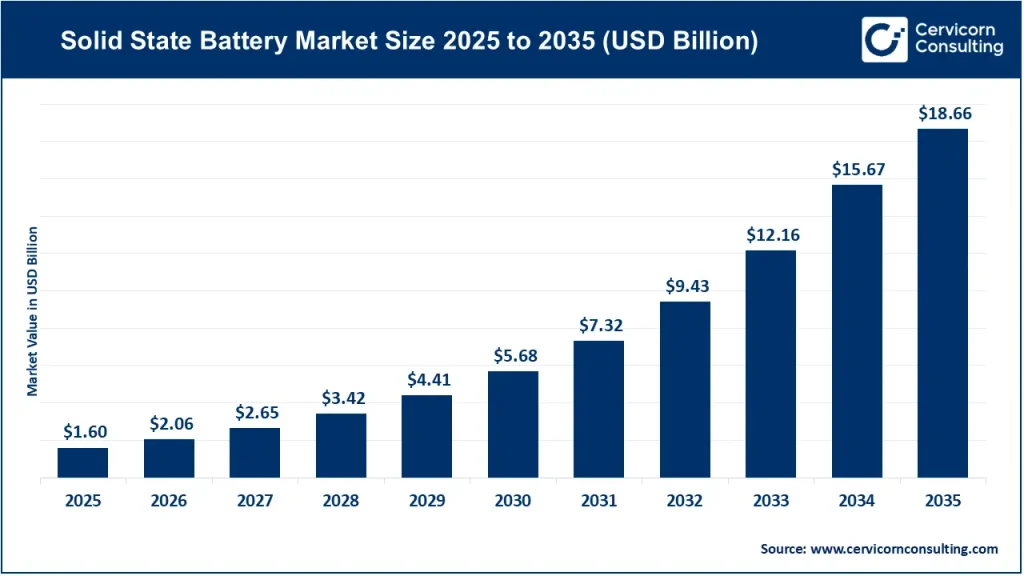
The global solid state battery market was valued at USD 1.60 billion in 2025, is estimated to reach USD 2.06 billion in 2026, and is projected to reach USD 18.66 billion by 2035, expanding at a 27.84% CAGR from 2026 to 2035.
The significance of this growth is not simply the emergence of another battery chemistry. It reflects a broader transition toward battery architectures designed to address performance and safety requirements that are becoming harder to meet with existing technologies.
When conventional batteries reach their limits, the industry needs a different architecture
The pressure on lithium-ion batteries is increasing because applications are becoming more demanding. EV manufacturers want longer driving ranges without continuously increasing battery-pack size. Consumers expect smartphones, laptops and wearables to become thinner while retaining longer operating times. Medical devices need compact, dependable power sources, while industrial equipment, robotics and energy-storage systems increasingly require high power and reliable operation.
Improving conventional lithium-ion cells remains important, but incremental improvements cannot necessarily solve every requirement simultaneously. Increasing energy density, for example, can create additional engineering challenges around thermal management and safety. Faster charging can place greater demands on cell materials and battery-management systems. Larger battery packs can increase vehicle weight, while smaller cells may require more sophisticated manufacturing and thermal-management solutions.
This creates a logical technology pathway: higher performance requirements → greater pressure on liquid-electrolyte systems → development of solid electrolytes → solid-state battery architectures.
How solid-state batteries attempt to solve the problem
The fundamental difference between a conventional lithium-ion battery and a solid-state battery is the electrolyte. Conventional lithium-ion batteries generally use a liquid electrolyte to transport lithium ions between electrodes, whereas solid-state designs use a solid electrolyte.
That architectural change creates several potential advantages, although the benefits depend on the specific chemistry, cell design and manufacturing process.
Liquid-electrolyte leakage and flammability → solid electrolyte → potential improvement in safety and reduced leakage risk.
Energy-density limitations → solid-state architecture and lithium-metal anodes → potential for higher energy density and greater driving range.
Battery-pack weight and size → more compact cell architecture → potential for lighter and smaller battery systems.
Charging limitations → advanced electrolyte and electrode designs → potential for faster charging.
Shorter operating life → improved cell materials and interfaces → potential for longer cycle life.
Lithium-metal anodes are particularly important because they can potentially store more energy than conventional graphite-based anodes. However, a solid electrolyte does not automatically eliminate battery failure or safety risks. Interface stability, mechanical stresses, dendrite formation, manufacturing defects and thermal behavior remain important engineering considerations.
The objective is therefore not simply to replace a liquid with a solid material. It is to create a cell architecture in which the electrolyte, electrodes, interfaces and manufacturing process work together reliably.
Get a Free Sample: https://www.cervicornconsulting.com/sample/2769
Why the Solid State Battery Market is expanding
The market is expanding because several industry problems are converging at the same time. EV manufacturers are searching for longer range, faster charging and improved safety; electronics manufacturers need smaller and more energy-dense batteries; medical-device developers require compact and reliable power sources; and industrial and renewable-energy applications increasingly require durable energy storage. Government incentives, sustainability objectives, automotive R&D programs and technology-company investment are accelerating the transition from laboratory research toward pilot production and commercialization. Cervicorn Consulting identifies safety and performance requirements, government support and significant investment from automotive and technology companies as major market drivers.
2026 marks a shift from laboratory research toward commercialization
The key question in 2026 is no longer whether solid-state batteries can work at laboratory scale. The more important question is whether they can work reliably, economically and repeatedly at automotive and industrial scale.
This is why the industry is increasingly focused on pilot lines, automotive testing, multi-cell systems, production equipment, electrolyte manufacturing and supply-chain development.
QuantumScape and Volkswagen Group battery company PowerCo expanded their collaboration in 2025, with PowerCo committing up to USD 131 million in additional payments over two years, subject to development milestones, to support scale-up of QuantumScape’s QSE-5 pilot line.
Factorial and Stellantis provide another example of this transition. In 2025, the companies validated automotive-sized FEST solid-state cells with 375 Wh/kg energy density and charging from 15% to 90% in 18 minutes. In June 2026, those cells were integrated into a Dodge Charger Daytona development vehicle and entered road testing to evaluate performance, safety and reliability under real-world conditions.
Solid Power is pursuing another commercialization pathway through electrolyte development and manufacturing partnerships. Its 2025 results highlighted work with Samsung SDI and BMW, a continuous electrolyte production pilot line planned for commissioning in 2026, and installation work for a pilot cell manufacturing line at SK On.
Samsung SDI is also targeting commercial production. The company stated in 2026 that it plans to begin mass production of all-solid-state batteries in the second half of 2027 and is positioning the technology for applications including humanoid and industrial robots.
These developments demonstrate the real commercialization pathway: research → prototype → pilot production → vehicle or product demonstration → qualification → commercial manufacturing.
Different solid-state technologies are solving different problems
There is no single solid-state battery architecture. Different electrolyte technologies involve different trade-offs.
Sulfide electrolytes offer high ionic conductivity and are being pursued extensively by Asian battery manufacturers. Their challenge is processing and environmental stability. Sulfide materials can be sensitive to air and moisture, creating additional manufacturing requirements.
Oxide electrolytes can offer strong chemical and thermal stability, but processing dense ceramic materials and creating reliable interfaces can increase manufacturing complexity.
Polymer electrolytes can offer manufacturing advantages and flexibility, but their ionic conductivity and temperature performance can create trade-offs depending on the application.
Lithium-metal anodes address the energy-density problem by enabling higher-capacity anode designs, but controlling interfaces and maintaining stable cycling remains a critical challenge.
Thin-film solid-state batteries address a different problem: miniaturization. Their small, lightweight architecture is relevant to wearables, IoT sensors and medical implants. Cervicorn identifies thin-film batteries as the leading type segment, with a 59.4% revenue share in 2025.
Multi-cell systems address the scale problem. A laboratory cell is insufficient for an EV or industrial application; manufacturers need hundreds or thousands of cells operating consistently as a system. Multi-cell batteries represented 54.6% of the market in 2025, according to Cervicorn.
The biggest commercial problem is scaling production
The strongest solid-state battery laboratory result does not automatically translate into a commercially viable battery.
Mass production introduces problems that may not appear at small scale: electrolyte processing, interface consistency, material handling, production yield, quality control, equipment requirements and cell-to-cell variation. A process that works for a small number of prototype cells may become expensive or unreliable when applied to millions of cells.
Production costs are therefore one of the most important constraints in the Solid State Battery Market. Cervicorn identifies intensive production expenditure and the difficulty of moving from pilot facilities to large-scale manufacturing as major restraints.
This explains why so much current investment is going into manufacturing rather than only chemistry.
Companies are competing to solve different parts of the battery problem
The competitive landscape includes established battery manufacturers, automakers, electronics companies, materials specialists and startups. Cervicorn identifies Bolloré Group (Blue Solutions), QuantumScape, Toyota, Solid Power, TDK, Samsung SDI, Hitachi Zosen, Ilika, Ganfeng Lithium, ProLogium, Ionic Materials, Prieto Battery, Factorial, theion, Sakuu, Ion Storage Systems, SK On and Natrion among the key companies in the market.
| Company | Main focus | Commercialization problem being addressed | Solid-state-specific 2025 revenue/market share |
|---|---|---|---|
| QuantumScape | Lithium-metal solid-state cells | Scaling high-performance cells for automotive applications | Not publicly disclosed |
| Toyota | Solid-state EV technology | Automotive durability, range and production scale | Not publicly disclosed |
| Solid Power | Sulfide electrolyte and cells | Electrolyte production and scalable cell manufacturing | Not publicly disclosed |
| Samsung SDI | All-solid-state batteries | High energy density, safety and mass production | Not publicly disclosed |
| Factorial | FEST solid-state technology | Automotive integration, fast charging and manufacturability | Not publicly disclosed |
| SK On | Solid-state and lithium-metal batteries | Pilot manufacturing and production processes | Not publicly disclosed |
| TDK | Solid-state and compact batteries | Miniaturization and electronics applications | Not publicly disclosed |
| ProLogium | Solid-state battery systems | Large-format cells and manufacturing scale | Not publicly disclosed |
Rather than competing only on energy density, these companies are increasingly competing on manufacturability, reliability, yield, cost and integration.
Investment is moving toward the commercialization bottleneck
The direction of capital provides another indication of where the industry sees its biggest challenges. Funding is increasingly supporting pilot production, electrolyte manufacturing, automotive partnerships, R&D facilities and scale-up programs.
TrendForce reported that global solid-state battery funding exceeded USD 1.3 billion across more than 57 financing deals from 2025 through the first quarter of 2026, involving 46 companies. The funding activity has focused heavily on sulfide-based and polymer/oxide-composite electrolyte technologies.
The significance is that investors are increasingly funding the infrastructure required to turn laboratory performance into repeatable industrial production.
Electric vehicles are creating the largest commercial opportunity
The automotive sector represents the most visible opportunity because EVs expose almost every weakness that next-generation batteries are trying to address.
Longer range requires higher energy density. Faster charging requires improved electrochemical performance. Lower vehicle weight improves efficiency. Greater safety can simplify some aspects of battery-pack engineering.
Cervicorn estimates that electric vehicles accounted for 47.8% of Solid State Battery Market revenue in 2025, making EVs the leading application.
The opportunity extends beyond passenger cars to motorcycles, commercial mobility and specialized transportation. QuantumScape and PowerCo demonstrated QSE-5 technology in a Ducati motorcycle in 2025, while Factorial and Stellantis moved from automotive-sized cell validation to vehicle-level road testing in 2026.
Consumer electronics and medical devices offer a different opportunity
Not every application requires a large automotive battery.
Wearables, IoT devices, medical sensors and implants can benefit from smaller batteries that prioritize compactness, safety and long operating life. Thin-film technology is particularly relevant because it can provide energy storage in form factors that are difficult to accommodate with conventional battery architectures.
Cervicorn reports that thin-film batteries represented 59.4% of market revenue in 2025, reflecting their relevance to compact electronics, wearables and IoT applications.
This creates opportunities for semiconductor companies, electronics manufacturers, medical-device developers, material suppliers and specialized battery startups.
Industrial, robotics and energy storage could become the next expansion areas
The solid-state opportunity is also moving beyond EVs. Industrial robots, aerospace systems, specialized equipment and renewable-energy applications can benefit from batteries designed around safety, compactness and high performance.
Samsung SDI’s 2026 strategy illustrates this expansion. The company is positioning all-solid-state batteries for physical-AI applications such as humanoid robots, mobile robots and industrial robots, where high energy density, stable power output and safety are important.
At the same time, multi-cell solid-state systems are important for industrial and energy-storage applications because they demonstrate whether individual cell performance can be converted into reliable system-level operation.
Regional competition is becoming a competition for manufacturing capability
Asia-Pacific held 48.2% of global Solid State Battery Market revenue in 2025, supported by EV production, battery manufacturing and R&D investment. Cervicorn estimates the Asia-Pacific market at USD 0.77 billion in 2025 and projects it to reach approximately USD 8.99 billion by 2035.
Japan is particularly focused on building an advanced battery supply chain. TrendForce reported in 2026 that Japan’s government had approved five major projects related to the all-solid-state battery supply chain under its battery-support framework, with total subsidies reaching approximately USD 660 million.
South Korea is combining battery-manufacturer investment with pilot production. Samsung SDI is targeting all-solid-state mass production in 2027, while SK On has been developing pilot manufacturing capabilities.
China brings another important advantage: enormous battery manufacturing capacity and a deep supplier ecosystem. Its companies are simultaneously developing solid-state technologies while advancing competing chemistries such as sodium-ion. This means solid-state developers face pressure not only from conventional lithium-ion batteries but also from alternative next-generation technologies.
North America remains important for startup innovation and commercialization. QuantumScape’s pilot-line development and partnerships with PowerCo demonstrate how technology developers are using strategic automotive relationships to reduce commercialization risk.
Europe is similarly using automotive partnerships to move solid-state technology toward vehicle integration, with companies such as Stellantis and BMW involved in development and testing programs.
What does it take to enter the Solid State Battery Market?
For a new entrant, developing a promising electrolyte is only the beginning.
Companies need access to materials, intellectual property, cell-design expertise, manufacturing equipment, quality-control systems and testing infrastructure. Automotive suppliers also face long qualification cycles because battery technologies must demonstrate consistent performance across temperature, charging, cycling, safety and durability conditions.
The most important question for market entrants is therefore not simply, “Can we develop a better battery?”
It is “Can we manufacture this battery consistently at an acceptable cost and integrate it into a customer’s product?”
That distinction separates laboratory innovation from commercial opportunity.
Governments are helping solve the scale-up problem
Government policy is increasingly focused on creating domestic battery ecosystems rather than funding research in isolation. Incentives can support R&D, pilot manufacturing, EV adoption, local production, strategic materials and supply-chain development.
In Japan, government support is being directed toward solid-state battery commercialization and supply-chain development. In South Korea, industrial policy supports the country’s large battery manufacturers and their next-generation technology programs. China is combining large-scale manufacturing infrastructure with substantial investment in multiple battery chemistries. India is building its broader battery and EV ecosystem through domestic manufacturing and electrification initiatives.
North America is focused heavily on domestic battery supply chains and advanced battery research, while Europe is linking battery development with EV manufacturing, sustainability and regulatory requirements.
The underlying problem is the same across these regions: without local manufacturing capability, technological leadership may not translate into commercial leadership.
The business impact is larger than the battery industry
Solid-state commercialization could affect automakers through new vehicle architectures, battery-pack design and charging strategies. Battery manufacturers will need new production equipment and materials. Electronics companies may gain access to smaller and safer energy-storage formats. Medical-device manufacturers could explore longer-lasting compact power sources. Material and mining companies may see changes in demand for lithium, electrolytes and advanced electrode materials.
Charging-infrastructure companies could also be affected if faster-charging solid-state EVs become commercially available. Investors and technology startups, meanwhile, will need to evaluate which technologies are progressing from laboratory performance to repeatable production.
The business opportunity therefore extends across the battery value chain: materials → electrolytes → cells → packs → vehicles and devices → manufacturing equipment → testing → charging and energy infrastructure.
The opportunity ahead
The next stage of the Solid State Battery Market will be determined less by laboratory breakthroughs and more by whether manufacturers can solve the difficult transition from prototype to production.
The market is already moving through that transition. Factorial and Stellantis are testing solid-state technology in a vehicle. QuantumScape and PowerCo are expanding pilot-scale commercialization work. Solid Power is developing electrolyte and manufacturing infrastructure. Samsung SDI is targeting mass production while expanding potential applications into robotics. Meanwhile, Asian manufacturers and governments are investing heavily in pilot lines and supply-chain development.
Competition will also remain intense. Solid-state batteries must demonstrate advantages against increasingly capable lithium-ion technology while competing for investment with sodium-ion and lithium-sulfur batteries and other next-generation chemistries. Cervicorn specifically identifies competition from sodium-ion, lithium-sulfur and flow batteries as an important market challenge.
The commercial opportunity ultimately depends on solving four connected problems: the performance limits of conventional batteries, the technical challenges of solid-state cells, the manufacturing difficulty of producing them at scale, and the cost of bringing them into real products.
With the market projected by Cervicorn Consulting to grow from USD 1.60 billion in 2025 to USD 18.66 billion by 2035, the Solid State Battery Market is increasingly becoming a commercialization race rather than a purely research-driven technology field.
To Get Detailed Overview, Contact Us: https://www.cervicornconsulting.com/contact-us
Read Report: Injectable Drug Delivery Market Revenue, Trends, and Strategic Insights by 2035