


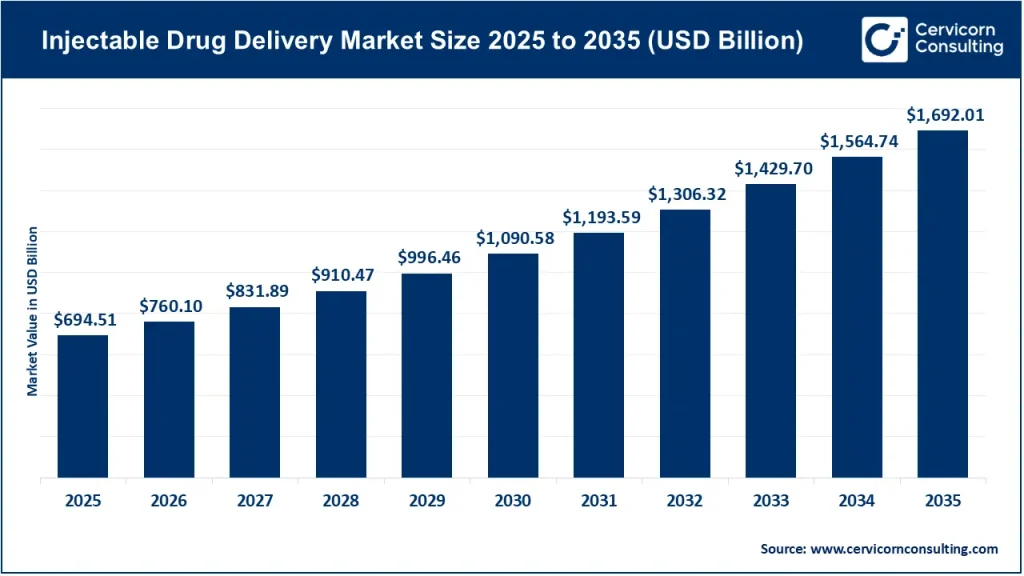
Injectable Drug Delivery Market Size
The global injectable drug delivery market size was valued at USD 694.51 billion in 2025 and is projected to reach USD 1,692.01 billion by 2035, representing a 9.31% CAGR.
Injectable drug delivery market growth factors
The global injectable drug delivery market is expanding as pharmaceutical companies increasingly rely on biologics, vaccines, insulin, monoclonal antibodies, long-acting therapies, and other medicines that require administration through injectable routes. The growing prevalence of chronic diseases such as diabetes, cancer, cardiovascular disorders, autoimmune diseases, and neurological conditions is increasing demand for reliable parenteral drug administration.
At the same time, the rapid development of high-value biologic and peptide-based medicines is encouraging manufacturers to adopt prefilled syringes, autoinjectors, pen injectors, wearable injectors, and other patient-centric delivery technologies. The shift from hospital-based treatment toward home-based care is another important growth driver because patients require delivery systems that are easier and safer to operate without continuous professional supervision. Increasing demand for self-administration, improved dose accuracy, reduced medication waste, needle-safety mechanisms, and connected drug delivery devices is further supporting market development.
Pharmaceutical companies are also increasingly using combination products that integrate a medicine with a delivery device, while regulatory agencies are developing clearer frameworks for these products. The U.S. FDA, for example, identifies prefilled syringes and autoinjectors as examples of drug-device combination products and has been developing guidance around drug-delivery performance.
Get a Free Sample: https://www.cervicornconsulting.com/sample/2766
What is the injectable drug delivery market?
The injectable drug delivery market encompasses technologies, devices, products, and services used to administer pharmaceutical and biological medicines through injection or infusion. Injectable administration can involve intravenous, intramuscular, subcutaneous, intradermal, or other parenteral routes depending on the drug, therapeutic objective, and formulation.
The market includes conventional syringes and needles as well as increasingly sophisticated systems such as prefilled syringes, autoinjectors, pen injectors, wearable injectors, infusion systems, needle-free injectors, and other specialized delivery platforms. The U.S. FDA classifies prefilled drug delivery systems such as prefilled syringes and autoinjectors among combination products when the drug and delivery device are integrated.
Injectable drug delivery is particularly important for medicines that cannot be effectively delivered orally because of degradation in the gastrointestinal tract, poor absorption, or the need for rapid or controlled systemic exposure. Injectable systems are therefore closely associated with vaccines, insulin, GLP-1 therapies, monoclonal antibodies, oncology drugs, anesthetics, emergency medicines, and numerous hospital-administered treatments.
Market research estimates also demonstrate the scale of the broader opportunity. One recent estimate places the global injectable drug delivery market at approximately USD 756.22 billion in 2025, with projections reaching about USD 1.72 trillion by 2034, representing a CAGR of approximately 9.56%. North America accounted for approximately 22.83% of the market in 2025 in that assessment.
Why is the injectable drug delivery market important?
Injectable delivery is essential because it provides a route for administering medicines that require high bioavailability, rapid action, precise dosing, or direct systemic delivery. In hospitals, injectable products are fundamental to emergency medicine, surgery, oncology, intensive care, vaccination, and treatment of severe infections.
The importance of the market is increasing as pharmaceutical innovation moves toward biologics and complex molecules. Many biological medicines cannot be administered conveniently through conventional oral dosage forms. Consequently, delivery technology increasingly becomes an important component of the overall pharmaceutical product.
Patient convenience is another important consideration. A conventional syringe generally requires a healthcare professional, while an autoinjector or pen injector can allow appropriately trained patients to administer medicines at home. This supports the broader transition toward decentralized healthcare and chronic-disease self-management.
Injectable delivery systems can also improve medication consistency. Prefilled systems can reduce preparation steps, while automated devices can provide controlled injection speeds and integrated safety mechanisms. These characteristics are especially relevant when medicines are expensive, require accurate dosing, or have complicated administration requirements.
Key companies in the injectable drug delivery market
Becton, Dickinson and Company
Company: Becton, Dickinson and Company (BD)
Specialization: Medical technology, injection devices, medication management, syringes, needles, and drug-delivery systems
Key Focus Areas: Safety-engineered injection devices, prefillable and prefilled systems, injection technologies, medication management, and pharmaceutical manufacturing support
Notable Features: Broad healthcare-device portfolio and extensive presence across hospitals, pharmaceutical manufacturers, laboratories, and healthcare providers
2025 Revenue: Approximately USD 21.84 billion in fiscal 2025
Market Share: BD does not publicly disclose a standalone percentage market share for the global injectable drug delivery market.
Global Presence: Global operations serving healthcare systems, pharmaceutical companies, and other customers across multiple geographic markets.
BD is a major participant in the injectable delivery ecosystem because its portfolio extends across syringes, needles, safety devices, and technologies used in pharmaceutical and clinical environments. Its position is particularly relevant to the infrastructure supporting injectable medicines rather than being limited to the pharmaceutical products themselves.
BD reported fiscal 2025 revenue of USD 21.84 billion, representing an 8.2% reported increase from fiscal 2024.
Pfizer Inc.
Company: Pfizer Inc.
Specialization: Innovative pharmaceuticals, vaccines, biologics, and specialty medicines
Key Focus Areas: Vaccines, oncology, internal medicine, inflammation and immunology, hospital medicines, and biologic therapies
Notable Features: Large global pharmaceutical portfolio and significant experience with injectable vaccines and biologic medicines
2025 Revenue: USD 62.58 billion
Market Share: Pfizer does not publicly report a standalone global injectable drug delivery market share.
Global Presence: Extensive commercial and manufacturing presence across international pharmaceutical markets.
Pfizer contributes to the injectable drug delivery ecosystem primarily through medicines that require or commonly use injectable administration, particularly vaccines and biologic therapies. Its portfolio includes major vaccine products and hospital-oriented medicines, creating ongoing demand for appropriate injectable presentation and administration systems.
Pfizer reported USD 62.579 billion in 2025 revenue. Its 2025 portfolio included major vaccine revenue, with the Prevnar family generating approximately USD 6.49 billion and Comirnaty generating approximately USD 4.37 billion.
Teva Pharmaceutical Industries Ltd.
Company: Teva Pharmaceutical Industries Ltd.
Specialization: Generic and innovative pharmaceuticals
Key Focus Areas: Specialty medicines, neuroscience, respiratory therapies, injectable medicines, biosimilars, and complex pharmaceutical formulations
Notable Features: Combination of generic and innovative pharmaceutical capabilities and growing specialty-medicine portfolio
2025 Revenue: USD 17.26 billion
Market Share: Teva does not publicly disclose a standalone share of the global injectable drug delivery market.
Global Presence: Broad international pharmaceutical presence spanning North America, Europe, Israel, and other markets.
Teva is relevant to injectable drug delivery through specialty pharmaceutical products and long-acting injectable medicines. Its UZEDY portfolio is an example of the increasing importance of long-acting injectable treatments in chronic neurological and psychiatric conditions.
Teva reported USD 17.258 billion in 2025 revenue, up 4% in U.S.-dollar terms from 2024. UZEDY generated USD 191 million in 2025 revenue and was identified by Teva as a rapidly growing long-acting injectable product.
Eli Lilly and Company
Company: Eli Lilly and Company
Specialization: Innovative pharmaceuticals and biologic medicines
Key Focus Areas: Diabetes, obesity, oncology, immunology, neuroscience, and cardiometabolic diseases
Notable Features: Major injectable portfolio involving incretin-based therapies and other biologic medicines
2025 Revenue: USD 65.18 billion
Market Share: Eli Lilly does not publicly disclose a standalone global injectable drug delivery market share.
Global Presence: Major pharmaceutical operations and commercial activities across global markets.
Eli Lilly has become particularly important to the injectable drug delivery landscape because of strong demand for injectable metabolic therapies. Its Mounjaro and Zepbound products have increased the strategic importance of convenient injection systems capable of supporting large patient populations.
Lilly reported USD 65.179 billion in 2025 revenue, while its 2025 results reflected strong volume growth associated with Mounjaro and Zepbound.
Leading trends and their impact on the injectable drug delivery market
Rising adoption of prefilled syringes
Prefilled syringes are becoming increasingly important because they reduce preparation requirements and can improve dosing convenience. They are particularly relevant to biologics and vaccines, where minimizing handling can support product integrity and workflow efficiency.
Regulators recognize prefilled syringes as drug-device combination products in several circumstances. The FDA specifically identifies prefilled drug syringes as single-entity combination products.
Expansion of autoinjectors and pen injectors
Autoinjectors and pen injectors are supporting the shift toward self-administration. Their potential to simplify injection procedures makes them attractive for chronic therapies administered outside hospitals.
The trend is particularly visible in diabetes, obesity, autoimmune disease, allergy, and other therapeutic areas requiring repeated subcutaneous administration. Device ergonomics, needle protection, dose confirmation, and human-factors engineering are becoming important design considerations.
Growth of biologics and high-value injectable therapies
The increasing development of monoclonal antibodies, peptide therapies, vaccines, cell and gene therapies, and other complex medicines is expanding demand for sophisticated injectable systems.
Because biologics can be sensitive to temperature, shear forces, container interactions, and mechanical stress, delivery systems must be designed around the characteristics of the specific formulation. FDA guidance on prefilled glass syringes highlights the importance of evaluating factors such as viscosity, fluid-path resistance, back pressure, shear forces, and potential effects on product safety and effectiveness.
Home-based healthcare and self-administration
Healthcare delivery is increasingly moving beyond hospitals and clinics. Patients with chronic diseases can increasingly receive injectable therapies at home, reducing dependence on frequent healthcare visits.
This trend is increasing demand for intuitive devices that require limited preparation, minimize user error, provide clear dose feedback, and incorporate needle-safety features.
Connected and smart injection devices
Digital health technologies are being integrated into drug delivery devices. Connected injectors can potentially record dosing events, provide reminders, monitor adherence, and transmit information to digital health platforms.
For pharmaceutical companies, connected delivery can also create opportunities to support adherence programs and gather real-world information about medication use, subject to applicable privacy and regulatory requirements.
Wearable injectors
Wearable injectors are emerging as an alternative for delivering larger volumes or medicines that require longer administration times. These devices can attach to the patient’s body and administer medication automatically.
The technology is particularly relevant to biologics and specialty therapies where traditional syringes may not provide the desired combination of volume, duration, and patient convenience.
Needle-free injection
Needle-free technologies are attracting attention because they can reduce needle-related concerns and potentially improve patient acceptance. Jet injectors use pressure to deliver medication through the skin without a conventional needle.
Although adoption varies by therapeutic application and technology, needle-free delivery remains an area of technological development within the broader injectable ecosystem.
Combination-product development
The convergence of pharmaceutical formulations and delivery devices is changing product development strategies. A modern injectable medicine may be designed simultaneously with a prefilled syringe, autoinjector, pen, or wearable injector.
This increases the importance of collaboration between pharmaceutical companies, device manufacturers, packaging specialists, and regulatory teams.
Successful examples of injectable drug delivery around the world
United States: injectable metabolic therapies
The United States has become an important market for self-administered injectable metabolic medicines. Products such as Mounjaro and Zepbound demonstrate how pharmaceutical demand and drug-delivery innovation can develop together.
The rapid commercial expansion of these therapies is increasing demand for convenient injection formats and manufacturing capacity. Lilly reported strong 2025 revenue growth driven in part by Mounjaro and Zepbound volume.
Europe: integrated prefilled delivery
European regulatory frameworks have established pathways for medicines supplied as integral drug-device products. EMA documentation specifically recognizes single-use prefilled syringes, prefilled pens, and prefilled injectors, including autoinjectors, as examples of integral products.
This regulatory structure supports the development of injectable therapies where the delivery device is an integrated part of the pharmaceutical product.
Israel and international markets: long-acting injectables
Teva’s UZEDY illustrates the development of long-acting injectable medicines for chronic neurological and psychiatric conditions. The company reported USD 191 million in UZEDY revenue in 2025 and highlighted its rapid growth.
Long-acting formulations can reduce the frequency of administration compared with some conventional treatment schedules, potentially improving convenience for appropriate patients.
Global vaccination programs
Vaccination remains one of the world’s largest applications of injectable drug delivery. The widespread use of injectable vaccines has driven requirements for high-volume syringe manufacturing, safety systems, cold-chain compatibility, sterile manufacturing, and efficient administration workflows.
The experience gained from large-scale vaccination programs has also strengthened the global ecosystem supporting injectable medicines.
Global regional analysis including government initiatives and policies shaping the market
North America
North America remains a major market for injectable drug delivery because of its pharmaceutical industry, advanced healthcare infrastructure, high adoption of biologics, and growing demand for self-administered therapies.
The United States has an established regulatory framework for combination products. The FDA’s Office of Combination Products coordinates regulatory approaches for products combining drugs, devices, and biological products.
In June 2024, the FDA issued draft guidance concerning Essential Drug Delivery Outputs (EDDO) for devices intended to deliver drugs and biological products. The guidance is intended to clarify the data needed to demonstrate drug-delivery performance and reduce uncertainty during regulatory review.
The U.S. framework also covers specific technical considerations for syringes, autoinjectors, injectors, and other drug-delivery technologies. This regulatory clarity is important as pharmaceutical companies increasingly commercialize combination products.
Canada also maintains regulatory oversight for pharmaceutical products and medical devices, supporting the development and commercialization of injectable therapies and associated delivery technologies.
Europe
Europe has a mature pharmaceutical and medical-device ecosystem and significant demand for biologics, vaccines, diabetes therapies, and specialty medicines.
The European regulatory environment is particularly important for drug-device combinations. EMA guidance addresses products that combine medicinal products and medical devices, including integral products such as prefilled syringes and pens.
The region’s regulatory framework encourages manufacturers to consider both the pharmaceutical characteristics of a medicine and the safety and performance of its delivery device. This is increasingly relevant as autoinjectors and other patient-administered systems become more common.
Asia-Pacific
Asia-Pacific is becoming increasingly important because of its large patient population, expanding healthcare expenditure, pharmaceutical manufacturing capabilities, and increasing access to advanced therapies.
China, Japan, South Korea, India, Australia, and Southeast Asian countries are developing healthcare and pharmaceutical infrastructure that supports injectable medicines. Local pharmaceutical manufacturing and biosimilar development can also expand access to injectable therapies.
India is particularly important as both a pharmaceutical manufacturing center and a major healthcare market. Government programs supporting pharmaceutical manufacturing, biotechnology, medical-device production, and healthcare infrastructure can contribute to domestic injectable drug-delivery capabilities.
The broader Indian biotechnology ecosystem has also expanded significantly, with India’s bioeconomy reported at approximately USD 195.3 billion in 2025 and a government-linked ambition of reaching USD 300 billion by 2030.
Latin America
Latin America presents opportunities for injectable drug delivery because of expanding healthcare coverage, vaccination programs, increasing chronic-disease prevalence, and greater availability of specialty medicines.
Brazil and Mexico represent major pharmaceutical markets in the region. Public healthcare systems and national vaccination programs create substantial requirements for injectable medicines and associated administration products.
Market development is influenced by regulatory requirements, procurement systems, healthcare budgets, and local pharmaceutical manufacturing. Suppliers able to provide cost-effective syringes, safety devices, and other injection technologies can benefit from increasing healthcare access.
Middle East and Africa
The Middle East and Africa represent developing opportunities for injectable drug delivery, particularly through vaccination, hospital infrastructure expansion, diabetes treatment, oncology, and infectious-disease management.
Gulf countries are investing in modern healthcare infrastructure and pharmaceutical manufacturing capabilities, while several African countries are strengthening vaccination and essential-medicine programs.
Challenges include healthcare-access disparities, cold-chain infrastructure, affordability, supply-chain reliability, and availability of trained healthcare personnel. Consequently, delivery systems that are robust, simple to use, cost-efficient, and compatible with local healthcare environments can have particular importance in these markets.
Government initiatives and regulatory policies shaping the market
Government policy is influencing injectable drug delivery through several channels, including pharmaceutical regulation, medical-device requirements, combination-product frameworks, manufacturing standards, patient safety, and procurement.
In the United States, FDA combination-product regulations are particularly significant because many modern injectable systems combine a pharmaceutical product with a device. Prefilled syringes, autoinjectors, and other delivery systems can therefore require evaluation of both pharmaceutical and device-related characteristics.
The FDA’s recent focus on Essential Drug Delivery Outputs is also significant because it aims to establish clearer expectations regarding evidence demonstrating that a device delivers the intended dose to the intended delivery site.
In Europe, EMA guidance addresses integral drug-device products and recognizes prefilled syringes, prefilled pens, and prefilled injectors as important examples of such products.
Regulatory attention is also increasing around human factors and use-related risks. This is particularly important as injectable systems move from healthcare professionals toward patient self-administration. Device manufacturers must therefore consider usability, labeling, instructions, packaging, needle protection, dose confirmation, and the ability of patients to correctly operate the system.
At the manufacturing level, sterile production, container-closure integrity, particulate control, device reliability, and pharmaceutical compatibility remain central requirements. As injectable therapies become more complex, regulatory expectations are increasingly connected to the entire drug-device combination rather than the pharmaceutical formulation alone.
The result is a market in which injectable drug delivery is no longer limited to conventional syringes. Pharmaceutical innovation, device engineering, digital health, biologics, self-administration, and regulatory development are increasingly converging to create integrated drug-delivery platforms.
To Get Detailed Overview, Contact Us: https://www.cervicornconsulting.com/contact-us
Read Report: Food Packaging Market Revenue, Trends, and Strategic Insights by 2035