


Table of Contents
ToggleSolar Hydrogen Panel Market Size
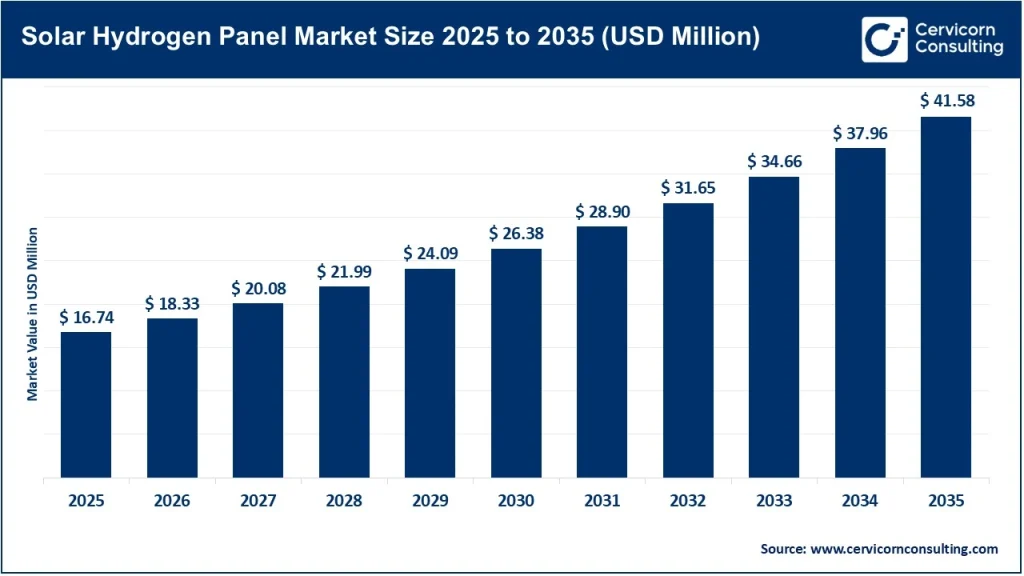
The global solar hydrogen panel market was valued at USD 16.74 million in 2025 and is projected to reach approximately USD 41.58 million by 2035, growing at a robust CAGR of 9.5% during the forecast period from 2026 to 2035.
What is the Solar Hydrogen Panel Market?
The solar hydrogen panel market refers to the industry focused on developing, manufacturing, and commercializing panels capable of producing hydrogen directly from sunlight and water. Unlike conventional solar photovoltaic systems that generate electricity, solar hydrogen panels combine solar energy harvesting with water-splitting technologies to produce green hydrogen, a clean fuel that can be stored and used later for electricity generation, transportation, industrial processes, and energy storage. These systems typically utilize photoelectrochemical (PEC) cells, photocatalytic materials, or integrated photovoltaic-electrolyzer technologies to convert solar energy directly into hydrogen. The market is gaining momentum as governments, energy companies, and technology developers seek sustainable alternatives to fossil fuels and long-duration energy storage solutions. According to industry estimates, the global solar hydrogen panel market remains in its early commercialization phase but is expected to experience strong growth as technological efficiencies improve and hydrogen infrastructure expands globally.
Why is the Solar Hydrogen Panel Market Important?
The importance of the solar hydrogen panel market extends beyond renewable electricity generation. One of the biggest challenges facing renewable energy systems is intermittency, as solar and wind power depend on weather conditions. Solar hydrogen panels address this issue by converting surplus solar energy into hydrogen, which can be stored for weeks or months and used when needed.
Green hydrogen produced through solar hydrogen panels offers several advantages:
- Supports global decarbonization goals.
- Enables long-term renewable energy storage.
- Reduces dependence on fossil fuels.
- Provides clean fuel for transportation and industrial sectors.
- Enhances energy security through local hydrogen production.
- Supports hard-to-abate industries such as steel, chemicals, and heavy manufacturing.
As countries pursue net-zero emissions targets, solar hydrogen technologies are emerging as a strategic solution for integrating renewable energy into broader energy systems. Research increasingly highlights hydrogen’s role in supporting renewable energy flexibility, grid balancing, and industrial decarbonization.
Get a Free Sample: https://www.cervicornconsulting.com/sample/2969
Solar Hydrogen Panel Market Growth Factors
The solar hydrogen panel market is experiencing rapid growth due to increasing global investments in green hydrogen infrastructure, rising commitments toward carbon neutrality, growing adoption of renewable energy systems, declining costs of solar technologies, advancements in photoelectrochemical and photocatalytic materials, expansion of hydrogen refueling networks, increasing industrial demand for clean hydrogen, supportive government funding programs, favorable hydrogen roadmaps across major economies, rising energy security concerns, growing need for long-duration energy storage solutions, and strong public-private partnerships focused on accelerating commercial-scale hydrogen production technologies. Additionally, ongoing research aimed at improving solar-to-hydrogen conversion efficiency and reducing production costs is expected to significantly enhance market adoption over the next decade.
Key Companies in the Solar Hydrogen Panel Market
| Company | Specialization | Key Focus Areas | Notable Features | 2025 Revenue* | Market Share* | Global Presence |
|---|---|---|---|---|---|---|
| SunHydrogen, Inc. | Photoelectrochemical hydrogen panels | Direct solar-to-hydrogen production | Nanoparticle-based PEC technology; pilot-scale development | Pre-revenue development stage | Emerging innovator | North America, Europe partnerships |
| Hysata Pty Ltd. | High-efficiency electrolyzers | Green hydrogen production systems | Capillary-fed electrolyzer technology with high efficiency | Private company; revenue not publicly disclosed | Growing hydrogen technology participant | Australia, Europe, Asia-Pacific |
| Fusion Fuel Green PLC | Solar-powered hydrogen generation | Integrated hydrogen solutions | HEVO solar-to-hydrogen technology | Approximately €6.9 million (H1 2025) | Emerging market participant | Europe, Middle East, North America |
| LAVO Hydrogen Technology Ltd. | Hydrogen energy storage systems | Residential and commercial energy storage | Metal hydride hydrogen storage systems | Private company; revenue not publicly disclosed | Niche technology provider | Australia, Asia-Pacific |
| LONGi Hydrogen Technology Co., Ltd. | Electrolyzers and renewable hydrogen equipment | Large-scale hydrogen projects | Backed by LONGi renewable energy ecosystem | Parent company generated significant renewable energy revenues in 2025 | Major hydrogen equipment supplier | China, Europe, Middle East, Asia-Pacific |
Leading Trends and Their Impact
1. Direct Solar-to-Hydrogen Production Technologies
The industry is increasingly moving toward direct hydrogen generation technologies that eliminate multiple conversion steps. Photoelectrochemical and photocatalytic systems reduce energy losses associated with conventional solar-electricity-to-electrolysis pathways.
Impact:
- Higher overall efficiency potential.
- Lower infrastructure requirements.
- Reduced hydrogen production costs.
2. Large-Scale Pilot Demonstrations
Several companies are transitioning from laboratory research to commercial-scale pilot installations. Demonstration projects are proving the viability of solar hydrogen panels under real-world conditions.
Impact:
- Accelerates investor confidence.
- Supports commercialization timelines.
- Validates long-term system performance.
3. Integration with Hydrogen Storage
Manufacturers are increasingly integrating hydrogen production and storage systems into unified energy platforms.
Impact:
- Improves energy resilience.
- Enables off-grid applications.
- Expands residential and commercial adoption.
4. AI and Digital Monitoring
Advanced monitoring systems, predictive maintenance tools, and AI-based optimization are being integrated into hydrogen production facilities.
Impact:
- Increased operational efficiency.
- Reduced maintenance costs.
- Enhanced system reliability.
5. Industrial Decarbonization Demand
Heavy industries are increasingly seeking green hydrogen alternatives to replace fossil fuel-based hydrogen production.
Impact:
- Creates large-scale demand.
- Encourages infrastructure investments.
- Accelerates technology deployment.
Successful Examples of Solar Hydrogen Panel Market Projects Around the World
Belgium’s Solhyd Project
Belgium has emerged as one of the most recognized centers for solar hydrogen panel innovation through the Solhyd initiative. Researchers developed hydrogen panels capable of producing hydrogen directly from moisture in the air using sunlight. Early pilot projects demonstrated promising hydrogen generation efficiency and attracted significant international attention.
SunHydrogen’s Pilot Development Program (United States)
SunHydrogen has advanced the development of large-area photoelectrochemical modules designed to generate renewable hydrogen directly from sunlight and water. The company has moved from laboratory-scale prototypes toward pilot-scale manufacturing and commercial demonstrations.
Fusion Fuel’s HEVO Technology (Portugal)
Fusion Fuel Green has developed the HEVO technology platform, which combines concentrated solar power and electrolysis to produce green hydrogen. The company has deployed multiple demonstration projects across Europe and continues expanding commercial opportunities.
Australia’s Hydrogen Innovation Programs
Australia has become a global hub for hydrogen innovation, with companies such as Hysata and LAVO developing highly efficient hydrogen generation and storage solutions supported by government-backed clean energy programs.
China’s Renewable Hydrogen Expansion
China is rapidly scaling green hydrogen production through major investments in solar-powered hydrogen facilities and electrolyzer manufacturing. Companies including LONGi Hydrogen are helping establish integrated renewable hydrogen ecosystems for domestic and export markets.
Global Regional Analysis
North America
North America remains one of the leading regions for solar hydrogen panel development due to strong clean energy investments, hydrogen innovation programs, and supportive regulatory frameworks. The United States has witnessed increasing public and private investments in green hydrogen technologies and demonstration projects. The region accounted for a substantial share of global solar hydrogen panel revenues in 2025.
Key Government Initiatives
- U.S. Inflation Reduction Act (IRA) hydrogen incentives.
- Clean Hydrogen Production Tax Credit (45V).
- Regional Clean Hydrogen Hubs Program.
- Department of Energy hydrogen research funding.
Market Impact
These initiatives significantly reduce production costs and encourage commercialization of solar hydrogen technologies.
Europe
Europe currently represents one of the most mature markets for solar hydrogen technologies and accounted for the largest regional share of the solar hydrogen panel market in 2025. Strong climate commitments and hydrogen deployment strategies continue to drive growth.
Key Government Initiatives
- European Green Deal.
- REPowerEU Strategy.
- EU Hydrogen Strategy.
- Important Projects of Common European Interest (IPCEI).
Market Impact
European policies have accelerated pilot projects, cross-border hydrogen infrastructure development, and research funding.
Asia-Pacific
Asia-Pacific is projected to be the fastest-growing regional market due to substantial renewable energy investments and increasing hydrogen demand from industrial sectors.
Key Government Initiatives
China
- National Hydrogen Industry Development Plan.
- Renewable hydrogen manufacturing incentives.
Japan
- Basic Hydrogen Strategy.
- Hydrogen Society Roadmap.
South Korea
- Hydrogen Economy Roadmap.
- Fuel-cell deployment incentives.
Australia
- National Hydrogen Strategy.
- Hydrogen Headstart Program.
Market Impact
The region is emerging as a global manufacturing hub for hydrogen equipment, electrolyzers, and renewable energy infrastructure.
Middle East & Africa
The Middle East is leveraging abundant solar resources to establish itself as a major future exporter of green hydrogen.
Key Government Initiatives
Saudi Arabia
- Vision 2030 hydrogen initiatives.
- NEOM Green Hydrogen Project.
United Arab Emirates
- National Hydrogen Strategy.
- Abu Dhabi renewable hydrogen investments.
Market Impact
Large-scale renewable energy resources create favorable economics for solar hydrogen production and export opportunities.
Latin America
Latin America is increasingly investing in green hydrogen projects due to exceptional solar resources and growing renewable energy capacity.
Key Government Initiatives
Chile
- National Green Hydrogen Strategy.
- Renewable energy export plans.
Brazil
- Hydrogen regulatory framework development.
- Renewable hydrogen investment incentives.
Market Impact
The region is positioning itself as a competitive exporter of low-cost green hydrogen to global markets.
Government Initiatives and Policies Shaping the Solar Hydrogen Panel Market
Government support remains one of the strongest drivers of the solar hydrogen panel market. Countries worldwide are introducing hydrogen-specific strategies that provide funding, tax incentives, research grants, infrastructure investments, and commercialization support.
Key policy developments include:
- Hydrogen production tax credits.
- Renewable energy subsidies.
- Carbon reduction mandates.
- Net-zero emission commitments.
- Green hydrogen procurement targets.
- Research and innovation grants.
- Public-private hydrogen partnerships.
- Hydrogen hub development programs.
These initiatives help reduce technology risks, encourage private investment, and accelerate the transition from pilot-scale projects to commercial deployment. As regulatory support expands globally, solar hydrogen panels are expected to play an increasingly important role in the future clean energy economy, supporting renewable energy integration, industrial decarbonization, and long-term energy storage solutions.
To Get Detailed Overview, Contact Us: https://www.cervicornconsulting.com/contact-us
Read Report: Digital Twins in Healthcare Market Revenue, Trends, and Strategic Insights by 2035