


Table of Contents
ToggleDigital Twins in Healthcare Market Size and Overview
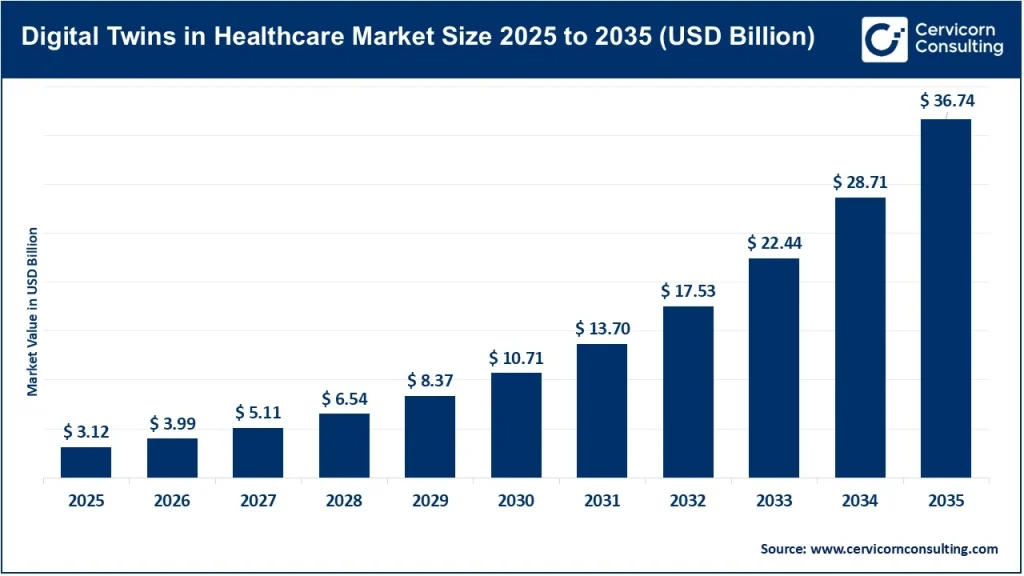
The global digital twins in healthcare market is experiencing rapid growth as healthcare organizations increasingly adopt advanced technologies to improve patient outcomes, optimize clinical workflows, and accelerate medical innovation. The healthcare digital twins market was valued at approximately USD 3.12 billion in 2025 and is expected to reach around USD 36.74 billion by 2035, expanding at a CAGR of nearly 28% during the forecast period. Other industry forecasts indicate even stronger long-term growth potential as artificial intelligence (AI), Internet of Things (IoT), cloud computing, and predictive analytics become deeply integrated into healthcare systems.
What is the Digital Twins in Healthcare Market?
A digital twin in healthcare is a virtual representation of a physical healthcare entity such as a patient, organ, medical device, hospital system, or healthcare process. These virtual models continuously receive real-time data from sensors, electronic health records (EHRs), imaging systems, wearable devices, and clinical databases to simulate, monitor, and predict outcomes.
The digital twins in healthcare market encompasses software platforms, cloud infrastructure, simulation technologies, AI algorithms, and services that create and manage these virtual replicas. Healthcare providers, pharmaceutical companies, medical device manufacturers, and research institutions use digital twins to improve diagnosis, personalize treatments, optimize hospital operations, and accelerate drug development.
Why is Digital Twin Technology Important in Healthcare?
Digital twin technology represents a major advancement in healthcare because it enables data-driven and predictive decision-making. Instead of relying solely on historical patient information, healthcare professionals can simulate disease progression, evaluate treatment options, and anticipate complications before they occur.
The technology helps healthcare systems:
- Improve personalized medicine approaches
- Enhance surgical planning and training
- Reduce clinical trial costs
- Accelerate drug discovery
- Improve patient monitoring
- Optimize hospital resource utilization
- Reduce operational inefficiencies
- Support preventive healthcare strategies
- Improve medical device performance
As healthcare shifts toward precision medicine and value-based care, digital twins are becoming an essential tool for delivering more accurate, efficient, and patient-centric healthcare services.
Get a Free Sample: https://www.cervicornconsulting.com/sample/2965
Digital Twins in Healthcare Market Growth Factors
The digital twins in healthcare market is expanding rapidly due to increasing adoption of artificial intelligence and machine learning in clinical decision-making, growing utilization of wearable health monitoring devices, rising demand for personalized medicine, increasing investments in healthcare digitalization, expansion of cloud computing infrastructure, growing focus on predictive healthcare models, accelerated pharmaceutical research activities, advancements in medical imaging technologies, increasing adoption of IoT-enabled healthcare systems, rising healthcare expenditure globally, and the need to optimize hospital operations while reducing costs. Additionally, healthcare providers are leveraging digital twin platforms to improve patient outcomes, enhance treatment precision, streamline clinical workflows, and support real-time monitoring of chronic diseases, creating substantial growth opportunities across developed and emerging healthcare markets.
Key Companies in the Digital Twins in Healthcare Market
| Company | Specialization | Key Focus Areas | Notable Features | 2025 Revenue* | Estimated Market Share* | Global Presence |
|---|---|---|---|---|---|---|
| Microsoft Corporation | Cloud computing, AI, digital twin platforms | Patient modeling, hospital operations, healthcare analytics | Azure Digital Twins, AI integration, IoT connectivity | ~$280 billion | 8–10% | 190+ countries |
| Siemens Healthineers AG | Medical imaging and healthcare infrastructure | Digital hospitals, imaging twins, diagnostics | AI-powered imaging, simulation platforms | ~$25 billion | 10–12% | 180+ countries |
| Koninklijke Philips N.V. | Connected healthcare solutions | Patient monitoring, digital health ecosystems | Integrated health platforms, predictive care | ~$19 billion | 7–9% | 100+ countries |
| Amazon Web Services | Cloud infrastructure and analytics | Healthcare cloud services, AI, digital twin hosting | Scalable cloud architecture, healthcare data platforms | ~$117 billion | 6–8% | Global operations |
| Dassault Systèmes | Simulation and virtual modeling | Virtual patient modeling, clinical trials, medical devices | 3DEXPERIENCE platform, Medidata solutions | ~$7 billion | 8–10% | 140+ countries |
Leading Trends and Their Impact on the Market
1. AI-Powered Personalized Medicine
Artificial intelligence is significantly enhancing digital twin capabilities by enabling predictive modeling of patient responses to treatments. Healthcare providers can develop individualized care plans based on each patient’s biological and clinical characteristics.
Impact: Improved treatment accuracy and reduced adverse outcomes.
2. Virtual Patient Models
Healthcare organizations are increasingly developing digital replicas of patients to simulate disease progression and treatment effectiveness.
Impact: Enhanced clinical decision-making and reduced trial-and-error treatment approaches.
3. Integration with Wearable Devices
Smartwatches, fitness trackers, biosensors, and remote monitoring tools continuously feed patient data into digital twin systems.
Impact: Real-time health monitoring and proactive intervention.
4. Drug Discovery Acceleration
Pharmaceutical companies use digital twins to simulate drug interactions and predict treatment outcomes before clinical trials.
Impact: Reduced development timelines and lower R&D costs.
5. Smart Hospitals
Hospitals are creating digital twins of facilities, equipment, and operational workflows.
Impact: Better resource allocation, reduced wait times, and improved patient experiences.
6. Medical Device Simulation
Manufacturers increasingly use digital twins to test and optimize medical devices before deployment.
Impact: Faster innovation cycles and improved product safety.
7. Cloud-Based Healthcare Ecosystems
Cloud platforms provide the scalability necessary to manage massive healthcare datasets required for digital twin applications.
Impact: Wider adoption among healthcare providers of all sizes.
Successful Examples of Digital Twins in Healthcare Around the World
Siemens Healthineers’ Digital Hospital Solutions
Siemens Healthineers uses digital twin technology to optimize hospital operations, medical imaging systems, and clinical workflows. Healthcare facilities can simulate patient movement, resource allocation, and equipment utilization to improve efficiency.
Result:
- Reduced operational bottlenecks
- Improved patient throughput
- Better utilization of healthcare assets
Philips Digital Patient Monitoring
Philips integrates digital twin concepts with connected care platforms and patient monitoring systems to create predictive healthcare environments.
Result:
- Enhanced chronic disease management
- Improved remote patient monitoring
- Earlier identification of health risks
Microsoft Azure Digital Twins in Healthcare
Microsoft enables healthcare organizations to build digital representations of hospitals, medical devices, and patient ecosystems using Azure Digital Twins.
Result:
- Real-time healthcare analytics
- Improved infrastructure management
- Better predictive maintenance
Dassault Systèmes and Virtual Human Modeling
Dassault Systèmes leverages its 3DEXPERIENCE platform and Medidata solutions to create virtual patient models for clinical research and drug development.
Result:
- Accelerated clinical trials
- Improved simulation accuracy
- Reduced pharmaceutical development costs
Virtual Heart Projects in Europe
Several European research institutions have developed digital heart twins capable of simulating cardiovascular conditions and treatment responses.
Result:
- Improved cardiac surgery planning
- Enhanced treatment personalization
- Better patient outcomes
Singapore’s Smart Healthcare Initiatives
Singapore has invested heavily in digital health infrastructure and advanced healthcare simulations.
Result:
- Enhanced predictive healthcare
- Greater healthcare efficiency
- Improved population health management
Global Regional Analysis
North America
North America currently dominates the digital twins in healthcare market, accounting for the largest revenue share globally. The United States leads adoption due to advanced healthcare infrastructure, strong technology ecosystems, and substantial investments in AI-driven healthcare solutions. The region benefits from high adoption of cloud computing, IoT technologies, and precision medicine initiatives. North America represented approximately 46.8% of the global healthcare digital twins market in 2024.
Government Initiatives and Policies
- National AI initiatives supporting healthcare innovation
- Expansion of digital health programs
- Increased federal funding for precision medicine
- Healthcare interoperability regulations promoting data integration
- Support for telehealth and remote monitoring technologies
Europe
Europe is emerging as a major digital twin healthcare hub, driven by strong research capabilities and increasing investments in healthcare digitalization. Countries such as Germany, France, the United Kingdom, and the Netherlands are actively integrating digital health technologies into healthcare systems.
Government Initiatives and Policies
- European Health Data Space (EHDS)
- EU Digital Strategy initiatives
- Horizon Europe healthcare innovation programs
- National AI healthcare frameworks
- Cross-border healthcare data sharing projects
Key Growth Drivers
- Strong regulatory support
- Advanced healthcare systems
- Growing investments in precision medicine
- Increased healthcare digitization
Asia-Pacific
Asia-Pacific is expected to witness the fastest growth during the forecast period due to rapid healthcare modernization, increasing healthcare expenditures, and expanding digital infrastructure.
Countries such as China, Japan, South Korea, Singapore, and India are actively investing in AI-enabled healthcare technologies.
Government Initiatives and Policies
China
- Healthy China 2030 strategy
- AI development plans
- Smart hospital programs
Japan
- Society 5.0 initiative
- Digital healthcare transformation projects
India
- Ayushman Bharat Digital Mission
- National Digital Health Mission
- Expansion of electronic health records
Singapore
- Smart Nation initiative
- National healthcare digital transformation programs
Key Growth Drivers
- Large patient populations
- Growing adoption of AI
- Expanding healthcare infrastructure
- Government-backed digital health investments
Latin America
Latin America is gradually adopting digital twin technologies in healthcare as governments prioritize healthcare modernization and digital transformation.
Government Initiatives and Policies
- National telehealth expansion programs
- Healthcare digitization initiatives
- Investments in cloud healthcare infrastructure
Key Growth Drivers
- Rising healthcare investments
- Increasing chronic disease burden
- Growing adoption of digital health technologies
Middle East and Africa
The Middle East and Africa region is experiencing increasing adoption of healthcare digitalization, particularly in Gulf Cooperation Council (GCC) countries.
Government Initiatives and Policies
Saudi Arabia
- Vision 2030 healthcare transformation initiatives
- Smart healthcare investments
UAE
- National AI Strategy
- Digital healthcare infrastructure programs
Key Growth Drivers
- Healthcare modernization projects
- Expansion of smart hospitals
- Government investments in AI and digital health
Competitive Outlook
The digital twins in healthcare market remains highly competitive, with technology giants, healthcare technology providers, cloud service companies, and simulation software developers investing heavily in innovation. Strategic partnerships between healthcare providers, pharmaceutical companies, cloud vendors, and AI developers are accelerating market expansion. The convergence of AI, cloud computing, IoT, and predictive analytics is expected to create new opportunities for digital twin applications across personalized medicine, hospital management, medical device development, and drug discovery throughout the coming decade.
To Get Detailed Overview, Contact Us: https://www.cervicornconsulting.com/contact-us
Read Report: 5G in Healthcare Market Revenue, Trends, and Strategic Insights by 2035