


Table of Contents
ToggleSoftware-Defined Vehicles Market Size
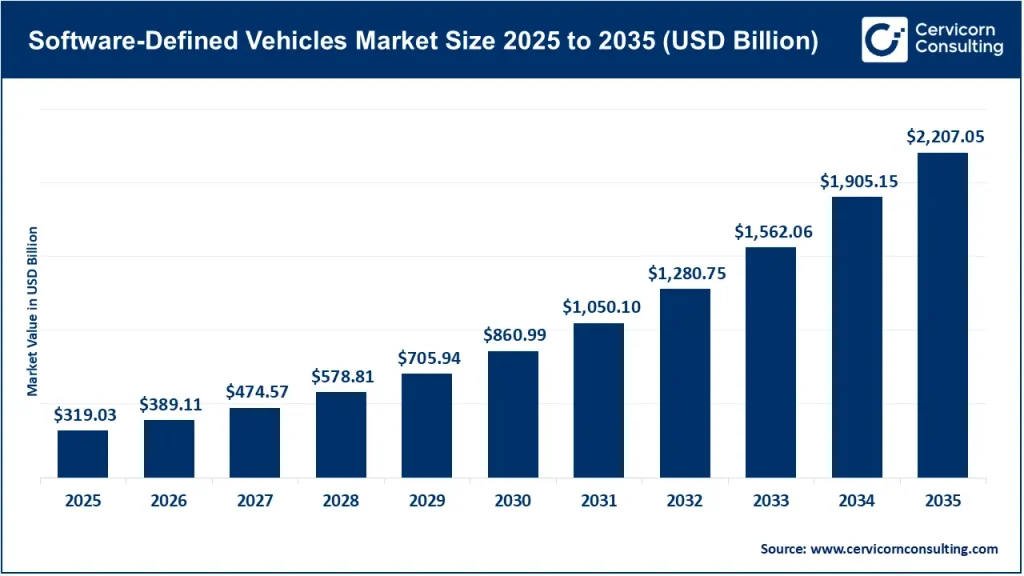
The global software-defined vehicles market size was USD 319.03 billion in 2025, with projections reaching USD 2,207.05 billion by 2035 at a 21.34% CAGR.
Software-Defined Vehicles Market Growth Factors
The software-defined vehicles market is expanding rapidly as automakers transition from hardware-centric vehicle architectures toward software-driven platforms capable of continuous updates, personalization, connected services, and advanced driver assistance. Key growth factors include the increasing penetration of electric vehicles, which provide architectures more suitable for centralized computing and software-controlled powertrains; growing demand for advanced driver-assistance systems (ADAS), digital cockpits, connected infotainment, predictive maintenance, and autonomous-driving functions; increasing adoption of over-the-air (OTA) software updates; migration from distributed electronic control units (ECUs) toward domain-centralized and zonal architectures; development of automotive-grade high-performance computing; integration of artificial intelligence and cloud computing; rising consumer expectations for smartphone-like digital experiences; and the emergence of recurring software revenues through subscriptions and feature-on-demand services.
Regulatory requirements are also accelerating adoption because cybersecurity, software-update management, and digital vehicle safety are becoming integral to vehicle type approval. UNECE Regulations R155 and R156 have established international frameworks for cybersecurity management and software updates, while governments in Europe, China, Japan, South Korea, and other automotive markets are supporting connected, intelligent, and automated mobility. The market is therefore moving beyond infotainment toward vehicle-wide software control encompassing propulsion, chassis, thermal management, safety, ADAS, connectivity, diagnostics, and personalized services.
Get a Free Sample: https://www.cervicornconsulting.com/sample/2742
What Is the Software-Defined Vehicles Market?
The software-defined vehicles (SDV) market refers to the ecosystem of technologies, products, platforms, software, hardware, services, and solutions used to develop vehicles whose functionality is increasingly determined and controlled by software.
Traditional automobiles typically rely on numerous independent ECUs, each responsible for a specific function such as engine control, braking, climate management, lighting, infotainment, or driver assistance. SDVs replace or consolidate many of these independent controllers with centralized or zonal computing architectures, enabling software to control multiple vehicle functions through a common digital platform.
In an SDV, software can be updated after the vehicle has left the factory. This allows manufacturers to improve vehicle performance, introduce new features, fix software defects, enhance cybersecurity, and personalize the driving experience without requiring a physical component replacement.
The concept also connects the vehicle to cloud infrastructure. Data generated by sensors, cameras, connectivity systems, vehicle controllers, and users can support remote diagnostics, fleet management, predictive maintenance, AI development, and continuous product improvement.
The International Energy Agency describes the transition as a move toward vehicles becoming software platforms, with pure-play EV manufacturers pioneering highly updateable software-based vehicle control.
Why Are Software-Defined Vehicles Important?
Continuous Vehicle Improvement
The traditional vehicle development cycle largely ends when a vehicle is delivered. SDVs change this model by allowing manufacturers to continue improving vehicles throughout their operating lives.
OTA updates can enhance infotainment, navigation, ADAS functionality, battery management, cybersecurity, and other features without requiring a dealership visit.
New Revenue Opportunities
SDVs enable automakers to generate revenue after the initial vehicle sale. Features can be offered through subscriptions, one-time purchases, pay-per-use models, or premium service packages.
Examples include enhanced driver assistance, connected navigation, remote vehicle services, performance upgrades, entertainment services, and fleet-management tools.
Better Vehicle Architecture
Moving from distributed ECUs to centralized or zonal architectures can simplify wiring, reduce system complexity, improve computing efficiency, and provide a common foundation for multiple software applications.
Continental, for example, has developed zone control units that form an important layer between vehicle zones and higher-performance computers in server-based architectures.
Faster Innovation
Software can be developed, tested, deployed, and updated more quickly than mechanical components. Digital twins and cloud-based development environments can further accelerate testing and validation.
Marelli identifies digital twins as a key SDV enabler because they allow vehicle features to be developed and tested virtually before deployment.
Improved Safety and Cybersecurity
Connected vehicles create new cybersecurity risks, but SDV architectures also make continuous security updates possible. UNECE R155 establishes cybersecurity-management requirements, while R156 provides a framework for software-update management.
Major Companies in the Software-Defined Vehicles Market
| Company | Specialization | Key Focus Areas | Notable Features | 2025 Revenue | Market Share | Global Presence |
|---|---|---|---|---|---|---|
| Aptiv | Automotive electronics, software and intelligent architecture | SDV platforms, E/E architecture, connectivity, ADAS | Smart Vehicle Architecture, cross-domain software, OTA capabilities | USD 20.4B | Not separately disclosed | 23 countries |
| Continental | Automotive electronics, computing, connectivity and vehicle systems | Zonal architecture, vehicle computing, software, connectivity | Zone Control Units, server-based architecture | €19.7B* | Not separately disclosed | 54 countries/markets |
| Ford | Passenger and commercial vehicles, connected vehicle services | OTA, ADAS, digital platforms, fleet software | BlueCruise, FNV3.X, Ford Pro software | USD 187.3B | Not separately disclosed | Global |
| General Motors | Vehicles, connected services and driver assistance | SDV platforms, OnStar, Super Cruise, vehicle software | Software-enabled services, OTA, Super Cruise | USD 185.0B | Not separately disclosed | More than 20 OnStar markets |
| Marelli Holdings | Automotive electronics, lighting, cockpit and vehicle systems | SDV electronics, zonal architecture, digital twin | ProZone, scalable hardware, microservices, Digital Twin | 2025 group revenue not publicly disclosed; 2024 revenue €9.13B | Not separately disclosed | Five continents / 24 countries |
*Continental’s 2025 group revenue reflects its reported group structure and is not a pure SDV revenue figure.
The company-specific SDV market shares are generally not publicly reported because these companies generate revenue across many automotive businesses and do not disclose a standardized SDV revenue category. Consequently, presenting estimated percentages as actual market shares would be misleading.
Aptiv
Aptiv is positioned strongly in the SDV ecosystem through automotive software, advanced computing, networking architecture, perception systems, and connection systems. The company describes its strategy around intelligent-edge technologies and Smart Vehicle Architecture.
Its cross-domain software infrastructure approach is particularly important because future vehicles need applications running across different domains and computing environments. Aptiv emphasizes modular, hardware-agnostic platforms with cloud connectivity, edge analytics, containers, and OTA update capabilities.
Aptiv reported USD 20.4 billion in 2025 revenue, representing a 3% increase from 2024. The company operates with more than 51,000 employees, 76 manufacturing facilities, and 11 major technical centers across 23 countries.
Continental
Continental is developing technologies required for server-based and zonal vehicle architectures. Its Zone Control Units are designed to manage physical vehicle zones and connect them with high-performance computing systems.
This architecture is important because SDVs require computing resources that can manage multiple vehicle functions rather than isolated ECUs. Continental has received orders for its zone-control technology from automotive manufacturers worldwide.
Continental reported €19.7 billion in 2025 sales and had approximately 76,000 employees across 54 countries and markets.
Ford
Ford has focused heavily on OTA capabilities, connected vehicles, ADAS, and digital vehicle architecture. Its FNV3.X architecture is designed to extend software capabilities across a wider portfolio of vehicles.
Ford’s BlueCruise illustrates the SDV model particularly well. Software improvements can be delivered through OTA updates rather than requiring hardware replacement. In 2025, Ford reported that more than half a million new BlueCruise-equipped vehicles were added, taking the global installed base to approximately 1.22 million vehicles.
Ford reported USD 187.3 billion in 2025 revenue, while Ford Pro’s software and physical services EBIT increased 10% year over year.
General Motors
General Motors has developed a broad software ecosystem encompassing OnStar, Super Cruise, connected services, vehicle applications, and software-enabled ownership experiences.
GM’s 2025 annual filing states that OnStar is available in more than 20 global markets and is intended to support safety, infotainment, connectivity, and driver-assistance features across GM’s expanding SDV portfolio.
GM generated USD 185.0 billion in total revenue in 2025, including USD 167.97 billion from automotive operations and USD 17.05 billion from GM Financial.
Marelli Holdings
Marelli is developing SDV solutions around centralized computing, zonal control, scalable electronics, microservices, cloud virtualization, and digital twins.
Its ProZone zone control unit consolidates multiple domains and supports functions including thermal management, chassis control, and propulsion. The company has also developed SDV platforms designed to separate software applications from hardware through microservices-based architectures.
Marelli reported €9.13 billion in revenue in 2024 in its sustainability reporting. The company operates across five continents, while court documents in its 2025 restructuring described operations in 24 countries and supply relationships with more than 65 OEMs and brands.
Leading Trends and Their Impact
1. Shift Toward Zonal E/E Architecture
Zonal architecture is becoming one of the defining foundations of SDVs. Instead of assigning separate ECUs to individual functions, the vehicle is divided into physical zones controlled by powerful computing units.
Impact: This can reduce wiring complexity, simplify software management, improve scalability, and make OTA updates easier to coordinate.
2. OTA Updates Become Standard
OTA updates are evolving from a premium feature into a fundamental SDV capability. Manufacturers can update software remotely, address vulnerabilities, improve ADAS performance, and introduce new services.
Impact: OTA reduces dependence on dealerships while creating new post-sale revenue opportunities.
3. AI-Driven Vehicle Intelligence
Artificial intelligence is increasingly being integrated into driver assistance, predictive maintenance, natural-language interfaces, personalized recommendations, perception, and automated driving.
Impact: AI makes vehicles more adaptive and increases demand for high-performance automotive computing.
4. Feature-on-Demand Business Models
Automakers are increasingly exploring subscription-based software features. The vehicle can contain the necessary hardware at production, while customers activate additional functionality digitally.
Impact: This changes the automotive revenue model from one-time transactions toward recurring revenue.
5. Digital Cockpit Expansion
Large displays, voice assistants, connected entertainment, smartphone integration, personalized user profiles, and app ecosystems are becoming major differentiation factors.
Impact: Cockpit software is becoming a key competitive battleground between traditional automakers and technology-oriented vehicle manufacturers.
6. Cloud-Native Automotive Software
Future SDVs increasingly require integration between vehicle-edge computing and cloud infrastructure.
Impact: Cloud-native development can accelerate software deployment, data analysis, simulation, fleet monitoring, and feature development.
7. Digital Twins
Digital twins allow automakers and suppliers to create virtual representations of vehicle systems and test software and hardware combinations before deployment.
Impact: This can shorten development cycles and reduce physical testing requirements while improving software validation.
8. Cybersecurity by Design
Connected vehicles expose more interfaces to cyber threats, increasing the importance of secure software development, threat monitoring, secure OTA updates, and incident response.
Impact: Cybersecurity is becoming an essential engineering discipline and a regulatory requirement rather than an optional feature.
Successful Examples of Software-Defined Vehicles Around the World
Tesla – Centralized Vehicle Software
Tesla is one of the most influential examples of the SDV model. The IEA identifies Tesla’s 2017 transition from a distributed electrical/electronic architecture toward a centralized software-defined approach as a significant turning point.
Tesla demonstrated how OTA updates could alter vehicle functionality after purchase, helping establish the idea that vehicles can evolve similarly to connected consumer electronics.
Ford – BlueCruise
Ford’s BlueCruise provides a strong example of software continuously improving an existing vehicle fleet. Ford has deployed updated BlueCruise versions through OTA mechanisms, allowing eligible vehicles to receive improvements without a traditional workshop visit.
General Motors – Super Cruise and OnStar
GM combines Super Cruise driver assistance with OnStar connectivity. Road-map expansions for Super Cruise have been delivered through OTA mechanisms, demonstrating how connectivity can support continuous feature enhancement.
Marelli – ProZone and Digital Twin
Marelli’s ProZone and digital-twin technologies demonstrate how suppliers are addressing the underlying architecture needed for SDVs. ProZone supports zonal consolidation, while digital twins provide virtual environments for vehicle development, testing, and deployment.
China – Rapid Software-Driven EV Development
Chinese EV manufacturers have accelerated the integration of intelligent cockpits, ADAS, OTA updates, connected services, and AI. This has increased competitive pressure on established global automakers and encouraged partnerships and software standardization.
Global Regional Analysis
North America
North America remains a major SDV innovation center because of its large automotive industry, technology ecosystem, semiconductor capabilities, cloud infrastructure, and concentration of automakers and technology companies.
The United States has been particularly influential through companies developing connected vehicles, ADAS, autonomous driving, cloud platforms, and automotive AI.
Ford’s BlueCruise and GM’s Super Cruise demonstrate how North American manufacturers are using software to differentiate vehicles after production. Ford reported that BlueCruise-equipped vehicles globally surpassed 1.2 million in 2025, while GM reported strong growth in its software and services business.
Government and regulatory influence: North American policy is increasingly focused on automated-driving safety, cybersecurity, vehicle data, and connected transportation. Federal agencies such as NHTSA continue to influence vehicle safety requirements, while regulatory attention toward automated-driving technologies is encouraging manufacturers to strengthen validation and software safety processes.
The region is likely to remain a key market for premium SDV services, connected commercial vehicles, autonomous-driving development, and software-based fleet management.
Europe
Europe is one of the most important regulatory and engineering centers for SDVs. The European Commission has established the Vehicle of the Future initiative, specifically targeting competitiveness in software-defined vehicles and digital automotive technologies.
The European Commission recognizes increasing software complexity, supply-chain dependencies, talent shortages, and competition from non-European manufacturers as major challenges. Its SDV initiatives emphasize common and largely open-source building blocks, interfaces, tools, modular software, and a code-first development approach.
Europe also benefits from the implementation of UNECE R155 and R156. These regulations require manufacturers to demonstrate cybersecurity-management and software-update-management capabilities. The regulations therefore directly influence SDV architecture, engineering processes, and lifecycle management.
Impact: European automakers and suppliers are increasingly investing in zonal architectures, automotive operating systems, digital twins, connected services, cybersecurity, and centralized vehicle computing.
Asia-Pacific
Asia-Pacific is emerging as the most dynamic SDV region because of its large vehicle production base, rapid EV adoption, strong semiconductor ecosystem, and aggressive development of intelligent connected vehicles. Market research estimates identify Asia-Pacific as the largest SDV region in 2025.
China
China is a major SDV development center because its EV market has encouraged rapid deployment of intelligent cockpits, OTA functionality, ADAS, connectivity, and centralized computing.
In February 2025, China’s Ministry of Industry and Information Technology and State Administration for Market Regulation issued requirements strengthening intelligent connected-vehicle product admission, recalls, and OTA software-update management. The rules require stronger testing, validation, safety management, and oversight of OTA activities.
China’s 2025 automotive standardization priorities also included automated-driving simulation testing, V2X communication, automotive information security, data security, intelligent cockpits, and automotive AI standards.
Impact: Regulation is pushing China’s SDV industry toward greater software reliability, cybersecurity, standardized testing, and lifecycle governance while maintaining rapid innovation.
Japan
Japan has developed one of the clearest national strategies around SDVs. METI and MLIT’s Mobility DX Strategy, updated in June 2025, targets Japanese SDVs reaching 30% of global SDV unit sales in 2030 and 2035. The strategy promotes AI-powered automated driving, SDV investment, supply-chain data integration, common vehicle requirements, development-process digitalization, software talent, and domestic SDV-system production.
Japan is also supporting automated-driving demonstrations and international standardization. In 2025, it contributed to ISO 7856, an international standard covering remote support for low-speed automated-driving systems.
Impact: Japan’s strategy is helping traditional automakers transition from hardware-focused development toward software, AI, data, simulation, and automated-driving capabilities.
South Korea
South Korea combines major automotive manufacturers with one of the world’s strongest semiconductor and electronics ecosystems. This provides advantages in high-performance computing, memory, displays, connectivity, AI, and automotive electronics.
The country’s SDV opportunity is supported by investment in intelligent vehicles, semiconductor technologies, autonomous driving, connectivity, and software development. Korean suppliers can leverage their electronics expertise to address increasingly compute-intensive vehicle architectures.
Latin America
Latin America is at an earlier stage of SDV adoption compared with North America, Europe, China, Japan, and South Korea. However, increasing vehicle connectivity, smartphone integration, fleet telematics, EV adoption, and ADAS penetration are creating opportunities.
Brazil and Mexico are particularly important because of their automotive manufacturing ecosystems. Mexico’s integration with North American automotive supply chains provides opportunities for suppliers involved in connected vehicles, automotive electronics, cloud services, and software development.
Government influence: Policies supporting vehicle safety, digital infrastructure, EV deployment, intelligent transportation systems, and connected mobility are likely to gradually strengthen SDV adoption.
Middle East & Africa
The Middle East and Africa represent emerging SDV markets. Adoption is being supported by premium vehicle demand, smart-city development, intelligent transportation initiatives, fleet digitization, and investments in connected infrastructure.
The Gulf countries are particularly relevant because smart mobility and autonomous transportation are increasingly incorporated into broader digital-transformation strategies. Advanced connected vehicles can integrate with smart-city platforms, digital identity systems, cloud infrastructure, and intelligent road networks.
Africa has a more gradual opportunity centered on fleet management, telematics, connected commercial vehicles, predictive maintenance, and mobility services rather than immediate widespread deployment of fully software-defined passenger vehicles.
Impact: The region is expected to develop initially through connected vehicle services and fleet applications before more complex centralized SDV architectures become widespread.
Government Initiatives and Policies Shaping the Global SDV Market
Several policy developments are creating a common regulatory foundation for SDVs:
- UNECE R155: Establishes cybersecurity requirements and cybersecurity-management processes for vehicles.
- UNECE R156: Establishes requirements for software-update management systems and OTA updates.
- European Union Vehicle of the Future Initiative: Promotes software-defined vehicle ecosystems, open standards, digital development tools, and European automotive competitiveness.
- China’s 2025 intelligent-connected vehicle regulations: Strengthen product admission, recalls, OTA management, testing, and safety responsibilities.
- Japan Mobility DX Strategy: Targets a 30% Japanese share of global SDV sales in 2030 and 2035 while supporting AI, automated driving, software talent, digital development, and SDV supply chains.
- Automotive cybersecurity standards: Increasing regulatory requirements are forcing manufacturers to integrate cybersecurity throughout vehicle development rather than treating it as an after-production service.
These policies are fundamentally changing the automotive product lifecycle. An automaker is no longer responsible only for producing a mechanically safe vehicle; it must increasingly demonstrate that software can be securely developed, validated, updated, monitored, and maintained throughout the vehicle’s operational life. This regulatory transformation is therefore becoming one of the strongest structural forces behind the global software-defined vehicles market.
To Get Detailed Overview, Contact Us: https://www.cervicornconsulting.com/contact-us
Read Report: Recyclable Packaging Market Revenue, Trends, and Strategic Insights by 2035