


Table of Contents
ToggleRecyclable Packaging Market Size
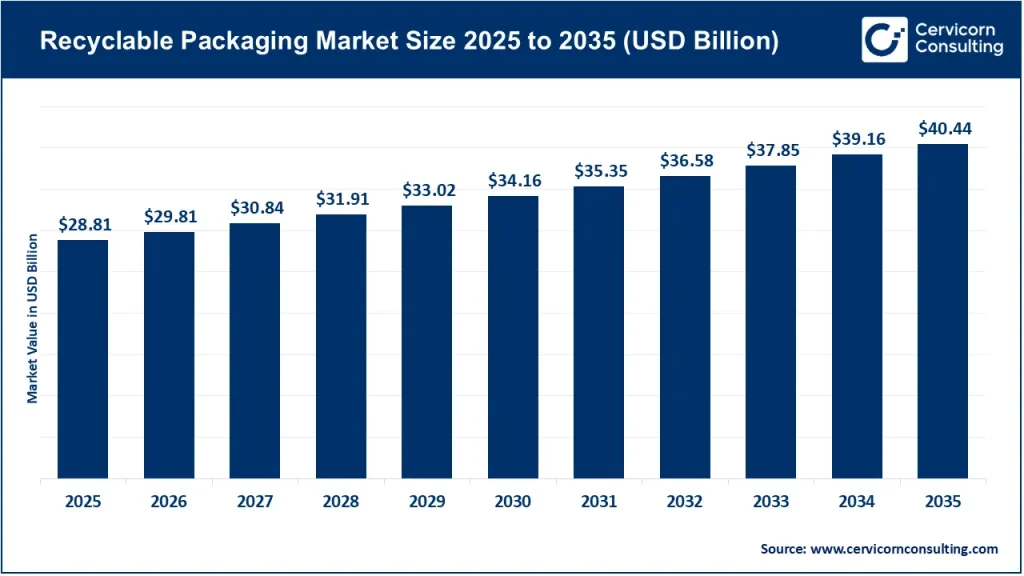
The global recyclable packaging market was valued at approximately USD 28.81 billion in 2025 and is projected to reach USD 40.44 billion by 2035, expanding at a CAGR of 3.45% during the forecast period.
Recyclable Packaging Market Growth Factors
The recyclable packaging market is being driven by rising environmental awareness, stricter government regulations on packaging waste, growing adoption of extended producer responsibility (EPR) programs, increasing corporate sustainability commitments, and consumer demand for packaging with lower environmental impact. Food and beverage, personal care, healthcare, e-commerce, and consumer goods companies are increasingly redesigning packaging around recyclable paperboard, PET, HDPE, aluminum, glass, and mono-material structures. At the same time, investments in recycling infrastructure, post-consumer recycled (PCR) materials, lightweighting, design-for-recycling, and advanced sorting technologies are improving the commercial attractiveness of recyclable formats.
Regulatory developments are particularly influential: the European Union’s Packaging and Packaging Waste Regulation requires packaging placed on the EU market to be recyclable, while California’s SB 54 establishes an EPR framework for packaging and single-use food-service products. E-commerce growth is another important catalyst because brands and logistics companies are seeking recyclable mailers, corrugated boxes, paper-based protective materials, and reduced secondary packaging. These factors are collectively shifting packaging procurement from a simple focus on cost and performance toward circularity, recyclability, recycled content, carbon footprint, and end-of-life recovery.
Get a Free Sample: https://www.cervicornconsulting.com/sample/2748
What Is the Recyclable Packaging Market?
The recyclable packaging market comprises packaging products and solutions that can be collected, sorted, processed, and converted into new materials or products through established or developing recycling systems.
It covers several major material categories, including paper and cardboard, plastics, glass, metals, recycled paper, and selected bio-based materials. Products include bottles, containers, cartons, corrugated boxes, trays, pouches, mailers, films, cans, wraps, and protective packaging.
The market is evolving beyond simply using a material that is technically recyclable. Increasingly, manufacturers are focusing on design for recycling, where packaging is engineered so that components can be efficiently separated, collected, sorted, and recycled at commercial scale.
This distinction is becoming particularly important in Europe. Under the EU’s Packaging and Packaging Waste Regulation, packaging must meet defined recyclability conditions, including material-recycling design and the ability to be separately collected, sorted, and recycled at scale.
Market estimates vary because research firms use different definitions and coverage. For example, Future Market Insights estimates the global recyclable packaging market at USD 32.3 billion in 2025, reaching USD 50.7 billion by 2035 at a 4.6% CAGR, while another market study estimates a substantially larger 2025 market of USD 124.74 billion. These differences demonstrate why market figures should be interpreted according to the specific scope and methodology of each study.
Why Is Recyclable Packaging Important?
Recyclable packaging is important because packaging represents a significant portion of municipal and commercial waste streams. Moving packaging into circular material systems can reduce dependence on virgin resources, improve material recovery, and help companies meet environmental targets.
Reducing Packaging Waste
Recyclable packaging enables materials such as paper, PET, HDPE, aluminum, and glass to remain in productive use instead of being discarded after a single application.
Supporting Circular Economy Models
A circular packaging model aims to keep materials circulating through collection, sorting, recycling, and reuse. This creates demand for recycled feedstock and encourages manufacturers to incorporate PCR materials into new packaging.
Helping Companies Meet Sustainability Goals
Consumer brands increasingly publish targets related to recyclable packaging, recycled content, carbon emissions, and packaging reduction. Packaging suppliers therefore play an increasingly important role in helping customers achieve those objectives.
Responding to Regulation
Governments are increasingly moving from voluntary sustainability programs toward mandatory packaging requirements. EPR schemes can shift the financial responsibility for packaging waste from governments and taxpayers toward producers.
Improving Resource Efficiency
Lightweighting and recycled-content technologies can reduce the quantity of raw material required for packaging. However, the environmental benefit depends on packaging performance, transportation, collection, recycling rates, and the overall lifecycle.
Key Companies in the Recyclable Packaging Market
| Company | Specialization | Key Focus Areas | Notable Features | 2025 Revenue* | Market Share* | Global Presence |
|---|---|---|---|---|---|---|
| Graham Packaging Company | Rigid plastic containers | Lightweighting, PCR, recyclability, circular packaging | Blow-molded HDPE/PET packaging; sustainability design services | Not publicly disclosed | Not publicly disclosed | North America, Europe, South America |
| Ebro Color GmbH | Folding cartons and paperboard packaging | Recycled board, FSC materials, resource efficiency | Customized recyclable cardboard packaging | Not publicly disclosed | Not publicly disclosed | Germany/Europe and international customers |
| Lacerta Group, Inc. | Thermoformed PET food packaging | PCR, recyclable PET, lightweight packaging | ReCERTA™ material; 100% PCR options | Not publicly disclosed | Not publicly disclosed | U.S. and international sourcing |
| Salazar Packaging, Inc. | Corrugated and e-commerce packaging | Recycled content, FSC materials, recyclable shipping solutions | Up to 70% recycled content in standard corrugated boxes | Not publicly disclosed | Not publicly disclosed | Primarily North America |
| Amcor | Flexible and rigid packaging | Circularity, recyclability, recycled content, lightweighting | Broad packaging portfolio across multiple materials | USD 23B annualized sales on FY2025 pro forma basis | Not separately disclosed for recyclable packaging | 40+ countries, 400+ locations |
*Company-level recyclable-packaging revenue and market share are generally not separately reported by these companies. Amcor’s FY2025 filing reports USD 23 billion in annualized sales on a pro forma basis, generated by 77,000 employees across more than 400 locations in over 40 countries.
Graham Packaging Company
Graham Packaging is a major manufacturer of custom blow-molded plastic containers for food and beverage, household, automotive, and personal-care applications. The company focuses heavily on lightweighting, PCR incorporation, recyclability, life-cycle assessment, and circular packaging.
Graham states that it works with customers to design packaging compatible with recycling streams and increase the use of recycled materials. Its sustainability strategy includes lightweighting, PCR, durability, reuse, and design for recyclability.
Its capabilities position it strongly in applications where brands want the performance benefits of rigid plastic while reducing virgin-material requirements.
Ebro Color GmbH
Ebro Color specializes in customized cardboard and folding-carton packaging. Its recyclable packaging portfolio includes recycled cardboard, FSC-certified materials, and resource-efficient cardboard qualities.
The company serves applications including cosmetics, pharmaceuticals, food, dietary supplements, household products, and technical goods. Its model reflects the growing movement toward fiber-based packaging, particularly where paperboard can replace more difficult-to-recycle structures.
Lacerta Group, Inc.
Lacerta Group is an important player in thermoformed food packaging, particularly PET-based packaging. The company states that most of its packaging is made from recyclable PET and has developed its ReCERTA™ material using post-consumer recycled plastic.
Lacerta reports that its PET-based packaging uses an average of at least 10% PCR content, with customized blends available. It also offers products containing an average of 100% post-consumer plastic. The company says it has recycled more than 150 million pounds of plastic since 1993.
Salazar Packaging, Inc.
Salazar Packaging focuses heavily on sustainable shipping and e-commerce packaging, including corrugated boxes, mailers, paperboard packaging, and protective packaging.
Its standard corrugated boxes contain up to 70% recycled materials, while the company states that it can produce packaging with 100% recycled content when required. Its corrugated products are designed to remain 100% recyclable.
The company’s strategy is particularly relevant to e-commerce, where the rapid expansion of parcel shipments has increased demand for recyclable boxes and mailers.
Amcor
Amcor is one of the largest global packaging companies and operates across flexible packaging, rigid packaging, cartons, closures, and other formats. Its products serve nutrition, healthcare, beauty, wellness, and other markets.
Amcor’s FY2025 reporting states that its operations generated approximately USD 23 billion in annualized sales on a pro forma basis, with more than 400 locations in over 40 countries.
Its sustainability strategy emphasizes circular economy development, packaging innovation, recycled materials, recyclability, and resource efficiency.
Leading Trends and Their Impact
1. Shift Toward Mono-Material Packaging
Mono-material packaging is becoming increasingly important because packaging made predominantly from one polymer or fiber stream can be easier to collect, sort, and recycle than complex multilayer structures.
Impact: Packaging manufacturers are redesigning pouches, films, trays, and containers to maintain barrier and mechanical performance while improving recyclability.
2. Growing Use of Post-Consumer Recycled Materials
PCR is becoming a central component of circular packaging strategies. Instead of relying exclusively on virgin resin or fiber, manufacturers incorporate material recovered from previously used products.
Lacerta, for example, incorporates PCR into its PET portfolio, while Graham works with customers to incorporate PCR content into packaging.
Impact: Demand for high-quality recycled resin and recycled fiber is increasing, creating opportunities for recyclers, material processors, converters, and packaging manufacturers.
3. Lightweighting
Lightweighting involves reducing the amount of material used without compromising packaging strength, safety, shelf life, or functionality.
Impact: Lightweight packaging can reduce material consumption and transportation weight, but manufacturers must balance sustainability with durability and product protection.
4. Design for Recycling
The industry is increasingly moving from “recyclable material” to “recyclable packaging design.”
This means considering labels, adhesives, closures, coatings, inks, barriers, colorants, and material combinations during product development.
Impact: Packaging engineers are becoming increasingly important in helping brands comply with emerging recyclability standards.
5. Paper and Fiber-Based Alternatives
Paperboard and corrugated packaging are gaining momentum in e-commerce, retail, cosmetics, food, and consumer products.
Ebro Color, for example, highlights recycled cardboard and FSC-certified materials as part of its sustainable packaging portfolio.
Impact: Fiber packaging creates opportunities for paper mills, converters, printers, coating suppliers, recycling companies, and packaging designers.
6. E-Commerce Packaging Optimization
Online retail generates unique packaging requirements because products must withstand transportation, handling, and fulfillment operations.
Impact: Recyclable corrugated boxes, paper mailers, recyclable cushioning, and right-sized packaging are becoming increasingly important.
7. Digital Packaging and Recycling Information
Packaging manufacturers are also exploring better consumer communication through labels, recycling instructions, digital information, and standardized identification systems.
Impact: Improved communication can increase correct sorting and reduce contamination within recycling systems.
8. Packaging EPR
EPR is transforming the economics of packaging by making producers more responsible for packaging waste.
Impact: Brands increasingly have financial incentives to reduce packaging material, improve recyclability, increase recycled content, and select packaging formats that perform better under local recycling systems.
Successful Examples of Recyclable Packaging Around the World
Europe: Recyclability Becoming a Regulatory Requirement
Europe represents one of the strongest examples of regulatory-driven packaging transformation. The EU’s Packaging and Packaging Waste Regulation (PPWR) establishes requirements for recyclable packaging and introduces recyclability performance grades. From the applicable implementation dates, packaging must meet defined recyclability criteria, with increasingly stringent requirements extending toward 2038.
This regulatory environment is encouraging companies to redesign packaging before requirements become mandatory.
United States: California’s EPR Model
California’s SB 54 is another major example. The law establishes an EPR program covering packaging and single-use plastic food-service ware. It is designed to encourage producers to make packaging easier to reuse and recycle.
The program is creating pressure for manufacturers and brands to consider recyclability at the design stage rather than treating waste management as an end-of-life issue.
Australia: National Packaging Targets
Australia has developed national packaging targets centered around circularity. Its framework targets packaging that is reusable, recyclable, or compostable, alongside increased recycled content and improved recycling infrastructure.
Recent APCO data show increasing recycled-content use across several packaging materials, demonstrating the gradual movement toward circular material systems.
China: Recyclable Packaging in E-Commerce
China’s enormous e-commerce and parcel-delivery ecosystem is encouraging greater attention to packaging recovery and reuse.
Regulatory changes effective from June 2025 require express-delivery companies to develop packaging-use procedures and packaging recovery/recycling management systems. They also encourage collection facilities and incentives for consumers to reuse packaging.
This creates a significant opportunity for recyclable and reusable packaging solutions in logistics.
Japan: Design and Recycled-Resource Utilization
Japan is advancing circular-economy policies through measures that encourage businesses to utilize recycled resources and promote environmentally friendly product design. In 2026, Japan also implemented design-certification standards for several plastic product categories, including PET beverage containers and household containers.
This approach links packaging design with resource efficiency, recycling, and market incentives.
Global Regional Analysis Including Government Initiatives and Policies
North America
North America is a major market for recyclable packaging because of strong demand from food and beverage, consumer goods, healthcare, personal care, retail, and e-commerce industries.
The U.S. market is being shaped by state-level policy developments, corporate sustainability targets, recycling infrastructure investment, and consumer expectations.
California’s SB 54 is particularly significant because it establishes producer responsibility for packaging and sets a framework for improving recyclability and reducing packaging waste.
The region is also seeing increasing interest in PCR plastics, recyclable flexible packaging, corrugated packaging, and lightweight rigid containers.
Market impact: North American manufacturers are increasingly investing in design-for-recycling capabilities, recycled-content procurement, packaging optimization, and recycling partnerships.
Europe
Europe is one of the most policy-intensive recyclable packaging markets globally.
The EU’s PPWR is fundamentally changing packaging design requirements by establishing recyclability criteria and performance grades. Packaging placed on the European market will increasingly need to demonstrate compatibility with recycling systems rather than merely carrying a recyclable-material claim.
Countries across Europe are also developing national collection, recycling, and EPR mechanisms.
Market impact: European brands and packaging manufacturers are accelerating investments in mono-material structures, recyclable paperboard, PCR content, lightweighting, and packaging redesign.
Asia-Pacific
Asia-Pacific is a particularly important growth region because of its large population, expanding middle class, manufacturing base, e-commerce ecosystem, and increasing environmental regulation.
India
India’s plastic-waste framework increasingly emphasizes EPR and recycled-content obligations. Government rules require relevant producers, importers, brand owners, and plastic-waste processors to participate in the centralized EPR system.
Government reporting also indicates the development of a large EPR certificate ecosystem for plastic packaging waste.
Market impact: Indian companies are increasingly exploring recycled plastics, recyclable flexible packaging, paper alternatives, and packaging designs compatible with EPR requirements.
China
China is placing greater emphasis on packaging reduction, recycling, and green logistics. Recent changes to express-delivery regulations encourage packaging recovery, recycling facilities, reduced secondary packaging, and environmentally friendly packaging.
China is also developing standards around easier collection and recycling of plastic packaging.
Market impact: Large-scale e-commerce and logistics operations are likely to remain major sources of demand for recyclable mailers, corrugated boxes, reusable shipping systems, and recyclable protective materials.
Japan
Japan’s circular-economy approach emphasizes resource efficiency, recycled-resource utilization, and environmentally friendly product design.
Market impact: High-quality recycled plastics, resource-efficient packaging, and advanced design-for-recycling technologies are expected to benefit from Japan’s emphasis on circular manufacturing.
Latin America
Latin America is developing recyclable packaging demand through a combination of urbanization, consumer awareness, packaging regulation, waste-management improvements, and multinational brand sustainability commitments.
Brazil and Mexico are particularly important because of their large consumer markets and expanding food, beverage, retail, and personal-care sectors.
Market impact: Growth opportunities are emerging for recyclable PET, paperboard, corrugated packaging, recycled plastics, and collection technologies. However, inconsistent recycling infrastructure remains a challenge in some markets, making investment in collection and sorting particularly important.
Middle East & Africa
The Middle East and Africa represent an emerging opportunity for recyclable packaging as governments, manufacturers, retailers, and consumers increasingly focus on waste reduction and resource efficiency.
Urban population growth, tourism, food and beverage consumption, retail expansion, and e-commerce are increasing packaging demand, while environmental policies are encouraging more sustainable material choices.
Market impact: Opportunities are developing for recyclable plastic containers, paper and corrugated packaging, aluminum, glass, and packaging recovery infrastructure. The major challenge remains uneven recycling infrastructure between countries and regions.
Competitive Outlook
Competition in the recyclable packaging market is increasingly based on more than production capacity. Companies are competing on material science, recyclability, recycled content, lightweighting, manufacturing efficiency, regulatory expertise, and lifecycle performance.
Large packaging manufacturers such as Amcor can leverage global manufacturing networks and relationships with multinational consumer brands, while specialized companies such as Lacerta, Ebro Color, Graham Packaging, and Salazar Packaging can compete through focused product expertise.
The next stage of competition is likely to center on packaging that can simultaneously deliver high performance, low material consumption, recycled content, cost efficiency, attractive design, and verified recyclability.
For packaging buyers, this means supplier selection is increasingly becoming a strategic sustainability decision rather than simply a procurement decision. For packaging manufacturers, investments in recyclable materials, PCR processing, design-for-recycling, lifecycle assessment, and compliance capabilities can create opportunities across food and beverage, healthcare, cosmetics, e-commerce, retail, and consumer goods markets.
To Get Detailed Overview, Contact Us: https://www.cervicornconsulting.com/contact-us
Read Report: Offshore Wind Market Revenue, Trends, and Strategic Insights by 2035