


Table of Contents
ToggleSoftware-as-a-Service (SaaS) Market Size
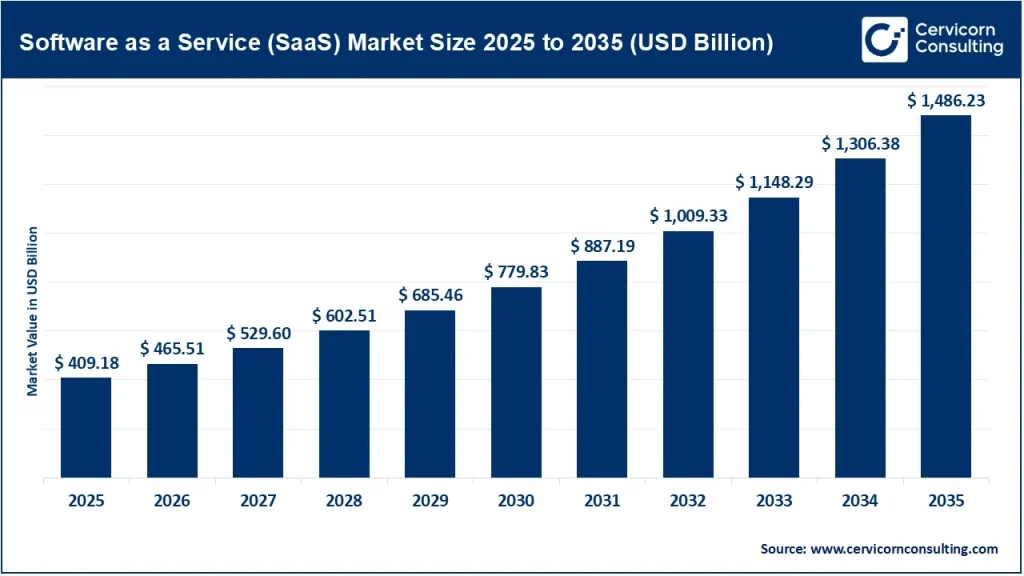
The global software as a service (SaaS) market was valued at approximately USD 409.18 billion in 2025 and is projected to reach nearly USD 1,486.23 billion by 2035, expanding at a compound annual growth rate (CAGR) of 13.77% between 2026 and 2035.
Growth is largely driven by rising adoption of digital transformation strategies, increasing integration of artificial intelligence into enterprise workflows, expanding remote and hybrid work environments, and strong demand for scalable enterprise software platforms delivered through cloud infrastructure.
Market Overview
The global software-as-a-service (SaaS) market is experiencing strong expansion as organizations across industries transition from traditional on-premises software systems to cloud-based subscription platforms. SaaS solutions allow businesses to access applications through the internet instead of installing and maintaining infrastructure locally, significantly improving flexibility, scalability, and operational efficiency.
What is the Software-as-a-Service (SaaS) Market?
The software-as-a-service market represents the ecosystem of cloud-hosted software applications delivered to users through internet-based subscription models rather than traditional licensing structures. In SaaS environments, vendors manage software updates, infrastructure maintenance, cybersecurity protection, and system availability, allowing organizations to focus on core operations instead of IT management.
SaaS applications span a wide range of enterprise functions, including:
- customer relationship management (CRM)
- enterprise resource planning (ERP)
- human resource management (HRM)
- collaboration platforms
- marketing automation tools
- workflow automation systems
This service model enables organizations to deploy software quickly across distributed teams while reducing upfront infrastructure investments and maintenance costs.
Get a Free Sample: https://www.cervicornconsulting.com/sample/2924
Key Market Growth Drivers
One of the primary drivers of SaaS market growth is the accelerating shift toward cloud-based digital transformation strategies across enterprises worldwide. Organizations are replacing legacy systems with flexible subscription-based software platforms that support remote collaboration, real-time analytics, and scalable operations.
The expansion of hybrid and remote work environments has further strengthened adoption of SaaS collaboration platforms, communication tools, and workflow automation solutions. Businesses increasingly rely on SaaS ecosystems to maintain productivity across geographically distributed teams.
Integration of artificial intelligence and automation technologies is another major growth catalyst. AI-enabled SaaS platforms provide predictive analytics, intelligent decision-support systems, automated workflows, and personalized customer experiences that improve operational efficiency and competitive performance.
Industry-specific SaaS platforms are also gaining traction as organizations adopt tailored cloud solutions designed for sectors such as healthcare, finance, manufacturing, and retail. These specialized platforms support regulatory compliance while improving operational accuracy.
Additionally, government-supported digitalization initiatives and rising investments in cloud infrastructure across emerging economies are accelerating SaaS adoption among small and medium-sized enterprises worldwide.
Market Challenges
Despite strong growth potential, several challenges continue to influence SaaS adoption across industries.
One major concern is data security and privacy risks, especially for organizations operating in highly regulated sectors such as healthcare, banking, and government services. Migrating sensitive information to cloud environments requires compliance with strict regulatory frameworks and cybersecurity protocols.
Another challenge involves integration complexity between SaaS platforms and legacy enterprise systems. Organizations transitioning toward cloud-native infrastructure often face compatibility issues that increase implementation time and operational costs.
Vendor lock-in risks also influence adoption decisions, particularly among large enterprises that require flexibility when selecting software providers.
Market Opportunities
The integration of artificial intelligence and automation technologies into SaaS ecosystems represents one of the most significant growth opportunities within the market.
AI-powered SaaS platforms enable:
- predictive business analytics
- automated marketing campaigns
- intelligent customer engagement
- workflow optimization
- content generation
- real-time operational insights
Generative AI capabilities are further enhancing SaaS platforms by enabling automated code generation, conversational interfaces, and adaptive enterprise analytics.
These capabilities are expected to significantly expand the role of SaaS platforms in enterprise digital transformation strategies during the next decade.
Market Segmentation Analysis
By Deployment Model
The public cloud segment dominated the SaaS market due to its scalability, affordability, and rapid deployment advantages. Businesses increasingly prefer public cloud SaaS platforms because they reduce infrastructure investment requirements and support flexible subscription pricing models.
The private cloud segment is projected to grow at the fastest rate during the forecast period as organizations prioritize cybersecurity, compliance, and data governance control.
By User Type
Large enterprises accounted for the highest revenue share, supported by strong IT budgets and large-scale digital transformation initiatives. These organizations rely heavily on integrated SaaS ecosystems to manage customer data, operations, workforce collaboration, and analytics infrastructure.
Small and medium-sized enterprises are expected to register the fastest growth due to increasing availability of affordable subscription-based digital solutions.
By Application
The customer relationship management (CRM) segment held the largest market share because organizations increasingly prioritize customer engagement and retention strategies supported by AI-enabled analytics platforms.
Other major SaaS applications include:
- enterprise resource planning
- collaboration platforms
- human resource management systems
- marketing automation tools
Marketing automation platforms are expected to witness the fastest growth due to increasing adoption of data-driven campaign optimization technologies.
By End-User Industry
The retail sector accounted for the largest share of SaaS adoption, supported by expansion of e-commerce platforms and omnichannel retail strategies. Retailers increasingly deploy SaaS tools to manage inventory, supply chains, and customer engagement systems.
The healthcare sector is projected to record the fastest growth due to increasing digitization of patient records, telehealth platforms, and regulatory compliance management systems.
Other major adopting industries include:
- manufacturing
- financial services
- education
Regional Market Analysis
North America
North America dominated the global SaaS market and is expected to maintain leadership through the forecast period due to strong digital infrastructure, early adoption of cloud technologies, and widespread integration of artificial intelligence into enterprise applications.
The region benefits from strong presence of major SaaS providers such as Microsoft, Salesforce, Adobe, Oracle, ServiceNow, and Workday. Government initiatives supporting AI adoption and cloud modernization are further strengthening SaaS penetration across public sector organizations.
Asia-Pacific
Asia-Pacific is projected to experience the fastest SaaS market growth during the forecast period due to expanding cloud infrastructure, rising enterprise digitalization, and government-supported technology transformation initiatives across emerging economies such as India and China.
Businesses across the region are increasingly adopting hybrid-cloud and multi-cloud deployment strategies to improve scalability and operational efficiency.
Europe
Europe represents a mature SaaS market supported by strong regulatory frameworks promoting data protection, enterprise modernization strategies, and digital economy development initiatives. Adoption is particularly strong across financial services, manufacturing, and healthcare industries.
Latin America
Latin America is gradually strengthening its SaaS adoption landscape due to increasing investment in digital infrastructure and expansion of cloud-based enterprise platforms across retail and financial sectors.
Middle East & Africa
The Middle East and Africa region is witnessing steady SaaS adoption supported by smart city initiatives, government digital transformation programs, and expansion of enterprise cloud ecosystems.
Countries across the region are investing in advanced IT infrastructure to improve operational efficiency across both public and private sector organizations.
To Get Detailed Overview, Contact Us: https://www.cervicornconsulting.com/contact-us
Read Report: Pollution-Free Construction Market Revenue, Trends, and Strategic Insights by 2035