


Table of Contents
TogglePollution-Free Construction Market Size
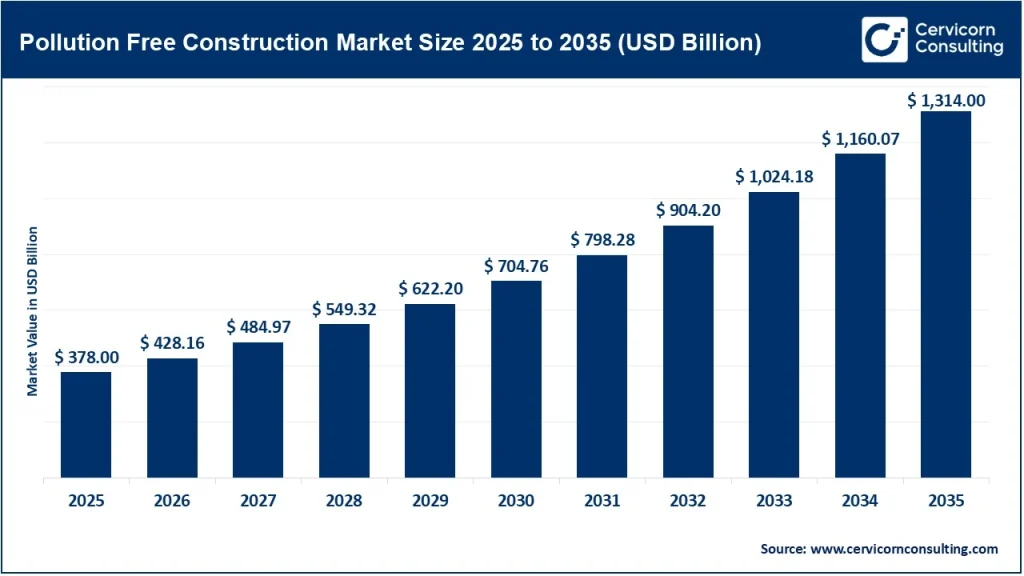
The global pollution free construction market reached an estimated valuation of USD 378 billion in 2025 and is projected to grow substantially, attaining approximately USD 1,314 billion by 2035. This growth reflects a strong compound annual growth rate (CAGR) of around 13.2% throughout the forecast period.
What Is the Pollution-Free Construction Market?
The pollution-free construction market refers to the global ecosystem of technologies, materials, engineering practices, and project management strategies designed to minimize environmental impact across the construction lifecycle—from raw material sourcing and design to building operation and demolition. Unlike traditional construction approaches that rely heavily on carbon-intensive cement, steel, diesel-powered machinery, and waste-generating processes, pollution-free construction emphasizes low-carbon materials, renewable energy integration, circular resource reuse, electrified equipment, prefabrication techniques, and net-zero building strategies. The market includes green cement, recycled aggregates, modular construction, passive-energy architecture, smart building management systems, and digital sustainability monitoring platforms. Growing climate urgency has accelerated adoption worldwide, as the building and construction sector contributes nearly 40% of global energy-related carbon emissions, making sustainable construction a priority across governments and private developers.
The pollution-free construction market is expanding rapidly and is projected to grow significantly over the next decade as governments introduce climate-neutral infrastructure mandates and developers increasingly adopt green building certification standards.
Pollution-Free Construction Market Growth Factors
The pollution-free construction market is experiencing strong growth due to increasing climate change awareness, stricter government emission regulations, rising adoption of green building certification frameworks such as LEED and BREEAM, and expanding demand for energy-efficient residential and commercial infrastructure worldwide. Rapid urbanization in emerging economies, particularly across Asia-Pacific and the Middle East, is accelerating sustainable infrastructure investments, while innovations in recycled building materials, prefabrication technologies, modular construction systems, and low-carbon cement alternatives are improving cost competitiveness. Government tax incentives, carbon-reduction mandates, and smart-city initiatives are encouraging developers to adopt environmentally responsible construction practices. At the same time, investors and corporate stakeholders are prioritizing ESG-aligned projects, driving green infrastructure financing globally and strengthening long-term market expansion prospects.
Get a Free Sample: https://www.cervicornconsulting.com/sample/2918
Why Pollution-Free Construction Is Important
Pollution-free construction is becoming essential for environmental sustainability, urban resilience, and long-term economic efficiency. Traditional construction contributes heavily to air pollution, resource depletion, and landfill waste, making eco-friendly alternatives critical for achieving global climate targets.
Reducing Carbon Emissions
Construction activities produce large volumes of greenhouse gases due to cement manufacturing, transportation, and heavy equipment usage. Low-carbon construction techniques significantly reduce lifecycle emissions.
Improving Energy Efficiency
Energy-efficient buildings reduce electricity consumption through passive ventilation, smart lighting systems, and renewable energy integration, lowering operational costs over decades.
Supporting Circular Economy Goals
Pollution-free construction promotes reuse of materials such as recycled steel, reclaimed wood, and crushed concrete, reducing landfill waste and conserving natural resources.
Enhancing Occupant Health
Green buildings improve indoor air quality using non-toxic materials, better ventilation systems, and natural lighting.
Strengthening Climate-Resilient Infrastructure
Sustainable construction techniques support resilience against floods, heatwaves, earthquakes, and extreme weather events.
Company Profiles: Leading Players in the Pollution-Free Construction Market
Below is a structured overview of major global firms shaping the pollution-free construction ecosystem.
Tata Projects
Specialization: Engineering, procurement, and construction (EPC) infrastructure solutions
Key Focus Areas: Smart cities, renewable energy infrastructure, metro rail, industrial sustainability
Notable Features: Deployment of green infrastructure technologies and digital construction monitoring platforms
2024 Revenue: Multi-billion-dollar infrastructure execution portfolio as part of the Tata Group ecosystem
Market Share: Strong presence in India’s sustainable infrastructure modernization initiatives
Global Presence: India, Middle East, and selective international EPC partnerships
Tata Projects contributes to pollution-free construction through smart transportation infrastructure, metro electrification systems, and renewable-energy-aligned industrial construction frameworks. Its smart-city involvement positions the company as a sustainability-focused EPC integrator in emerging markets.
Mace
Specialization: Sustainable project management and consultancy
Key Focus Areas: Net-zero buildings, infrastructure delivery optimization, lifecycle carbon reduction
Notable Features: Advisory leadership in carbon-neutral megaprojects and sustainable infrastructure planning
2024 Revenue: Multi-billion-dollar global consultancy turnover
Market Share: Strong consulting presence across European and Middle Eastern green infrastructure programs
Global Presence: UK, Europe, Asia, Middle East, North America
Mace plays a critical role in pollution-free construction by integrating carbon-tracking analytics into project planning and enabling lifecycle sustainability compliance for major infrastructure projects worldwide.
Skanska
Specialization: Sustainable urban development and green infrastructure construction
Key Focus Areas: Low-carbon concrete, fossil-free construction logistics, circular materials reuse
Notable Features: Development of energy-positive buildings and large-scale recycled material deployment
2024 Revenue: Global construction group with multi-billion-dollar annual turnover
Market Share: Leading contributor to European green infrastructure transformation
Global Presence: Europe, United States, Nordic countries
Skanska has introduced cement-replacement binders and fossil-free construction processes while increasing recycled material usage and electrified project operations.
Turner Construction
Specialization: Commercial green building construction
Key Focus Areas: LEED-certified building delivery, healthcare infrastructure sustainability
Notable Features: Delivery of high-performance sustainable campuses and smart commercial facilities
2024 Revenue: Major U.S. construction contractor with strong sustainability project pipeline
Market Share: Significant role in North America’s green building construction segment
Global Presence: North America, Europe, Asia
Turner Construction is widely recognized for implementing green building certification strategies and sustainability-optimized project delivery in institutional and commercial sectors.
ACCIONA
Specialization: Renewable infrastructure and sustainable engineering
Key Focus Areas: Net-zero infrastructure, green mobility corridors, water sustainability
Notable Features: Carbon-neutral construction commitments and renewable-energy-powered project execution
2024 Revenue: Large multinational infrastructure developer with strong sustainability investments
Market Share: Major contributor to renewable infrastructure integration across Europe and Latin America
Global Presence: Europe, Latin America, Asia-Pacific
ACCIONA integrates renewable energy directly into construction execution processes and promotes low-impact infrastructure across transportation and water systems.
Leading Trends in the Pollution-Free Construction Market and Their Impact
The pollution-free construction sector is being reshaped by multiple innovation trends transforming infrastructure delivery worldwide.
Low-Carbon Building Materials
Green cement, recycled steel, and bio-based insulation are reducing emissions associated with structural materials.
Impact: Lower lifecycle emissions and improved ESG investment attractiveness.
Modular and Prefabricated Construction
Factory-manufactured building components reduce waste and construction time.
Impact: Faster project completion and reduced onsite pollution levels.
Smart Energy-Efficient Buildings
IoT-enabled energy monitoring systems optimize heating, ventilation, and lighting consumption.
Impact: Lower operational costs and improved occupant comfort.
Circular Construction Practices
Material reuse and recycling reduce dependency on virgin resources.
Impact: Lower landfill waste and stronger resource security.
Electrification of Construction Equipment
Battery-powered heavy machinery reduces diesel usage onsite.
Impact: Reduced air pollution and lower project carbon footprints.
Net-Zero and Positive-Energy Buildings
Buildings designed to produce more energy than they consume are becoming mainstream in advanced markets.
Impact: Long-term operational sustainability and regulatory compliance advantages.
Successful Examples of Pollution-Free Construction Around the World
Global infrastructure leaders are already implementing pollution-free construction practices across landmark projects.
Stockholm Slakthusområdet Redevelopment (Sweden)
This redevelopment project reused excavated rock materials and implemented fossil-free logistics solutions to significantly reduce construction emissions.
Bosco Verticale Towers (Italy)
Vegetation-integrated architecture combined with sustainable construction materials helped reduce the urban heat-island effect while improving air quality.
Masdar City (UAE)
Masdar City represents one of the most ambitious carbon-neutral smart-city developments integrating renewable energy systems and sustainable mobility infrastructure.
One Angel Square (United Kingdom)
This commercial building achieved one of the lowest operational carbon footprints among office developments in Europe through advanced energy-efficient design strategies.
Apple Park Campus (United States)
Apple Park operates primarily on renewable energy and incorporates optimized passive ventilation systems that significantly reduce energy consumption.
Global Regional Analysis Including Government Initiatives and Policies Shaping the Market
Government policies play a decisive role in accelerating adoption of pollution-free construction worldwide.
North America
The United States leads adoption through green building certification programs and tax incentives encouraging sustainable commercial infrastructure development.
Key Initiatives
- Federal clean-energy incentives
- Net-zero building mandates at state levels
- Green infrastructure investment programs
These policies promote adoption of low-carbon materials and smart building technologies.
Europe
Europe represents one of the most advanced markets due to strict climate regulations and sustainability targets.
Key Policies
- European Green Deal
- Circular Economy Action Plan
- Carbon neutrality targets by 2050
These frameworks require developers to integrate sustainable materials and energy-efficient systems across infrastructure projects.
Asia-Pacific
Asia-Pacific is the fastest-growing pollution-free construction market due to rapid urbanization and strong policy support.
Key Drivers
- Smart-city initiatives
- Renewable infrastructure investments
- Expansion of green building certification programs
Governments across the region are encouraging international partnerships to accelerate adoption of sustainable construction technologies.
Middle East
Countries including the United Arab Emirates and Saudi Arabia are investing heavily in sustainable megaprojects.
Key Initiatives
- Net-zero city programs
- Renewable infrastructure integration
- Climate-adaptive architecture development
These programs are accelerating adoption of pollution-free engineering practices.
Latin America
Sustainable construction adoption is growing due to climate-resilient infrastructure requirements and renewable transportation investments.
Key Drivers
- Water sustainability infrastructure
- Renewable mobility corridors
- Green urban planning strategies
Infrastructure developers are playing a significant role in delivering low-carbon projects across the region.
Africa
Africa represents an emerging opportunity driven by climate-resilient housing demand and international sustainability funding programs.
Key Initiatives
- Climate adaptation infrastructure
- Solar-integrated housing developments
- Sustainable transport modernization
These projects support long-term sustainable urban expansion across the continent.
To Get Detailed Overview, Contact Us: https://www.cervicornconsulting.com/contact-us
Read Report: Multimodal AI Market Revenue, Trends, and Strategic Insights by 2035