


Smart Retail Market: Where Should Retailers Invest to Build Smarter Stores?
The smart retail market is moving from isolated technology pilots toward connected store operations, where artificial intelligence, IoT, RFID, digital signage, smart payment systems, computer vision, analytics and automation increasingly work together.
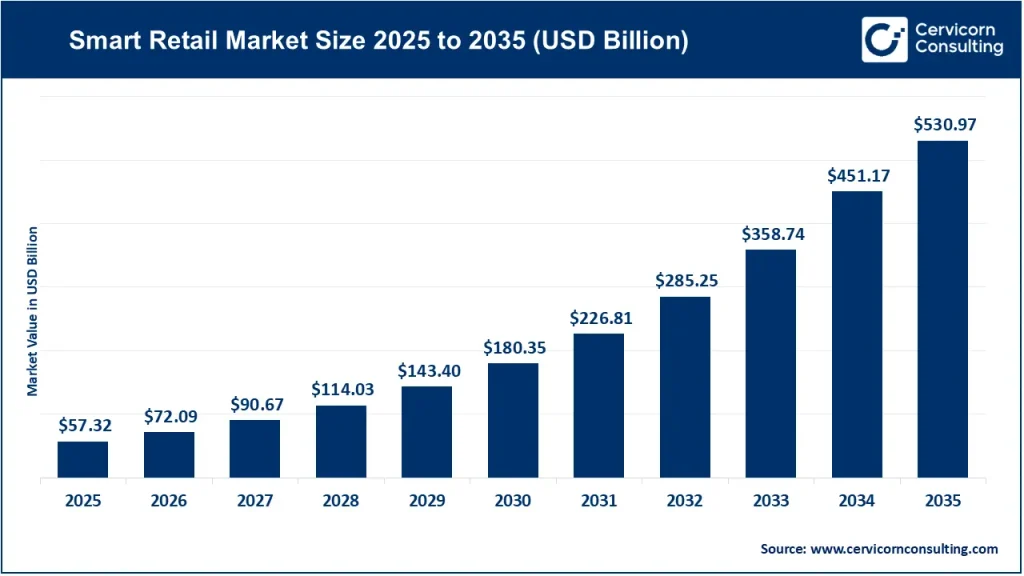
The global smart retail market was valued at approximately USD 57.32 billion in 2025 and is projected to reach USD 530.97 billion by 2035, expanding at a CAGR of 24.93% from 2026 to 2035.
For retailers, however, market growth alone does not answer the most important investment questions.
The strategic issue is becoming:
Which smart retail technologies can improve store economics, and where should retailers invest first?
This matters because smart retail is not a single technology purchase. A retailer introducing electronic shelf labels may also need new connectivity, store-management software, analytics, cybersecurity, integration with inventory systems and employee training. A computer-vision deployment may require edge infrastructure and changes to existing cameras and data-management systems.
As retailers move from experimentation toward scaled deployment, technology selection must therefore be connected to measurable business outcomes.
The Smart Retail Investment Case Is Shifting From Experience to Economics
Customer experience remains important, but retailers are increasingly evaluating technology according to its impact on revenue, operating costs, inventory productivity and capital efficiency.
KPMG’s 2026 Global Tech Report for Consumer & Retail highlights this transition, noting that retailers are moving toward AI-first modernization while focusing more closely on measurable value, investment levels, organizational maturity and the ability to scale AI beyond pilots.
This changes how technology investments should be assessed.
Instead of asking:
“Should we adopt AI in our stores?”
retailers need to ask:
- Can the technology reduce stockouts?
- Can it improve inventory accuracy?
- Can it increase conversion or basket size?
- Can it reduce checkout or labor costs?
- Can it improve price execution?
- Can the existing IT infrastructure support deployment across hundreds or thousands of stores?
- How quickly can the investment reach an acceptable payback period?
These questions make smart retail a business transformation decision rather than simply an IT modernization project.
Inventory Intelligence Could Become the Strongest Starting Point
Inventory remains one of the most commercially important applications of smart retail.
Cervicorn’s market analysis estimates that inventory management represented approximately 37.5% of smart retail revenue in 2025.
The reason is straightforward: inventory problems affect several financial metrics simultaneously.
An out-of-stock product can result in lost sales. Excess inventory ties up working capital. Incorrect shelf information can create pricing and replenishment errors. Poor visibility across stores can also make omnichannel fulfillment more difficult.
Smart shelves, RFID, computer vision, IoT sensors and predictive analytics can provide more frequent visibility into what is happening at the shelf rather than relying entirely on periodic manual checks.
The business case therefore becomes stronger when retailers connect smart-store technologies with:
inventory → replenishment → merchandising → fulfillment → sales data.
For retailers evaluating investment priorities, inventory intelligence may offer a clearer path to measurable returns than technologies focused primarily on customer novelty.
Smart Shelves Are Evolving Into Real-Time Decision Systems
Smart shelves are becoming more than connected displays.
Modern systems can combine RFID, electronic shelf labels, weight sensors, cameras and AI-enabled analytics to monitor shelf conditions and product availability.
The global smart shelves market was estimated at USD 4.63 billion in 2025 and is projected to reach USD 22.91 billion by 2034, according to Fortune Business Insights. Asia-Pacific accounted for approximately 48.35% of the market in 2025.
This creates several potential use cases:
- automated out-of-stock detection
- planogram compliance
- real-time inventory visibility
- automated price updates
- promotional execution
- shrinkage monitoring
- demand forecasting
- shelf-level customer behavior analysis
The strategic opportunity is to avoid deploying smart shelves simply as standalone hardware.
Their value increases when shelf-level data feeds the retailer’s broader decision architecture.
Digital Signage Is Moving From Promotion to Personalization
Digital signage represented approximately 38.1% of smart retail system revenue in 2025, according to Cervicorn’s market analysis.
Traditional digital signage primarily replaces printed promotional material.
The next generation is more data-driven.
Retailers can connect digital displays with inventory availability, customer analytics, time of day, promotions and product information. This allows content to be changed according to store conditions rather than following a fixed promotional schedule.
For example, a retailer could prioritize:
- high-inventory products
- products approaching promotional windows
- complementary products
- location-specific offers
- time-sensitive promotions
This creates an important investment consideration.
The value of digital signage depends less on the screen itself and more on the quality of the data and decision engine behind it.
AI Is Becoming the Intelligence Layer Across the Store
Artificial intelligence accounted for approximately 38.02% of smart retail technology revenue in 2025, according to Cervicorn.
AI is increasingly being applied across:
- demand forecasting
- personalized recommendations
- dynamic pricing
- customer behavior analysis
- inventory optimization
- predictive maintenance
- fraud and loss prevention
- workforce scheduling
- visual merchandising
But retailers should be careful about treating AI as a standalone investment category.
The strongest deployments are likely to be those where AI is connected to operational data.
For example:
POS data + inventory data + customer data + shelf data + external demand signals → AI forecasting → replenishment decision.
The objective is not simply to add an AI model to the store.
The objective is to shorten the distance between data and operational action.
Computer Vision Could Change How Physical Stores Are Measured
Computer vision is becoming particularly important because physical stores historically provide less granular data than digital commerce environments.
Online retailers can observe clicks, searches, dwell time and conversion paths. Physical retailers have traditionally relied more heavily on sales data and manual observation.
Computer vision can help close part of this information gap.
Potential applications include:
- customer traffic measurement
- shelf availability
- queue monitoring
- planogram compliance
- product interaction analysis
- loss prevention
- operational compliance
Recent developments in India illustrate the broader shift. Financial Express reported in 2026 that only around 5% of India’s approximately 50 million CCTV cameras sold annually incorporate intelligent features, while video analytics, computer vision and edge computing are expanding the use of cameras beyond passive surveillance.
For retailers, this suggests an important possibility: existing physical infrastructure may become a data source rather than requiring every smart-store capability to begin with completely new hardware.
Electronic Shelf Labels Could Have a Different Investment Logic
Electronic shelf labels (ESLs) address a very specific operational problem: changing and maintaining pricing across large numbers of products and stores.
They can reduce manual price-change activity while enabling faster promotional updates and greater synchronization between shelf prices and centralized systems.
The opportunity becomes more significant when ESLs are integrated with:
- inventory systems
- pricing engines
- promotions
- loyalty platforms
- demand forecasting
- digital signage
However, retailers should evaluate the total deployment economics rather than only the hardware cost.
A meaningful business case should consider:
hardware + connectivity + software + installation + integration + maintenance + battery/lifecycle costs + labor savings + pricing flexibility.
This is particularly important for retailers with large store networks.
Self-Checkout and Smart Payments Require a Different ROI Framework
Smart payment systems represented approximately 17.3% of smart retail system revenue in 2025, according to Cervicorn.
The business case can involve several variables:
- checkout throughput
- queue time
- labor allocation
- transaction accuracy
- fraud
- customer adoption
- payment processing costs
Self-checkout can therefore appear attractive from a labor-efficiency perspective, but adoption and loss-prevention economics need to be evaluated at store level.
A technology that performs well in a high-volume urban supermarket may produce a very different return in a smaller convenience store.
Store format matters.
Omnichannel Retail Makes Store Intelligence More Valuable
The physical store is no longer isolated from the digital channel.
Customers increasingly expect inventory visibility, click-and-collect, mobile ordering, flexible fulfillment and consistent pricing across physical and digital touchpoints.
Cervicorn identifies omnichannel retailing as a major smart-retail trend, with retailers increasingly connecting e-commerce, mobile applications and physical stores.
This changes the role of store technology.
A store can function simultaneously as:
- a sales location
- a fulfillment node
- a customer-service point
- an inventory hub
- a returns center
- a data-generation environment
As a result, investments in store intelligence should be evaluated against the retailer’s entire commerce network, rather than store-level metrics alone.
Where Should Retailers Invest First?
There is no universal smart-retail technology stack.
A practical investment sequence could look like this:
| Business Priority | Technologies to Evaluate | Metrics to Track |
|---|---|---|
| Inventory accuracy | RFID, smart shelves, computer vision | Stock accuracy, stockouts, inventory turns |
| Pricing efficiency | ESLs, pricing software, AI | Price-change time, margin, promotion execution |
| Store productivity | IoT, automation, analytics | Labor hours, task completion, operating cost |
| Customer conversion | AI recommendations, digital signage, analytics | Conversion, basket size, dwell time |
| Checkout efficiency | Self-checkout, smart payment systems | Queue time, transactions/hour, labor allocation |
| Loss prevention | Computer vision, analytics | Shrinkage, incident rates |
| Omnichannel fulfillment | Real-time inventory, store systems | Fulfillment time, order accuracy, pickup rate |
This framework helps retailers prioritize technology according to measurable business outcomes rather than technology popularity.
Regional Strategy Will Also Matter
Cervicorn estimates that North America accounted for approximately 38.3% of global smart retail revenue in 2025, while Asia-Pacific represented approximately 30.5%. North America’s market is projected to rise from USD 21.95 billion in 2025 to approximately USD 203.36 billion by 2035.
Asia-Pacific, meanwhile, is projected to grow from approximately USD 17.48 billion in 2025 to USD 161.95 billion by 2035.
The regional opportunity is not identical.
North American retailers may have greater emphasis on automation, AI-enabled operations and sophisticated omnichannel infrastructure.
Asia-Pacific can present a different combination of opportunities driven by urbanization, mobile payments, new retail formats and rapid digital adoption.
Therefore, companies entering smart retail markets should assess not only global market size but also:
- store-format penetration
- technology adoption
- labor economics
- digital payment maturity
- data regulations
- retail infrastructure
- consumer behavior
- local technology ecosystems
The Biggest Risk May Not Be Technology Cost
The cost of smart retail hardware is visible.
The cost of poor integration is less visible.
A retailer can deploy advanced cameras, RFID readers, smart shelves and AI software and still fail to generate meaningful value if the resulting data remains disconnected from core retail systems.
Cervicorn identifies high implementation costs, privacy and security concerns, rapid technology changes and integration challenges among the factors that can constrain smart-retail adoption.
This makes architecture an important part of the investment decision.
Retailers should examine:
POS → inventory → ERP → CRM → IoT → computer vision → analytics → AI → decision/action
before committing to a large technology rollout.
A fragmented technology stack can create multiple data silos, duplicate infrastructure and higher long-term operating costs.
What Retail Technology Leaders Should Measure Before Scaling
Before moving from pilot to chain-wide deployment, retailers should establish a baseline.
At minimum, the evaluation should include:
- Current operating cost
How much does the existing process cost per store? - Current performance
What are current stockout, shrinkage, conversion, labor and checkout metrics? - Technology-enabled improvement
What measurable change is expected? - Total cost of ownership
What are hardware, software, connectivity, integration and maintenance costs? - Scalability
Can the solution move from 10 stores to 1,000 stores without disproportionate costs? - Data and cybersecurity requirements
What customer and operational information will be collected? - Integration requirements
Can the technology work with existing POS, ERP, WMS and CRM environments? - Payback period
Under realistic adoption assumptions, when does the investment begin generating positive economic value?
This approach makes technology investment easier to compare across competing projects.
The Smart Retail Market Is Becoming an Infrastructure Decision
Smart retail is entering a more mature phase.
The competitive advantage will not necessarily come from the retailer with the largest number of connected devices. It is more likely to come from companies that can connect store data, customer intelligence and operational systems quickly enough to make better decisions.
The USD 57.32 billion smart retail market in 2025 is projected to reach USD 530.97 billion by 2035, but the commercial opportunity will differ substantially by technology, retail format, geography and use case.
For retailers, technology providers and investors, the important questions are therefore becoming more specific:
Which technologies are moving from pilot to scalable deployment?
Which retail formats offer the strongest economics?
Where can AI, computer vision, RFID and automation generate measurable operating value?
Which technology combinations can integrate into existing retail infrastructure without creating excessive complexity?
And ultimately:
Which smart-retail investments can improve store economics rather than simply making stores more technologically advanced?
The answers will determine where capital flows as the next phase of smart retail develops.
To Get Detailed Overview, Contact Us: https://www.cervicornconsulting.com/contact-us
Read Report: Inulin in food and nutrition: What companies need to solve across cost, formulation and consumer demand