


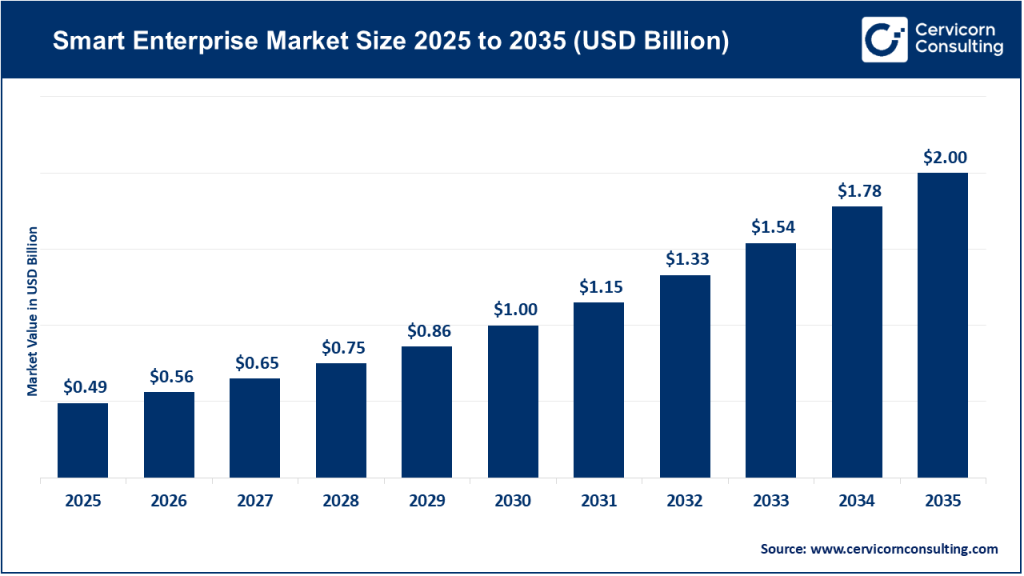
Smart Enterprise Market Size
The global smart enterprise market was valued at approximately USD 0.49 billion in 2025 and is projected to reach nearly USD 2.00 billion by 2035, growing at a CAGR of 15.1%.
Smart Enterprise Market Growth Factors
The smart enterprise market is witnessing rapid expansion due to the accelerating adoption of artificial intelligence (AI), cloud computing, Internet of Things (IoT), big data analytics, automation, digital twins, edge computing, and enterprise resource planning (ERP) modernization. Organizations across manufacturing, healthcare, retail, banking, telecommunications, logistics, and government sectors are investing heavily in digital transformation to improve operational efficiency, reduce costs, strengthen cybersecurity, enhance customer experience, and enable data-driven decision-making.
Increasing demand for predictive maintenance, intelligent supply chain management, connected industrial operations, hybrid workplaces, and real-time business intelligence is further driving market growth. Additionally, supportive government initiatives promoting Industry 4.0, smart manufacturing, digital infrastructure, and cloud adoption are encouraging enterprises worldwide to modernize legacy systems, making smart enterprise solutions an essential component of future business competitiveness.
Get a Free Sample: https://www.cervicornconsulting.com/sample/2636
What is the Smart Enterprise Market?
The smart enterprise market refers to the ecosystem of technologies, software platforms, hardware solutions, and digital services that enable organizations to operate intelligently through connected systems, automation, and real-time analytics.
A smart enterprise integrates data from multiple business functions—including finance, operations, supply chain, customer relationship management (CRM), human resources, manufacturing, and IT infrastructure—to create an interconnected digital environment. These systems leverage AI, machine learning, cloud computing, IoT sensors, advanced analytics, and automation tools to optimize business performance.
Unlike traditional enterprises that rely on isolated systems and manual workflows, smart enterprises utilize integrated digital platforms capable of making predictive recommendations, automating repetitive processes, detecting anomalies, improving asset utilization, and supporting strategic decision-making.
As digital transformation becomes a strategic priority, smart enterprise technologies are evolving from optional innovations into core business infrastructure across virtually every industry.
Why is the Smart Enterprise Market Important?
The growing importance of smart enterprises lies in their ability to transform business operations into intelligent, connected ecosystems.
Major benefits include:
- Faster and data-driven decision making
- Enhanced operational efficiency
- Reduced operational costs
- Improved employee productivity
- Better customer experience
- Predictive maintenance of assets
- Stronger cybersecurity monitoring
- Supply chain visibility
- Increased sustainability through optimized resource usage
- Greater organizational agility during market disruptions
Modern enterprises generate enormous volumes of operational data every day. Smart enterprise technologies convert this data into actionable business intelligence, enabling executives to make informed decisions with greater speed and confidence.
Furthermore, enterprises adopting intelligent automation are better positioned to respond to economic uncertainty, changing customer expectations, labor shortages, and global supply chain disruptions.
Major Companies Shaping the Smart Enterprise Market
| Company | Specialization | Key Focus Areas | Notable Features | 2025 Revenue* | Estimated Market Position | Global Presence |
|---|---|---|---|---|---|---|
| Microsoft | Cloud computing, AI, enterprise software | Azure, Dynamics 365, Microsoft Fabric, Copilot AI, cybersecurity | Comprehensive AI-powered enterprise ecosystem | Approximately US$281.7 billion | Leading global technology provider | 190+ countries |
| Cisco Systems | Enterprise networking and cybersecurity | Networking, collaboration, AI infrastructure, industrial IoT | Secure enterprise networking with AI integration | Approximately US$56.7 billion | Major networking infrastructure leader | 100+ countries |
| Oracle | Cloud infrastructure and enterprise applications | Oracle Cloud Infrastructure (OCI), ERP, HCM, databases, AI | High-performance cloud database and enterprise applications | Approximately US$57.4 billion | Leading enterprise cloud software provider | 175+ countries |
| SAP | Enterprise resource planning (ERP) | ERP, supply chain, finance, AI-powered business applications | End-to-end enterprise process management | Approximately €36.8 billion | Global ERP market leader | 180+ countries |
| Honeywell Process Solutions | Industrial automation | Process automation, smart manufacturing, industrial IoT, digital twins | Industrial intelligence and operational technology integration | Approximately US$41 billion (guidance) | Major industrial automation provider | 100+ countries |
Leading Trends in the Smart Enterprise Market and Their Impact
1. Artificial Intelligence Becoming Enterprise-Wide
AI has moved beyond experimental deployments into enterprise-wide implementation. Organizations now use AI assistants, predictive analytics, intelligent document processing, and generative AI to automate complex business functions.
Impact:
- Higher workforce productivity
- Faster decision-making
- Reduced operational expenses
- Improved customer engagement
2. Cloud-First Digital Transformation
Cloud infrastructure continues replacing traditional on-premise systems.
Organizations increasingly deploy:
- Hybrid cloud
- Multi-cloud
- Cloud-native ERP
- SaaS platforms
- Cloud security solutions
Impact:
- Improved scalability
- Lower infrastructure costs
- Global accessibility
- Faster software deployment
3. Intelligent Automation
Robotic Process Automation (RPA) combined with AI enables organizations to automate repetitive workflows across finance, procurement, HR, customer support, and compliance.
Impact:
- Lower processing costs
- Fewer human errors
- Faster business operations
- Higher employee productivity
4. Industrial IoT Expansion
Connected sensors across factories, warehouses, utilities, and logistics networks continuously generate operational intelligence.
Applications include:
- Predictive maintenance
- Remote monitoring
- Quality control
- Equipment optimization
Impact:
- Reduced downtime
- Improved equipment lifespan
- Increased manufacturing efficiency
5. Digital Twin Technology
Digital twins create virtual replicas of manufacturing plants, machinery, logistics systems, and entire enterprise operations.
Organizations simulate operational changes before implementing them.
Impact:
- Lower operational risks
- Better planning
- Reduced maintenance costs
- Improved productivity
6. Cybersecurity Integration
As enterprise systems become increasingly connected, cybersecurity has become an integral component of smart enterprise platforms.
Modern enterprises implement:
- Zero Trust architecture
- AI-powered threat detection
- Identity management
- Network security automation
Impact:
- Reduced cyber risks
- Faster incident response
- Improved regulatory compliance
7. Sustainable Enterprise Operations
Environmental sustainability is becoming an important business objective.
Smart enterprise technologies help organizations:
- Monitor energy usage
- Optimize resource consumption
- Reduce emissions
- Improve ESG reporting
Impact:
- Lower operating costs
- Better regulatory compliance
- Improved corporate reputation
Successful Smart Enterprise Examples Around the World
Microsoft Smart Factory Solutions
Microsoft’s Azure IoT, Dynamics 365, AI services, and industrial cloud solutions enable manufacturers to build connected factories with predictive maintenance, intelligent production planning, and real-time operational monitoring.
Industries served include:
- Automotive
- Pharmaceuticals
- Electronics
- Consumer goods
Cisco Smart Manufacturing
Cisco enables smart factories using secure industrial networking, edge computing, industrial IoT, AI-enabled networking, and cybersecurity solutions.
Its networking infrastructure connects production equipment, warehouse systems, robotics, and enterprise applications securely across manufacturing environments.
Oracle Intelligent Supply Chain
Oracle Cloud ERP provides integrated finance, procurement, logistics, warehouse management, and AI-driven planning capabilities.
Global enterprises leverage Oracle’s intelligent supply chain solutions to improve inventory optimization, demand forecasting, and procurement efficiency.
SAP Intelligent Enterprise
SAP integrates ERP, analytics, AI, customer experience, procurement, manufacturing, and sustainability into a unified business platform.
Thousands of multinational organizations rely on SAP for enterprise-wide digital transformation.
Honeywell Connected Plant
Honeywell Process Solutions has transformed industrial operations through:
- Connected factories
- Industrial IoT
- Predictive maintenance
- Process optimization
- Digital twins
Its technologies improve operational reliability across oil & gas, chemicals, mining, utilities, and manufacturing industries.
Global Regional Analysis
North America
North America remains the largest smart enterprise market due to its advanced digital infrastructure, high cloud adoption, strong enterprise IT spending, and rapid AI implementation.
Market Drivers
- Strong cloud ecosystem
- Large technology investments
- Mature enterprise software adoption
- Advanced manufacturing modernization
- High cybersecurity spending
Government Initiatives
The United States supports digital transformation through programs promoting advanced manufacturing, semiconductor production, AI innovation, cybersecurity resilience, and smart infrastructure. Federal investments in digital modernization and Industry 4.0 initiatives continue to encourage enterprise adoption of intelligent technologies.
Canada is also expanding investments in AI commercialization, digital infrastructure, cloud innovation, and industrial modernization through national innovation programs.
Europe
Europe continues to witness significant growth as organizations focus on digital sovereignty, sustainability, smart manufacturing, and industrial automation.
Market Drivers
- Industry 4.0 adoption
- ESG compliance
- Manufacturing modernization
- Industrial automation
- Data governance
Government Policies
The European Union’s Digital Europe Programme, AI Act implementation, Horizon Europe research funding, and initiatives supporting cloud computing, cybersecurity, and digital innovation hubs are accelerating enterprise digital transformation. Many European governments also provide incentives for smart factories, energy-efficient manufacturing, and digital skills development.
Asia-Pacific
Asia-Pacific is expected to experience the fastest market growth.
Rapid industrialization, manufacturing expansion, urbanization, and government-led digital transformation initiatives are driving enterprise modernization.
Major Growth Countries
- China
- Japan
- India
- South Korea
- Singapore
- Australia
Government Initiatives
China
China’s “Made in China 2025” strategy promotes intelligent manufacturing, industrial robotics, AI, cloud computing, and digital industrial infrastructure.
India
The Digital India initiative, National Strategy for Artificial Intelligence, Smart Cities Mission, Production-Linked Incentive (PLI) schemes, and manufacturing digitization programs encourage enterprises to adopt cloud technologies, AI, and automation.
Japan
Japan’s Society 5.0 vision integrates AI, IoT, robotics, and digital transformation across industries to build highly connected enterprises and smart manufacturing ecosystems.
South Korea
The Korean New Deal emphasizes digital innovation, AI infrastructure, cloud computing, smart factories, and industrial automation to strengthen national competitiveness.
Latin America
Latin America is steadily adopting smart enterprise technologies as businesses modernize operations.
Key Growth Areas
- Banking
- Telecommunications
- Retail
- Manufacturing
- Energy
Government Support
Countries such as Brazil, Mexico, and Chile are investing in digital government services, broadband expansion, Industry 4.0 programs, and innovation ecosystems that support enterprise digitalization.
Middle East & Africa
The Middle East and Africa are increasingly investing in intelligent enterprise technologies as part of economic diversification strategies.
Growth Drivers
- Smart cities
- Oil & gas digitization
- Cloud adoption
- Industrial automation
- Government digital transformation
Government Initiatives
United Arab Emirates
The UAE Artificial Intelligence Strategy 2031, Smart Dubai initiatives, and national digital government programs encourage AI adoption, cloud services, and intelligent enterprise platforms across public and private sectors.
Saudi Arabia
Vision 2030 promotes industrial automation, digital infrastructure, smart manufacturing, cloud computing, and AI-powered enterprise innovation to diversify the national economy beyond oil.
South Africa
Government-backed digital economy initiatives encourage cloud adoption, industrial modernization, broadband connectivity, and enterprise innovation, particularly across manufacturing and financial services.
To Get Detailed Overview, Contact Us: https://www.cervicornconsulting.com/contact-us
Read Report: Implantable Medical Devices Market Revenue, Trends, and Strategic Insights by 2035