


Table of Contents
ToggleImplantable Medical Devices Market Size
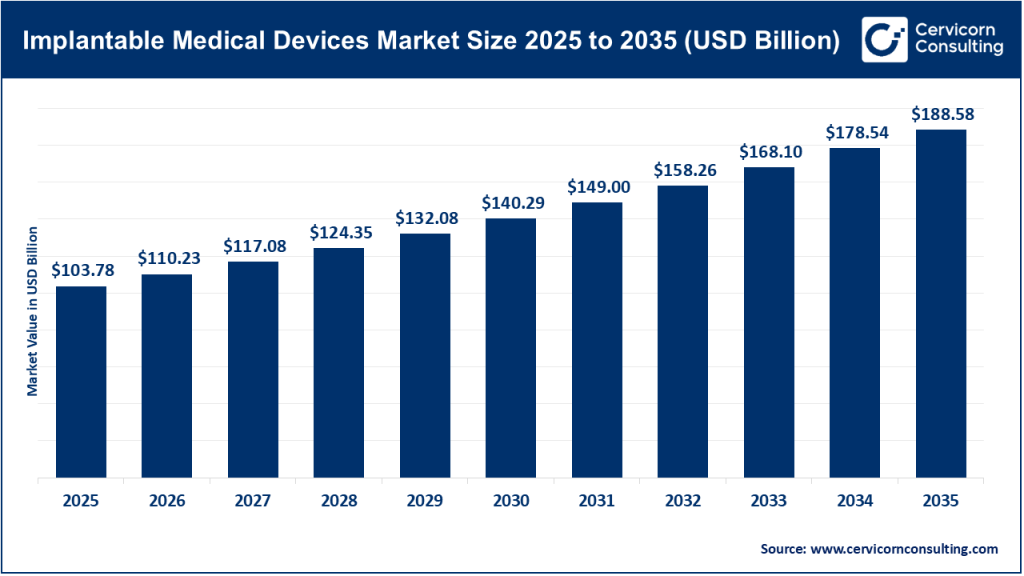
The global implantable medical devices market was valued at USD 103.78 billion in 2025 and is projected to reach approximately USD 7,930.84 million by 2035, growing at a robust CAGR of 33.1% during the forecast period from 2026 to 2035.
What is the Implantable Medical Devices Market?
The implantable medical devices market comprises medical technologies that are surgically or minimally invasively placed inside the human body to diagnose, monitor, replace, or support biological functions over an extended period. These devices include cardiac pacemakers, implantable cardioverter-defibrillators (ICDs), cochlear implants, orthopedic implants, spinal implants, neurostimulators, dental implants, implantable drug delivery systems, vascular stents, breast implants, and retinal implants. The market encompasses device manufacturers, component suppliers, software providers, healthcare facilities, and post-implant monitoring services. Continuous advances in biomaterials, miniaturization, wireless connectivity, artificial intelligence (AI), and remote patient monitoring are transforming implantable devices into smarter, longer-lasting, and more personalized therapeutic solutions.
Why is the Implantable Medical Devices Market Important?
Implantable medical devices have fundamentally changed the treatment of chronic diseases and life-threatening conditions. Unlike conventional medications that require continuous administration, implantable devices often provide long-term therapeutic benefits with greater precision and improved patient compliance. Cardiac implants help regulate abnormal heart rhythms, orthopedic implants restore mobility, cochlear implants enable hearing restoration, and neurostimulators improve quality of life for patients suffering from neurological disorders.
The importance of this market continues to grow due to several global healthcare trends:
- Rising prevalence of cardiovascular diseases
- Aging populations worldwide
- Increasing incidence of hearing loss and orthopedic disorders
- Expansion of minimally invasive surgical procedures
- Growing demand for personalized healthcare
- Rapid digitalization of connected healthcare systems
Healthcare providers increasingly rely on implantable technologies because they reduce hospital readmissions, improve clinical outcomes, enhance patient monitoring, and lower long-term treatment costs.
Implantable Medical Devices Market Growth Factors
The implantable medical devices market is experiencing sustained expansion due to the growing burden of chronic diseases, increasing elderly populations, rising demand for minimally invasive surgeries, continuous technological innovations in biomaterials and smart implants, expanding healthcare infrastructure across emerging economies, growing awareness regarding early disease management, wider adoption of remote patient monitoring, increasing investments in medical device research and development, supportive reimbursement policies in developed economies, rising prevalence of cardiovascular and neurological disorders, increasing orthopedic replacement procedures, greater integration of artificial intelligence with implantable technologies, expanding clinical applications of bioelectronic medicine, improved surgical precision through robotic-assisted procedures, favorable regulatory pathways for breakthrough medical technologies, and growing collaboration between healthcare providers, technology companies, and medical device manufacturers.
Get a Free Sample: https://www.cervicornconsulting.com/sample/2774
Major Market Segments
The implantable medical devices market can be segmented into:
By Product
- Cardiovascular implants
- Orthopedic implants
- Dental implants
- Cochlear implants
- Neurostimulators
- Ophthalmic implants
- Cosmetic implants
- Spinal implants
- Implantable drug delivery devices
By Material
- Metallic implants
- Ceramic implants
- Polymer implants
- Biomaterial-based implants
- Composite implants
By End User
- Hospitals
- Specialty clinics
- Ambulatory surgical centers
- Research institutes
Leading Companies in the Implantable Medical Devices Market
| Company | Specialization | Key Focus Areas | Notable Features | 2025 Revenue* | Estimated Market Share | Global Presence |
|---|---|---|---|---|---|---|
| Abbott Laboratories | Cardiovascular devices, neuromodulation, diabetes care | Cardiac rhythm management, structural heart, vascular therapies | Strong portfolio of pacemakers, ICDs, heart valves, vascular devices | US$44.3 Billion | ~7–9% | Operations in over 160 countries |
| Alcon | Ophthalmic medical devices | Intraocular lenses, cataract surgery, glaucoma implants | Global leader in eye-care technologies | ~US$10 Billion | ~4–5% | Presence in more than 140 countries |
| Cochlear Limited | Hearing implants | Cochlear implants, bone conduction systems | Pioneer in implantable hearing technologies | ~US$1.5 Billion | Dominant in cochlear implants | Over 180 countries |
| Fresenius Medical Care | Renal care technologies | Dialysis systems, vascular access devices | Integrated renal care ecosystem | ~€19–20 Billion | Strong renal implant ecosystem | Operations in over 150 countries |
| GE HealthCare | Medical imaging and interventional technologies | Image-guided surgery, diagnostics, monitoring | Advanced imaging supporting implant procedures | US$20.6 Billion | Major imaging technology provider | Presence in more than 160 countries |
*Revenues represent total company revenue rather than implantable device revenue.
Leading Trends Shaping the Implantable Medical Devices Market
Smart Implantable Devices
Modern implants increasingly include embedded sensors capable of transmitting physiological information in real time. Smart pacemakers, neurostimulators, and cardiac monitors now support remote patient management.
Impact
- Earlier detection of complications
- Reduced hospital visits
- Improved patient outcomes
- Better physician decision-making
Artificial Intelligence Integration
AI algorithms analyze data generated by implantable devices to predict disease progression, optimize therapy settings, and personalize treatment plans.
Impact
- Predictive healthcare
- Personalized medicine
- Improved implant performance
- Enhanced clinical efficiency
Miniaturization of Devices
Manufacturers continue reducing implant size while increasing functionality.
Examples include:
- Leadless pacemakers
- Miniature neurostimulators
- Wireless pressure sensors
Impact
- Less invasive surgery
- Faster recovery
- Lower infection risk
- Better patient comfort
Bioengineered Materials
Next-generation biomaterials improve implant compatibility with human tissues while reducing rejection and inflammatory responses.
Innovations include:
- Titanium alloys
- Biodegradable polymers
- Ceramic coatings
- Nanostructured surfaces
Impact
- Longer implant lifespan
- Reduced revision surgeries
- Better tissue integration
Wireless Charging Technologies
Researchers are developing implantable devices that receive power wirelessly instead of relying solely on batteries.
Impact
- Extended device longevity
- Reduced replacement surgeries
- Lower healthcare costs
Remote Patient Monitoring
Cloud-connected implantable devices continuously share patient data with healthcare providers.
Impact
- Continuous monitoring
- Early intervention
- Improved chronic disease management
- Better patient engagement
Successful Examples of Implantable Medical Devices Around the World
Cardiac Pacemakers
Millions of patients worldwide rely on implantable pacemakers to regulate abnormal heart rhythms. These devices have become standard treatment for arrhythmias and heart block.
Impact
- Longer life expectancy
- Reduced sudden cardiac death
- Improved quality of life
Cochlear Implants
Cochlear implants have transformed hearing restoration for patients with severe hearing loss.
Countries with widespread adoption include:
- United States
- Australia
- Germany
- United Kingdom
- Japan
Impact
- Restored hearing
- Improved speech development
- Enhanced educational opportunities
- Better social inclusion
Deep Brain Stimulation (DBS)
Implantable neurostimulators successfully treat:
- Parkinson’s disease
- Essential tremor
- Dystonia
- Epilepsy
Major treatment centers across Europe and North America have demonstrated substantial improvements in motor function and patient quality of life.
Orthopedic Joint Replacements
Hip and knee replacement implants have become among the world’s most successful implantable medical procedures.
Countries with high adoption include:
- United States
- Germany
- Sweden
- Canada
- Australia
Impact
- Restored mobility
- Reduced pain
- Increased independence
- Lower disability rates
Implantable Cardioverter Defibrillators (ICDs)
ICDs continuously monitor heart rhythms and deliver life-saving electrical therapy when dangerous arrhythmias occur.
These devices have significantly reduced mortality among high-risk cardiac patients worldwide.
Global Regional Analysis
North America
North America remains the largest implantable medical devices market.
Key Growth Drivers
- Advanced healthcare infrastructure
- High healthcare expenditure
- Strong reimbursement systems
- Rapid adoption of innovative technologies
- High prevalence of cardiovascular diseases
Government Initiatives
The U.S. government continues to support innovation through accelerated regulatory pathways for breakthrough medical devices, expanded digital health initiatives, and investments in biomedical research. Public healthcare programs also facilitate access to implantable therapies for eligible patients.
Market Outlook
Growing use of AI-powered implants, remote monitoring systems, and robotic-assisted surgeries will continue strengthening regional market leadership.
Europe
Europe represents one of the world’s most mature implantable medical device markets.
Major Contributors
- Germany
- France
- United Kingdom
- Italy
- Netherlands
Growth Drivers
- Aging population
- Universal healthcare systems
- Strong orthopedic implant demand
- Advanced cardiac care infrastructure
Government Policies
European governments support medical technology innovation through research funding, collaborative healthcare programs, and regulatory frameworks emphasizing patient safety and post-market surveillance. The implementation of the European Medical Device Regulation (MDR) has strengthened quality and clinical evidence requirements while promoting long-term patient safety.
Future Outlook
The region continues investing in digital hospitals, AI-assisted surgeries, and precision medicine.
Asia-Pacific
Asia-Pacific is expected to witness the fastest market growth.
Growth Factors
- Large aging population
- Increasing chronic diseases
- Growing healthcare investments
- Rising medical tourism
- Expanding private healthcare sector
Major Markets
- China
- Japan
- India
- South Korea
- Australia
Government Initiatives
Governments across Asia-Pacific are expanding universal healthcare coverage, encouraging domestic medical device manufacturing, investing in digital healthcare infrastructure, and supporting innovation through research grants and favorable industrial policies. Initiatives promoting local production and faster regulatory approvals are strengthening regional competitiveness.
Future Potential
Rapid urbanization and improving healthcare accessibility are expected to significantly increase implant adoption across emerging economies.
Latin America
Latin America continues expanding its implantable medical devices market.
Growth Drivers
- Improved healthcare access
- Increasing orthopedic surgeries
- Rising cardiovascular disease burden
- Expansion of private hospitals
Government Support
Several governments are modernizing healthcare systems, increasing investments in specialized hospitals, and promoting public-private healthcare partnerships to improve access to advanced medical technologies.
Future Outlook
Growing awareness and improved reimbursement mechanisms are expected to accelerate market growth.
Middle East & Africa
The Middle East & Africa region is gradually emerging as an important growth market.
Key Drivers
- Healthcare modernization
- Rising government healthcare spending
- Increasing medical tourism
- Growing prevalence of chronic diseases
Government Policies
Countries across the Gulf region are investing heavily in healthcare transformation strategies, advanced hospitals, digital healthcare ecosystems, and specialized cardiovascular and orthopedic treatment centers. National healthcare diversification programs are encouraging adoption of advanced implantable technologies.
Market Outlook
Although smaller than other regions, increasing investments in healthcare infrastructure are expected to support sustained long-term growth.
Government Initiatives and Policies Shaping the Market
Governments worldwide play a pivotal role in advancing the implantable medical devices market through supportive regulations, research funding, and healthcare modernization initiatives.
Accelerated Regulatory Pathways
Regulatory agencies have introduced expedited approval pathways for breakthrough medical technologies, enabling faster patient access while maintaining safety and efficacy standards.
Increased Public Healthcare Spending
Many countries continue expanding healthcare budgets to improve access to advanced implantable therapies, particularly for cardiovascular diseases, orthopedic disorders, and hearing impairment.
Digital Health Integration
National digital health programs increasingly encourage interoperability between implantable devices, electronic health records, and remote monitoring platforms, supporting more efficient long-term patient management.
Research and Innovation Funding
Governments are investing in biomedical engineering, biomaterials, AI-enabled medical devices, and precision medicine through grants, academic partnerships, and innovation hubs, fostering next-generation implant development.
Local Manufacturing Incentives
Several emerging economies are promoting domestic production of medical devices through tax incentives, manufacturing subsidies, and simplified regulatory procedures, aiming to reduce import dependence and strengthen healthcare resilience.
Quality and Safety Regulations
Enhanced post-market surveillance requirements, clinical evidence standards, and cybersecurity guidelines for connected medical devices are improving patient safety while encouraging manufacturers to adopt higher-quality design and monitoring practices.
To Get Detailed Overview, Contact Us: https://www.cervicornconsulting.com/contact-us
Read Report: Functional Food Market Revenue, Trends, and Strategic Insights by 2035