


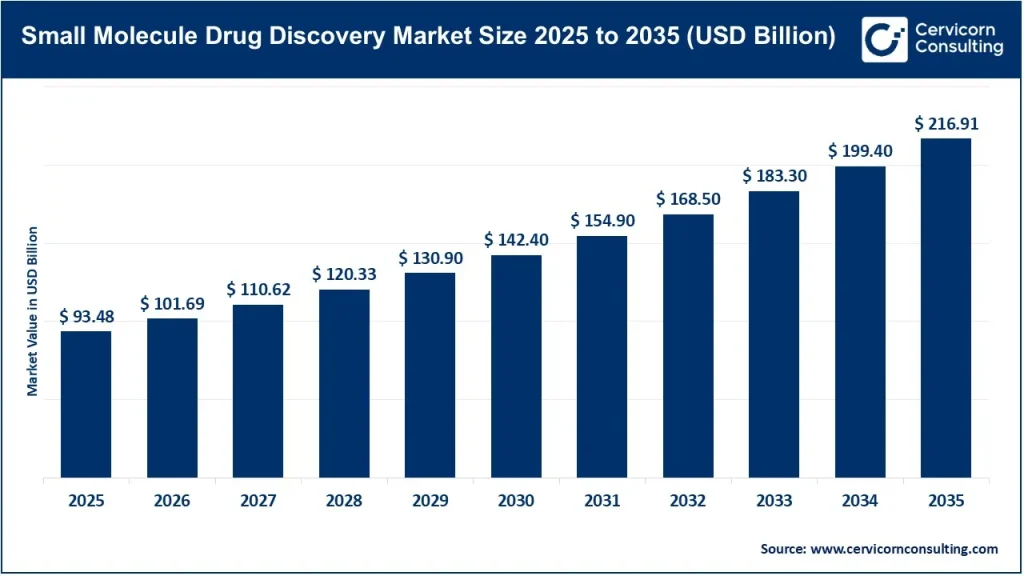
Small Molecule Drug Discovery Market Size
The global small molecule drug discovery market reached an estimated valuation of USD 93.48 billion in 2025 and is projected to grow substantially, attaining approximately USD 216.91 billion by 2035. This growth reflects a strong compound annual growth rate (CAGR) of around 8.8% throughout the forecast period.
What is the Small Molecule Drug Discovery Market?
The small molecule drug discovery market refers to the global industry involved in the research, identification, development, optimization, and commercialization of small molecule therapeutics. Small molecules are chemically synthesized compounds with low molecular weight that can modulate biological processes by interacting with proteins, enzymes, receptors, or nucleic acids.
The market encompasses multiple stages of the drug discovery process, including target identification, target validation, hit generation, lead optimization, preclinical testing, and clinical development. Pharmaceutical companies, biotechnology firms, contract research organizations (CROs), academic institutes, and research laboratories collectively contribute to the development of innovative small molecule drugs.
Small molecule therapies remain highly preferred because they can often be administered orally, exhibit strong stability, possess scalable manufacturing capabilities, and provide cost-effective treatment solutions compared to many biologics. These advantages have made small molecules a critical component of therapeutic innovation worldwide.
Why is the Small Molecule Drug Discovery Market Important?
The small molecule drug discovery market is important because it serves as the foundation for the development of life-saving medicines that address some of the world’s most challenging diseases. Small molecule therapeutics have historically dominated the pharmaceutical industry and continue to account for a significant portion of approved drugs globally.
One of the key reasons for the market’s importance is its role in improving patient outcomes. Small molecule drugs can precisely target disease pathways, helping to reduce symptoms, slow disease progression, and improve quality of life. These therapies are essential in oncology, infectious disease management, cardiovascular treatment, neurology, and rare disease treatment.
The market is also important because it drives pharmaceutical innovation and economic growth. Drug discovery activities generate substantial investments in research and development, create employment opportunities, and foster collaborations among academic institutions, biotechnology startups, and pharmaceutical giants.
Additionally, small molecule drug discovery supports the advancement of precision medicine by enabling the development of targeted therapies based on genetic and molecular profiles. This approach improves treatment effectiveness while minimizing adverse effects.
The growing use of artificial intelligence and computational drug design has further enhanced the strategic importance of the market. AI-driven drug discovery platforms are helping researchers identify novel drug candidates faster and more efficiently, ultimately accelerating the delivery of therapies to patients.
Get a Free Sample: https://www.cervicornconsulting.com/sample/2951
Small Molecule Drug Discovery Market Growth Factors
The small molecule drug discovery market is experiencing substantial growth due to several interconnected factors that are transforming the pharmaceutical and biotechnology landscape. The increasing prevalence of chronic diseases such as cancer, diabetes, cardiovascular disorders, and neurological conditions is creating strong demand for innovative therapeutics worldwide. Rising investments in pharmaceutical research and development are encouraging the discovery of novel small molecule compounds with improved efficacy and safety profiles. Technological advancements including artificial intelligence, machine learning, molecular modeling, high-throughput screening, bioinformatics, and computational chemistry are significantly improving drug discovery efficiency and reducing development timelines. The growing adoption of precision medicine and targeted therapies is further supporting market growth as healthcare providers seek personalized treatment solutions.
Expansion of contract research organizations and strategic collaborations between pharmaceutical companies and biotechnology firms are accelerating innovation and clinical development activities. Government support for orphan drug development, favorable regulatory pathways, and increased funding for biomedical research are also strengthening the market. Additionally, the increasing demand for orally administered drugs, cost-effective therapeutic solutions, and scalable manufacturing processes continues to drive the widespread adoption of small molecule therapeutics globally.
Key Companies in the Small Molecule Drug Discovery Market
| Company | Specialization | Key Focus Areas | Notable Features | 2024 Revenue | Market Share | Global Presence |
|---|---|---|---|---|---|---|
| Pfizer | Pharmaceuticals and biotechnology | Oncology, vaccines, inflammation, rare diseases, cardiology | Strong R&D pipeline, AI-driven research collaborations, global manufacturing network | Approx. USD 63 billion | Significant global share in pharmaceutical therapeutics | Operations across North America, Europe, Asia-Pacific, Latin America, and Middle East |
| AstraZeneca | Biopharmaceutical innovation | Oncology, respiratory diseases, cardiovascular disorders, immunology | Advanced targeted therapy programs and precision medicine capabilities | Approx. USD 54 billion | Strong presence in oncology drug discovery | Extensive operations in over 100 countries |
| F. Hoffmann-La Roche (Roche) | Pharmaceuticals and diagnostics | Oncology, immunology, neuroscience, infectious diseases | Integrated diagnostics and therapeutics platform, personalized medicine expertise | Approx. USD 69 billion | Major contributor to oncology and diagnostics market | Broad global footprint across developed and emerging markets |
| Novartis | Innovative medicines and generics | Cancer therapeutics, cardiovascular disease, gene therapy, immunology | Strong focus on digital innovation and next-generation therapies | Approx. USD 46 billion | Leading position in innovative therapeutics | Presence across Europe, Asia-Pacific, North America, and Latin America |
| Merck & Co. | Pharmaceutical research and biotechnology | Oncology, vaccines, infectious diseases, metabolic disorders | Strong immuno-oncology portfolio and advanced clinical pipeline | Approx. USD 60 billion | Major player in global pharmaceutical market | Extensive international operations and research centers |
Leading Trends in the Small Molecule Drug Discovery Market and Their Impact
Integration of Artificial Intelligence and Machine Learning
Artificial intelligence and machine learning are transforming the small molecule drug discovery market by enabling researchers to analyze massive biological datasets rapidly and accurately. AI-powered platforms can identify potential drug targets, predict molecular interactions, optimize lead compounds, and reduce failure rates in clinical trials.
The impact of AI integration is significant because it reduces research costs and accelerates the time required to bring new drugs to market. Pharmaceutical companies are increasingly partnering with AI-focused biotechnology firms to improve discovery efficiency and strengthen competitive advantage.
Growth of Precision Medicine
Precision medicine is becoming a major trend in the market as healthcare systems increasingly focus on personalized treatment strategies. Small molecule drugs are being designed to target specific genetic mutations and molecular pathways associated with individual diseases.
This trend is improving therapeutic outcomes, reducing adverse effects, and enabling the development of highly specialized treatments for cancer and rare diseases. The growing availability of genomic sequencing technologies is further supporting the expansion of precision medicine initiatives.
Expansion of High-Throughput Screening Technologies
High-throughput screening technologies allow researchers to evaluate thousands of chemical compounds simultaneously for biological activity. This approach has significantly accelerated hit identification and lead optimization processes.
The adoption of automated screening platforms is improving research productivity and increasing the probability of discovering promising drug candidates. Pharmaceutical companies are heavily investing in robotic systems and advanced analytics to enhance discovery workflows.
Increasing Outsourcing to Contract Research Organizations
Pharmaceutical and biotechnology companies are increasingly outsourcing drug discovery activities to contract research organizations. CROs provide specialized expertise, advanced technologies, and cost-effective research services.
This trend is helping companies reduce operational expenses, access global talent pools, and accelerate project timelines. The expansion of CRO services in emerging markets such as India and China is further contributing to market growth.
Rising Focus on Rare Diseases and Orphan Drugs
The development of therapies for rare diseases has become a major focus area within the small molecule drug discovery market. Governments and regulatory agencies are offering incentives such as tax credits, market exclusivity, and accelerated approval pathways for orphan drugs.
This trend is encouraging pharmaceutical companies to invest in niche therapeutic areas with high unmet medical needs. The result is an increasing number of innovative small molecule therapies entering clinical pipelines.
Adoption of Cloud-Based Drug Discovery Platforms
Cloud computing technologies are enabling seamless collaboration among researchers, pharmaceutical companies, and academic institutions. Cloud-based platforms facilitate data sharing, remote access to computational tools, and real-time collaboration.
The impact of this trend includes improved research efficiency, enhanced scalability, reduced infrastructure costs, and accelerated innovation across global research networks.
Successful Examples of Small Molecule Drug Discovery Around the World
Imatinib (Gleevec) – Cancer Treatment Revolution
Imatinib, developed by Novartis, is one of the most successful examples of small molecule drug discovery. The drug targets the BCR-ABL protein responsible for chronic myeloid leukemia (CML). Imatinib transformed cancer treatment by demonstrating the effectiveness of targeted therapies.
The success of Imatinib highlighted the potential of precision medicine and encouraged pharmaceutical companies to invest heavily in targeted oncology drug discovery.
Oseltamivir (Tamiflu) – Influenza Management
Oseltamivir, marketed as Tamiflu, became a globally recognized antiviral drug used for the treatment and prevention of influenza. The drug demonstrated the importance of rapid-response therapeutics during viral outbreaks.
Its widespread adoption strengthened investments in antiviral drug discovery programs and pandemic preparedness strategies.
Pembrolizumab-Related Small Molecule Research Programs
Although Pembrolizumab itself is a biologic therapy, the success of immuno-oncology has stimulated extensive small molecule research targeting immune checkpoints and tumor microenvironments. Pharmaceutical companies worldwide are developing small molecule immunotherapies to complement biologic treatments.
This has accelerated innovation in cancer drug discovery and expanded opportunities for combination therapies.
Sildenafil (Viagra) – Repurposed Drug Discovery Success
Originally investigated for cardiovascular disease treatment, Sildenafil became a highly successful therapy for erectile dysfunction after researchers identified its additional therapeutic effects.
The drug demonstrated the importance of drug repurposing and highlighted how unexpected clinical findings can create major commercial opportunities.
Remdesivir – Rapid Antiviral Development
Remdesivir gained global attention during the COVID-19 pandemic due to its antiviral properties. The rapid development and deployment of the therapy demonstrated the critical role of small molecule drug discovery in responding to public health emergencies.
The success of antiviral discovery programs has encouraged governments and pharmaceutical companies to strengthen infectious disease research capabilities.
Global Regional Analysis of the Small Molecule Drug Discovery Market
North America
North America dominates the global small molecule drug discovery market due to strong pharmaceutical infrastructure, advanced research capabilities, and high healthcare expenditure. The United States represents the largest regional market because of significant investments in biotechnology innovation, clinical research, and precision medicine.
Major pharmaceutical companies, research universities, and biotechnology startups are concentrated in the region, creating a highly collaborative innovation ecosystem. The increasing adoption of artificial intelligence and computational drug discovery platforms is further strengthening North America’s market leadership.
Government Initiatives and Policies in North America
The U.S. government supports drug discovery through agencies such as the National Institutes of Health (NIH), Biomedical Advanced Research and Development Authority (BARDA), and the Food and Drug Administration (FDA). Funding programs for cancer research, rare disease treatment, and pandemic preparedness are accelerating innovation.
The FDA’s fast-track designation, breakthrough therapy designation, and orphan drug programs are helping pharmaceutical companies accelerate regulatory approvals for innovative therapies.
Canada is also investing in biotechnology innovation through research grants, public-private partnerships, and advanced healthcare research initiatives.
Europe
Europe represents a significant share of the global small molecule drug discovery market due to strong academic research networks, supportive healthcare systems, and increasing pharmaceutical investments.
Countries such as Germany, the United Kingdom, Switzerland, and France are major contributors to regional growth. European pharmaceutical companies are heavily investing in oncology, neuroscience, and immunology research.
The region is witnessing increased adoption of AI-driven drug discovery technologies and collaborative research programs involving universities and biotechnology firms.
Government Initiatives and Policies in Europe
The European Union supports pharmaceutical innovation through Horizon Europe research funding programs and collaborative scientific initiatives. Regulatory agencies such as the European Medicines Agency (EMA) provide accelerated approval pathways for innovative therapies.
Governments across Europe are encouraging personalized medicine initiatives, genomic research, and digital health innovation. Policies promoting rare disease research and orphan drug development are further strengthening the market.
Asia-Pacific
Asia-Pacific is expected to experience the fastest growth in the small molecule drug discovery market due to expanding pharmaceutical manufacturing, increasing healthcare expenditure, and rising investments in biotechnology research.
Countries such as China, India, Japan, and South Korea are becoming major hubs for pharmaceutical innovation and contract research services. The region offers cost advantages, skilled scientific talent, and rapidly growing clinical trial capabilities.
The increasing burden of chronic diseases and expanding access to healthcare services are creating strong demand for innovative therapeutics.
Government Initiatives and Policies in Asia-Pacific
China is investing heavily in biotechnology innovation through national strategic initiatives and funding programs. The Chinese government is supporting AI-driven healthcare research, pharmaceutical modernization, and domestic drug development.
India is strengthening its pharmaceutical ecosystem through initiatives such as “Make in India,” biotechnology research funding, and expansion of research infrastructure. The country is also emerging as a leading destination for contract research and clinical trials.
Japan is promoting regenerative medicine, precision healthcare, and pharmaceutical innovation through government-backed research programs and regulatory reforms.
South Korea is investing in advanced biotechnology clusters, digital healthcare infrastructure, and AI-powered drug discovery research.
Latin America
Latin America is gradually emerging as a promising market for small molecule drug discovery due to improving healthcare infrastructure, increasing clinical research activities, and growing pharmaceutical investments.
Brazil and Mexico are leading regional markets because of expanding biotechnology sectors and rising demand for innovative therapeutics.
Government Initiatives and Policies in Latin America
Governments in Latin America are implementing healthcare modernization programs, increasing biomedical research funding, and encouraging foreign pharmaceutical investments.
Regulatory improvements and international research collaborations are helping regional companies participate more actively in global drug discovery activities.
Middle East and Africa
The Middle East and Africa region is witnessing steady growth in the small molecule drug discovery market due to increasing healthcare investments, rising prevalence of chronic diseases, and expanding pharmaceutical infrastructure.
Countries such as Saudi Arabia, the United Arab Emirates, and South Africa are investing in biotechnology innovation and healthcare modernization.
Government Initiatives and Policies in the Middle East and Africa
Governments across the region are implementing national healthcare transformation programs aimed at improving pharmaceutical research capabilities and reducing dependence on imported medicines.
Saudi Arabia’s Vision 2030 initiative and the UAE’s biotechnology investment programs are supporting innovation, research collaborations, and pharmaceutical manufacturing expansion.
African governments are also increasing investments in infectious disease research, vaccine development, and healthcare infrastructure improvement.
Future Outlook of the Small Molecule Drug Discovery Market
The future of the small molecule drug discovery market appears highly promising due to continuous technological innovation, expanding therapeutic applications, and growing demand for targeted therapies. Artificial intelligence, machine learning, and computational drug design are expected to further revolutionize discovery workflows and improve success rates.
The market is likely to witness increased collaboration among pharmaceutical companies, biotechnology startups, academic institutions, and contract research organizations. Personalized medicine, rare disease treatment, and oncology research will continue to remain key growth areas.
Emerging markets are expected to play an increasingly important role in global drug discovery activities due to expanding research capabilities, supportive government policies, and cost-effective clinical development environments. As the global healthcare industry continues to prioritize innovation and precision medicine, the small molecule drug discovery market is expected to maintain strong long-term growth momentum.
To Get Detailed Overview, Contact Us: https://www.cervicornconsulting.com/contact-us
Read Report: Industrial Filtration Market Revenue, Trends, and Strategic Insights by 2035