


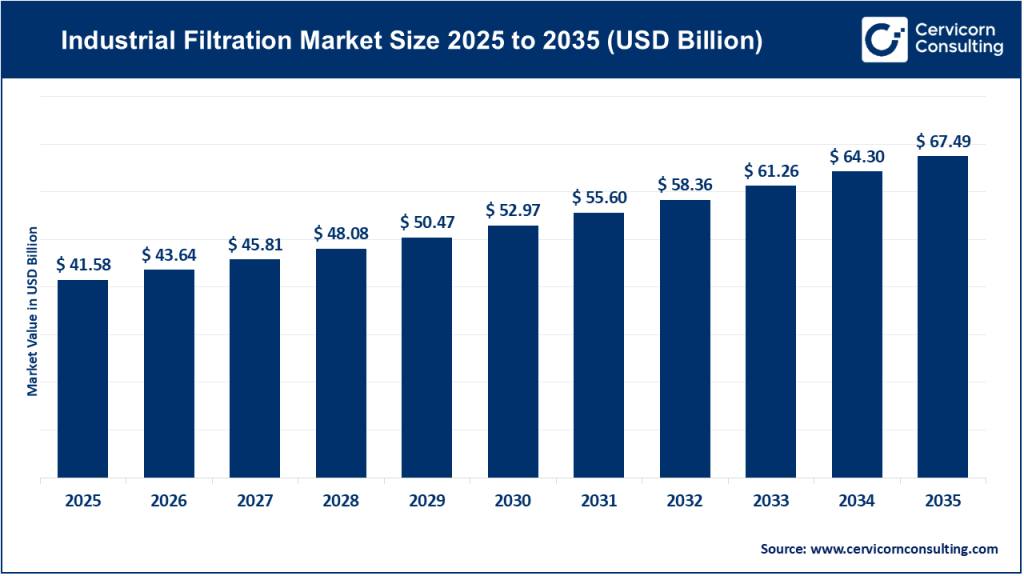
Industrial Filtration Market Size
The global industrial filtration market reached an estimated valuation of USD 41.58 billion in 2025 and is projected to grow substantially, attaining approximately USD 67.49 billion by 2035. This growth reflects a strong compound annual growth rate (CAGR) of around 4.96% throughout the forecast period.
What is the Industrial Filtration Market?
The industrial filtration market refers to the global industry involved in designing, manufacturing, and deploying filtration systems used to remove contaminants from air, water, gases, and industrial fluids across various sectors. These systems are critical in industries such as chemicals, pharmaceuticals, food & beverages, oil & gas, power generation, and manufacturing, where maintaining purity, safety, and regulatory compliance is essential. Industrial filtration includes both air filtration (dust collectors, HEPA filters, gas filters) and liquid filtration (membranes, cartridge filters, reverse osmosis systems). The market has been expanding steadily, driven by industrialization, environmental awareness, and regulatory pressure.
Why is the Industrial Filtration Market Important?
Industrial filtration plays a vital role in modern industrial ecosystems for several reasons. First, it ensures environmental protection by reducing emissions, wastewater discharge, and harmful pollutants released into air and water systems. Second, it enhances workplace safety by minimizing exposure to hazardous particles, gases, and contaminants. Third, filtration improves product quality and consistency, especially in industries like pharmaceuticals and food processing, where contamination can compromise entire production batches. Additionally, filtration systems help extend the lifespan of machinery by preventing the buildup of debris and impurities, thereby reducing maintenance costs and downtime. With increasing global emphasis on sustainability, industrial filtration has become a cornerstone for achieving cleaner production processes and regulatory compliance.
Industrial Filtration Market Growth Factors
The growth of the industrial filtration market is driven by a combination of macroeconomic and industry-specific factors, including rapid industrialization in emerging economies, stringent environmental regulations aimed at reducing air and water pollution, increasing demand for clean and safe manufacturing processes, rising awareness regarding occupational health and safety, advancements in filtration technologies such as nanofiber filters and membrane filtration, growing adoption of smart filtration systems integrated with IoT and AI for predictive maintenance, and expanding applications across industries like pharmaceuticals, food & beverage, and semiconductors; additionally, the push toward sustainability and energy efficiency, along with increasing investments in water treatment infrastructure and waste management systems, further accelerates market growth globally.
Get a Free Sample: https://www.cervicornconsulting.com/sample/2945
Key Companies in the Industrial Filtration Market
Below is a structured overview of major players:
1. MANN+HUMMEL Group
- Specialization: Filtration solutions for automotive, industrial, and water applications
- Key Focus Areas: Air filtration, liquid filtration, mobility solutions
- Notable Features: Strong global presence with advanced R&D and sustainability focus
- 2024 Revenue: Estimated multi-billion USD range (industry estimates)
- Market Share: Approx. 17% in filtration equipment segment
- Global Presence: 80+ locations worldwide
2. Donaldson Company, Inc.
- Specialization: Air, liquid, and engine filtration systems
- Key Focus Areas: Industrial dust collection, life sciences, aerospace filtration
- Notable Features: Strong innovation pipeline and strategic acquisitions
- 2024 Revenue: Approx. USD 3+ billion (company financial trends)
- Market Share: Around 6.1%–15% depending on segment
- Global Presence: Operations in 140+ countries
3. Pentair plc
- Specialization: Water treatment and filtration systems
- Key Focus Areas: Industrial water filtration, residential water solutions
- Notable Features: Strong sustainability and water conservation focus
- 2024 Revenue: Approx. USD 4 billion+ (industry estimates)
- Market Share: Mid-range global player
- Global Presence: North America, Europe, Asia
4. Ahlstrom-Munksjö Oyj
- Specialization: Fiber-based filtration materials
- Key Focus Areas: Filtration media for industrial and healthcare sectors
- Notable Features: Strong expertise in fiber technology and sustainable materials
- 2024 Revenue: Approx. USD 3 billion+
- Market Share: Significant in filtration media segment
- Global Presence: Europe, Americas, Asia
5. Camfil AB
- Specialization: Air filtration solutions
- Key Focus Areas: Clean air solutions for industrial and commercial applications
- Notable Features: Strong emphasis on energy-efficient filters
- 2024 Revenue: Estimated USD 1+ billion
- Market Share: Among top players in air filtration segment
- Global Presence: Operations in over 30 countries
Leading Trends and Their Impact
Several transformative trends are shaping the industrial filtration market:
1. Smart Filtration Systems
Integration of IoT and AI enables real-time monitoring, predictive maintenance, and performance optimization. This reduces operational costs and improves efficiency.
2. Sustainability and Eco-Friendly Filters
There is a growing shift toward recyclable filters and biodegradable materials, reducing environmental impact and supporting circular economy goals.
3. Increasing Demand for Water Filtration
Water scarcity and stricter wastewater regulations are driving investments in advanced water filtration technologies globally.
4. Nanotechnology and Advanced Materials
Nanofiber filters and membrane technologies offer higher efficiency and durability, making them increasingly popular.
5. Customization and Industry-Specific Solutions
Industries now demand tailored filtration systems to meet unique operational requirements, enhancing performance and compliance.
These trends collectively improve efficiency, reduce environmental impact, and create new growth opportunities for market players.
Successful Examples of Industrial Filtration Around the World
1. United States – Advanced Emission Control
The U.S. has implemented stringent EPA regulations, leading industries to adopt advanced air filtration systems, particularly in manufacturing and power generation.
2. Germany – Industrial Air Quality Excellence
Germany’s manufacturing sector utilizes high-efficiency filtration systems to maintain strict environmental standards and workplace safety.
3. China – Water Treatment Expansion
China has heavily invested in wastewater treatment infrastructure, significantly boosting demand for industrial filtration systems.
4. India – Rapid Market Growth
India’s industrial filtration market is growing at a CAGR of over 10%, driven by increasing industrialization and government initiatives for clean water and air.
5. Middle East – Oil & Gas Filtration
Countries like Saudi Arabia and UAE use advanced filtration systems in oil refining and petrochemical industries to ensure operational efficiency.
Global Regional Analysis Including Government Initiatives and Policies
North America
North America dominates the industrial filtration market, accounting for over 36% of global revenue share. This growth is driven by strict environmental regulations such as the Clean Air Act and Clean Water Act in the United States. Government policies emphasize emission reduction and wastewater treatment, pushing industries to adopt advanced filtration systems. Additionally, technological innovation and strong industrial infrastructure support market growth.
Europe
Europe is a mature market with strong regulatory frameworks like REACH (Registration, Evaluation, Authorization, and Restriction of Chemicals) and the Industrial Emissions Directive. Countries such as Germany, France, and the UK emphasize sustainability and environmental protection, driving demand for high-efficiency filtration systems. The European Union also promotes green manufacturing practices, encouraging industries to invest in eco-friendly filtration technologies.
Asia-Pacific
Asia-Pacific is the fastest-growing region due to rapid industrialization in countries like China, India, and Japan. Governments are implementing strict environmental policies to combat pollution. For instance, China’s “Blue Sky” initiative aims to reduce air pollution, while India’s National Clean Air Programme (NCAP) focuses on improving air quality. The region also benefits from increasing investments in manufacturing and infrastructure development.
Latin America
Latin America is witnessing moderate growth, driven by expanding industrial activities and increasing awareness of environmental protection. Countries like Brazil are investing in water treatment and pollution control systems, boosting demand for industrial filtration solutions.
Middle East & Africa
The Middle East & Africa region is growing due to investments in oil & gas, water desalination, and industrial infrastructure. Governments are focusing on water conservation and pollution control, particularly in arid regions where water scarcity is a major concern.
Market Structure and Competitive Landscape
The industrial filtration market is moderately consolidated, with major players collectively holding a significant share. Leading companies such as MANN+HUMMEL, Donaldson, Camfil, and Pentair focus on innovation, strategic partnerships, and mergers & acquisitions to strengthen their market position. Top players together account for a substantial portion of the global market, indicating strong competition and continuous innovation.
To Get Detailed Overview, Contact Us: https://www.cervicornconsulting.com/contact-us
Read Report: AI-RAN Market Revenue, Trends, and Strategic Insights by 2035