


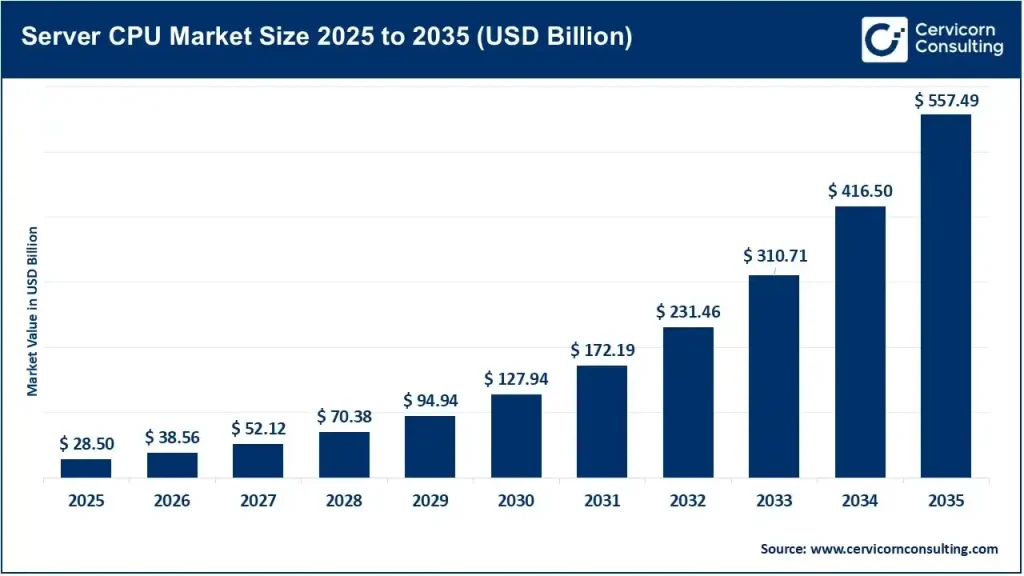
Server CPU Market Size
The global server CPU market was valued at approximately USD 28.50 billion in 2025 and is projected to reach USD 557.49 billion by 2035, expanding at a CAGR of 34.6% during the forecast period.
Server CPU Market Growth Factors
The server CPU market is expanding as enterprises, cloud service providers, hyperscalers, governments, and digital businesses invest in increasingly powerful data-center infrastructure to support cloud computing, artificial intelligence, machine learning, virtualization, high-performance computing, edge computing, analytics, cybersecurity, and digital services. A major growth factor is the rapid expansion of AI infrastructure, which is increasing demand not only for GPUs and accelerators but also for high-performance CPUs responsible for orchestration, preprocessing, storage management, networking, virtualization, inference, and general-purpose workloads. The transition toward cloud-native applications is also encouraging organizations to deploy servers offering higher core density, memory bandwidth, security, and energy efficiency.
At the same time, hyperscalers are increasingly developing or adopting customized Arm-based server processors to optimize cost and power consumption at massive scale. AWS, for example, has continued expanding its internally designed Graviton processors, while Arm reported that Arm-based processors were on track to account for close to half of compute shipped to top hyperscalers in 2025. Competition among Intel, AMD, Arm-based platforms, and custom hyperscaler silicon is consequently increasing the pace of innovation in core counts, chiplet architectures, memory technologies, security features, accelerators, and performance-per-watt. Data-center modernization, increasing server workloads, enterprise digital transformation, sovereign-cloud initiatives, semiconductor localization programs, and government investment in AI infrastructure are further supporting market expansion.
Energy consumption is another important factor: operators increasingly prefer CPUs that can deliver more computational performance per watt because electricity, cooling, and rack-density constraints are becoming major components of data-center operating costs. Consequently, server CPU purchasing decisions are shifting from simply comparing processing speed toward evaluating total cost of ownership, energy efficiency, workload optimization, software compatibility, security, and lifecycle economics.
What Is the Server CPU Market?
The server CPU market refers to the global industry involved in designing, developing, manufacturing, supplying, and deploying central processing units specifically engineered for servers and data-center systems. Server CPUs are designed to handle continuous workloads, large numbers of simultaneous users, virtualization, databases, cloud applications, enterprise software, analytics, networking, storage operations, and increasingly AI-related workloads.
Unlike consumer processors, server CPUs generally emphasize high core counts, large memory capacity, multi-socket capabilities, reliability, availability, serviceability, virtualization, advanced security, and long operating lifecycles. Leading architectures include x86, primarily represented by Intel and AMD, and Arm, which is increasingly being adopted through processors designed by cloud providers and semiconductor companies.
The market encompasses processors used in enterprise servers, hyperscale data centers, cloud infrastructure, high-performance computing systems, telecom infrastructure, edge servers, government computing platforms, and specialized workloads.
Market estimates vary depending on whether analysts define the market as server CPUs, data-center CPUs, or the broader processor market. One 2025 estimate for the global data-center CPU market placed Intel at approximately 52.1% revenue share and AMD at approximately 29.2%, meaning the two companies together represented about 81.3% of the market.
Get a Free Sample: https://www.cervicornconsulting.com/sample/3008
Why Is the Server CPU Market Important?
Server CPUs are the foundational processing engines of modern digital infrastructure. Every cloud application, database, enterprise platform, website, streaming service, AI system, and many government digital services ultimately depend on server-side computing.
Their importance has increased because organizations are processing significantly larger datasets and operating more applications simultaneously. A modern server CPU must therefore deliver a combination of computational throughput, memory bandwidth, virtualization capabilities, security, reliability, and power efficiency.
Server CPUs are also becoming increasingly important in AI infrastructure. Although GPUs receive much of the attention because of their role in model training and accelerated inference, CPUs remain essential for coordinating workloads, feeding accelerators, running operating systems, managing data pipelines, hosting virtual machines, and handling general-purpose workloads.
The shift toward heterogeneous computing is consequently changing the role of the CPU. Intel itself identifies system-level integration involving CPUs, accelerators, networking, memory, and software as increasingly important to large-scale AI deployment.
Server CPU Market Company Comparison
| Company | Specialization | Key Focus Areas | Notable Features | 2025 Revenue* | Market Share** | Global Presence |
|---|---|---|---|---|---|---|
| Intel | x86 server CPUs and data-center platforms | Xeon, AI infrastructure, networking, enterprise servers | Large OEM ecosystem, Xeon platform, security, virtualization | $52.9B total company revenue | ~52.1% | North America, Europe, Asia-Pacific, Middle East and other global markets |
| AMD | x86 server CPUs and accelerated computing | EPYC, AI, data centers, cloud, HPC | High core density, chiplets, memory bandwidth, energy efficiency | $34.6B total company revenue | ~29.2% | Global enterprise, cloud and hyperscale markets |
| Ampere Computing | Arm-based server CPUs | Cloud-native computing, energy efficiency | Arm architecture, high core density, performance-per-watt | Private; revenue not publicly disclosed | Smaller/niche share | Primarily global cloud and enterprise ecosystem |
| Amazon Web Services (AWS) | Custom Arm-based cloud CPUs | Graviton, cloud infrastructure, AI, hyperscale computing | Custom silicon, cloud optimization, vertical integration | $128.7B AWS revenue | Not separately disclosed | Global AWS regions and availability zones |
| Arm | CPU architecture and IP licensing | Neoverse, Armv9, data centers, cloud, AI | IP licensing model, energy efficiency, scalable architecture | $4.01B FY2025 revenue | IP/architecture provider; not directly comparable | Global semiconductor and cloud ecosystem |
*Company revenue is shown where publicly available and should not be interpreted as server-CPU-only revenue.
**Market-share figures are indicative 2025 data-center/server CPU estimates; AWS, Arm and Ampere do not report directly comparable standalone server CPU revenue shares. Intel’s 2025 total revenue was $52.9 billion, while its DCAI revenue was $16.9 billion. AMD reported $34.6 billion in 2025 revenue, including $16.6 billion from its Data Center segment. AWS generated $128.7 billion in 2025 revenue. Arm reported $4.007 billion in FY2025 revenue.
Intel
Intel remains one of the dominant suppliers of server CPUs through its Xeon family and extensive relationships with server OEMs, cloud providers, enterprises, and government organizations. Its competitive strength comes from a large installed base, software compatibility, mature enterprise ecosystem, and broad platform capabilities.
In 2025, Intel’s total revenue was $52.9 billion, while its Data Center and AI segment generated approximately $16.9 billion. Intel reported that server revenue increased as hyperscale demand increased server volumes by 9% during 2025.
Intel’s strategic focus is increasingly moving toward heterogeneous computing, AI acceleration, networking, memory, advanced packaging, and system-level integration alongside traditional CPU performance.
AMD
AMD has become Intel’s most significant x86 competitor in server CPUs through its EPYC portfolio. AMD’s chiplet architecture, high core counts, memory capabilities, and competitive total cost of ownership have helped it expand across cloud, enterprise, HPC, and AI infrastructure.
AMD generated $34.6 billion in 2025 revenue, with Data Center revenue reaching a record $16.6 billion, up 32% from 2024. AMD attributed the increase to demand for EPYC processors and Instinct accelerators.
AMD also stated that its EPYC processors surpassed 40% server CPU market share according to its own 2025 assessment, highlighting the company’s rapid competitive gains.
Ampere Computing
Ampere Computing focuses on Arm-based server processors, particularly for cloud-native workloads where power efficiency and predictable performance are important. Its architecture is designed around high-density computing and performance-per-watt.
Ampere’s importance extends beyond its direct market share because it helped demonstrate that Arm-based CPUs could compete in cloud and enterprise server environments. Its acquisition by SoftBank in 2025 further strengthened the strategic relationship between Arm’s ecosystem and Ampere’s server CPU business.
Amazon Web Services
AWS is different from traditional CPU vendors because it is simultaneously a cloud provider and a custom-silicon developer. Its Graviton processors are designed around Arm architecture and optimized for AWS infrastructure.
AWS generated $128.7 billion in revenue in 2025, up 20% year over year.
Graviton represents one of the strongest examples of vertical integration in server computing. AWS can optimize processor design, cloud software, virtualization, networking, storage, and infrastructure together. Arm reported that Graviton accounted for more than half of new CPU capacity deployed at AWS for the third consecutive year and that 98% of the top 1,000 Amazon EC2 customers relied on Graviton in production.
Arm
Arm does not primarily sell server CPUs in the same manner as Intel or AMD. Instead, it licenses processor architecture and IP to companies that develop their own chips.
Its Neoverse platform has become increasingly important in data centers, with cloud companies such as AWS and other hyperscalers developing customized Arm-based processors.
Arm generated $4.007 billion in FY2025 revenue, compared with $3.233 billion in FY2024. Its revenue growth was supported by licensing, royalties, and increased adoption of Armv9 CPUs and Compute Subsystems, including in data-center applications.
Leading Trends and Their Impact
1. Rise of Arm-Based Server CPUs
Arm is transitioning from being primarily associated with smartphones and embedded devices to becoming a significant server architecture. Cloud providers are attracted by the ability to customize processors and optimize performance-per-watt.
The impact is substantial because it introduces a stronger alternative to the traditional x86 model. AWS Graviton, Google Axion, Microsoft Cobalt and other Arm-based platforms are creating a broader ecosystem for cloud workloads. Arm reported that close to half of compute shipped to top hyperscalers in 2025 was on track to be Arm-based.
2. AI-Driven CPU Demand
AI infrastructure is not eliminating CPUs; instead, it is changing their role. CPUs increasingly operate alongside GPUs and other accelerators, handling orchestration, preprocessing, networking, storage, virtualization, and inference workloads.
This trend is encouraging vendors to design CPUs with higher memory bandwidth, faster interconnects, improved security and tighter integration with accelerators.
3. Performance-per-Watt
Energy efficiency is becoming a central purchasing criterion. As data centers increase rack density, electricity and cooling can become constraints on expansion.
Consequently, CPU vendors are competing on performance-per-watt rather than raw performance alone. Arm’s momentum is particularly relevant because its architecture has historically emphasized efficiency, while Intel and AMD are also investing heavily in power-efficient server platforms.
4. Chiplet Architecture
Chiplet technology enables manufacturers to combine multiple smaller silicon components within a single processor package. This approach can improve scalability, manufacturing flexibility, product segmentation and integration.
AMD’s EPYC strategy has been particularly associated with chiplet-based server designs, while Intel is also developing advanced packaging approaches.
5. Customized Hyperscaler Silicon
Large cloud providers increasingly want processors optimized for their own infrastructure and workloads. Instead of relying entirely on merchant CPUs, hyperscalers are designing or commissioning custom silicon.
AWS Graviton demonstrates how customized processors can become a strategic component of cloud infrastructure. This trend could gradually reduce the addressable market for traditional merchant CPUs in some hyperscale workloads while increasing demand for Arm IP.
6. Security-Centric Server Design
Cybersecurity is becoming a fundamental CPU purchasing criterion. Confidential computing, memory encryption, secure boot, hardware-based isolation and virtualization security are increasingly important as enterprises move sensitive workloads to cloud and hybrid infrastructure.
This creates opportunities for vendors that can combine processing performance with hardware-level security.
7. Edge Computing
Not all computing will occur in centralized hyperscale data centers. Telecommunications infrastructure, manufacturing facilities, autonomous systems, retail locations, healthcare facilities and smart-city infrastructure increasingly require localized computing.
Edge servers need compact, energy-efficient processors that can deliver low latency and reliability. This is expanding opportunities for both x86 and Arm architectures.
Successful Examples of the Server CPU Market Around the World
AWS Graviton in Global Cloud Computing
AWS Graviton is one of the strongest examples of successful custom server CPU deployment. Rather than treating CPUs as interchangeable components, AWS has integrated processor development into its broader cloud infrastructure strategy.
The high adoption rate among AWS customers demonstrates that Arm-based server CPUs can support large-scale production workloads. Graviton’s success also encourages other hyperscalers to develop custom processors.
AMD EPYC in Enterprise and Cloud Data Centers
AMD EPYC provides another successful example. AMD has expanded from a challenger position to a major supplier of server processors.
The company’s 2025 Data Center revenue reached $16.6 billion, up 32%, driven partly by demand for EPYC processors. The company’s ability to combine high core counts, chiplet architecture and competitive total cost of ownership has helped it win deployments across cloud and enterprise environments.
Intel Xeon in Enterprise Infrastructure
Intel Xeon continues to benefit from its established enterprise ecosystem. Large server OEMs, software vendors, enterprises and government organizations have built extensive infrastructure around x86 compatibility.
Intel’s 2025 server business benefited from higher hyperscale demand, with server volumes increasing 9%, although competitive pricing and manufacturing constraints affected performance.
Arm-Based Cloud Platforms
The emergence of AWS Graviton and other Arm-based cloud processors illustrates a broader global shift. Arm’s architecture provides companies with the flexibility to develop processors tailored to particular workloads.
This model is particularly successful in hyperscale environments, where even modest improvements in power efficiency can create significant infrastructure savings when multiplied across thousands of servers.
Global Regional Analysis Including Government Initiatives and Policies
North America
North America remains the leading center for server CPU innovation and deployment, supported by the presence of Intel, AMD, AWS, Microsoft, Google, major cloud providers, hyperscalers and large data-center operators.
The United States benefits from enormous cloud infrastructure investment and strong demand for AI computing. The rapid construction of AI data centers is directly increasing requirements for CPUs, accelerators, memory, networking and power infrastructure.
U.S. policy is increasingly treating data-center and semiconductor infrastructure as strategic assets. In July 2025, the White House issued an executive order designed to accelerate federal permitting for large data-center projects. The order covers AI data centers requiring more than 100 MW of new load and includes semiconductors, networking equipment and energy infrastructure among covered components.
The United States is therefore likely to remain a major market for high-performance server CPUs, particularly as hyperscalers expand AI infrastructure.
Canada is also positioned to benefit from data-center investment, cloud adoption, AI research and growing demand for high-performance computing. Its proximity to the U.S. technology ecosystem and access to relatively clean electricity in several provinces support opportunities for data-center expansion.
Europe
Europe represents an important market because enterprises are increasing cloud adoption while governments prioritize digital sovereignty, semiconductor resilience and domestic technology capabilities.
The European Chips Act is a central policy initiative. The European Commission says the program aims to strengthen semiconductor supply chains, reduce external dependencies and increase Europe’s global semiconductor market share to 20% by 2030. The framework was designed to mobilize more than €43 billion in public investment and related private investment.
By 2025, the EU had approved multiple semiconductor projects under the Chips Act, including projects in Germany, Italy and Austria.
For the server CPU market, these policies can strengthen the broader semiconductor ecosystem, improve supply-chain resilience and encourage investments in advanced computing infrastructure.
Europe is also experiencing rising demand for energy-efficient computing because electricity costs and sustainability regulations influence data-center economics. This creates opportunities for Arm-based CPUs as well as efficient x86 processors.
Asia-Pacific
Asia-Pacific is one of the fastest-developing regions for server CPU demand, driven by China, Japan, India, South Korea, Singapore, Taiwan and other technology-intensive economies.
The region combines semiconductor manufacturing, cloud infrastructure, electronics production and rapidly expanding digital economies. Increasing AI adoption is accelerating investments in data centers and high-performance computing.
China
China’s large cloud-computing, e-commerce, telecommunications and AI ecosystem generates significant demand for server processors. Domestic semiconductor development is also becoming strategically important as the country seeks greater technology self-sufficiency.
The market is consequently characterized by a combination of imported processors, domestic CPU architectures and locally developed server technologies.
Japan
Japan is increasing investment in semiconductors and AI infrastructure. In February 2025, Japan’s Ministry of Economy, Trade and Industry announced measures designed to respond to rapidly increasing computing demand from generative AI.
The initiative includes support for advanced semiconductors, high-performance servers, digital talent and large-scale public-private investment. Japan stated that its AI and semiconductor industrial infrastructure framework would provide more than ¥10 trillion in public support over seven years.
This policy direction supports demand for high-performance and energy-efficient server CPUs as Japan expands AI and data-center capabilities.
India
India is becoming increasingly important as both a data-center market and semiconductor ecosystem. The India Semiconductor Mission seeks to build a semiconductor and display ecosystem and position India as a global hub for electronics manufacturing and design.
The IndiaAI Mission, approved with an outlay of ₹10,372 crore, is designed to expand AI computing access, strengthen indigenous AI capabilities, support startups and develop AI infrastructure.
The combination of expanding cloud adoption, digital public infrastructure, AI development, enterprise digitization and semiconductor policies is expected to support demand for server CPUs across Indian data centers.
South Korea
South Korea’s advanced semiconductor ecosystem, hyperscale infrastructure, electronics industry and AI ambitions provide strong foundations for server CPU demand. Samsung and SK hynix’s positions in memory and advanced semiconductor technologies also complement the processor ecosystem.
Growing AI data-center deployment is expected to increase demand for CPU platforms that can work alongside accelerators, high-bandwidth memory and advanced networking technologies.
Latin America
Latin America is developing as an emerging market for server CPUs as enterprises adopt cloud services, digital banking, e-commerce, telecom services and data analytics.
Brazil and Mexico represent particularly important markets because of their large digital economies and growing data-center investment. Cloud providers are expanding regional infrastructure, reducing latency and encouraging enterprises to migrate workloads from traditional on-premise systems to cloud platforms.
Government digitalization programs and increasing demand for local data processing can further support server infrastructure investment.
Middle East & Africa
The Middle East is becoming an increasingly important destination for AI and data-center investment. Countries such as the United Arab Emirates and Saudi Arabia are pursuing national AI strategies and investing heavily in digital infrastructure.
The region’s expanding cloud adoption and AI ambitions create opportunities for high-performance CPUs, especially in AI servers where CPUs operate as host processors alongside accelerators.
Africa represents a longer-term growth opportunity. Increasing internet penetration, cloud adoption, mobile services, fintech and digital government initiatives are driving demand for localized computing infrastructure.
Data-center development remains concentrated in major markets, but expanding cloud availability and investments in digital infrastructure should gradually increase server CPU demand.
Regional Outlook
The global server CPU market is therefore moving toward a more diversified competitive structure. North America remains the technological and hyperscale center, Europe emphasizes supply-chain resilience and technological sovereignty, Asia-Pacific combines semiconductor manufacturing with rapid digital growth, Latin America is expanding through cloud adoption, and the Middle East is investing heavily in AI infrastructure.
The most significant structural change is the transition from a predominantly x86 server environment toward a more heterogeneous ecosystem involving Intel Xeon, AMD EPYC, Arm Neoverse-based processors, AWS Graviton and other customized CPUs.
Government semiconductor policies are reinforcing this transition by encouraging domestic production, supply-chain resilience, AI infrastructure, advanced computing and strategic technology capabilities. At the same time, hyperscalers are placing greater emphasis on customized silicon and energy-efficient computing.
As AI infrastructure expands globally, the server CPU market is consequently becoming less about a simple competition between processor speeds and more about performance-per-watt, workload specialization, memory bandwidth, security, interoperability, scalability, total cost of ownership and integration with accelerators. These factors are expected to remain central to purchasing decisions across cloud, enterprise, government, HPC and edge-computing markets.
To Get Detailed Overview, Contact Us: https://www.cervicornconsulting.com/contact-us
Read Report: Specialty Care Market Revenue, Trends, and Strategic Insights by 2035