


Table of Contents
ToggleSachet Packaging Market Size
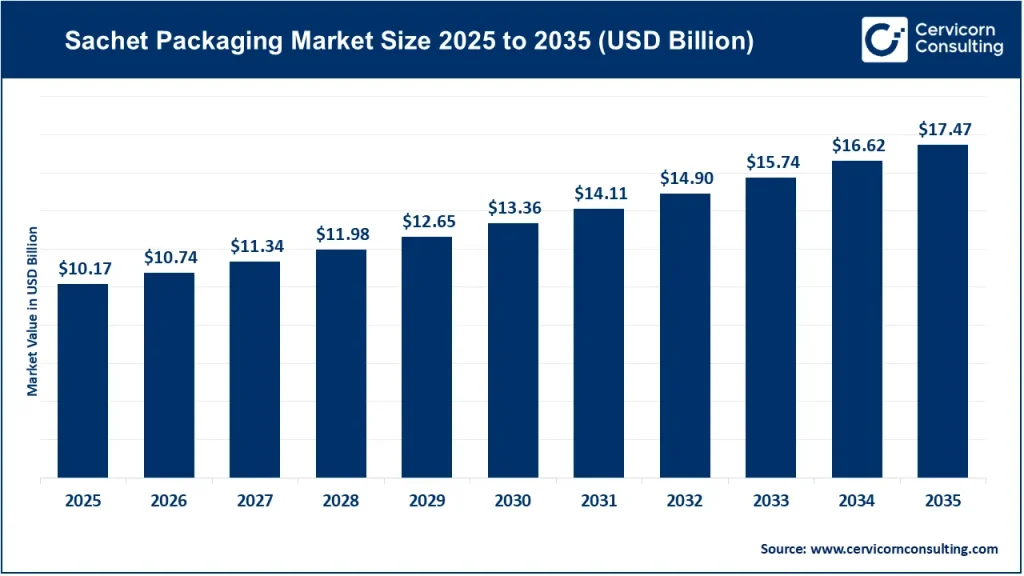
The global sachet packaging market was valued at approximately USD 10.17 billion in 2025 and is projected to reach USD 17.47 billion by 2035, representing a 5.56% CAGR from 2026 to 2035.
Sachet Packaging Market Growth Factors
The sachet packaging market is being driven by the growing demand for affordable single-use products, increasing penetration of FMCG products into emerging and rural markets, rising preference for convenient and portable packaging, expansion of food and beverage consumption, growth in pharmaceutical and nutraceutical applications, and the increasing use of sachets for product sampling and promotional campaigns. Sachets allow manufacturers to offer shampoos, sauces, coffee, spices, detergents, cosmetics, medicines, and other products in small quantities at relatively low upfront prices, making branded products accessible to price-sensitive consumers.
At the same time, lightweight packaging can reduce transportation and storage requirements compared with rigid containers. Technological advances in multilayer films, high-barrier structures, heat-sealable papers, mono-material laminates, digital printing, high-speed form-fill-seal equipment, and improved sealing technologies are expanding the functional capabilities of sachets. Sustainability is becoming another major growth factor as packaging producers develop recyclable, paper-based, compostable, and lower-material solutions in response to regulatory pressure and customer requirements.
Get a Free Sample: https://www.cervicornconsulting.com/sample/2743
What Is the Sachet Packaging Market?
The sachet packaging market comprises the manufacturing, conversion, printing, filling, and supply of small flexible packages designed primarily for single-use or controlled-quantity applications. Sachets can be manufactured using plastic films, aluminum foil, paper, coated paper, or multilayer combinations of these materials.
Common formats include:
- Three-side-seal sachets
- Four-side-seal sachets
- Pillow sachets
- Stick packs
- Flat sachets
- Single-dose pharmaceutical sachets
- Powder sachets
- Liquid and viscous-product sachets
- Sample sachets
- Multi-compartment sachets
Sachets are widely used for shampoo, conditioner, creams, lotions, detergents, sauces, seasonings, coffee, tea, powdered beverages, pharmaceuticals, nutraceuticals, agricultural products, and household chemicals.
Why Is Sachet Packaging Important?
Sachet packaging is important because it bridges the gap between product accessibility and packaging efficiency.
Affordability
Small sachets allow companies to sell products at low absolute price points. This is particularly valuable in emerging economies, where consumers may prefer purchasing products according to their immediate cash availability rather than buying larger packs.
Product Accessibility
Sachets enable brands to reach rural, semi-urban, low-income, and first-time consumers. India’s FMCG industry provides a strong example: small packs and sachets have historically helped brands introduce aspirational products to consumers who might not initially purchase larger bottles or containers.
Convenience
Sachets are easy to carry and consume while traveling, working, commuting, or participating in outdoor activities. They are particularly suitable for single-use products.
Portion Control
For pharmaceuticals, food ingredients, sauces, seasonings, coffee, and nutritional products, sachets provide a predetermined quantity that can improve dosing and reduce product waste.
Product Protection
Advanced barrier films protect contents from moisture, oxygen, light, contamination, and aroma loss. This is particularly important for food, pharmaceutical, and personal care products.
Sampling and Marketing
Companies can distribute low-cost product samples through sachets, reducing the barrier to product trial. This has become increasingly relevant for cosmetics, skincare, personal care, and premium FMCG brands.
Major Companies in the Sachet Packaging Market
The competitive landscape includes multinational packaging companies, flexible-film converters, regional manufacturers, and specialized sachet producers. The following five companies are among the major participants identified across market research coverage.
| Company | Specialization | Key Focus Areas | Notable Features | 2025 Revenue | Market Share* | Global Presence |
|---|---|---|---|---|---|---|
| Amcor plc | Flexible and rigid consumer packaging | Healthcare, food, beverage, personal care, sustainability | Recyclable films, high-barrier packaging, lightweight structures | ~USD 15.0B annual sales from operations | Major global sachet player; exact global sachet share not publicly disclosed | 400+ locations, 40+ countries |
| Constantia Flexibles | Flexible packaging and specialty films | Food, pharma, personal care, sustainability | High-barrier laminates, pharmaceutical packaging, recyclable structures | Not publicly disclosed for 2025 | Major global flexible packaging participant; exact sachet share not publicly disclosed | Global manufacturing and sales network |
| Huhtamaki Oyj | Flexible, fiber, and foodservice packaging | Food packaging, flexible packaging, sustainability | Strong flexible packaging capabilities and global manufacturing footprint | EUR 3.96B | Major sachet/flexible packaging participant; exact sachet share not publicly disclosed | 35 countries, 100+ locations |
| Mondi Group | Paper and flexible packaging | Sustainable packaging, paper-based formats, food and consumer products | Recyclable paper solutions, flexible packaging, integrated materials | EUR 7.66B revenue | Major global packaging participant; exact sachet share not publicly disclosed | Global operations across Europe, Asia, Africa and other markets |
| Sonoco Products Company | Consumer and industrial packaging | Consumer packaging, food, healthcare and specialty packaging | Large-scale packaging portfolio and global manufacturing | USD 7.52B net sales | Major packaging supplier; exact sachet share not publicly disclosed | Global manufacturing and commercial footprint |
Amcor plc
Amcor plc is one of the most prominent global packaging companies serving nutrition, health, beauty, wellness, food, and consumer markets. Its portfolio covers flexible packaging, rigid packaging, cartons, and closures. Following completion of its Berry Global combination in April 2025, Amcor reported approximately USD 15 billion in fiscal 2025 annual sales from operations across more than 400 locations in over 40 countries.
Its sachet-related competitive advantages include high-barrier structures, lightweighting, recyclable films, printing capabilities, and collaboration with large consumer brands.
Constantia Flexibles
Constantia Flexibles specializes in flexible packaging for food, pharmaceutical, personal care, and other industries. The company is particularly relevant to sachet packaging because of its capabilities in barrier films and laminates.
Its focus on pharmaceutical and healthcare packaging is important because sachets used in these applications require strong protection against oxygen, moisture, light, and contamination. Industry analysis identifies Constantia as a significant participant in medical and pharmaceutical sachets.
Constantia is privately held, and a directly comparable audited 2025 company-wide revenue figure is not readily disclosed in the same manner as listed companies.
Huhtamaki Oyj
Huhtamaki Oyj is a major global packaging producer headquartered in Finland. The company generated EUR 3.96 billion in net sales in 2025, with its Flexible Packaging business generating approximately EUR 1.25 billion. It operated in 35 countries and more than 100 locations, employing approximately 17,400 people.
Its focus on food safety, hygiene, sustainability, flexible packaging, and lightweight solutions positions it strongly within the sachet ecosystem.
Mondi Group
Mondi Group generated EUR 7.663 billion in group revenue in 2025, compared with EUR 7.416 billion in 2024. Its strategic focus includes sustainable packaging, paper-based alternatives, flexible packaging, and integrated material solutions.
Mondi is particularly important to the sachet market because sustainability requirements are encouraging manufacturers to replace difficult-to-recycle structures with paper-based and recyclable alternatives.
Sonoco Products Company
Sonoco Products Company generated USD 7.519 billion in 2025 net sales, an increase of approximately 42% from 2024, largely reflecting the acquisition of Eviosys.
Sonoco’s broad consumer packaging portfolio gives it exposure to food, healthcare, household, and other applications where flexible and portion-controlled packaging can be deployed.
Leading Trends and Their Impact on the Sachet Packaging Market
1. Shift Toward Recyclable Sachets
One of the most important trends is the transition from complex multilayer structures toward mono-material and recycle-ready sachets.
Traditional sachets frequently combine plastic films, aluminum foil, adhesives, inks, and coatings. These structures provide excellent barrier performance but can be difficult to recycle.
Packaging companies are therefore investing in mono-polymer structures and paper-based alternatives. The trend is likely to accelerate as regulatory requirements become stricter.
2. Paper-Based Sachets
Paper-based sachets are gaining attention because they can reduce dependence on conventional plastic structures.
Amcor, for example, has expanded its paper-based AmFiber portfolio to include heat-sealable sachets for dry culinary and beverage applications such as instant coffee, spices, seasonings, drink powders, and dried soups.
The major challenge is achieving the barrier performance required for moisture-sensitive and oxygen-sensitive products.
3. Premiumization
Sachets are no longer restricted to low-income consumer markets. Premium skincare, cosmetics, nutraceuticals, specialty foods, and beverages increasingly use small-format packaging for sampling and trial.
High-resolution digital printing, metallic effects, improved graphics, tactile finishes, and customized designs enable brands to make small packs visually attractive.
4. Growth of Pharmaceutical Sachets
Pharmaceutical and nutraceutical applications are creating new opportunities because sachets offer controlled dosage, hygiene, portability, and protection.
Powdered medicines, oral rehydration products, nutritional supplements, and other healthcare products can be efficiently distributed through single-dose formats.
5. Digital Printing and Customization
Digital printing enables short production runs, multiple designs, regional-language versions, promotional campaigns, and rapid product launches.
This is particularly useful for brands that want to test new products without committing to very large packaging inventories.
6. Smart Packaging
QR codes, serialization, authentication features, NFC technologies, and digital engagement mechanisms are gradually becoming more relevant.
Smart sachets can help brands provide product information, promotional offers, authentication, traceability, and consumer engagement.
7. High-Speed Automation
The adoption of automated vertical and horizontal form-fill-seal equipment is helping manufacturers produce sachets at high speeds while improving consistency and reducing material losses.
According to Mordor Intelligence, VFFS systems accounted for more than half of the market’s machinery segment in 2025.
Successful Examples of Sachet Packaging Around the World
India’s Shampoo Sachet Revolution
India is perhaps one of the world’s strongest examples of how sachet packaging can reshape an entire consumer category.
CavinKare’s introduction of small shampoo sachets helped make branded personal care products accessible to consumers who could not easily justify purchasing larger bottles. The approach was subsequently adopted across the FMCG industry.
The model demonstrated that small pack sizes can create entirely new consumer markets, rather than simply replacing larger packages.
Maggi Seasoning Sachets in India
Maggi uses single-use seasoning sachets in India. Its Masala Magic product, for example, is offered in a 6-gram single-use sachet, illustrating how small-format packaging can provide portion control while maintaining product freshness.
Nescafé Sachets in Africa and the Middle East
NESCAFÉ has used sachets as a mechanism for expanding coffee consumption among price-sensitive consumers.
In Egypt, a Nescafé 3-in-1 campaign built around single-serve sachets reportedly increased sales by 30% in the first quarter of the campaign.
Nestlé has also continued developing more sustainable sachet structures. In Australia, Nescafé reports that certain creamy and frothy coffee sachets use 50% recycled plastic through a mass-balance approach.
Recyclable Nescafé 3-in-1 Sachets
In another example, Nescafé’s 3-in-1 sachets have moved toward mono-structured plastic, designed to improve recyclability while retaining coffee freshness.
This illustrates the industry’s broader transition: the future of sachets is likely to depend not simply on making them smaller and cheaper, but on making them more circular without compromising barrier performance.
Global Regional Analysis
Asia Pacific
Asia Pacific is the dominant region in the sachet packaging market, accounting for approximately 43.45% of global market share in 2025 according to Fortune Business Insights.
India, China, Indonesia, the Philippines, Vietnam, Thailand, and other Southeast Asian markets have strong demand because of large consumer populations, extensive FMCG distribution networks, rising disposable incomes, and widespread small-format retail.
India is particularly important because sachets have become deeply integrated into shampoo, detergent, food, beverage, personal care, and pharmaceutical distribution.
However, environmental regulation is increasing pressure on producers. India’s Plastic Waste Management framework includes extended producer responsibility mechanisms and recycled-content requirements, while the 2024 amendments strengthened reporting and monitoring.
This is encouraging manufacturers to investigate recyclable, compostable, and mono-material structures.
Europe
Europe is becoming a major innovation center for sustainable sachet packaging.
The EU’s Packaging and Packaging Waste Regulation (PPWR) entered into force on February 11, 2025 and generally applies from August 12, 2026. It covers packaging regardless of material or origin and introduces requirements related to packaging design, waste prevention, recyclability, labeling, collection, recycling, and extended producer responsibility.
The regulation is particularly important for sachet manufacturers because traditional multilayer packaging may face increasing pressure to demonstrate recyclability and compliance.
European producers are consequently investing in:
- Mono-material films
- Paper-based structures
- Recyclable barrier coatings
- Reduced material consumption
- Recycled content
- Improved recyclability
- Circular packaging systems
The regulatory environment is therefore turning sustainability from a marketing advantage into a competitive requirement.
North America
North America is experiencing growing demand for single-serve packaging in food, beverages, healthcare, personal care, and convenience-oriented products.
Consumers increasingly value portability, controlled portions, easy opening, and products suitable for travel and on-the-go consumption.
The region also benefits from advanced flexible packaging manufacturing capabilities and high adoption of automation.
However, sustainability concerns remain significant. Brand owners increasingly require packaging suppliers to improve recyclability, reduce virgin plastic use, and optimize material structures.
North American companies are therefore likely to prioritize recyclable mono-material sachets, paper alternatives, lightweighting, and improved recovery infrastructure.
Latin America
Latin America represents an attractive growth market because of its large population, developing retail infrastructure, and strong demand for affordable consumer products.
Countries such as Brazil, Mexico, Argentina, Colombia, and Chile provide opportunities for sachets across food, beverages, personal care, household products, and pharmaceuticals.
Sachets are particularly useful in markets where consumers purchase products frequently in small quantities.
At the same time, governments and businesses are increasingly focused on reducing plastic waste. This is expected to create demand for packaging structures that balance affordability with environmental compliance.
Middle East & Africa
The Middle East and Africa represent significant opportunities for sachet packaging because of the importance of affordability, product portability, and distribution efficiency.
Sachets are widely applicable to coffee, powdered beverages, personal care products, food ingredients, and healthcare products.
Africa offers a particularly important opportunity because single-serve formats can allow multinational FMCG brands to reach consumers through informal and traditional retail channels.
However, regulation varies considerably between countries. Several African countries have introduced restrictions on plastic bags or flexible plastic formats. UNEP’s review of national measures, for example, identifies prohibitions or restrictions in countries including Rwanda, Senegal, Niger, and Seychelles.
This creates a dual market dynamic: demand for affordable sachets remains strong, while packaging companies must increasingly develop materials compatible with national environmental policies.
Government Initiatives and Policies Shaping the Market
Government policy is becoming one of the most important forces determining the future design of sachet packaging.
European Union: PPWR
The EU PPWR establishes requirements covering the entire packaging lifecycle, including design, composition, waste prevention, recycling, labeling, and producer responsibility. It also establishes packaging waste reduction targets and encourages circular-economy approaches.
For sachet manufacturers, this is accelerating investment in recyclable structures and reducing reliance on packaging combinations that are difficult to recover.
India: Plastic Waste Management and EPR
India’s Plastic Waste Management Rules and subsequent amendments have established an increasingly structured EPR framework.
The 2024 amendment introduced strengthened reporting mechanisms and made manufacturers and importers of plastic raw materials obligated entities in relation to certain responsibilities involving micro and small producers.
India has also established category-specific recycling requirements and recycled-plastic-content targets, increasing the importance of material selection for sachet producers.
Global Plastic Reduction Policies
Governments in Africa, Asia, Europe, and other regions are introducing plastic taxes, extended producer responsibility schemes, restrictions on selected single-use plastics, recycling targets, and packaging-design requirements.
These policies will influence the sachet market in two opposing ways. On one side, they may increase compliance costs for conventional plastic sachets. On the other, they create a major opportunity for manufacturers capable of developing recyclable, compostable, paper-based, and mono-material sachets.
Future Direction of the Sachet Packaging Market
The next phase of the sachet packaging market is likely to be characterized by a balance between affordability, functionality, sustainability, and regulatory compliance.
Asia Pacific will remain a critical consumption center because of its large population and established sachet culture. Meanwhile, Europe is likely to exert disproportionate influence on packaging design because of its increasingly strict circular-economy regulations.
For packaging manufacturers, the competitive landscape will increasingly depend on the ability to deliver high-barrier performance with fewer materials, improve recyclability, introduce paper-based alternatives, automate production, and support brand owners with customized packaging solutions.
The market is therefore moving beyond the traditional concept of a low-cost single-use pouch. Modern sachets are evolving into sophisticated packaging systems that combine portion control, barrier protection, portability, branding, affordability, and increasingly measurable sustainability performance.
To Get Detailed Overview, Contact Us: https://www.cervicornconsulting.com/contact-us
Read Report: Pharmaceutical Packaging Market Revenue, Trends, and Strategic Insights by 2035