


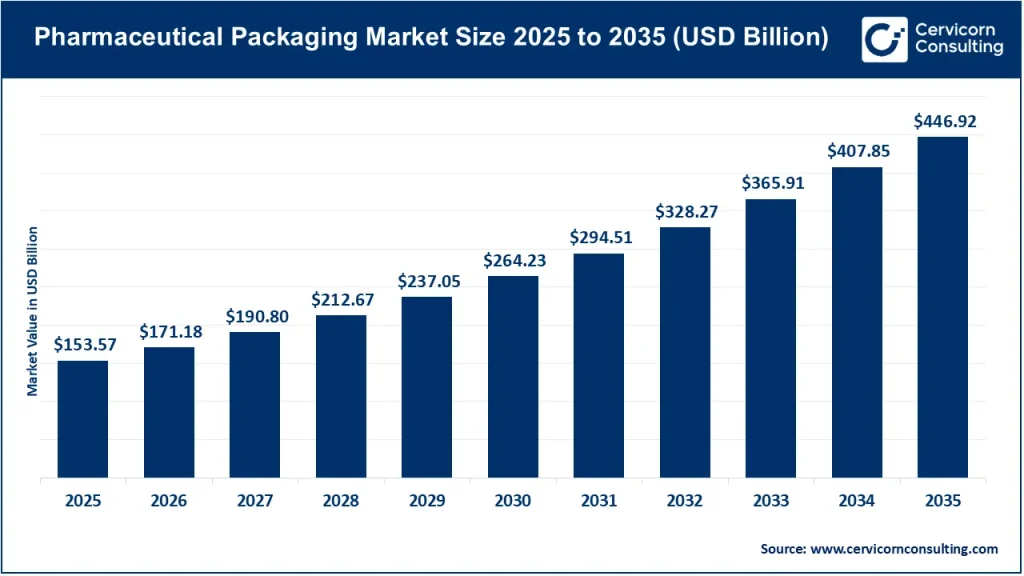
Pharmaceutical Packaging Market Size
The global pharmaceutical packaging market was valued at approximately USD 153.57 billion in 2025 and is projected to reach USD 446.92 billion by 2035, representing a 11.27% CAGR from 2026 to 2035.
Pharmaceutical Packaging Market Growth Factors
The global pharmaceutical packaging market is being driven by the expanding pharmaceutical and biopharmaceutical industries, increasing demand for prescription and over-the-counter medicines, rising production of biologics and injectable therapies, growing adoption of specialty drugs, and stricter requirements for drug safety, traceability, tamper resistance, and product authentication. The increasing prevalence of chronic diseases is expanding pharmaceutical consumption and, consequently, demand for bottles, blister packs, vials, ampoules, prefillable syringes, cartridges, closures, labels, pouches, and other packaging formats.
At the same time, biologics and sensitive injectable medicines require advanced packaging materials capable of maintaining product stability and preventing contamination, moisture, oxygen, light, and temperature-related degradation. Regulatory initiatives such as the U.S. Drug Supply Chain Security Act (DSCSA) and the European Union’s Falsified Medicines Directive are also encouraging serialization, unique identification, anti-tampering technologies, and package-level traceability. Sustainability is another major growth factor, with pharmaceutical companies and packaging suppliers investing in lightweight materials, recyclable plastics, optimized glass designs, lower-material packaging, and circular-economy solutions. The expansion of e-commerce pharmacies, home healthcare, self-administration therapies, and patient-centric drug delivery is further increasing demand for convenient, portable, easy-to-use, and adherence-focused packaging.
Meanwhile, emerging economies in Asia-Pacific, Latin America, and the Middle East are expanding pharmaceutical manufacturing capacity, creating additional opportunities for packaging suppliers.
Get a Free Sample: https://www.cervicornconsulting.com/sample/2746
What Is the Pharmaceutical Packaging Market?
The pharmaceutical packaging market encompasses the materials, containers, closures, devices, systems, and technologies used to protect, store, transport, identify, and administer pharmaceutical products.
Pharmaceutical packaging extends from primary packaging, which directly contacts the drug, to secondary packaging, such as cartons and labels, and tertiary packaging, which supports transportation and distribution.
Common pharmaceutical packaging products include:
- Bottles and jars
- Blister packs
- Vials and ampoules
- Pre-fillable syringes
- Cartridges
- Injectable packaging
- Tubes
- Pouches and sachets
- Caps and closures
- Drug delivery devices
- Specialty cartons
- Tamper-evident packaging
- Serialization and authentication systems
Materials include glass, plastic, aluminum, paper and paperboard, and multilayer barrier materials.
The market is becoming increasingly technology-intensive because pharmaceutical packaging must do more than simply contain a medicine. Packaging needs to preserve drug stability, prevent contamination, withstand transportation, provide accurate product information, support regulatory compliance, and increasingly contribute to authentication and patient engagement.
The World Health Organization emphasizes that pharmaceutical packaging must protect medicines from external influences such as moisture, light, oxygen and temperature variation, as well as biological contamination and physical damage.
Why Is Pharmaceutical Packaging Important?
Pharmaceutical packaging is a critical component of the pharmaceutical supply chain because packaging quality directly affects medicine quality and patient safety.
1. Protecting Drug Stability
Many medicines are sensitive to moisture, oxygen, light, temperature, or physical contamination. Appropriate packaging creates a protective barrier and helps maintain the product’s stability throughout its shelf life.
2. Preventing Contamination
Vials, ampoules, syringes and specialized closures are particularly important for injectable and sterile medicines. High-performance containment systems reduce the risk of contamination and interaction between the drug and packaging material.
3. Improving Patient Safety
Clear labeling, dosage information, expiration dates, batch numbers and tamper-evident features help patients and healthcare professionals identify and use medicines correctly.
4. Fighting Counterfeit Medicines
Serialization, unique identifiers, 2D barcodes and anti-tampering devices are becoming increasingly important for pharmaceutical authentication. The EU requires safety features including a unique identifier and anti-tampering device on the outer packaging of medicines covered by its falsified-medicines framework.
5. Supporting Drug Delivery
Modern packaging is increasingly integrated with drug-delivery technology. Prefillable syringes, cartridges, inhalers, auto-injectors and on-body systems combine containment and administration functions.
6. Supporting Sustainability
Pharmaceutical packaging manufacturers are under increasing pressure to reduce packaging weight, improve recyclability, increase recycled content where appropriate, and reduce waste without compromising product protection.
Major Companies in the Pharmaceutical Packaging Market
The competitive landscape includes global packaging manufacturers, specialty glass producers, drug-delivery companies and suppliers of high-barrier materials. Five important companies include Amcor plc, Berry Global, Inc., Gerresheimer AG, SCHOTT AG and AptarGroup, Inc.
| Company | Specialization | Key Focus Areas | Notable Features | 2025 Revenue* | Market Share* | Global Presence |
|---|---|---|---|---|---|---|
| Amcor plc | Flexible and rigid pharmaceutical and healthcare packaging | Flexible packaging, rigid packaging, specialty cartons, closures, healthcare packaging | Major global scale; combination with Berry expanded portfolio | ~US$15.0B FY2025 reported | Not separately disclosed | 40+ countries; 400+ locations |
| Berry Global, Inc. | Rigid/flexible plastic packaging and healthcare products | Pharmaceutical containers, closures, specialty healthcare packaging | Combined with Amcor in April 2025 | Standalone FY2025 not comparable after merger | Not separately disclosed | Global operations; now part of Amcor |
| Gerresheimer AG | Pharmaceutical glass and plastic primary packaging and drug delivery | Vials, syringes, cartridges, bottles, inhalers, pens, auto-injectors | Strong focus on pharma and biotech | €2.321B | Not separately disclosed | 39 production sites across Europe, Americas and Asia |
| SCHOTT AG | Specialty glass and pharmaceutical containment | Pharmaceutical glass, vials, cartridges, syringes, containment | Advanced borosilicate glass and high-value pharma solutions | €2.83B group sales | Not separately disclosed | Global operations |
| AptarGroup, Inc. | Drug delivery and dispensing systems | Nasal, pulmonary, injectable and oral delivery; closures and dispensing | Strong drug-delivery technology portfolio | ~US$3.8B | Not separately disclosed | Global manufacturing and commercial footprint |
Revenue figures represent company-level revenue rather than pharmaceutical-packaging-only revenue where a separate figure is not publicly reported. Market-share figures are generally not disclosed by the companies on a pharmaceutical-packaging-only basis and should therefore not be interpreted as independently audited market shares.
Amcor plc
Amcor is one of the largest global packaging companies and provides flexible and rigid packaging solutions across healthcare, pharmaceutical, nutrition, beauty and other markets. Its combination with Berry Global was completed on April 30, 2025, creating a substantially larger packaging organization. Amcor reported approximately US$15.0 billion in FY2025 annual sales, including the applicable contribution from Berry after the transaction. The company subsequently described the combined organization as employing approximately 77,000 people and operating more than 400 manufacturing facilities in over 40 countries on a pro-forma basis.
For pharmaceutical packaging, its capabilities span flexible packaging, rigid containers, closures, specialty solutions and healthcare-focused packaging. Sustainability, lightweighting and recyclable packaging are important strategic priorities.
Berry Global, Inc.
Berry Global was a major supplier of rigid and flexible plastic packaging, healthcare containers, closures and specialized packaging solutions before becoming part of Amcor. The April 2025 merger significantly changed the competitive landscape because the combined organization created one of the world’s largest packaging businesses.
Rather than presenting a standalone 2025 revenue number that would not represent a complete fiscal year, Berry’s financial contribution should be evaluated in the context of the Amcor transaction. Amcor’s SEC filing states that the combination was completed on April 30, 2025.
Gerresheimer AG
Gerresheimer is highly specialized in pharmaceutical primary packaging and drug delivery. Its portfolio includes vials, syringes, cartridges, bottles, ampoules, inhalers, pens, auto-injectors and on-body devices.
Gerresheimer reported €2.321 billion in revenue for fiscal 2025, following the first-time consolidation of Bormioli Pharma. The company operates 39 production sites across Europe, America and Asia and focuses heavily on pharmaceutical, biotechnology and healthcare customers.
The company is particularly well positioned for the growth of biologics, injectable therapies and self-administration devices.
SCHOTT AG
SCHOTT is a global specialty-glass company with an important pharmaceutical packaging business through SCHOTT Pharma. Its capabilities include pharmaceutical glass containers, drug containment systems and delivery solutions.
SCHOTT reported €2.83 billion in global sales for fiscal year 2024/2025 at the group level.
SCHOTT Pharma separately reported €986.2 million in FY2025 revenue, up 5.8% at constant currencies, with high-value solutions accounting for 57% of revenue.
Its specialization in high-quality pharmaceutical glass makes it particularly relevant to injectable drugs, biologics and other sensitive medicines.
AptarGroup, Inc.
Aptar focuses on drug delivery, dispensing, dosing and protection technologies. Its pharmaceutical activities include nasal delivery, pulmonary delivery, injectable systems and other drug-delivery technologies.
Aptar reported record 2025 sales of approximately US$3.8 billion.
The company benefits from the shift toward patient-centric drug delivery because packaging increasingly serves as part of the delivery mechanism rather than merely as a passive container.
Leading Trends and Their Impact on the Pharmaceutical Packaging Market
1. Growth of Biologics and Injectable Drugs
The growing use of biologics, vaccines, peptides, monoclonal antibodies and other injectable therapies is increasing demand for high-performance vials, cartridges, syringes and specialized containment systems.
Impact: Suppliers with expertise in high-quality glass, elastomers, coatings, closures and prefillable systems are gaining strategic importance.
2. Prefillable Syringes and Self-Administration
Patients increasingly administer medicines outside hospitals. Prefillable syringes, auto-injectors, pens and on-body systems make treatment more convenient.
Impact: Packaging companies are moving toward integrated drug-containment and drug-delivery solutions.
3. Serialization and Track-and-Trace
Regulations increasingly require pharmaceutical products to be identifiable throughout distribution. In the United States, the DSCSA establishes requirements for interoperable electronic identification and tracing of certain prescription drugs at the package level.
Impact: Packaging lines increasingly incorporate serialization printers, scanners, aggregation systems, 2D barcodes and digital verification technologies.
4. Sustainable Pharmaceutical Packaging
Pharmaceutical packaging historically prioritized maximum product protection, but environmental considerations are increasingly influencing material selection and design.
Impact: Manufacturers are exploring lightweighting, material reduction, recyclable structures and more efficient production processes while maintaining stringent barrier and safety requirements.
5. Smart and Connected Packaging
QR codes, NFC technologies, connected labels and digital authentication can provide product information, patient support and supply-chain visibility.
Impact: Packaging is becoming a digital interface connecting manufacturers, distributors, pharmacists and patients.
6. Child-Resistant and Senior-Friendly Packaging
Packaging designers increasingly need to balance child safety with accessibility for elderly patients and people with limited dexterity.
Impact: Demand is increasing for improved closures, dosing systems and patient-centric designs.
7. Premium Barrier Packaging for Sensitive Medicines
Advanced drugs may require highly controlled protection from moisture, oxygen, light and interaction with packaging materials.
Impact: High-barrier films, specialty coatings, advanced glass and engineered polymers are becoming increasingly valuable.
Successful Examples of Pharmaceutical Packaging Around the World
United States: Package-Level Drug Traceability
The U.S. DSCSA represents one of the strongest examples of pharmaceutical packaging becoming part of the country’s drug-security infrastructure. The law is designed to enable electronic identification and tracing of certain prescription drugs at the package level, helping stakeholders detect illegitimate products and respond rapidly when problems occur.
Market impact: Pharmaceutical packaging suppliers have expanded serialization, aggregation, barcode and digital tracking capabilities.
European Union: Unique Identifiers and Anti-Tampering
The EU’s falsified-medicines framework introduced safety features that include a unique identifier and anti-tampering device on the outer packaging of covered medicines. The unique identifier can be encoded in a 2D barcode and verified through the pharmaceutical supply chain.
Market impact: European pharmaceutical packaging has increasingly incorporated authentication features directly into packaging and labeling processes.
Germany and Europe: Advanced Pharmaceutical Glass
European manufacturers such as Gerresheimer and SCHOTT have built strong positions in pharmaceutical glass and high-value containment systems. Their products support the growing demand for injectable drugs, biologics, vaccines and specialized drug-delivery formats.
Market impact: The region remains an important innovation center for high-quality pharmaceutical containers and drug-delivery systems.
Global: Prefillable and Ready-to-Use Systems
Prefillable syringes and ready-to-use containment systems are examples of packaging innovation driven by changes in drug administration. These systems reduce handling steps and can support more convenient administration.
Market impact: Packaging manufacturers are increasingly participating directly in the drug-delivery ecosystem.
Global Regional Analysis Including Government Initiatives and Policies
North America
North America represented approximately 29.97% of the global pharmaceutical packaging market in 2025 according to one recent market estimate.
The United States is the largest regional market because of its extensive pharmaceutical industry, high healthcare spending, strong biologics pipeline and sophisticated regulatory environment.
Government policy is a major influence. The U.S. Drug Supply Chain Security Act requires an interoperable electronic system for identifying and tracing certain prescription drugs at the package level.
The U.S. market is therefore experiencing demand for:
- Serialization technologies
- 2D barcodes
- Tamper-evident packaging
- Smart labels
- High-performance injectable containers
- Prefillable syringes
- Specialty closures
- Temperature-sensitive packaging
Canada also benefits from strong pharmaceutical manufacturing and healthcare infrastructure, supporting demand for regulated packaging solutions.
Europe
Europe is a major center for pharmaceutical packaging because of its pharmaceutical manufacturing base, advanced healthcare infrastructure and strict product-safety requirements.
The EU Falsified Medicines Directive requires safety features including a unique identifier and anti-tampering device for covered medicines.
European policy is also increasingly connected to environmental sustainability. Packaging suppliers must balance pharmaceutical safety and stability requirements with broader waste-reduction and circular-economy objectives.
Germany, Italy, Switzerland, France and the United Kingdom are important pharmaceutical-packaging markets.
Companies such as Gerresheimer and SCHOTT have strengthened Europe’s position in pharmaceutical glass, injectable containment and drug delivery.
Asia-Pacific
Asia-Pacific is one of the most important long-term growth regions because of its expanding pharmaceutical manufacturing base, large patient population, increasing healthcare expenditure and growing production of generic drugs and biologics.
China and India are particularly significant.
China’s pharmaceutical industry has expanded manufacturing capacity and invested in domestic supply chains, while regulatory modernization has increased the importance of traceability, product quality and packaging compliance.
India is a major producer of generic medicines and vaccines and has a rapidly expanding pharmaceutical export industry. Government initiatives supporting domestic pharmaceutical manufacturing and healthcare infrastructure are indirectly increasing demand for compliant pharmaceutical packaging.
The region is also attractive for packaging manufacturers because pharmaceutical companies increasingly seek localized production and shorter supply chains.
Latin America
Latin America is witnessing increasing pharmaceutical consumption because of population growth, healthcare expansion and greater access to generic and branded medicines.
Brazil and Mexico are the region’s major pharmaceutical markets. Regulatory authorities continue to emphasize product quality, labeling, traceability and supply-chain security.
The growth of domestic pharmaceutical production and increasing imports of specialty medicines are supporting demand for bottles, blister packaging, vials, cartons and closures.
The region also presents opportunities for manufacturers offering cost-efficient packaging without compromising regulatory requirements.
Middle East & Africa
The Middle East and Africa represent a developing opportunity for pharmaceutical packaging. Growth is supported by expanding healthcare infrastructure, pharmaceutical localization initiatives and increasing demand for medicines.
Gulf countries are investing in healthcare and domestic pharmaceutical capabilities, while several African countries are working to improve local medicine manufacturing and supply-chain resilience.
Government efforts to strengthen pharmaceutical quality and reduce counterfeit medicines create opportunities for tamper-evident packaging, authentication systems and traceable packaging.
As pharmaceutical manufacturing capacity expands, regional demand is expected to shift from basic packaging toward more sophisticated primary and secondary packaging solutions.
Government Initiatives and Policies Shaping the Market
Government policies are increasingly transforming pharmaceutical packaging from a basic manufacturing input into a critical component of pharmaceutical safety.
The U.S. DSCSA is encouraging package-level electronic traceability and secure pharmaceutical distribution.
The EU Falsified Medicines Directive requires safety features including unique identifiers and anti-tampering mechanisms for covered medicines.
The World Health Organization provides international standards covering pharmaceutical packaging, storage, stability and quality. WHO guidance emphasizes that packaging materials must protect medicines while avoiding adverse interactions with pharmaceutical products.
Good manufacturing practices also place significant controls on printed packaging materials, labeling, packaging operations, reconciliation and prevention of packaging mix-ups.
These initiatives are creating several structural effects across the industry:
First, traceability is becoming standard. Packaging must increasingly carry machine-readable information that can be linked to manufacturing and distribution data.
Second, authentication is becoming more sophisticated. Anti-counterfeiting features are moving beyond simple labels toward serialized, digitally verifiable packaging.
Third, sustainability requirements are becoming more influential. Packaging companies are being pushed to reduce material consumption and improve recyclability while preserving pharmaceutical integrity.
Fourth, packaging quality is becoming strategically important for biologics. Sensitive therapies require specialized containment solutions, creating opportunities for manufacturers with advanced glass, polymer, coating and closure technologies.
Fifth, packaging is becoming part of drug delivery. The expansion of self-administered therapies is accelerating demand for prefillable syringes, pens, auto-injectors, inhalers and other integrated systems.
Overall, the pharmaceutical packaging industry is moving from conventional containers and labels toward high-performance, traceable, sustainable and patient-centric packaging systems. The strongest opportunities are emerging at the intersection of pharmaceutical manufacturing, biologics, drug delivery, digital authentication, sustainability and regulatory compliance.
To Get Detailed Overview, Contact Us: https://www.cervicornconsulting.com/contact-us
Read Report: Metal Recycling and Recovery Market Revenue, Trends, and Strategic Insights by 2035