


Regulatory Affairs Outsourcing Market Size
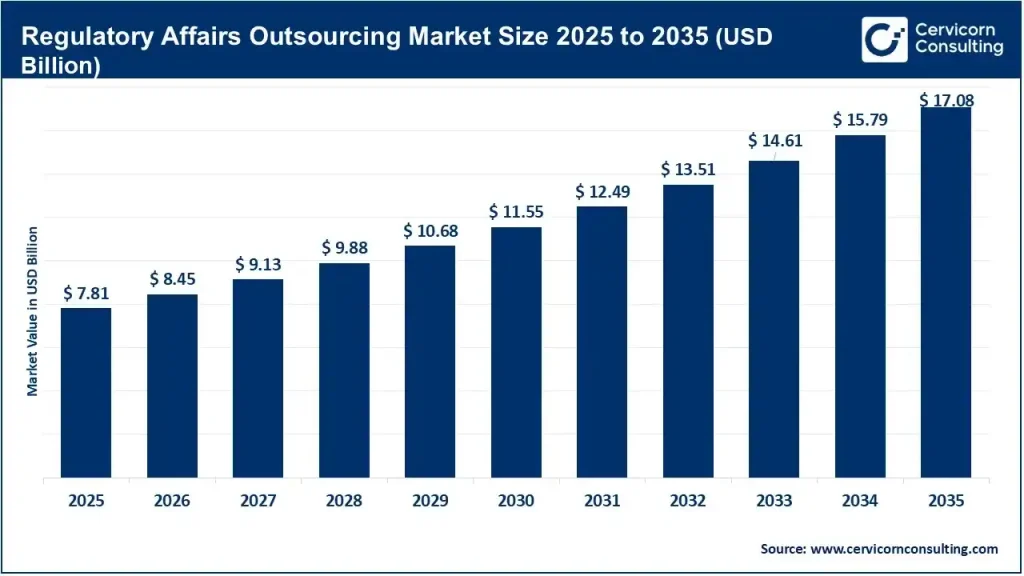
The global regulatory affairs outsourcing market size was valued at USD 7.81 billion in 2025 and is projected to reach USD 17.08 billion by 2035, representing a 8.1% CAGR.
Regulatory affairs outsourcing market growth factors
The global regulatory affairs outsourcing market is expanding as pharmaceutical, biotechnology, medical device, and healthcare companies face increasingly complex regulatory requirements across multiple jurisdictions, rising clinical-trial activity, growing development of biologics and advanced therapies, and increasing pressure to accelerate product approvals while controlling operational costs. Regulatory requirements now extend across the complete product lifecycle, from early development and clinical-trial applications to marketing authorization, labeling, regulatory submissions, post-approval changes, and lifecycle management.
The expansion of multinational clinical trials, increasing regulatory complexity for biologics, biosimilars, cell and gene therapies, medical devices, and combination products, along with the adoption of electronic regulatory submissions, is creating additional demand for specialist outsourcing providers. Regulatory agencies are also increasingly digitizing submission and review processes. For example, the U.S. FDA uses the electronic Common Technical Document (eCTD) as the standard format for many major drug submissions, while the European Union requires sponsors to use the Clinical Trials Information System for new clinical-trial applications. These developments increase the need for specialized regulatory professionals who can interpret changing requirements, prepare compliant documentation, coordinate submissions, communicate with health authorities, and maintain regulatory compliance across different markets.
Get a Free Sample: https://www.cervicornconsulting.com/sample/3033
What is the regulatory affairs outsourcing market?
The regulatory affairs outsourcing market refers to third-party services provided to pharmaceutical companies, biotechnology companies, medical device manufacturers, diagnostics companies, and other healthcare organizations to help them meet regulatory requirements throughout a product’s development and commercial lifecycle.
Outsourced regulatory affairs activities can include regulatory strategy, clinical-trial applications, regulatory intelligence, dossier preparation, Common Technical Document (CTD) and eCTD publishing, product registration, health-authority interactions, labeling, regulatory writing, submission management, variations, renewals, post-approval changes, and lifecycle management.
The outsourcing model can range from individual specialist assignments to fully managed regulatory programs. Companies may outsource regulatory affairs because they require specialized expertise in a particular country, therapeutic area, product type, or regulatory pathway, or because their internal regulatory teams need additional capacity during periods of high submission activity.
The market includes large global contract research organizations (CROs), specialist regulatory consultancies, technology-enabled regulatory service providers, and regional regulatory organizations. Providers such as ICON, Parexel, and IQVIA increasingly combine regulatory expertise with technology, automation, regulatory intelligence, and data-management capabilities.
Why is regulatory affairs outsourcing important?
Regulatory affairs outsourcing is important because regulatory compliance directly affects the ability of healthcare companies to conduct clinical trials, obtain marketing authorization, launch products, and maintain products in commercial markets.
Managing increasingly complex regulations
Pharmaceutical and medical-device companies frequently operate across multiple regulatory jurisdictions. Each market can have different submission formats, timelines, documentation requirements, labeling standards, clinical-trial requirements, and post-market obligations. External regulatory specialists can provide country-specific knowledge and help companies coordinate requirements across regions.
Reducing internal resource requirements
Maintaining large regulatory teams can be expensive, particularly for smaller biotechnology companies with limited internal resources. Outsourcing enables organizations to access experienced regulatory professionals when required without building permanent teams for every jurisdiction or regulatory specialization.
Supporting faster regulatory submissions
Regulatory outsourcing providers can support submission planning, document preparation, publishing, quality checks, and health-authority responses. This can help sponsors organize complex submissions and reduce administrative bottlenecks.
Supporting specialized products
Advanced therapies, biologics, biosimilars, combination products, medical devices, software as a medical device, and other innovative products can require highly specialized regulatory strategies. External providers can supplement internal expertise in these emerging areas.
Maintaining products after approval
Regulatory responsibilities continue after a product reaches the market. Labeling changes, manufacturing changes, renewals, variations, safety-related updates, and regulatory commitments require continuous management. Outsourcing providers therefore increasingly support lifecycle management rather than only initial product registration.
Leading companies in the regulatory affairs outsourcing market
The competitive environment includes global CROs and specialist regulatory service organizations. Among the major companies are ICON plc, Parexel, IQVIA, Labcorp Drug Development, and Syneos Health.
| Company | Specialization | Key Focus Areas | Notable Features | 2025 Revenue* | Regulatory Market Share |
|---|---|---|---|---|---|
| ICON plc | Clinical development and regulatory consulting | Regulatory strategy, submissions, clinical-trial regulatory support, lifecycle management | 1,000+ regulatory consultants, 100+ locations and 50+ regulatory service capabilities | USD 8.25 billion | Not separately disclosed |
| Parexel | Clinical development, regulatory strategy and market access | Global submissions, regulatory writing, dossier publishing, lifecycle management | 1,300+ regulatory specialists and experience in 110+ countries | Not publicly disclosed separately | Not separately disclosed |
| IQVIA | R&D solutions, healthcare technology and regulatory services | Regulatory strategy, labeling, intelligence, publishing and lifecycle management | 3,300+ regulatory professionals across 65+ locations | USD 16.31 billion | Not separately disclosed |
| Labcorp Drug Development | Clinical development and laboratory services | Drug development, clinical research, regulatory support and evidence generation | Global drug-development and laboratory infrastructure | Approx. USD 14 billion Labcorp revenue | Not separately disclosed |
| Syneos Health | Clinical development and commercial services | Regulatory support, clinical development and commercialization | Integrated clinical and commercial capabilities | Not publicly disclosed separately | Not separately disclosed |
ICON plc
ICON provides regulatory consulting and operational support across the product lifecycle. Its regulatory portfolio covers clinical-trial global regulatory activities, strategic development, licensing, marketing authorization, lifecycle management, regulatory intelligence, and related services. ICON reports more than 1,000 regulatory consultants, more than 100 locations, and more than 6,350 strategic development, licensing and lifecycle-management submissions annually based on its stated three-year averages.
ICON reported USD 8.251 billion in full-year 2025 revenue, while regulatory affairs revenue is not separately reported. Its global footprint enables sponsors to coordinate regulatory activities across North America, Europe, Asia-Pacific, and other markets.
Parexel
Parexel has a long-standing presence in regulatory consulting and provides global regulatory submissions and outsourcing services. Its offerings include submission strategy, technical authoring, regulatory dossier preparation, publishing, submission dispatch, post-approval support, regulatory information management, and staff augmentation. Parexel reports a regulatory organization of more than 1,300 specialists, including former regulators, with experience across more than 110 countries.
A published Parexel case study describes a regulatory outsourcing partnership involving a global pharmaceutical company’s mature portfolio of 65 products registered in more than 100 markets. Parexel reports that the program enabled the release of 59 client FTEs for other activities, reduced dedicated FTE requirements by 20%, and achieved reductions in duplicated effort through coordinated variation submissions.
IQVIA
IQVIA combines regulatory affairs expertise with data, analytics, technology, and clinical-development capabilities. Its regulatory services include strategy, labeling, publishing, regulatory intelligence, submission support, and lifecycle management. IQVIA reports more than 3,300 regulatory professionals across more than 65 global locations.
IQVIA generated USD 16.31 billion in total revenue in 2025, including USD 8.896 billion from Research & Development Solutions. Regulatory affairs outsourcing is part of a broader service portfolio and is not separately reported as a standalone revenue category.
Labcorp Drug Development
Labcorp provides drug-development services supported by clinical research, laboratory testing, diagnostics, and scientific capabilities. Its drug-development business serves pharmaceutical and biotechnology organizations throughout clinical development and commercialization.
Labcorp reported approximately USD 14 billion in FY2025 revenue and approximately 71,000 employees serving clients in around 100 countries. The company’s regulatory capabilities are integrated with its wider clinical and laboratory infrastructure rather than being separately reported as a regulatory-outsourcing revenue segment.
Syneos Health
Syneos Health operates across clinical development and commercialization, supporting biopharmaceutical companies with integrated services. Its position in regulatory outsourcing is linked to clinical development, regulatory support, evidence generation, and commercialization activities.
Because Syneos Health is privately held, a comparable publicly reported 2025 total revenue and regulatory-affairs-specific revenue figure is not readily available. Consequently, a precise 2025 regulatory market-share percentage should not be inferred from corporate revenue estimates.
Leading trends and their impact on the regulatory affairs outsourcing market
AI-enabled regulatory affairs
Artificial intelligence is increasingly being incorporated into regulatory workflows involving document review, regulatory intelligence, content classification, data extraction, labeling, submission management, and document quality control. IQVIA, for example, describes its regulatory offering as AI-augmented regulatory affairs, operations, and lifecycle management.
The impact is a shift from manual document-processing activities toward technology-assisted regulatory operations. AI can help identify information, compare documents, monitor regulatory changes, and support repetitive workflows, while human regulatory experts remain important for interpretation, strategy, quality control, and interactions with authorities.
Growth of biologics and advanced therapies
The increasing development of biologics, biosimilars, cell and gene therapies, and other advanced therapies is creating demand for specialized regulatory expertise. These products can involve complex chemistry, manufacturing and controls (CMC), clinical, safety, manufacturing, and post-approval requirements.
This trend benefits outsourcing providers that can combine therapeutic expertise with regulatory strategy and global submission capabilities.
Increasing electronic submissions
Electronic regulatory submissions are becoming a central part of regulatory operations. The FDA identifies eCTD as the standard format for multiple major application types, including NDAs, ANDAs, INDs, and BLAs. FDA also supports eCTD version 4.0 for new applications.
For outsourcing providers, this creates demand for specialized publishing, validation, document-management, submission-tracking, and regulatory-information-management capabilities.
Expansion of lifecycle management
Companies increasingly outsource post-approval activities instead of limiting outsourcing to initial submissions. Regulatory variations, renewals, labeling updates, manufacturing changes, commitments, and country-specific maintenance can involve thousands of individual regulatory activities.
This creates recurring demand for regulatory outsourcing and supports long-term managed-service relationships.
Growth of global product launches
As pharmaceutical and biotechnology companies seek international market access, regulatory teams must coordinate requirements across the U.S., Europe, Asia-Pacific, Latin America, and emerging markets.
Outsourcing providers with local regulatory expertise can therefore support multinational submission programs while maintaining consistency between global and country-level regulatory strategies.
Successful examples of regulatory affairs outsourcing around the world
North America: FDA submission support
ICON reports a case involving a Canadian mid-sized pharmaceutical company that partnered with its regulatory affairs team to support an FDA ANDA submission for a generic injectable opioid-overdose treatment. ICON supported pre-submission activities, filing, and responses to FDA review questions.
This example illustrates how mid-sized companies can use external regulatory expertise when entering the highly structured U.S. regulatory environment.
Europe-to-Canada biologic approval
ICON also reports a case involving an international European biopharmaceutical company that contracted regulatory support for a new biologic application in Canada for an oncology therapy. The engagement combined CMC and local regulatory expertise to support the application.
Europe and multinational clinical trials
The European Union’s Clinical Trials Regulation created a more harmonized approach to multinational clinical-trial applications. CTIS enables sponsors to submit applications through a single platform for clinical trials conducted in multiple European countries. Since January 31, 2023, CTIS has been mandatory for new clinical-trial applications, and by January 31, 2025, ongoing trials under the previous framework had to transition to the new requirements.
This regulatory environment creates opportunities for outsourcing providers that can manage multinational submissions, documentation, country requirements, and ongoing regulatory communications.
Global mature-product portfolio management
Parexel reports a long-term regulatory outsourcing engagement involving a global pharmaceutical company’s mature portfolio of 65 products across more than 100 markets and approximately 2,500 marketing applications. The provider supported lifecycle management, local regulatory activities, variation submissions, regulatory systems, and process optimization.
The example demonstrates the growing importance of outsourcing for maintaining established products rather than focusing solely on new product approvals.
Global regional analysis
North America
North America remains a major regulatory outsourcing market because of the scale of the U.S. pharmaceutical and biotechnology industry, extensive clinical-development activity, and detailed FDA requirements. The United States also has a mature CRO ecosystem, creating a strong base for outsourced regulatory services.
The FDA’s electronic submission requirements further reinforce demand for specialized regulatory publishing and submission-management capabilities. FDA guidance states that eCTD is the standard electronic format for several major drug application types.
The region is also experiencing increasing regulatory requirements associated with biologics, advanced therapies, combination products, medical devices, and digital health.
Europe
Europe represents an important market because regulatory activities frequently span multiple national authorities and the European Medicines Agency. The Clinical Trials Regulation and CTIS have increased harmonization of multinational clinical-trial applications.
Under the EU framework, sponsors can use CTIS to apply for authorization in multiple European countries through a single online application. From January 31, 2025, ongoing trials previously approved under the Clinical Trials Directive were also required to comply with the Clinical Trials Regulation and have information recorded in CTIS.
These changes support demand for regulatory specialists who understand European submission processes, clinical-trial requirements, transparency obligations, and lifecycle management.
Asia-Pacific
Asia-Pacific is becoming increasingly important as pharmaceutical manufacturing, clinical research, biotechnology investment, and product launches expand across China, India, Japan, South Korea, Australia, and Southeast Asia.
India is particularly relevant because CDSCO oversees new-drug and clinical-trial approvals under the New Drugs and Clinical Trials Rules, 2019. The regulator’s New Drugs Division handles applications for new-drug approvals, clinical trials, imports, manufacturing permissions, and related regulatory activities.
India has also introduced digital processes such as the SUGAM portal for applications associated with investigational new drugs and clinical trials. These systems increase the importance of regulatory expertise, documentation accuracy, and digital submission capabilities.
Japan continues to operate a sophisticated pharmaceutical regulatory environment through PMDA and its collaboration with international regulatory frameworks, while China and other Asian markets continue to develop their regulatory systems in line with expanding pharmaceutical and biotechnology activity.
Latin America
Latin American countries represent an expanding opportunity for regulatory outsourcing as pharmaceutical companies seek broader market access and regional product registrations. Regulatory requirements differ across countries, increasing demand for local regulatory representatives, dossier localization, translations, registration support, and post-approval maintenance.
Brazil and Mexico are particularly important markets because of their large healthcare sectors and established regulatory institutions. Outsourcing providers with regional teams can help international pharmaceutical companies manage country-specific requirements while coordinating them with global regulatory strategies.
Middle East and Africa
The Middle East and Africa region is developing as pharmaceutical companies expand market access and manufacturing activities. Regulatory environments vary considerably between countries, creating demand for local regulatory intelligence and country-specific registration expertise.
Regulatory outsourcing can be particularly relevant for companies entering new markets where they do not have established regulatory teams. Services can include local representation, registration dossiers, product renewals, labeling, regulatory intelligence, and authority interactions.
Government initiatives and policies shaping the market
United States: FDA electronic submission framework
The FDA’s electronic regulatory submission framework is one of the major policy factors influencing regulatory outsourcing. The agency identifies eCTD as the standard format for many major drug submissions and requires electronic submission processes for relevant application categories.
This increases demand for regulatory publishing, document validation, submission management, and technical regulatory expertise.
European Union: Clinical Trials Regulation and CTIS
The EU Clinical Trials Regulation aims to harmonize clinical-trial assessment and supervision across member states. CTIS functions as the single-entry point for sponsors and regulators, supporting applications across multiple European countries.
For regulatory outsourcing companies, this creates demand for multinational regulatory strategy, CTIS submission support, document management, and ongoing trial compliance.
United Kingdom: International Recognition Procedure
The UK’s MHRA introduced the International Recognition Procedure (IRP) on January 1, 2024. The procedure allows applicants to use certain approvals from specified reference regulators, including regulators in Australia, Canada, the EU, Japan, Switzerland, Singapore, and the United States, as part of the UK authorization process.
The framework creates opportunities for regulatory consultants that can assess eligibility, coordinate reference approvals, prepare submissions, and manage UK-specific requirements.
India: New Drugs and Clinical Trials Rules
India’s New Drugs and Clinical Trials Rules, 2019 provide the regulatory framework for new-drug approvals and clinical trials. CDSCO processes clinical-trial and new-drug applications under the framework, including through online systems.
As Indian pharmaceutical companies expand internationally and global companies conduct more activities in India, regulatory outsourcing can support both domestic compliance and international registration programs.
Increasing regulatory convergence
International harmonization initiatives are also influencing the market. Common technical documentation, electronic submissions, international regulatory standards, and increased cooperation between regulators are encouraging pharmaceutical companies to coordinate regulatory strategies across jurisdictions.
For outsourcing providers, the implication is a growing need to combine global regulatory knowledge with country-level expertise. Providers that can manage centralized submission strategies while adapting documentation to local requirements are positioned to participate in increasingly complex multinational development programs.
To Get Detailed Overview, Contact Us: https://www.cervicornconsulting.com/contact-us
Read Report: Cloud Backup and Recovery Solutions Market Revenue, Trends, and Strategic Insights by 2035