


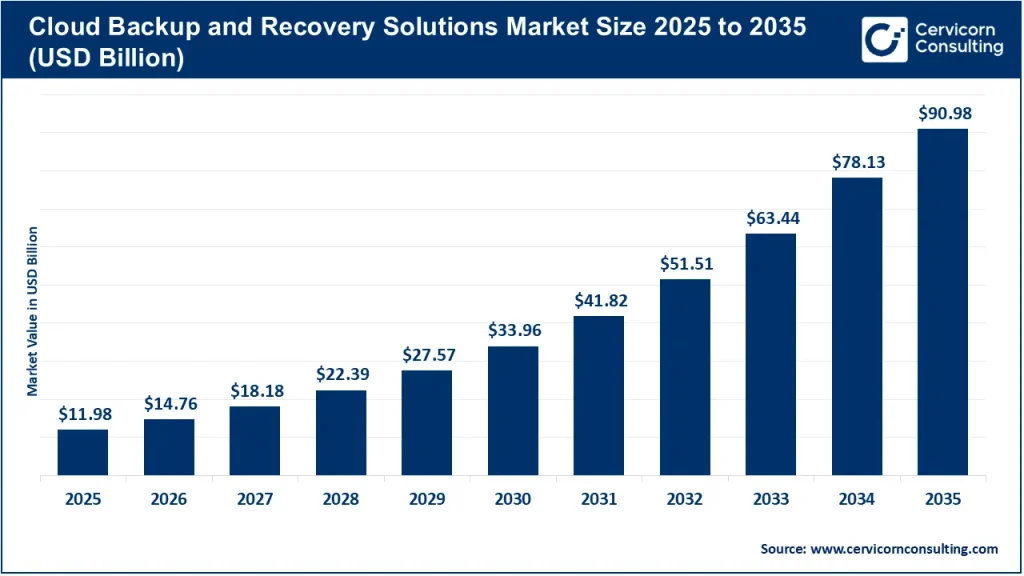
Cloud Backup and Recovery Solutions Market Size
The global cloud backup and recovery solutions market size was valued at USD 1.89 billion in 2025 and is projected to reach USD 17.24 billion by 2035, representing a 24.74% CAGR.
Cloud backup and recovery solutions market growth factors
The global cloud backup and recovery solutions market is being driven by the rapid expansion of enterprise data, increasing adoption of public, private, and hybrid cloud environments, rising ransomware and cyberattack incidents, stricter regulatory requirements, remote and distributed workforces, and the growing need for business continuity. Organizations are increasingly moving beyond traditional backup infrastructure toward cloud-based platforms that provide scalable storage, automated backup policies, immutable copies, disaster recovery orchestration, and rapid data restoration. The increasing use of SaaS applications, virtual machines, containers, databases, artificial intelligence, Internet of Things devices, and cloud-native workloads is also expanding the volume of information that requires protection.
At the same time, regulatory frameworks requiring stronger data security, resilience, retention, and recovery capabilities are encouraging BFSI, healthcare, government, IT, telecommunications, and other highly regulated industries to strengthen their backup architectures. AI and machine learning are further influencing the market by enabling anomaly detection, automated threat identification, intelligent backup management, recovery-point selection, and predictive monitoring.
Get a Free Sample: https://www.cervicornconsulting.com/sample/2772
What is the cloud backup and recovery solutions market?
The cloud backup and recovery solutions market comprises software, platforms, and services that enable organizations to copy, store, protect, manage, and restore data using cloud infrastructure. These solutions can protect files, databases, applications, virtual machines, SaaS platforms, endpoints, and entire workloads.
Unlike conventional backup systems that depend heavily on physical storage infrastructure, cloud-based backup solutions use remote infrastructure to provide scalable storage and geographically distributed recovery capabilities. Depending on organizational requirements, enterprises can choose public cloud, private cloud, or hybrid cloud deployment models.
Cloud backup generally involves creating copies of production data and transferring those copies to secure cloud repositories. Recovery capabilities then allow organizations to restore individual files, applications, virtual machines, databases, or entire IT environments following accidental deletion, hardware failure, cyberattacks, natural disasters, software corruption, or operational disruptions.
Modern platforms increasingly combine backup with cybersecurity, disaster recovery, observability, compliance management, encryption, immutable storage, and automated recovery. This convergence is shifting the market from traditional “backup and restore” toward broader data resilience and cyber-recovery platforms.
Why is the cloud backup and recovery solutions market important?
Cloud backup and recovery solutions are becoming an important component of enterprise business continuity because digital operations increasingly depend on continuously available data. A ransomware attack, infrastructure failure, cloud outage, accidental deletion, or corrupted database can interrupt operations and create significant financial and reputational consequences.
Cloud-based architectures provide organizations with geographically separated copies of critical data, helping reduce dependence on a single physical location. Organizations can also use immutable or logically isolated backup repositories to reduce the possibility that attackers can modify or delete recovery copies.
Cybersecurity agencies increasingly emphasize this requirement. The U.S. Cybersecurity and Infrastructure Security Agency recommends maintaining offline, encrypted backups and regularly testing their availability and integrity. The UK National Cyber Security Centre similarly recommends ransomware-resistant backup architectures, including protections against deletion and corruption.
Cloud recovery also improves scalability. Enterprises can expand backup capacity as data volumes increase without continuously purchasing physical infrastructure. This is particularly relevant for organizations adopting AI, analytics, digital commerce, remote work, IoT, and SaaS applications.
Market structure and major segments
The cloud backup and recovery solutions market can be analyzed across several dimensions. By component, solutions and services form the two major categories. Cervicorn Consulting estimates that solutions accounted for approximately 60% of revenue in 2025, while services represented 40%.
By deployment mode, public cloud accounted for approximately 46% of revenue in 2025. Hybrid cloud is emerging as a rapidly expanding model because organizations can retain sensitive workloads in controlled environments while using public cloud infrastructure for scalability and disaster recovery.
By service type, incremental backup represented approximately 53% of the market in 2025, ahead of full and differential backup. Incremental backup reduces bandwidth and storage requirements because only changed data is transferred after the initial backup.
By end-use industry, BFSI accounted for approximately 26% of market revenue in 2025, reflecting the sector’s high dependence on transactional data, regulatory compliance, continuous availability, and disaster recovery. Healthcare is another rapidly developing application area as electronic health records, telemedicine, medical imaging, and AI-based healthcare systems generate increasing volumes of sensitive data.
Company profiles in the cloud backup and recovery solutions market
| Company | Specialization | Key Focus Areas | Notable Features | 2025 Revenue* | Market Share | Global Presence |
|---|---|---|---|---|---|---|
| Veeam Software | Data protection and cyber resilience | Cloud, virtual workloads, SaaS, ransomware recovery | Immutable backup, orchestration, cloud data protection, ransomware recovery | Private company; ARR was reported at $1.7B in 2025 | 13.6% worldwide data protection software share in 2H 2025 | Global |
| Dell Technologies | Infrastructure, storage and data protection | Enterprise backup, storage, hybrid cloud | PowerProtect, integrated infrastructure, cyber recovery | $95.6B FY2025 company revenue | Standalone cloud-backup share not publicly disclosed | 170+ countries |
| Commvault | Data protection and cyber resilience | Hybrid cloud, SaaS, enterprise recovery | Commvault Cloud, cyber resilience, recovery orchestration | $995.6M FY2025 revenue | Standalone cloud-backup share not publicly disclosed | Global |
| Rubrik | Cloud data security and cyber recovery | Cloud, SaaS, ransomware recovery, identity | Immutable architecture, threat detection, orchestrated recovery | $886.5M FY2025 revenue | Standalone cloud-backup share not publicly disclosed | Global |
| Veritas Technologies | Enterprise data management and backup | Hybrid cloud, enterprise backup, recovery | NetBackup, data management, cyber resilience | Private company; standalone 2025 revenue not publicly disclosed | Standalone cloud-backup share not publicly disclosed | Global |
*Company revenues represent total reported company revenue or the closest publicly disclosed financial measure, rather than cloud backup revenue specifically.
Veeam Software
Veeam focuses on data protection, backup, recovery, and cyber resilience across physical, virtual, cloud, and SaaS environments. Its portfolio includes Veeam Data Platform and Veeam Data Cloud, with capabilities covering Microsoft 365, Microsoft Entra ID, cloud workloads, virtual machines, and enterprise applications.
Veeam reported approximately $1.7 billion in annualized recurring revenue in 2025. IDC’s 2H 2025 Semiannual Software Tracker subsequently reported Veeam with 13.6% worldwide market share in data protection software, making it a significant participant in the broader data protection category.
Dell Technologies
Dell Technologies combines infrastructure, storage, software, and services. Its PowerProtect portfolio addresses enterprise data protection across on-premises and cloud environments, making Dell particularly relevant to organizations pursuing hybrid architectures.
Dell reported $95.6 billion in fiscal 2025 revenue, while its Infrastructure Solutions Group generated $43.6 billion in FY2025 revenue, including servers, networking, and storage. Dell operates in more than 170 countries.
Commvault
Commvault provides data protection and cyber-resilience capabilities through Commvault Cloud. The platform supports backup, monitoring, reporting, and recovery across distributed enterprise environments.
Commvault reported $995.6 million in fiscal 2025 revenue, compared with $839.2 million in fiscal 2024. Its strategy increasingly emphasizes cloud-native data security, rapid recovery, SaaS protection, and cyber resilience.
Rubrik
Rubrik focuses on cloud data security, cyber resilience, and automated recovery. Its platform protects data across cloud, SaaS, on-premises, and identity environments while incorporating immutable storage, threat detection, and recovery orchestration.
Rubrik generated $886.5 million in fiscal 2025 revenue, including $828.7 million from subscription revenue. Subscription ARR reached approximately $1.09 billion at the end of fiscal 2025.
Veritas Technologies
Veritas Technologies has a long-established position in enterprise backup and data management. Its portfolio is centered around protecting large and complex IT estates, with NetBackup and related capabilities supporting hybrid and multi-cloud environments.
Because Veritas is privately held, a standalone 2025 company revenue figure and precise cloud-backup market share are not publicly disclosed in the same manner as listed companies. Therefore, comparisons should avoid treating third-party estimates as audited financial results.
Leading trends and their impact
Multi-cloud and hybrid-cloud adoption
Enterprises are increasingly operating across multiple cloud platforms while retaining selected workloads on-premises. This creates demand for backup platforms that can operate consistently across different environments.
Hybrid architectures can also help organizations balance scalability, data sovereignty, security, latency, and regulatory requirements. Consequently, vendors are developing centralized management platforms capable of protecting workloads regardless of where they reside.
AI and machine learning integration
AI is becoming increasingly integrated into backup and recovery platforms. AI-based systems can analyze backup activity, identify abnormal behavior, detect potential ransomware activity, classify sensitive information, and identify clean recovery points.
The market is consequently moving toward intelligent recovery rather than simply storing backup copies. AI can also help automate administrative processes, reducing the workload placed on IT teams.
Ransomware-resistant and immutable backups
Ransomware is one of the strongest forces shaping the market. Attackers increasingly attempt to compromise backup systems because destroying recovery copies can make recovery more difficult.
As a result, immutable storage, air-gapped repositories, multifactor authentication, privileged-access controls, anomaly detection, and recovery testing are becoming important purchasing criteria. The NCSC specifically recommends that backup systems resist malicious editing, overwriting, and deletion.
Continuous data protection and faster recovery
Organizations increasingly require low recovery point objectives (RPOs) and recovery time objectives (RTOs). Continuous data protection, near-real-time replication, automated recovery workflows, and application-aware backup are therefore becoming more important.
The objective is shifting from simply maintaining a backup copy to restoring business operations as quickly and reliably as possible.
Backup-as-a-Service and Disaster-Recovery-as-a-Service
Managed backup and disaster recovery services are becoming attractive to organizations that lack the internal resources to operate complex infrastructure. Cervicorn Consulting reports that 88% of enterprises surveyed in the Veeam Data Protection Trends Report 2024 were likely or almost certain to use Backup-as-a-Service or Disaster-Recovery-as-a-Service for at least some production servers.
This trend creates opportunities for cloud providers, managed service providers, systems integrators, and specialist backup vendors.
Increased recovery testing and validation
Organizations are increasingly recognizing that having a backup does not automatically guarantee recoverability. Recovery environments must be tested to verify that backup data is complete, clean, and usable.
Automated recovery testing can validate applications, virtual machines, databases, and dependencies before an actual disaster occurs. This creates demand for recovery orchestration and automated testing features.
Successful examples of cloud backup and recovery solutions around the world
VNOG – Netherlands
Veiligheidsregio Noord- en Oost-Gelderland, a Dutch emergency-services organization, adopted Veeam after experiencing a ransomware attack and challenges with older backup infrastructure. Its subsequent architecture uses immutable backup principles and Veeam Data Cloud for Microsoft 365 and Microsoft Entra ID.
The organization reports that it can restore its complete data environment within approximately 12 hours rather than weeks and backs up its IT environment daily.
HCLTech logistics environment
A logistics company working with HCLTech experienced a ransomware attack that encrypted approximately 800 TB of data and affected 700 virtual machines. According to Commvault’s customer case study, the organization achieved a 100% data restore with zero data loss using Commvault’s data protection and recovery capabilities.
Renown Health – United States
Renown Health implemented Rubrik Identity Recovery to improve recovery of Active Directory and cloud-based Entra ID environments. The customer case study reports that recovery time for Active Directory was reduced from approximately 24 hours to under three hours.
This illustrates the expansion of the market from traditional file and application backup toward identity and operational recovery.
Granules India
Indian pharmaceutical company Granules India uses Veeam to protect laboratory systems, quality-control systems, SAP S/4HANA applications, and Microsoft Active Directory. Its architecture includes on-site tape, off-site tape, and public cloud backup destinations.
The deployment demonstrates how Indian enterprises can combine traditional storage with cloud-based protection to create multiple recovery layers.
FAAC Technologies – Italy
FAAC Technologies adopted Veeam Data Cloud for Microsoft 365 and Veeam Data Cloud Vault to strengthen its global data protection strategy. According to the customer case study, the company estimated that it reduced storage and maintenance costs by up to 40% while adding immutable and logically air-gapped cloud protection.
Rackspace and Rubrik – global public-cloud recovery
In 2025, Rackspace Technology and Rubrik introduced a managed cyber-recovery service for public-cloud workloads. The offering combines immutable backups, isolated recovery environments, Infrastructure as Code, and managed services to support recovery from ransomware and other cyber incidents.
The partnership demonstrates the broader transition toward managed, cloud-native cyber recovery rather than traditional backup products alone.
Global regional analysis
North America
North America held the largest regional position in 2025, accounting for approximately 38% of global cloud backup and recovery solutions market revenue. The region benefits from mature cloud infrastructure, high enterprise cloud adoption, major technology vendors, extensive data-center capacity, and strong cybersecurity spending.
The United States also has an extensive regulatory and cybersecurity ecosystem. CISA’s ransomware guidance emphasizes offline and encrypted backups, recovery testing, golden images, object-lock capabilities, version control, and cloud-to-cloud backup. These recommendations support enterprise demand for resilient backup architectures.
Government agencies and regulated organizations are consequently placing greater emphasis on recoverability, cyber resilience, identity protection, and continuity planning.
Europe
Europe represents an important market because data protection, cybersecurity, operational resilience, and data sovereignty are strongly influenced by regulatory requirements.
The EU’s NIS2 Directive explicitly includes business continuity measures such as backup management and disaster recovery within cybersecurity risk-management requirements.
The Digital Operational Resilience Act (DORA) is particularly relevant to financial institutions. DORA requires financial entities to establish backup systems and documented restoration and recovery procedures and to test those procedures periodically. It also addresses segregation and protection of recovery environments.
These requirements support demand for cloud backup platforms capable of policy enforcement, audit reporting, recovery testing, encryption, immutable storage, and geographically separated recovery.
Asia-Pacific
Asia-Pacific is expected to register the fastest growth in the cloud backup and recovery solutions market. India, China, Japan, South Korea, Australia, and Southeast Asian economies are expanding cloud infrastructure and digitizing business operations.
The region is experiencing rising demand from BFSI, healthcare, manufacturing, telecommunications, retail, and government organizations. Increasing IoT deployment, digital payments, e-commerce, mobile applications, AI adoption, and cloud migration are creating large volumes of data requiring protection.
India represents a particularly important growth market. CERT-In’s cybersecurity directions establish requirements related to information-security practices, incident prevention, response, reporting, and cloud-service-provider environments.
India also notified the Digital Personal Data Protection Rules, 2025, creating an implementation framework around the Digital Personal Data Protection Act. The rules introduce requirements related to protection and responsible processing of personal data, further increasing the importance of appropriate data-management and security practices.
Japan is also strengthening its cybersecurity ecosystem. In 2025, Japan’s Ministry of Economy, Trade and Industry released a strategy designed to strengthen the domestic cybersecurity industry, including support for cybersecurity products, research and development, government adoption, and vendor-industry collaboration.
Latin America
Latin America is gradually increasing adoption of cloud backup and disaster recovery as enterprises modernize IT infrastructure and move workloads to cloud platforms. Banking, telecommunications, retail, healthcare, and government organizations represent important demand centers.
Cloud adoption can help regional businesses overcome limitations associated with maintaining extensive physical infrastructure. However, organizations must also address data residency, connectivity, cybersecurity skills, and recovery requirements when designing cloud backup architectures.
Middle East and Africa
The Middle East and Africa are developing opportunities through government digitization programs, cloud-region investments, smart-city projects, financial technology adoption, and expansion of digital services.
Organizations operating critical infrastructure and government systems are increasingly focused on cyber resilience and operational continuity. Demand is expected to expand as cloud adoption increases and enterprises seek geographically distributed backup and disaster recovery capabilities.
Government initiatives and policies shaping the market
Government policies are becoming an important market-development factor because backup and recovery are increasingly treated as components of cybersecurity and operational resilience.
In the United States, CISA promotes offline, encrypted, tested backups and protections such as object lock and version control for cloud resources. These recommendations encourage organizations to design backup systems that remain recoverable even when production environments are compromised.
In the European Union, NIS2 incorporates backup management and disaster recovery into cybersecurity risk management, while DORA establishes detailed backup, restoration, recovery, and testing expectations for financial entities.
In the United Kingdom, the National Cyber Security Centre provides specific ransomware-resistant backup guidance covering both on-premises and cloud backup environments. Its recommendations emphasize isolation, resilience against destructive actions, protected previous versions, secure key management, and monitoring of privileged activity.
In Australia, the 2023–2030 Australian Cyber Security Strategy is being implemented through multiple horizons, with Horizon 2 covering 2026–2028 and focusing on improving cyber maturity across the economy and digital infrastructure. Australia’s cyber authorities have also reported ransomware as a major disruptive cybercrime threat, reinforcing the importance of recovery capabilities.
In India, CERT-In’s cybersecurity directions and the Digital Personal Data Protection framework are shaping requirements around cybersecurity, incident management, personal-data protection, and responsible data handling. These developments are increasing the need for organizations to understand where their data resides, how it is protected, and how it can be recovered following an incident.
Collectively, these policies are pushing the cloud backup and recovery solutions market toward stronger encryption, immutable storage, geographically separated recovery, access controls, recovery testing, compliance reporting, and automated cyber-recovery capabilities.
Market outlook
The cloud backup and recovery solutions market is moving from conventional backup infrastructure toward integrated cloud data protection, cyber resilience, and automated recovery platforms. The combination of rising data volumes, ransomware exposure, cloud migration, regulatory requirements, AI adoption, and hybrid infrastructure is creating demand for solutions that can protect data throughout its lifecycle.
As enterprises increasingly treat recoverability as part of cybersecurity rather than a separate IT function, vendors are expected to compete around immutable architectures, AI-powered threat detection, cloud-native protection, SaaS backup, identity recovery, automated recovery orchestration, and managed backup services.
To Get Detailed Overview, Contact Us: https://www.cervicornconsulting.com/contact-us
Read Report: Stainless Steel Market Revenue, Trends, and Strategic Insights by 2035