


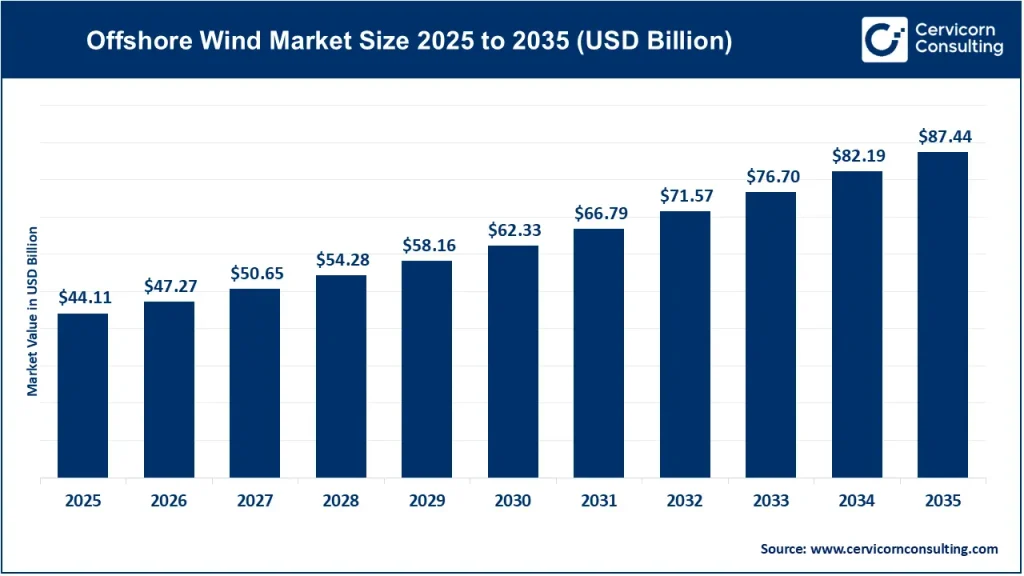
Offshore Wind Market Size
The global offshore wind market was valued at approximately USD 44.11 billion in 2025 and is projected to reach USD 87.44 billion by 2035, expanding at a CAGR of 7.08% during the forecast period.
Offshore Wind Market Growth Factors
The offshore wind market is expanding as governments, utilities, industrial companies, and investors seek large-scale renewable electricity sources that can support decarbonization and energy security. Strong offshore wind resources, increasing turbine capacity, declining technology costs over the long term, ambitious net-zero targets, government auctions, Contracts for Difference (CfDs), renewable-energy procurement programs, and investments in offshore transmission networks are creating favorable conditions for market development. Offshore wind also benefits from its ability to generate electricity at high and relatively consistent capacity factors compared with many land-based renewable projects, while projects can be developed at utility scale without competing directly with urban land uses.
Technology is another major growth catalyst: modern offshore turbines increasingly exceed 10 MW, with larger machines reducing the number of turbines, foundations, cables, and installation activities required for a given project capacity. GWEC reports that global offshore wind installations reached 92.5 GW by the end of 2025, after 9.3 GW of new capacity was grid-connected during 2025, the third-highest annual addition in the industry’s history. China alone commissioned 6.6 GW during the year, while Europe added nearly 2 GW. At the same time, supply-chain localization, floating wind development, green-hydrogen integration, offshore-grid development, and corporate demand for clean electricity are creating additional opportunities.
However, inflation, high financing costs, permitting delays, supply-chain bottlenecks, transmission constraints, and policy uncertainty remain important factors influencing project economics. The IEA expects offshore wind capacity additions to accelerate substantially through 2030, although it has reduced its forecast because of higher costs, policy changes, and project cancellations or delays in several markets.
Get a Free Sample: https://www.cervicornconsulting.com/sample/2745
What Is the Offshore Wind Market?
The offshore wind market encompasses the development, manufacturing, installation, operation, maintenance, financing, and supporting infrastructure associated with generating electricity from wind turbines installed in marine environments.
An offshore wind farm generally consists of wind turbines, foundations or floating platforms, subsea cables, offshore substations, export cables, onshore substations, transmission systems, and operations and maintenance infrastructure. The market includes fixed-bottom offshore wind and floating offshore wind.
Fixed-bottom turbines are installed on foundations anchored to the seabed and are currently the dominant technology. They are particularly suitable for relatively shallow coastal waters. Floating offshore wind turbines, by contrast, are mounted on floating platforms that are moored to the seabed. Floating technology can open access to deeper waters where wind resources are strong and seabed-fixed foundations become technically or economically challenging.
The industry has moved rapidly toward larger turbines. GWEC reports that the average offshore turbine installed in 2025 reached 10.3 MW, surpassing the 10 MW threshold for the first time. This trend is important because larger turbines can generate more electricity from each installation, potentially improving project productivity and reducing the number of turbines needed.
Why Is Offshore Wind Important?
Offshore wind is becoming strategically important for four major reasons.
1. Energy Security
Countries seeking to reduce dependence on imported fossil fuels are increasingly turning toward domestic renewable resources. Offshore wind can provide large volumes of electricity from coastal waters, helping diversify national energy systems.
2. Decarbonization
Electricity generation from offshore wind does not require combustion during operation. Large offshore projects can therefore contribute substantially to national emissions-reduction targets and support electrification of transportation, buildings, and industrial processes.
3. Large-Scale Electricity Generation
Offshore wind farms can reach gigawatt-scale capacity. Projects such as Dogger Bank demonstrate how offshore wind can become a major component of national electricity supply. The 3.6 GW Dogger Bank project is being developed in three 1.2 GW phases and is expected to generate enough electricity to serve millions of UK homes annually.
4. Industrial and Economic Development
Offshore wind creates demand for turbine manufacturing, steel, cables, ports, vessels, engineering, construction, software, project finance, operations, and specialized maintenance. Governments are therefore increasingly treating offshore wind as both an energy technology and an industrial-development opportunity.
Major Companies in the Offshore Wind Market
The competitive landscape includes established European turbine manufacturers, rapidly expanding Chinese suppliers, and Asian manufacturers developing domestic offshore wind capabilities.
| Company | Specialization | Key Focus Areas | Notable Features | 2025 Revenue* | Offshore Market Share* | Global Presence |
|---|---|---|---|---|---|---|
| General Electric / GE Vernova | Offshore and onshore wind turbines, grid and energy technologies | Haliade-X platform, offshore services, large-scale projects | Haliade-X 13–18 MW platform; major role in Dogger Bank | US$38.1B GE Vernova revenue | ~3% of 2024 new offshore installations by capacity; 8th supplier ranking | North America, Europe, Asia-Pacific |
| Vestas | Wind turbines and services | Offshore turbines, service, large-scale wind projects | V236-15.0 MW; 201 GW global wind installations by end-2025 | €18.82B | Not separately disclosed; 6th offshore supplier by 2024 installations | 88 countries |
| Shanghai Electric Wind Power Equipment Co. | Wind turbine manufacturing and renewable-energy equipment | Offshore turbines, large-scale Chinese projects, international expansion | Strong Chinese manufacturing ecosystem and offshore capability | RMB22.97B wind-equipment orders at parent Shanghai Electric | Not separately disclosed | China and international markets |
| Siemens Gamesa | Offshore and onshore wind turbines and services | SG 14/15 MW platform, offshore manufacturing, service | 67% offshore market share according to Siemens Energy; >22 GW SG 14/15 pipeline | Not separately disclosed; Siemens Energy FY2025 revenue €39.1B | 67% offshore market share | Europe, Americas, Asia-Pacific and other markets |
| Doosan Heavy Industries and Construction / Doosan Enerbility | Power equipment and offshore wind turbines | Korean offshore wind, turbine localization, floating wind | 5.56 MW turbine deployed at Jeju Hallim | 2025 company revenue not separately isolated in available disclosures | Not separately disclosed | South Korea and international markets |
*Revenue figures represent company or parent-group revenue where offshore-wind-only revenue was not separately disclosed. Market-share figures are therefore not directly comparable across all companies.
General Electric / GE Vernova
GE Vernova is a major global energy-technology company with an established offshore wind business centered on the Haliade-X platform. The company reported US$38.1 billion in total 2025 revenue across GE Vernova, although offshore wind represents only one portion of its business. Its Wind segment generated US$9.11 billion in 2025, while Offshore Wind revenue was approximately US$652 million, according to its 2025 segment presentation.
GE Vernova’s Haliade-X platform has become particularly significant in the European offshore wind sector. Its turbines are being deployed at Dogger Bank, where 277 Haliade-X units are planned across the three project phases.
GWEC’s 2024 supplier data ranked GE Vernova eighth among offshore turbine suppliers by annual installed capacity, with 24 Haliade-X 13 MW turbines installed during 2024.
Vestas
Vestas is one of the world’s largest wind-turbine manufacturers, with a significant offshore portfolio. Vestas reported €18.822 billion in 2025 revenue, while its Power Solutions segment generated €15.052 billion. Offshore turbine deliveries increased to 1,977 MW in 2025, compared with 1,352 MW in 2024. Its offshore turbine order backlog was valued at €10.1 billion at the end of 2025.
The company reached approximately 201 GW of cumulative wind installations across 88 countries by the end of 2025.
Vestas focuses heavily on large offshore turbines, digital monitoring, service optimization, project execution, and supply-chain expansion. The company’s offshore business is especially relevant to European and Asian markets.
Shanghai Electric Wind Power Equipment Co.
Shanghai Electric is an important Chinese wind-power equipment manufacturer and benefits from China’s enormous offshore wind deployment ecosystem.
In 2025, Shanghai Electric’s energy-equipment segment generated RMB75.02 billion in revenue, while wind-power equipment orders reached RMB22.966 billion, up 32.18% year over year.
Its key focus areas include large-scale turbine manufacturing, offshore wind equipment, intelligent manufacturing, renewable-energy technologies, and international expansion. China’s extensive offshore wind installation base provides Shanghai Electric and other domestic turbine manufacturers with a substantial home-market advantage.
Siemens Gamesa
Siemens Gamesa remains one of the most influential offshore wind turbine suppliers globally.
Siemens Energy reported €39.1 billion in FY2025 revenue, but it does not disclose Siemens Gamesa’s offshore revenue as a standalone figure in the same way.
Offshore wind is Siemens Gamesa’s strongest competitive area. Siemens Energy stated in its FY2025 shareholder materials that Siemens Gamesa held 67% offshore market share and had a secured pipeline exceeding 22 GW for its SG 14/15 platform.
The company’s strategy emphasizes larger turbines, production scale-up, quality improvement, offshore nacelle manufacturing, and service optimization. Offshore nacelle production at Cuxhaven increased from 100 units in 2023 to 300 in 2025.
Doosan Heavy Industries and Construction / Doosan Enerbility
Doosan Enerbility is particularly important to South Korea’s offshore wind localization strategy. The company has developed domestic wind-turbine technology and has participated in major Korean offshore projects.
A notable example is the 100 MW Jeju Hallim Offshore Wind Farm, where 18 Doosan 5.56 MW turbines were commissioned. GWEC identifies the project as South Korea’s largest commercial offshore wind farm at that stage.
Doosan’s strategy centers on domestic turbine development, Korean supply-chain participation, large-scale offshore projects, and next-generation wind technologies. Its offshore business is smaller internationally than Siemens Gamesa, Vestas, or GE Vernova, but it has strategic importance in the Korean market.
Leading Trends and Their Impact on the Offshore Wind Market
1. Larger Offshore Turbines
The offshore wind industry is moving rapidly toward larger turbines. The average turbine installed globally reached 10.3 MW in 2025.
Larger turbines can produce more electricity from each foundation and potentially reduce the number of turbines required for a project. This can lower some balance-of-plant and maintenance requirements, although larger machines also increase manufacturing, transportation, installation, and reliability challenges.
2. Floating Offshore Wind
Floating wind is one of the most important long-term technology opportunities.
Fixed-bottom projects are constrained by water depth. Floating platforms can potentially enable development farther offshore and in deeper waters with strong and consistent wind resources.
Japan is particularly focused on floating wind because of its deep coastal waters and limited shallow seabed areas. Its government is targeting 30–45 GW of offshore wind project formation by 2040, including floating technology.
The United Kingdom, Norway, France, South Korea, Portugal, and other markets are also developing floating-wind projects.
3. Offshore Grid Development
As offshore wind farms become larger and are developed farther from shore, transmission infrastructure becomes increasingly important.
Traditional radial connections can become expensive when multiple projects are built in the same region. Offshore transmission hubs, high-voltage direct current systems, and integrated offshore grids could improve electricity transfer and cross-border trading.
Dogger Bank demonstrates the importance of transmission innovation. It uses HVDC technology and includes offshore HVDC substations, providing a major example of how large offshore wind projects are increasingly integrated with advanced transmission systems.
4. Supply-Chain Localization
Governments are increasingly seeking domestic manufacturing and supply chains for turbines, foundations, cables, vessels, and ports.
This trend can strengthen domestic industries and reduce exposure to international supply-chain disruption, but it may also increase project costs if local manufacturing is substantially more expensive.
The United States and European countries are particularly focused on building domestic offshore wind supply chains, while China has developed one of the world’s largest renewable-energy manufacturing ecosystems.
5. Digitalization and Predictive Maintenance
Offshore wind farms operate in harsh environments where equipment failures can be expensive to repair.
Artificial intelligence, digital twins, remote monitoring, drones, predictive maintenance, and advanced analytics are therefore becoming increasingly important. These technologies can help identify potential gearbox, blade, generator, bearing, and electrical-system failures before major downtime occurs.
6. Integration With Green Hydrogen
Offshore wind can also supply electricity for electrolyzers producing green hydrogen.
This model could become particularly useful where offshore wind resources are strong but grid infrastructure is constrained. Hydrogen can act as an energy carrier and industrial feedstock for sectors such as steel, chemicals, shipping, and refining.
7. Corporate Renewable-Energy Procurement
Large technology companies, manufacturers, logistics businesses, and industrial consumers increasingly seek long-term renewable electricity contracts.
Corporate power purchase agreements can provide additional revenue certainty for offshore wind projects and complement government-backed mechanisms such as auctions and CfDs.
8. Rising Focus on Project Economics
The offshore wind industry has entered a period where growth is no longer determined solely by technical potential.
Inflation, higher interest rates, commodity costs, vessel availability, cable shortages, turbine prices, and permitting delays can significantly affect project economics. The IEA has consequently revised its offshore wind forecast downward by more than 25% compared with its previous outlook.
This has encouraged developers to renegotiate contracts, seek higher auction prices, improve turbine reliability, standardize project designs, and pursue better risk-sharing arrangements.
Successful Examples of Offshore Wind Markets Around the World
Dogger Bank – United Kingdom
Dogger Bank is one of the most important offshore wind projects globally.
Located approximately 130 km from the northeast coast of England, the project is being developed in three phases—Dogger Bank A, B, and C—with combined capacity of 3.6 GW. Each phase has 1.2 GW of capacity.
The project uses GE Vernova’s Haliade-X turbines and innovative HVDC transmission technology. It represents a major demonstration of large-scale project finance, turbine scaling, long-distance transmission, and industrial supply-chain development.
Hornsea – United Kingdom
The Hornsea development has demonstrated how offshore wind can evolve from individual projects into large-scale regional clusters.
The Hornsea projects helped establish the UK as one of the world’s leading offshore wind markets and demonstrated the benefits of developing offshore wind at very large scale in the North Sea.
Hywind Scotland – United Kingdom
Hywind Scotland was a landmark floating offshore wind project.
The 30 MW project became the world’s first floating wind farm when it began producing electricity in 2017. It demonstrated that turbines mounted on floating platforms could operate commercially in challenging offshore conditions.
Its significance extends beyond its relatively small capacity because floating wind technology could eventually unlock deep-water offshore markets that are inaccessible to fixed-bottom turbines.
China’s Offshore Wind Expansion
China has become the dominant offshore wind market by installed capacity.
GWEC reports that China commissioned 6.6 GW of offshore wind in 2025, taking its cumulative offshore capacity to approximately 48.4 GW.
The scale of China’s market has enabled domestic manufacturers, developers, ports, engineering companies, cable manufacturers, and vessel operators to develop extensive offshore-wind capabilities.
Jeju Hallim – South Korea
South Korea’s Jeju Hallim project illustrates the country’s efforts to establish a domestic offshore wind supply chain.
The project has 100 MW of capacity and uses 18 Doosan 5.56 MW turbines. It represents an important domestic reference project for South Korean offshore turbine technology.
Global Regional Analysis Including Government Initiatives and Policies
Europe
Europe remains one of the world’s most mature offshore wind markets and has extensive experience with fixed-bottom wind farms.
The European Union’s offshore renewable-energy strategy targets at least 60 GW of offshore wind by 2030 and 300 GW by 2050. The strategy also emphasizes coordinated grid planning, maritime spatial planning, regulatory improvements, investment mobilization, research, innovation, and supply-chain development.
The United Kingdom is particularly important. Its Clean Power 2030 Action Plan includes reforms to the Contracts for Difference mechanism intended to support the volume of offshore wind needed for the country’s clean-power ambitions.
The UK market is supported by CfD auctions, long-term renewable-energy objectives, offshore leasing, port investment, and grid-development programs.
Germany, the Netherlands, Denmark, France, Belgium, and Poland are also developing offshore wind projects and auction pipelines.
However, Europe faces challenges related to inflation, supply-chain costs, financing conditions, permitting, grid connection, and auction design. The IEA expects Europe’s annual offshore wind market to approach 14.6 GW by 2030, demonstrating significant long-term potential despite recent market pressures.
Asia-Pacific
Asia-Pacific is becoming the center of offshore wind growth, led by China.
China
China has dominated global offshore installations for years. In 2025, it added approximately 6.6 GW, the highest annual installation volume worldwide.
The country’s offshore wind industry benefits from extensive domestic turbine manufacturing, large coastal industrial centers, government-backed renewable-energy development, strong infrastructure capabilities, and rapidly expanding electricity demand.
China’s policy approach increasingly emphasizes renewable-energy expansion, marine-resource utilization, grid integration, and industrial development. Its massive domestic market also provides Chinese turbine manufacturers with opportunities to scale production and reduce costs.
Japan
Japan has established one of the most ambitious offshore wind development frameworks in Asia.
The government targets 10 GW of offshore wind projects by 2030 and 30–45 GW by 2040, including floating wind.
Japan is also expanding the regulatory framework to enable offshore wind development in its Exclusive Economic Zone. The government is promoting centralized site assessment, public auctions, port infrastructure, domestic supply chains, and floating-wind technology.
The country’s geography makes floating wind particularly important because deeper waters limit the potential for conventional fixed-bottom development.
South Korea
South Korea views offshore wind as an opportunity to improve energy security, reduce emissions, and build a domestic renewable-energy manufacturing base.
The country has focused on large offshore projects, domestic turbine manufacturing, port infrastructure, and supply-chain development. Doosan Enerbility’s Jeju Hallim project demonstrates the role of domestic turbine technology in this strategy.
Taiwan
Taiwan has developed one of Asia’s most advanced offshore wind markets outside mainland China.
Its strategy combines offshore leasing, local-content requirements, grid investment, and international developer participation. Taiwan’s market has also helped create a domestic supply chain covering foundations, subsea cables, vessels, engineering, and other components.
The island’s offshore wind sector is strategically important because renewable electricity can reduce dependence on imported fossil fuels while supporting industrial decarbonization.
North America
The United States has enormous technical offshore wind potential, particularly along the Atlantic and Pacific coasts.
However, the US market has experienced considerable policy uncertainty. Changes in federal policy, permitting, leasing, tax incentives, project approvals, and state-level procurement have affected investment decisions.
At the same time, states such as New York, New Jersey, Massachusetts, Maryland, and California have established offshore wind ambitions. State-level clean-energy targets and procurement mechanisms remain important drivers.
The US market also has an emerging domestic supply chain involving ports, vessels, steel, cables, turbine components, and offshore construction.
The challenge is that project economics are highly sensitive to financing costs, construction expenses, vessel availability, transmission requirements, and regulatory changes. These factors have contributed to project delays and cancellations in recent years.
India
India represents a longer-term opportunity for offshore wind because of its extensive coastline and growing electricity demand.
The country’s offshore wind potential is particularly relevant to decarbonizing coastal industrial clusters and supporting the broader renewable-energy transition. Gujarat and Tamil Nadu are expected to be among the most important regions for future development.
India’s market requires continued progress in offshore leasing, seabed assessment, transmission infrastructure, financing mechanisms, port readiness, environmental clearances, and auction design.
The IEA identifies India as one of the markets where renewable electricity capacity is expected to expand strongly, although offshore wind deployment faces greater development challenges than solar and onshore wind.
Latin America
Latin America is still an emerging offshore wind region.
Brazil has attracted significant attention because of its extensive coastline, strong offshore wind resources, and potential demand from industrial decarbonization and green-hydrogen projects. Chile and Colombia are also examining offshore renewable opportunities.
The region’s future growth will depend on clear maritime regulations, leasing frameworks, environmental approval systems, transmission infrastructure, and bankable electricity-purchase mechanisms.
Middle East and Africa
Offshore wind is at an earlier development stage in the Middle East and Africa, but the long-term opportunity is substantial.
South Africa has significant renewable-energy resources and could eventually use offshore wind to complement its large solar and onshore wind potential. North African countries may also consider offshore wind as part of broader renewable-energy and green-hydrogen strategies.
The Middle East has traditionally focused more heavily on solar power, but offshore wind could become relevant for coastal industrial zones and desalination or hydrogen production if project economics become competitive.
Policy Environment and Future Market Direction
Across regions, the policy framework is shifting from simple renewable-energy targets toward integrated offshore energy strategies.
The most effective policy structures increasingly combine:
- Competitive offshore wind auctions
- Long-term electricity-price support
- CfDs or equivalent revenue-stabilization mechanisms
- Government-led seabed surveys
- Streamlined permitting
- Maritime spatial planning
- Offshore transmission investment
- Port modernization
- Domestic manufacturing incentives
- Workforce development
- Floating-wind research and demonstration
- Grid-access guarantees
- Environmental and fisheries coordination
Japan’s centralized model, Europe’s coordinated offshore strategy, Britain’s CfD system, China’s large-scale industrial deployment, and South Korea’s localization strategy illustrate different approaches to market development.
The global offshore wind industry entered 2026 with 92.5 GW of installed capacity worldwide, while the IEA expects the annual offshore wind market to grow from about 9.2 GW in 2024 to more than 37 GW by 2030 under its current outlook.
The market’s next phase will therefore depend not only on installing larger turbines, but also on making entire offshore ecosystems—turbines, foundations, vessels, ports, cables, transmission networks, financing, regulation, and operations—more standardized, reliable, and economically sustainable.
To Get Detailed Overview, Contact Us: https://www.cervicornconsulting.com/contact-us
Read Report: Internal Combustion Engine Market Revenue, Trends, and Strategic Insights by 2035