


Table of Contents
ToggleIndustrial Automation and Control Systems Market Size
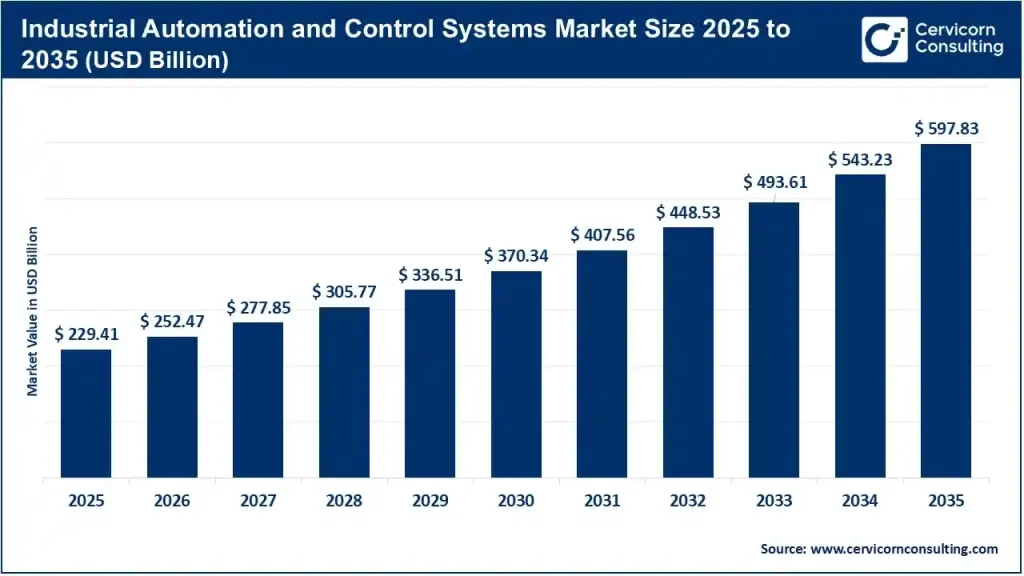
The global industrial automation and control systems market size was valued at USD 229.41 billion in 2025 and is projected to reach USD 597.83 billion by 2035, representing a 10.1% CAGR.
Industrial automation and control systems market growth factors
The principal growth factors include increasing pressure to improve production efficiency, labor shortages, demand for consistent product quality, expansion of smart manufacturing, growing use of industrial robotics, increasing adoption of AI-enabled predictive maintenance, energy-efficiency requirements, rising demand for real-time production visibility, modernization of aging industrial infrastructure, and the integration of cloud and edge computing with operational technology (OT). In addition, manufacturers are increasingly connecting machines, sensors, production software, and enterprise systems to create data-driven production environments. Government-supported Industry 4.0, intelligent manufacturing, digitalization, domestic manufacturing, and industrial AI programs across major economies are further encouraging investment in automation technologies.
What is the industrial automation and control systems market?
The industrial automation and control systems market encompasses hardware, software, and services used to monitor, control, optimize, and automate industrial processes. Core technologies include PLCs, DCS, SCADA systems, HMIs, industrial robots, control valves, sensors, actuators, motion-control systems, safety systems, industrial communication networks, manufacturing execution systems (MES), industrial software, and IIoT platforms.
These systems can automate individual machines, complete production lines, or entire industrial facilities. In a manufacturing plant, for example, sensors can collect information about temperature, pressure, vibration, speed, or product quality. A PLC or DCS can process this information and automatically adjust machinery or production parameters. SCADA systems provide supervisory monitoring, while HMI platforms allow operators to visualize production conditions and intervene when necessary.
The market serves industries including automotive, electronics and semiconductors, pharmaceuticals, food and beverage, chemicals, oil and gas, power generation, utilities, mining and metals, aerospace and defense, logistics, and water and wastewater treatment.
Why is industrial automation and control systems important?
Industrial automation has become important because modern production increasingly requires higher throughput, consistent quality, operational visibility, safety, and resource efficiency. Automated systems can perform repetitive or precision-sensitive operations continuously, while integrated control platforms can identify deviations and trigger corrective actions.
Automation also supports predictive maintenance. Instead of servicing equipment only according to fixed schedules, sensors and analytics can monitor equipment conditions and identify patterns associated with potential failures. This can help companies plan maintenance and reduce unplanned downtime.
Another important benefit is flexibility. Modern factories increasingly manufacture multiple product variants, which requires production systems that can be rapidly reconfigured. Digital twins, software-defined automation, robotics, machine vision, and centralized production-management platforms can support this flexibility.
Cybersecurity has also become an essential part of automation. As operational technology becomes connected to enterprise networks, cloud platforms, and external systems, industrial operators must address cyber risks alongside traditional reliability and safety requirements.
Major companies in the industrial automation and control systems market
The market is fragmented, with numerous global automation suppliers competing across factory automation, process control, robotics, software, instrumentation, electrification, and industrial services. One 2025 market analysis estimates that the top 10 companies collectively accounted for 31.09% of market revenue, with Siemens at 5.20%, Honeywell at 4.74%, ABB at 3.76%, Schneider Electric at 3.58%, and Rockwell Automation at 3.11%. These percentages are source-specific estimates rather than audited company-reported market shares.
Siemens AG
Specialization: Factory automation, industrial control, PLCs, motion control, industrial software, digital twins, industrial AI, and process automation.
Key Focus Areas: Siemens focuses heavily on the integration of physical production systems with digital technologies. Its Digital Industries portfolio covers automation hardware, industrial software, digital twins, industrial communication, and data-driven production.
Notable Features: Siemens’ SIMATIC automation ecosystem, Industrial Edge, digital-twin capabilities, and industrial AI initiatives position the company across multiple layers of the automation stack. Its Electronics Works Amberg provides an example of highly integrated automation, with approximately 17 million SIMATIC products manufactured annually and about 75% of the value chain handled independently by machines and robots.
2025 Revenue: Siemens reported €78.9 billion in fiscal 2025 group revenue. Its Digital Industries business generated €17.788 billion in revenue.
Market Share: Approximately 5.20% according to the cited 2025 industrial automation and control systems market-share analysis.
Global Presence: Siemens operates globally across Europe, the Americas, Asia-Pacific, the Middle East, and Africa, serving manufacturing, infrastructure, mobility, energy, and other industrial markets.
Rockwell Automation, Inc.
Specialization: Factory automation, PLCs, industrial control, industrial software, motion control, safety systems, information solutions, and lifecycle services.
Key Focus Areas: Rockwell focuses particularly on discrete and hybrid manufacturing, connected production environments, industrial software, industrial cybersecurity, and lifecycle optimization.
Notable Features: Its portfolio combines intelligent devices, software and control, and lifecycle services. This approach enables customers to integrate shop-floor automation with higher-level production and business systems.
2025 Revenue: Rockwell Automation reported USD 8.342 billion in fiscal 2025 sales. Its three principal operating segments generated approximately USD 3.756 billion from Intelligent Devices, USD 2.383 billion from Software & Control, and USD 2.203 billion from Lifecycle Services.
Market Share: Approximately 3.11% based on the cited 2025 market-share analysis.
Global Presence: Rockwell serves customers across North America, Europe, the Middle East and Africa, Asia-Pacific, and Latin America. Its fiscal 2025 reported sales included USD 5.27 billion in North America, USD 1.488 billion in Europe/Middle East/Africa, USD 1.024 billion in Asia-Pacific, and USD 560 million in Latin America.
ABB Ltd.
Specialization: Industrial automation, robotics, electrification, process automation, motion, measurement, marine automation, and industrial digitalization.
Key Focus Areas: ABB emphasizes automation combined with electrification and digital technologies, with applications spanning process industries, manufacturing, energy, marine operations, and infrastructure.
Notable Features: ABB’s portfolio includes industrial robots, automation systems, measurement technologies, drives, control platforms, and digital services. The company’s positioning around electrification and automation also makes energy efficiency an important part of its industrial proposition.
2025 Revenue: ABB reported USD 33.220 billion in 2025 revenue.
Market Share: Approximately 3.76% according to the cited market analysis.
Global Presence: ABB operates across more than 100 countries and has approximately 110,000 employees globally.
Schneider Electric SE
Specialization: Industrial automation, energy management, control systems, industrial software, process automation, motion control, and digital energy solutions.
Key Focus Areas: Schneider Electric combines automation with electrification and energy management. Its industrial portfolio targets manufacturing, infrastructure, data centers, process industries, and other energy-intensive operations.
Notable Features: Schneider’s EcoStruxure architecture integrates connected products, edge control, applications, analytics, and services. The company is increasingly focused on integrating industrial automation with energy efficiency and digital operations.
2025 Revenue: Schneider Electric generated approximately €40 billion in 2025 revenue, representing 9% organic growth. Industrial Automation increased 3% organically during the year.
Market Share: Approximately 3.58% according to the cited market analysis.
Global Presence: Schneider Electric has a broad global footprint spanning North America, Europe, Asia-Pacific, Latin America, the Middle East, and Africa.
Honeywell International Inc.
Specialization: Process automation, industrial control, sensing and safety, warehouse automation, industrial software, building automation, and industrial analytics.
Key Focus Areas: Honeywell serves refining and petrochemicals, life sciences, utilities, manufacturing, logistics, warehousing, and other industrial sectors.
Notable Features: Honeywell integrates automation and instrumentation with its Honeywell Forge industrial IoT platform. Its industrial automation portfolio includes control and instrumentation products, sensing technologies, safety systems, software, analytics, and automation equipment.
2025 Revenue: Honeywell reported USD 37.442 billion in total 2025 sales, including USD 9.401 billion from Industrial Automation.
Market Share: Approximately 4.74% according to the cited 2025 market-share analysis.
Global Presence: Honeywell serves industrial customers worldwide, with automation applications extending across process industries, manufacturing, logistics, infrastructure, and energy.
Leading trends and their impact
Industrial AI and machine learning
AI is moving automation from simple rule-based control toward systems capable of analyzing large volumes of operational data. Industrial AI can support predictive maintenance, process optimization, anomaly detection, quality inspection, production scheduling, and energy management.
Germany’s Platform Industrie 4.0 has also shifted its focus toward Industrial AI, with the German government stating in 2026 that it wants data-driven and AI-based applications to become standard in German industry by 2030.
Industrial IoT and connected factories
IIoT connects sensors, machines, controllers, production software, and enterprise platforms. This provides greater visibility into production performance and allows manufacturers to build centralized dashboards and analytics systems.
The result is a shift from isolated automation toward interconnected production ecosystems in which equipment data can support maintenance, quality management, supply-chain planning, and production optimization.
Edge computing and cloud integration
Edge computing allows industrial data to be processed closer to machines, reducing latency and supporting real-time decision-making. Cloud systems, meanwhile, enable broader analytics and centralized management.
A hybrid architecture combining edge computing with cloud platforms is increasingly relevant because industrial facilities require both real-time control and enterprise-level data analysis.
Robotics and human-machine collaboration
Industrial robots are expanding beyond traditional automotive applications into electronics, food processing, pharmaceuticals, logistics, warehousing, and other industries. Collaborative robots, machine vision, autonomous mobile robots, and AI-enabled robotic systems are widening the range of automation applications.
Cybersecurity and secure OT
The increasing connection between operational technology and IT creates new cybersecurity requirements. Industrial organizations are therefore investing in secure communication, access controls, network segmentation, monitoring, threat detection, and resilient automation architectures.
Digital twins
Digital twins allow manufacturers to create virtual representations of equipment, production lines, or entire facilities. These models can be used to simulate production changes before implementing them physically.
Siemens’ Amberg facility demonstrates this approach: digital-twin simulations have been used to evaluate production-line performance and optimize cycle times before physical implementation.
Energy-efficient automation
Industrial companies are increasingly connecting automation with energy-management systems. Automated monitoring can identify energy-intensive equipment, optimize operating parameters, and support integration of renewable energy and storage.
This trend is particularly significant in sectors such as chemicals, metals, automotive, semiconductor manufacturing, and data-intensive industrial operations.
Successful examples of industrial automation and control systems around the world
Siemens Electronics Works Amberg, Germany
Siemens’ Electronics Works Amberg is a frequently cited example of highly integrated industrial automation. The facility manufactures SIMATIC products and uses extensive automation, industrial communication, AI, edge computing, and digital technologies. Siemens reports that approximately 75% of the value chain is independently handled by machines and robots, while the facility produces around 17 million SIMATIC products annually.
Bosch Blaichach, Germany
Bosch’s Blaichach facility demonstrates the application of connected production and logistics systems in automotive manufacturing. Bosch’s Nexeed platform connects production and logistics data streams, supporting more efficient and resource-conscious manufacturing of automotive safety technologies such as ABS and ESP systems.
Smart manufacturing in China
China has developed a large ecosystem of smart factories and intelligent manufacturing projects. Its government has continued strengthening intelligent-manufacturing standards and deployment. In 2025, China’s Ministry of Industry and Information Technology issued a reference guide for typical intelligent-manufacturing scenarios to support smart-factory development, digital transformation, system-solution development, and standards implementation.
Industrial automation across North America
North American manufacturers are deploying automation across automotive, electronics, food and beverage, pharmaceuticals, logistics, and semiconductor production. The U.S. industrial automation and control systems market was estimated at USD 51.63 billion in 2025, according to Grand View Research, reflecting substantial adoption of automation, robotics, industrial software, and connected control systems.
Global regional analysis including government initiatives and policies
North America
North America is an important market for industrial automation because of its mature manufacturing base, high technology adoption, industrial robotics deployment, and investment in digital manufacturing. The U.S. market is supported by modernization of manufacturing infrastructure and increasing demand for automation in automotive, aerospace, semiconductor, logistics, pharmaceuticals, and food processing.
The region is also experiencing greater integration of AI, cloud computing, machine vision, and industrial cybersecurity. Automation helps manufacturers address labor constraints while improving production consistency and real-time monitoring.
Government initiatives supporting domestic semiconductor and advanced manufacturing capacity also indirectly strengthen demand for automation equipment, industrial control systems, robotics, and smart-factory technologies. The U.S. policy environment has increasingly emphasized domestic manufacturing resilience and technology investment.
Europe
Europe has a strong industrial automation ecosystem, supported by Germany, Italy, France, Switzerland, the Netherlands, and other advanced manufacturing economies. Germany remains particularly influential because of its long-running Industrie 4.0 framework.
Germany’s Platform Industrie 4.0 brings together government, companies, academia, associations, and labor organizations to support standards, cybersecurity, technology development, skills, legal frameworks, and digital business models.
The initiative has increasingly moved toward industrial data ecosystems and Industrial AI. In 2025, the German government highlighted initiatives including Manufacturing-X, Catena-X, Factory-X, and Aerospace-X as mechanisms for advancing interconnected industrial data ecosystems.
European industrial automation demand is also influenced by energy-efficiency objectives, sustainability regulations, reshoring, industrial competitiveness programs, and requirements for secure digital infrastructure.
Asia-Pacific
Asia-Pacific represents the largest regional market in several recent market studies, driven by China, Japan, South Korea, India, Southeast Asia, and other manufacturing economies. Grand View Research estimated that Asia-Pacific accounted for 38% of global industrial automation and control systems revenue in 2025.
China is a major contributor because of its extensive manufacturing base and government emphasis on intelligent manufacturing. In 2025, China’s Ministry of Industry and Information Technology and the National Standardization Administration issued the National Intelligent Manufacturing Standard System Development Guidelines (2024 Edition) to strengthen the standardization framework supporting intelligent manufacturing.
China has also moved toward closer integration of AI and manufacturing. The 2026 implementation guidance for the AI+Manufacturing Special Action set targets including industrial AI agents, high-quality industrial datasets, demonstration applications, and thousands of benchmark enterprises by 2027.
India
India is becoming an important automation market because of manufacturing expansion, electronics production, automotive manufacturing, pharmaceuticals, food processing, renewable energy, and infrastructure development.
Government programs supporting domestic manufacturing can create additional demand for automated production equipment. For example, India’s Production Linked Incentive program for Advanced Chemistry Cell battery manufacturing has a budgetary outlay of ₹18,100 crore and aims to develop large-scale domestic battery manufacturing capacity. The expansion of battery, electronics, automotive, and other manufacturing facilities creates opportunities for PLCs, robotics, sensors, machine vision, MES, process-control systems, and industrial software.
Latin America
Latin America’s automation demand is concentrated in sectors such as automotive, mining, food and beverage, oil and gas, chemicals, agriculture-related processing, and utilities. Mexico is particularly important because of its integration with North American manufacturing supply chains.
Automation adoption in the region is increasingly linked to productivity improvement, worker safety, export manufacturing, and modernization of industrial facilities. Brazil also represents a significant market because of its large industrial base spanning food processing, mining, energy, chemicals, and manufacturing.
Middle East and Africa
The Middle East is investing in automation as part of industrial diversification, energy modernization, smart infrastructure, and downstream manufacturing initiatives. Oil and gas remains an important application area for process automation, instrumentation, distributed control systems, and safety systems, while newer investments in chemicals, logistics, mining, renewable energy, and advanced manufacturing are creating additional opportunities.
Africa represents an emerging opportunity, particularly in mining, food processing, energy, water infrastructure, and manufacturing. Automation adoption is increasingly connected to the need for reliable production, remote monitoring, operational safety, and efficient resource utilization.
Market outlook
The industrial automation and control systems market is moving from traditional automation toward connected, software-intensive, AI-enabled industrial ecosystems. PLCs, DCS, SCADA, sensors, HMIs, robotics, and control valves remain fundamental, but their value is increasingly enhanced through IIoT connectivity, edge computing, cloud platforms, digital twins, industrial AI, machine vision, and cybersecurity.
To Get Detailed Overview, Contact Us: https://www.cervicornconsulting.com/contact-us
Read Report: Regulatory Affairs Outsourcing Market Revenue, Trends, and Strategic Insights by 2035