


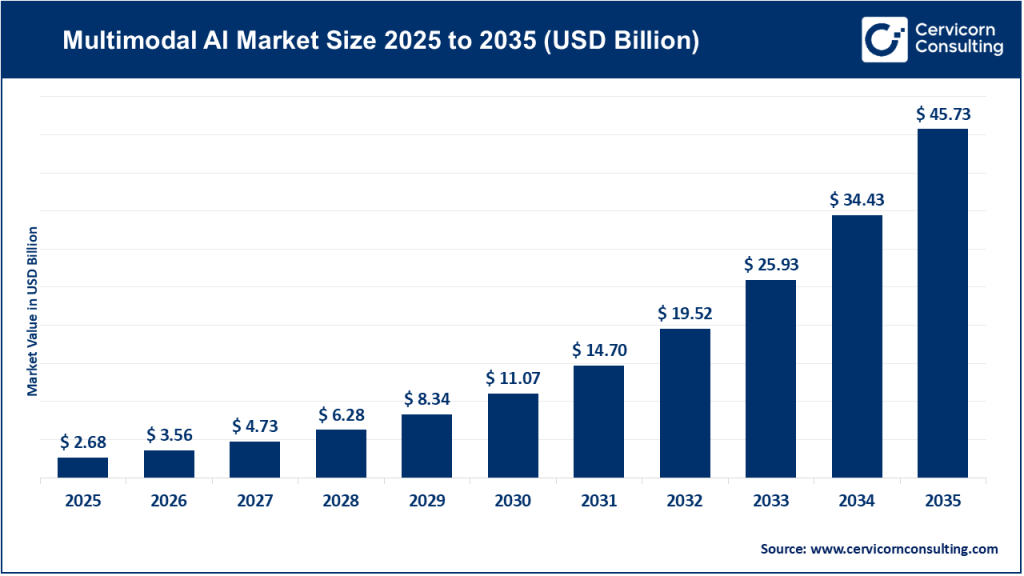
Multimodal AI Market Size
The global multimodal AI market reached an estimated valuation of USD 2.68 billion in 2025 and is projected to grow substantially, attaining approximately USD 45.73 billion by 2035. This growth reflects a strong compound annual growth rate (CAGR) of around 32.8% throughout the forecast period.
What Is the Multimodal AI Market?
The Multimodal AI market refers to the economic ecosystem comprising technologies, software platforms, and services that enable artificial intelligence systems to process, interpret, and generate insights across multiple data modalities simultaneously, such as text, image, audio, video, sensor data, and speech. Unlike traditional AI that focuses on a single modality, multimodal AI blends these formats to produce richer contextual understanding and more human-like intelligence, enabling applications from smart assistants and medical diagnostics to autonomous vehicles and creative generation. The market encompasses foundational models, multimodal APIs, integration services, deployment platforms, and vertical-specific solutions that harness deep learning and neural network architectures to interpret complex data inputs and deliver actionable outputs across industries and use cases, driving digital transformation at scale.
Market Growth Factors
The multimodal AI market is growing rapidly due to a convergence of several powerful large-scale drivers: rising digital transformation initiatives by enterprises and governments; the increasing need for AI systems that can understand diverse forms of data (text, images, video, audio) to mirror real-world complexity; scalable cloud-based deployments making adoption more cost-effective; surge in AI investments and AI-ready infrastructure including GPUs, 5G, and edge computing; demand for automated decision-making and customer experience enhancement across verticals like healthcare, e-commerce, finance, and manufacturing; and supportive policies that encourage AI research and development. Additionally, heightened demand for advanced analytics, personalized consumer experiences, and AI tools for complex problem-solving further propels growth.
Get a Free Sample: https://www.cervicornconsulting.com/sample/2913
Why Is Multimodal AI Important?
Multimodal AI represents a foundational shift in how machines understand and interact with the world—it mimics human cognitive abilities by processing and correlating information across different sensory data types simultaneously. This enables far more accurate interpretation of user intent and context, improves decision-making, and reduces ambiguity in automation workflows. In enterprise environments, multimodal AI boosts operational intelligence, accelerates analytics by combining structured and unstructured data, powers collaborative robots, and delivers enhanced personalization in services and products. In consumer applications, it enables more natural interactions through voice, vision, and text, better accessibility tools, and creative generative capabilities. Across industries—healthcare diagnoses, autonomous driving perception, financial anomaly detection, and immersive user experiences—multimodal AI dramatically expands AI’s utility, moving beyond siloed insights toward holistic, integrated intelligence.
Key Players in the Multimodal AI Market
OpenAI
Specialization & Focus Areas:
OpenAI is recognized for its multimodal AI advances that power models capable of processing text, vision, and other sensory inputs within a unified framework. Its flagship models integrate text and image understanding, enabling applications from conversational agents to creative AI tools and developer APIs.
Notable Features:
- Industry leadership in large language and multimodal models.
- Strong developer ecosystem via API integrations and ChatGPT platform.
- Wide footprint in consumer and enterprise applications.
2024/2025 Revenue & Market Share:
OpenAI’s revenue has surged into the billions of dollars, with an annualized run rate of around $10 billion in 2025, highlighting rapid adoption of its AI services.
Global Presence:
Headquartered in the United States, OpenAI’s tools are widely used globally across sectors, with millions of users and extensive enterprise partnerships.
Microsoft
Specialization & Focus Areas:
Microsoft integrates advanced AI models across its products, including Azure AI and Copilot suites, supporting multimodal workloads via its cloud infrastructure and expanding AI research initiatives.
Notable Features:
- Azure AI infrastructure, Copilot productivity tools, and multimodal APIs.
- Strategic partnerships with AI leaders.
- Integration into business software suites.
2024/2025 Revenue & Market Share:
Microsoft reported strong overall revenues ($281+ billion in FY2025) with AI driving cloud segment growth; its AI integrations significantly contribute to Azure’s expansion.
Global Presence:
Operating globally, Microsoft’s AI products have strong adoption in enterprise sectors, especially in North America and Europe.
Mistral AI
Specialization & Focus Areas:
Mistral AI is a French startup focusing on efficient, open-source AI models including multimodal support, offering models deployable on less demanding infrastructure. It emphasizes cost-efficient, transparent models suited for international markets and enterprise use.
Notable Features:
- Open-source models with multilingual capabilities.
- Tools integrating code generation, agent workflows, and multimodal embeddings.
- Emphasis on sovereignty and enterprise deployment flexibility.
2025 Revenue & Market Share:
Mistral AI’s revenue has grown rapidly, surpassing $400 million annualized run rate in 2026, with a target of $1 billion by year-end.
Global Presence:
While Europe remains its core base, Mistral serves clients across the U.S. and Asia and is expanding infrastructure beyond France.
Stability AI
Specialization & Focus Areas:
Stability AI is a pioneer in open-source generative models, especially for images and media generation, with emerging multimodal capabilities blending text, visuals, and audio.
Notable Features:
- Community-centric open-source modeling.
- Strong ecosystem for creative AI tools.
- Emphasis on democratized AI capabilities.
2024/2025 Revenue & Market Presence:
Exact revenue figures vary, but Stability AI’s models have seen extensive adoption.
Global Presence:
Its models are widely downloaded and foundational for many independent developers worldwide.
Baidu
Specialization & Focus Areas:
Baidu integrates multimodal capabilities into its AI Cloud services and conversational AI offerings like its Ernie chatbot, combining language with other data modalities.
Notable Features:
- Strong AI Cloud business and accelerator programs.
- Integration of multimodal intelligence into search and enterprise solutions.
Revenue & Market Presence:
Baidu’s AI business contributes significantly to its broader revenue, with AI Cloud revenues growing strongly year over year.
Global Presence:
Primarily strong in China, with increasing expansion in Asia and global partnerships.
Alibaba Group
Specialization & Focus Areas:
Alibaba has invested heavily in AI, particularly within Alibaba Cloud and retail-oriented AI models. Its multimodal AI research includes generative frameworks supporting diverse e-commerce and enterprise applications.
Notable Features:
- AI integration with cloud, logistics, and online platforms.
- Models enabling video, audio, and text generation.
- Significant investment in AI infrastructure.
Revenue & Market Presence:
AI is part of Alibaba’s broader platform strategy, with multi-billion-dollar investments to strengthen AI capabilities and adoption.
Global Presence:
Strong presence in China and expanding international cloud services.
Leading Trends and Their Impact
Generative Multimodal Foundation Models:
Advanced models that handle text, image, audio, and sometimes video enable richer content creation, improved user engagement, and deeper human-AI interaction.
Cloud-First Multimodal AI Deployments:
Enterprises increasingly adopt cloud-based AI infrastructure for scalability, eliminating costly on-prem solutions and enabling rapid model deployment across industries.
AI Democratization and Open Models:
Open-source multimodal models lower barriers to entry and foster innovation, while raising concerns about responsible use and safety.
Enterprise Integration and Automation:
From customer support to R&D analytics, multimodal AI embedded into workflows improves efficiency, lowers operational costs, and unlocks new business models.
Edge and 5G Enhancements:
Integration with edge computing and 5G enhances real-time processing of multimodal data in IoT and autonomous systems, reducing latency and bandwidth constraints.
These trends create a more diverse, agile, and sector-ready multimodal AI market, with applications from creative industries to regulated sectors like healthcare and finance.
Successful Examples of Multimodal AI Worldwide
Healthcare Diagnostics: Multimodal AI systems analyze scans, lab data, and patient notes to assist clinicians with superior prediction and decision-making.
Autonomous Vehicles: Vehicles integrate camera visuals, radar/lidar sensor input, and contextual maps for better perception and safety.
Smart Assistants: AI systems process voice input, context from sensors, and visual cues to deliver context-aware responses.
Retail Personalization: E-commerce platforms use text, image, and behavioral data to recommend products and tailor user experiences.
Content Creation and Media: Tools blend text prompts with image and audio generation to automate creative workflows.
Global Regional Analysis & Government Initiatives
North America
Market Position:
North America holds a leading share of the multimodal AI market due to strong enterprise adoption, investment in cloud infrastructure, and concentration of AI leaders.
Government Initiatives:
Funding for AI research, public-private partnerships, and regulatory frameworks promote AI innovation and commercialization.
Impact:
Supportive R&D programs and private-sector funding accelerate advances in healthcare, defense, and enterprise AI applications.
Europe
Market Position:
Europe maintains a strong footprint with supportive ethical AI and data protection regulations.
Government Initiatives:
The EU’s AI Act and Digital Europe Programme fund AI research and deployment, promoting trusted and transparent AI development practices.
Impact:
Regulation drives demand for compliant, explainable AI solutions, balancing innovation with accountability.
Asia-Pacific
Market Position:
Asia-Pacific is a rapidly growing region with dynamic adoption of multimodal AI across manufacturing, retail, and public sectors.
Government Initiatives:
Countries including China, India, Japan, and South Korea have active AI strategies focusing on digital transformation, R&D funding, and public sector integration.
Impact:
Strong national programs and industry uptake position the region as a major growth hub, often outpacing Western markets in adoption rates.
Latin America
Market Position:
Emerging use in media, entertainment, and localized language services.
Government Initiatives:
Investment in digital infrastructure and local AI startups expands application of multimodal AI, with language diversity boosting demand for context-aware AI systems.
Middle East & Africa
Market Position:
Emerging market driven by investments in smart city initiatives, digital transformation, and healthcare AI.
Government Initiatives:
Countries like the UAE and Saudi Arabia have AI strategies that include multimodal AI for urban mobility and citizen services.
Impact:
Governments support AI adoption through funding and partnerships, promoting economic diversification.
To Get Detailed Overview, Contact Us: https://www.cervicornconsulting.com/contact-us
Read Report: Metal Recycling Market Revenue, Trends, and Strategic Insights by 2035