


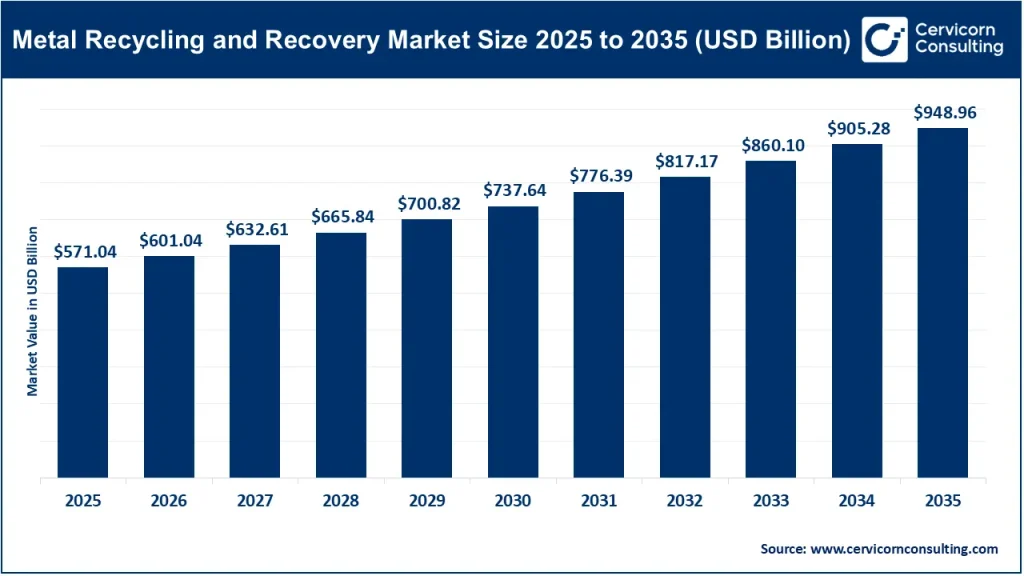
Metal Recycling and Recovery Market Size
The global metal recycling and recovery market was valued at approximately USD 571.04 billion in 2025 and is projected to reach around USD 948.96 billion by 2035, expanding at a CAGR of approximately 5.21% during the forecast period.
Metal Recycling and Recovery Market Growth Factors
The global metal recycling and recovery market is being driven by rising demand for secondary metals, growing environmental concerns associated with mining and primary metal production, stricter waste-management regulations, expansion of automotive and construction industries, increasing electronic waste generation, and the transition toward circular-economy business models.
The market is also benefiting from increased demand for recycled steel, aluminum, copper and other non-ferrous metals as manufacturers seek to reduce dependence on virgin raw materials. Growth in electric vehicles, renewable-energy infrastructure, batteries, consumer electronics and urban construction is generating larger volumes of recoverable metal. At the same time, governments worldwide are introducing vehicle-scrappage programs, extended producer responsibility requirements, recycled-content targets, landfill restrictions and circular-economy policies that encourage businesses to recover valuable materials rather than dispose of them.
Get a Free Sample: https://www.cervicornconsulting.com/sample/2739
What Is the Metal Recycling and Recovery Market?
The metal recycling and recovery market encompasses the collection, sorting, processing, refining and reuse of ferrous and non-ferrous metals recovered from industrial scrap, end-of-life vehicles, construction and demolition waste, discarded machinery, consumer products, packaging, electrical equipment, batteries and electronic waste.
Unlike primary metal production, which depends on mining and processing ores, recycling extracts value from materials that have already entered the economic system. The process may involve collection and dismantling, shredding, magnetic separation, eddy-current separation, sensor-based sorting, baling, melting, refining, hydrometallurgical recovery, pyrometallurgical processing or electrochemical techniques.
The market covers ferrous metals, including iron and steel, as well as non-ferrous metals, including aluminum, copper, zinc, nickel and lead. Increasingly, recovery operations are also targeting valuable metals from batteries and electronic waste, including cobalt, lithium, nickel and other critical materials.
The market is therefore evolving from conventional scrap processing toward sophisticated resource recovery and urban mining. Advanced sorting technologies, artificial intelligence, robotics and chemical recovery processes are enabling recyclers to recover higher-purity materials from increasingly complex waste streams.
Why Is Metal Recycling and Recovery Important?
Metal recycling is important because metals can generally be recycled repeatedly without losing their fundamental material properties. Recovering metals from existing products reduces the requirement for additional mining, lowers pressure on natural resources and provides manufacturers with alternative sources of raw materials.
The economic value is equally significant. Recycled metals can create revenue streams for waste-management companies, manufacturers, scrap dealers and specialized recovery facilities. The availability of secondary metals can also improve supply-chain resilience, particularly for materials exposed to geopolitical risks or concentrated mining supply.
Metal recycling additionally supports decarbonization. Steel producers using electric arc furnaces can use substantial quantities of scrap as feedstock, while aluminum recycling avoids many of the energy-intensive stages associated with primary production. This makes recycled metal increasingly attractive to manufacturers facing carbon-reduction targets.
The automotive industry is another major source of recoverable material. End-of-life vehicles contain large quantities of steel, aluminum, copper and other valuable components. India’s Vehicle Scrapping Policy, for example, explicitly aims to formalize vehicle scrapping and increase the availability of lower-cost raw materials for automotive, steel and electronics industries.
Key Companies and Their Role in the Market
A clarification is important when evaluating the companies requested for this market. Amcor, Sealed Air, Tetra Pak, Huhtamaki and Mondi are primarily packaging companies rather than dedicated metal recyclers such as Sims, EMR, Aurubis, Novelis or Radius Recycling. Their relevance to metal recycling and recovery comes mainly from packaging design, material recovery, recycling infrastructure, circularity initiatives and the reduction or replacement of difficult-to-recycle packaging materials. Consequently, a specific metal recycling and recovery market share is not publicly disclosed for these companies, and assigning an artificial percentage would be misleading.
| Company | Specialization | Key Focus Areas | Notable Features | 2025 Revenue | Metal Recycling & Recovery Market Share | Global Presence |
|---|---|---|---|---|---|---|
| Amcor plc | Flexible and rigid packaging | Recyclability, circular packaging, recycled content, lightweighting | Recycle-ready packaging and circularity R&D | USD 15.01B FY2025; approximately USD 23B annualized pro forma sales after Berry combination | Not separately disclosed | 400+ locations in 40+ countries |
| Sealed Air | Food and protective packaging | Material efficiency, packaging optimization, circularity | Food packaging and protective packaging systems | USD 5.36B | Not separately disclosed | Global operations |
| Tetra Pak | Food and beverage processing and carton packaging | Packaging recycling, circularity, collection systems | Global recycling partnerships and carton recovery initiatives | EUR 12.35B | Not separately disclosed | 160+ sales countries |
| Huhtamaki Oyj | Foodservice and consumer packaging | Fiber-based packaging, resource efficiency, recyclability | Flexible, fiber and foodservice packaging | EUR 3.96B | Not separately disclosed | Global manufacturing and sales network |
| Mondi | Sustainable packaging and paper | Recyclable packaging, waste reduction, circular materials | 88% of Group revenue from reusable, recyclable or compostable products in 2025 | EUR 7.66B | Not separately disclosed | Global operations |
Amcor plc
Amcor plc is a major global packaging company with operations spanning flexible packaging, rigid packaging, cartons and closures. Its relevance to the circular economy comes from designing packaging for recycling, increasing recycled content and investing in infrastructure and partnerships supporting circularity.
Amcor reported USD 15.009 billion in fiscal 2025 net sales, although this figure excludes most of the legacy Berry Global business for the period before the April 2025 merger. On a pro-forma basis after the combination, Amcor describes the enlarged company as generating approximately USD 23 billion in annualized sales across more than 400 locations in over 40 countries.
In FY2025, Amcor reported that 72% of packaging production by weight was designed for recyclability, while 75% of operational waste was recycled.
Sealed Air
Sealed Air specializes in food and protective packaging solutions. Its sustainability strategy focuses on reducing packaging material requirements, improving packaging efficiency and increasing circularity.
Sealed Air generated USD 5.36 billion in net sales in 2025, with Food and Protective representing its primary business segments.
Its influence on metal recycling and recovery is indirect but relevant because packaging design affects material consumption, waste generation and the feasibility of downstream recycling.
Tetra Pak
Tetra Pak operates across food processing, packaging and filling systems. While its principal packaging products are fiber-based multilayer cartons rather than metal products, the company’s recycling initiatives are relevant to broader material-recovery systems.
Tetra Pak reported EUR 12.35 billion in 2025 net sales, sold approximately 174 billion packages, and operated across more than 160 sales countries, with 52 production plants, 90 sales offices and 26 market companies.
The company has also worked on collection and recycling initiatives, including projects designed to integrate informal waste pickers into more organized recycling systems.
Huhtamaki Oyj
Huhtamaki Oyj specializes in foodservice and consumer packaging, including fiber, flexible and molded-fiber solutions.
Huhtamaki generated EUR 3.96 billion in net sales in 2025, while adjusted EBIT reached EUR 405.1 million. Its circularity strategy focuses on resource efficiency, recyclable packaging and the development of alternative materials.
Although it is not a metal-recycling operator, its packaging innovations can affect the volume, composition and recoverability of post-consumer material entering waste-management systems.
Mondi
Mondi is a global packaging and paper producer with a strong emphasis on sustainable packaging.
Mondi reported EUR 7.663 billion in Group revenue in 2025, while underlying EBITDA was EUR 1.001 billion. Importantly, 88% of Mondi’s Group revenue in 2025 came from reusable, recyclable or compostable products, compared with 74% in its 2020 baseline.
This demonstrates how packaging companies are increasingly connecting product design with end-of-life recovery and circular material systems.
Leading Trends and Their Impact
1. AI-Powered Sorting and Automation
Advanced sorting is transforming metal recycling facilities. Magnetic separators, eddy-current systems, optical sensors, X-ray technologies and AI-powered recognition systems can identify different materials more efficiently.
The impact is higher recovery rates, improved material purity and lower dependence on manual sorting. Automation also enables recyclers to handle increasingly complex waste streams from vehicles, appliances and electronics.
2. Growth of Urban Mining
Urban mining is becoming an important source of secondary metals. Rather than relying solely on traditional scrap, recyclers are recovering metals from buildings, automobiles, consumer electronics, industrial equipment and batteries.
This trend is particularly important for copper, nickel, cobalt and other materials required for electrification.
3. Electric Vehicles and Battery Recycling
EV adoption is creating a new recovery opportunity. Batteries contain valuable materials that can potentially be recovered and returned to manufacturing supply chains.
The growth of battery recycling is encouraging investment in mechanical separation, hydrometallurgical processing and direct-recycling technologies. The sector is also moving toward closed-loop systems in which recovered battery materials are used to manufacture new batteries.
4. Scrap-Based Steelmaking
Electric arc furnaces are increasing the importance of steel scrap. Greater use of recycled steel can reduce dependence on iron ore and support lower-carbon steel production.
As governments and manufacturers pursue industrial decarbonization, demand for high-quality ferrous scrap is expected to remain an important market driver.
5. Recycled Content Requirements
Governments are increasingly introducing recycled-content requirements and circular-design standards. These policies create predictable demand for secondary metals.
The European Commission’s 2025 Steel and Metals Action Plan specifically identifies increasing secondary-metal production and developing recycled-content requirements as part of the EU’s circularity strategy.
6. Digital Traceability
Digital platforms are increasingly being used to track scrap collection, processing and recycled-material content. Traceability can help manufacturers verify recycled-content claims and meet environmental reporting requirements.
7. Recovery of Critical Metals
Critical minerals are becoming strategically important because they are required for batteries, renewable energy systems, electronics and advanced manufacturing. Recycling offers governments and companies an additional source of these materials without relying entirely on primary mining.
Successful Examples of Metal Recycling and Recovery Around the World
Japan’s Automotive Recycling System
Japan provides an important example of integrating vehicle end-of-life management with material recovery. Its automotive recycling framework has encouraged systematic dismantling and recovery of materials from vehicles.
Japan has also examined the potential to use waste steel scrap for automotive steel production, linking vehicle recycling with domestic steel manufacturing.
Europe’s Circular Metals Strategy
Europe is increasingly treating scrap metal as a strategic industrial resource. The European Commission’s European Steel and Metals Action Plan, published in 2025, seeks to strengthen secondary-metal production, improve scrap availability and reduce dependence on primary imports.
The EU has also activated customs surveillance for exports of steel, aluminum and copper scrap and is considering additional measures to strengthen domestic recycling capacity.
India’s Vehicle Scrappage Ecosystem
India’s Vehicle Scrapping Policy provides a strong example of policy-driven metal recovery. The framework establishes Registered Vehicle Scrapping Facilities and integrates vehicle dismantling into a more formalized recycling ecosystem.
By January 30, 2026, India had 129 operational Registered Vehicle Scrapping Facilities across 21 States and Union Territories, with 430,306 vehicles scrapped through these facilities.
The program is particularly important for steel and non-ferrous metal recovery because end-of-life vehicles contain large volumes of recoverable materials.
Closed-Loop Aluminum Recycling
Aluminum producers and beverage-can manufacturers have developed increasingly sophisticated collection and remelting systems. Aluminum’s high material value makes it commercially attractive to recover from packaging and industrial scrap.
Closed-loop systems allow recovered aluminum to return to similar applications, shortening material cycles and reducing dependence on primary aluminum.
Global Regional Analysis Including Government Initiatives and Policies
North America
North America is one of the most developed metal-recycling markets because of its established scrap collection networks, automotive sector, construction industry and large-scale steelmaking capacity.
The region benefits from significant demand for recycled steel and aluminum. Electric arc furnace steelmaking has also increased the strategic importance of scrap as an industrial input.
In the United States, policy increasingly links recycling with critical-mineral supply security, industrial decarbonization and domestic manufacturing. Federal support for battery and critical-mineral supply chains is encouraging companies to develop domestic recovery capacity.
Canada is similarly emphasizing circular economy principles, critical minerals and resource recovery. These developments are expected to encourage investment in metal separation, battery recycling and advanced processing.
Europe
Europe is a major center for circular-economy policy. The region’s metal recycling industry benefits from strict environmental regulations, mature collection infrastructure and strong demand for low-carbon materials.
The European Commission’s 2025 Steel and Metals Action Plan focuses on competitiveness, decarbonization and circularity. It specifically proposes measures to increase the availability and use of secondary metals while improving domestic demand for scrap.
The EU is also working toward a Circular Economy Act, with the Commission indicating that work on recycled-content requirements and related circularity measures is underway.
The European regulatory environment is therefore shifting metals from being viewed merely as waste toward being treated as strategic secondary raw materials.
Asia-Pacific
Asia-Pacific represents one of the largest and fastest-growing opportunities because of its huge manufacturing base, infrastructure development, automotive production and electronics industry.
China, Japan, India and South Korea are major contributors to regional metal demand and scrap generation. The region is also becoming increasingly important for battery and critical-metal recovery as EV production expands.
China’s enormous steel and manufacturing industries create substantial demand for scrap. Japan combines mature automotive recycling systems with advanced manufacturing capabilities, while India is rapidly formalizing its vehicle-scrapping and recycling infrastructure.
India is particularly promising because its expanding automotive fleet, construction activity, electronics consumption and infrastructure investment are generating larger quantities of recyclable metal.
Latin America
Latin America is benefiting from increasing industrialization, infrastructure development and urbanization. Brazil, Mexico, Argentina and other markets have significant automotive, construction and manufacturing industries capable of generating recoverable metal scrap.
The region’s opportunity lies in improving formal collection systems and recycling infrastructure. Informal collection remains an important component of scrap recovery in several countries, creating an opportunity to improve worker safety, traceability and recovery efficiency by integrating informal operators into formal systems.
Middle East & Africa
The Middle East and Africa represent emerging opportunities for metal recycling and recovery because of infrastructure development, urbanization, industrial expansion and growing waste volumes.
Gulf countries are increasingly investing in circular-economy initiatives as part of broader economic diversification strategies. Construction and demolition waste is particularly significant because it contains recoverable steel, aluminum and copper.
Africa also has substantial potential in e-waste recovery. However, inadequate collection infrastructure, informal processing and limited recycling capacity remain barriers. Developing formal recycling facilities and regional collection networks could unlock significant quantities of recoverable metals.
Government Initiatives and Policies Shaping the Market
Government policy is becoming one of the most important factors influencing the metal recycling and recovery market.
European Union: The 2025 European Steel and Metals Action Plan seeks to increase secondary-metal production, improve scrap availability and support recycled-content requirements. The EU is also developing broader circular-economy measures.
India: The Vehicle Scrapping Policy establishes Registered Vehicle Scrapping Facilities and provides financial incentives, including motor-vehicle tax concessions of up to 25% for non-transport vehicles and 15% for transport vehicles purchased against a Certificate of Deposit. India has also introduced End-of-Life Vehicles Management Rules, 2024, establishing an extended producer responsibility framework for vehicle producers and importers.
United States: Federal industrial and climate policies are increasingly supporting domestic recycling, critical-mineral recovery and low-carbon manufacturing. The country’s large scrap-processing and electric-arc-furnace ecosystem provides a strong foundation for metal recovery.
Japan: Japan’s vehicle recycling framework provides a mature model for systematic end-of-life vehicle collection, dismantling and material recovery, while its manufacturing sector creates demand for high-quality recycled metals.
China: China’s large manufacturing base and growing circular-economy policies are increasing attention on scrap utilization, resource efficiency and recovery of materials from industrial and consumer waste.
Across markets, the direction of policy is increasingly similar: improve collection, formalize recycling, increase recycled-content utilization, reduce landfill disposal, strengthen traceability and make secondary materials more competitive with virgin resources.
To Get Detailed Overview, Contact Us: https://www.cervicornconsulting.com/contact-us
Read Report: Power Electronics Market Revenue, Trends, and Strategic Insights by 2035