


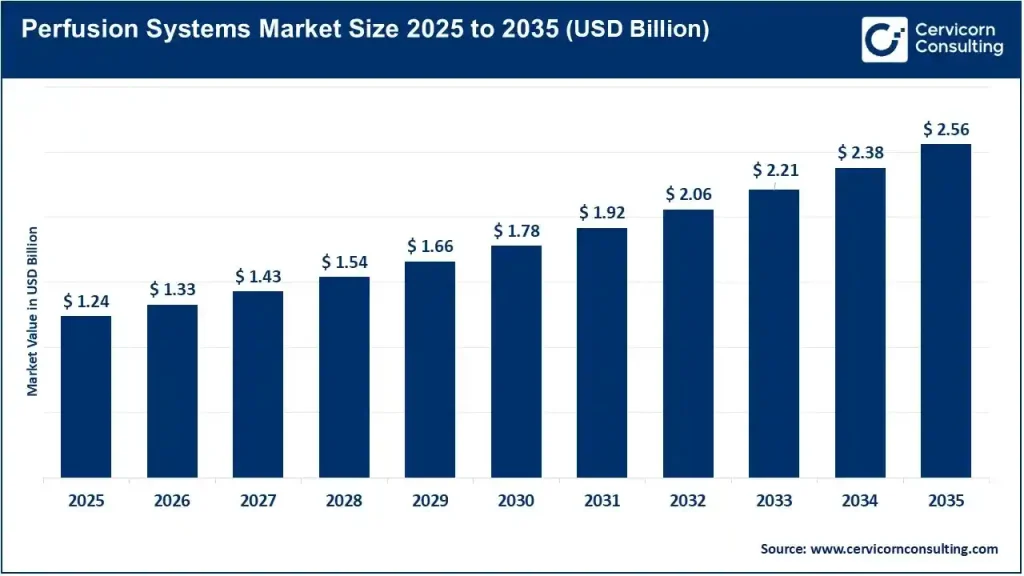
Perfusion Systems Market Size
The global perfusion systems market size was valued at USD 1.24 billion in 2025 and is projected to reach USD 2.56 billion by 2035, representing a 7.5% CAGR.
Perfusion systems market growth factors
The global perfusion systems market is being driven by rising cardiovascular disease burden, increasing volumes of cardiac and cardiopulmonary bypass procedures, expansion of organ transplantation programs, growing demand for extracorporeal support, technological advances in heart-lung machines and oxygenators, and increasing adoption of data-enabled perfusion monitoring.
Perfusion systems are increasingly being used across cardiovascular surgery, organ transplantation, respiratory care, oncology and other extracorporeal applications, while hospitals are seeking systems that improve flow control, oxygenation, monitoring, workflow efficiency and patient safety. Demand is also supported by advances in organ-preservation technologies, particularly as transplantation networks seek to improve the utilization and viability of donated organs.
Meanwhile, manufacturers are integrating sensors, software, connectivity, automated controls and real-time blood monitoring into traditional perfusion platforms, creating opportunities for higher-value systems and recurring disposable-component revenues. Regulatory requirements for safety, clinical evidence, traceability and performance are also shaping product development, encouraging companies to invest in reliable, digitally connected and clinically validated technologies.
Get a Free Sample: https://www.cervicornconsulting.com/sample/3038
What is the perfusion systems market?
The perfusion systems market comprises medical devices and associated components used to maintain, control or support blood circulation and oxygenation outside the human body during medical procedures. A perfusion system can temporarily perform functions normally carried out by the heart and lungs, allowing surgeons to operate on a motionless or bloodless heart during cardiopulmonary bypass.
The market includes heart-lung machines, extracorporeal membrane oxygenation systems, organ-preservation perfusion systems, isolated limb perfusion systems, pumps, oxygenators, cannulas, monitoring systems, tubing sets and related components. Applications span cardiovascular surgery, organ transplantation, respiratory care, oncology and other specialized procedures.
Modern systems are moving beyond basic mechanical circulation. Advanced platforms increasingly combine pumps, oxygenation, blood-gas monitoring, pressure and temperature measurements, automated safety mechanisms, data management and connectivity. This transition is changing perfusion from a largely equipment-centered function into a more integrated and information-driven component of surgical care.
Why is the perfusion systems market important?
Perfusion technology is important because it supports procedures in which maintaining adequate circulation and oxygen delivery is essential. During open-heart surgery requiring cardiopulmonary bypass, the heart-lung machine can temporarily provide blood circulation and oxygenation while the surgical team performs the procedure.
Perfusion systems are also increasingly relevant to organ transplantation. Traditional static cold storage can limit the time available for organ transportation and assessment, whereas machine-perfusion approaches can provide controlled circulation through an organ under preservation conditions. This creates opportunities to evaluate and potentially improve organ utilization.
The market is also important because technological improvements can support more precise monitoring. LivaNova, for example, describes its Essenz platform as combining a heart-lung machine, patient monitoring and sensing technology to support data-driven decision-making.
As hospitals manage more complex cardiac and transplant procedures, demand is shifting toward systems that can combine clinical functionality with safety, usability, connectivity and data management.
Major companies in the perfusion systems market
The competitive landscape includes diversified medical-device companies as well as specialized cardiopulmonary technology manufacturers. The following companies are important participants across different portions of the perfusion ecosystem.
Medtronic plc
Company: Medtronic plc
Specialization: Cardiovascular, surgical, neuroscience, diabetes and other medical technologies.
Key Focus Areas: Cardiopulmonary bypass, oxygenation, blood pumps, cannulas, filters, tubing and perfusion-related consumables.
Notable Features: Medtronic offers a broad cardiopulmonary portfolio covering adult and pediatric oxygenators, cardiotomy reservoirs, centrifugal blood pumps, flow probes, cannulae, hemoconcentrators and heart-lung machines. Its Affinity Fusion oxygenation system, for example, incorporates an integrated arterial filter and is designed around input from more than 500 perfusionists worldwide.nFDA records also list Medtronic Perfusion Systems as a manufacturer of cardiopulmonary-bypass oxygenators.
2025 Revenue: USD 33.54 billion for the fiscal year ended April 30, 2025.
Market Share: The company is a significant global participant, although a company-specific 2025 perfusion-system market share is not publicly disclosed in the cited sources.
Global Presence: Extensive international presence across major healthcare markets.
LivaNova PLC
Company: LivaNova PLC
Specialization: Cardiopulmonary and neuromodulation technologies.
Key Focus Areas: Heart-lung machines, perfusion systems, oxygenators, autotransfusion, blood monitoring and cardiopulmonary bypass technologies.
Notable Features: LivaNova’s Essenz Perfusion System combines a heart-lung machine, patient monitor and sensing technology. The system is designed to integrate with operating-room devices and hospital information systems, while its monitoring capabilities support data-driven perfusion management. LivaNova reports that its S5 heart-lung machine has supported more than 5.5 million patients, while its cardiopulmonary business services more than 100 countries.
2025 Revenue: USD 1.388 billion.
Market Share: A company-specific 2025 global perfusion-system share is not publicly disclosed in the cited financial sources.
Global Presence: More than 100 countries are serviced through its cardiopulmonary business.
Terumo Corporation
Company: Terumo Corporation
Specialization: Cardiovascular, blood and cell technologies, medical care solutions and other healthcare technologies.
Key Focus Areas: Cardiovascular intervention, cardiac surgery, blood management, extracorporeal technologies and blood-processing solutions.
Notable Features: Terumo’s cardiac and vascular business is a major contributor to its overall operations. During the fiscal year ended March 2025, the company’s Cardiac and Vascular Company generated JPY 624.36 billion in revenue, up 12.4% year over year.
2025 Revenue: Terumo reported approximately JPY 1.036 trillion in sales revenue for fiscal 2024, with its fiscal 2025 guidance targeting JPY 1.05 trillion.
Market Share: A specific global perfusion-system market share is not separately disclosed.
Global Presence: Terumo operates internationally, with its cardiovascular business generating substantial overseas revenue.
Nipro Corporation
Company: Nipro Corporation
Specialization: Medical devices, pharmaceuticals and pharmaceutical packaging.
Key Focus Areas: Dialysis technologies, blood-management products, medical devices and related healthcare solutions.
Notable Features: Nipro has a strong position in extracorporeal medical technologies, particularly through its dialysis-related product portfolio. Its global medical-device activities provide an established platform for technologies involving blood circulation and fluid management.
2025 Revenue: JPY 644.586 billion in net sales for the fiscal year ended March 2025.
Market Share: A separately reported global perfusion-system market share is not disclosed in the cited financial material.
Global Presence: Nipro has substantial international operations and reported strong overseas sales across its medical-related business in fiscal 2025.
Fresenius Medical Care AG & Co. KGaA
Company: Fresenius Medical Care AG & Co. KGaA
Specialization: Kidney care, dialysis products and services.
Key Focus Areas: Extracorporeal blood treatment, dialysis machines, dialyzers, bloodlines, vascular access and integrated kidney-care services.
Notable Features: Fresenius Medical Care has extensive expertise in extracorporeal blood circulation and operates a large global healthcare network. Its 2025 annual report states that the company serves approximately 4.5 million people worldwide dependent on dialysis treatment.
2025 Revenue: €19.63 billion.
Market Share: A specific 2025 share of the broader perfusion-system market is not separately reported.
Global Presence: International operations across kidney-care markets, with both products and care-delivery activities.
Note: The revenue figures above are total company/group revenues, not perfusion-system revenues. Direct company-level perfusion-system market shares are generally not disclosed in public financial statements, so they should not be interpreted as market-share percentages.
Leading trends and their impact
Digitalization and intelligent perfusion
One of the strongest trends is the integration of digital technology into perfusion platforms. New-generation systems increasingly provide centralized displays, automated alerts, electronic data capture, monitoring and connectivity with hospital information systems.
LivaNova’s Essenz platform illustrates this transition by connecting the heart-lung machine with monitoring and sensing capabilities and supporting integration with operating-room and hospital information systems.
Impact: Digitalization can improve data availability, support clinical documentation and reduce manual information transfer. It also increases demand for cybersecurity, software maintenance and interoperability.
Advanced oxygenators and blood-management technologies
Oxygenators are a core component of cardiopulmonary bypass systems. Manufacturers are developing technologies intended to improve oxygenation efficiency, reduce circuit complexity and support safer extracorporeal circulation.
Medtronic’s cardiopulmonary portfolio includes oxygenators, blood pumps, filters, hemoconcentrators and cannulae, demonstrating the increasing importance of integrated perfusion ecosystems rather than standalone machines.
Impact: Greater integration can create opportunities for manufacturers to sell complete systems and recurring disposable components.
Expansion of organ-preservation perfusion
Organ transplantation is becoming an increasingly important application area for perfusion technology. Machine perfusion can provide controlled circulation during organ preservation and may help transplant centers manage organs across longer logistical distances.
Impact: Growth in transplantation infrastructure can create new demand for perfusion devices, pumps, monitoring systems and specialized preservation consumables.
Patient-specific perfusion
Perfusion is moving toward more individualized management, with monitoring technologies providing information about blood gases, oxygen saturation, temperature and other physiological parameters.
LivaNova’s Essenz system, for instance, includes in-line monitoring of arterial oxygen partial pressure, venous oxygen saturation, hemoglobin/hematocrit and temperature.
Impact: Patient-specific perfusion can increase demand for advanced sensors and software while placing greater emphasis on clinical data quality and interoperability.
Minimally invasive and procedure-efficient technologies
Hospitals are seeking technologies that reduce complexity, improve operating-room efficiency and support standardized workflows. Perfusion systems are therefore increasingly being designed around modularity, compact configurations and easier integration with existing surgical infrastructure.
Impact: Manufacturers that combine performance with simplified workflow and service support can address hospitals’ efforts to improve operating-room utilization.
Successful examples of perfusion systems around the world
LivaNova’s Essenz expansion in China
A notable example of international perfusion-system expansion is LivaNova’s launch of the Essenz Perfusion System in China in 2025. The company announced that Essenz had received approval from China’s National Medical Products Administration and that China represented its second-largest heart-lung-machine market after the United States. LivaNova also reported that Ess
enz had surpassed 100,000 patients supported worldwide since its 2023 launch.
The example demonstrates how regulatory approval, hospital infrastructure and local cardiac-surgery demand can accelerate adoption of next-generation perfusion technology.
LivaNova’s established S5 platform
LivaNova’s S5 heart-lung machine represents another example of long-term global adoption. The company reports more than 5.5 million patients treated using the S5 platform.
This illustrates how reliability, installed-base support, service infrastructure and familiarity among perfusionists can remain important competitive factors even as newer digital systems enter the market.
India’s expanding transplant infrastructure
India provides an example of how national transplant infrastructure can support demand for advanced organ-preservation technologies. The country’s National Organ and Tissue Transplant Organisation (NOTTO) operates under the Directorate General of Health Services and coordinates the National Organ Transplant Program. Its network includes regional and state organizations and hundreds of hospitals and institutions involved in transplantation and organ retrieval.
As transplantation capacity expands, technologies for organ procurement, preservation, transport and assessment can become increasingly relevant to hospitals and transplant centers.
Global regional analysis
North America
North America remains a major market for perfusion technologies because of its established cardiovascular-care infrastructure, advanced surgical centers, high adoption of medical technology and substantial transplant capabilities. The United States also has a mature regulatory framework for cardiopulmonary devices.
The FDA classifies cardiopulmonary-bypass oxygenators under cardiovascular medical-device regulations, while recognized consensus standards cover nonroller blood pumps used for applications including cardiopulmonary bypass and extracorporeal membrane oxygenation.
Market impact: Strong clinical infrastructure and regulatory requirements encourage manufacturers to emphasize safety, clinical evidence, performance validation and post-market monitoring.
Europe
Europe represents another important market supported by established cardiac-surgery infrastructure, transplantation networks and strong medical-device regulation. The EU Medical Device Regulation, or MDR 2017/745, emphasizes safety, performance, clinical evidence and transparency, with additional scrutiny for higher-risk devices.
The European Commission proposed a targeted revision of medical-device rules in December 2025 aimed at simplifying processes, supporting digitalization and improving the regulatory framework while maintaining patient-safety objectives. The proposal still requires adoption through the EU legislative process before becoming binding law.
Market impact: European manufacturers and suppliers must balance innovation with extensive clinical, quality and compliance requirements.
Asia Pacific
Asia Pacific is an important growth region because of expanding healthcare infrastructure, rising cardiac-surgery capabilities, increasing transplantation activity and growing investment in medical technology.
China represents a particularly significant opportunity. LivaNova’s 2025 launch of Essenz in China followed approval from the country’s National Medical Products Administration, highlighting the importance of regulatory access and local cardiac-care demand.
China’s regulatory framework for organ transplantation has also evolved. Regulations effective from May 1, 2024 establish a national framework for organ donation and transplantation, including supervision, allocation, medical quality and institutional responsibilities.
Market impact: Increasing transplantation and cardiovascular-care capacity can support demand for heart-lung machines, extracorporeal systems and organ-preservation technologies.
India
India is developing a broader transplantation ecosystem through government-supported infrastructure and national coordination. NOTTO serves as the apex organization for implementing the National Organ Transplant Program and maintains national donor and recipient registries. The government has also established a national network involving NOTTO, regional organizations, state organizations and hospitals.
The National Organ Transplant Program has included support for additional regional and state-level centers, organ-transplant and retrieval facilities, and training of transplant professionals.
Market impact: Expansion of transplantation centers can increase the need for organ-retrieval, preservation and perfusion technologies, while broader cardiac-care development supports demand for cardiopulmonary bypass systems.
Latin America
Latin American countries are gradually expanding cardiovascular and transplant-care capabilities, although adoption varies substantially by country. Large urban hospitals and specialized medical centers represent important demand centers for advanced perfusion equipment.
Market development is influenced by healthcare expenditure, availability of trained perfusionists, reimbursement conditions, hospital investment and access to imported medical devices.
Market impact: Vendors may increasingly focus on distributor networks, technical training, service infrastructure and cost-effective product configurations to expand adoption.
Middle East & Africa
The Middle East and Africa represent developing opportunities for perfusion-system suppliers as specialist hospitals, cardiac centers and transplant programs expand. Adoption is concentrated in countries with higher healthcare investment and specialized medical infrastructure.
Market impact: Demand can increasingly emerge from tertiary-care hospitals and medical centers investing in cardiovascular surgery, ECMO and transplantation. However, equipment affordability, skilled personnel availability and after-sales service remain important considerations.
Government initiatives and policies shaping the market
Government policy is influencing the perfusion systems market through medical-device regulation, transplantation governance, hospital infrastructure development and patient-safety requirements.
In the United States, FDA classification and recognized consensus standards establish regulatory pathways and technical expectations for devices such as cardiopulmonary-bypass oxygenators and blood pumps.
In the European Union, MDR requirements place greater emphasis on clinical evidence, safety, performance, transparency and traceability.
In India, the National Organ Transplant Program and NOTTO provide a national framework for organ procurement, allocation, transplantation and infrastructure development.
In China, the 2024 Regulations on Human Organ Donation and Transplantation strengthened national oversight and established requirements concerning donation, transplantation, institutional responsibilities and medical quality. The country also introduced procedures in 2024 for registration and management of clinical organ-transplantation services.
Together, these initiatives are encouraging the market toward higher safety standards, stronger clinical evidence, better traceability, specialized training, improved transplantation infrastructure and more sophisticated medical technologies. For manufacturers, regulatory compliance is therefore becoming not only a market-entry requirement but also a major factor shaping product design, software development, data management and international expansion.
To Get Detailed Overview, Contact Us: https://www.cervicornconsulting.com/contact-us
Read Report: 3D Cell Culture Market Revenue, Trends, and Strategic Insights by 2035