


3D Cell Culture Market Size
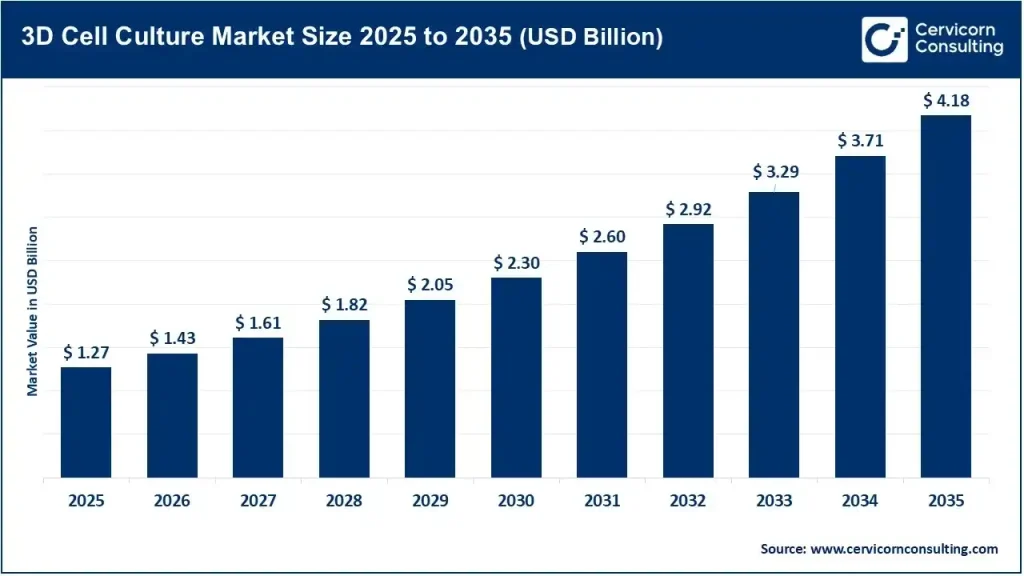
The global 3D cell culture market size was valued at approximately USD 1.27 billion in 2025 and is projected to reach USD 4.18 billion by 2035, representing a 12.7% CAGR from 2026 to 2035.
3D cell culture market growth factors
The global 3D cell culture market is being driven by the growing demand for physiologically relevant models that can better reproduce the structure, cellular interactions, and microenvironment of human tissues than conventional two-dimensional cell cultures. Increasing pharmaceutical and biotechnology research, rising drug discovery and development activity, growing adoption of organoids and spheroids, expansion of cancer and stem cell research, and increasing interest in alternatives to animal testing are strengthening market demand.
The growing use of 3D models in personalized medicine is another important factor, as patient-derived organoids and other advanced cellular models can support disease modeling and evaluation of treatment responses. Advances in biomaterials, extracellular matrix technologies, hydrogels, microfluidics, bioreactors, 3D bioprinting, and automated imaging are making 3D cultures more reproducible and scalable.
At the same time, pharmaceutical companies are increasingly seeking models that can improve the predictive value of preclinical research and help identify ineffective drug candidates earlier. Government and academic funding for organoid research, tissue engineering, regenerative medicine, and alternative testing methods is also supporting adoption. The market is therefore expanding across drug discovery, cancer research, stem cell research, tissue engineering, toxicology, regenerative medicine, and academic research, while increasing integration with artificial intelligence, high-content imaging, automation, and organ-on-chip platforms is creating additional opportunities for technology providers.
Get a Free Sample: https://www.cervicornconsulting.com/sample/3034′
What is the 3D cell culture market?
The 3D cell culture market comprises products, technologies, consumables, instruments, software, and services used to grow and maintain cells in three-dimensional environments. Unlike traditional 2D cell culture, where cells generally grow as a flat layer on a surface, 3D cell culture enables cells to interact with neighboring cells and extracellular matrix components in three dimensions.
The market includes several technology categories, including scaffold-based systems, scaffold-free systems, organoids, spheroids, hydrogel-based cultures, bioreactor-based systems, microfluidic platforms, and other advanced tissue models. These technologies are used with different cell types, including primary cells, stem cells, induced pluripotent stem cells, cancer cells, and patient-derived cells.
3D cell culture has become particularly relevant because biological responses can vary significantly between flat laboratory cultures and living tissues. Three-dimensional models can provide information about cell differentiation, proliferation, cell-cell communication, drug penetration, oxygen gradients, nutrient availability, and tissue architecture.
The market therefore sits at the intersection of cell biology, pharmaceutical research, biotechnology, regenerative medicine, tissue engineering, and advanced laboratory automation.
Why is 3D cell culture important?
More physiologically relevant research models
One of the principal advantages of 3D cell culture is its ability to reproduce aspects of the tissue environment more closely than conventional 2D models. Spheroids, organoids, and engineered tissue constructs can reproduce spatial relationships between cells and generate gradients that influence cellular behavior.
This makes 3D models valuable for investigating disease progression and treatment response, particularly in cancer, neurological diseases, liver disorders, cardiovascular conditions, and other complex biological systems.
Improving drug discovery
Pharmaceutical companies use 3D cell culture to evaluate drug candidates before progressing them into later stages of development. Tumor spheroids, organoids, and other models can provide information about drug penetration, toxicity, efficacy, and cellular response.
By incorporating more physiologically relevant conditions into preclinical workflows, 3D systems can complement conventional cell-based assays and animal studies.
Supporting personalized medicine
Patient-derived organoids are becoming increasingly important for precision medicine research. Cells obtained from individual patients can potentially be expanded and organized into models that retain certain characteristics of the original disease.
These models can be used to investigate differences in treatment response and support the development of patient-specific research approaches.
Supporting alternatives to animal testing
The development of advanced human-relevant models has become increasingly important as researchers and regulators explore ways to reduce reliance on animal studies. Governments and research organizations are supporting alternative methods that can provide better human biological relevance while maintaining rigorous safety evaluation.
Enabling advanced tissue engineering
3D cell culture also provides a foundation for tissue engineering and regenerative medicine. Researchers can combine cells with scaffolds, biomaterials, growth factors, and bioreactors to develop increasingly complex tissue models.
Leading companies in the 3D cell culture market
Thermo Fisher Scientific Inc.
Company: Thermo Fisher Scientific Inc.
Specialization: Life sciences tools, laboratory equipment, reagents, cell culture products, analytical instruments, and research solutions.
Key Focus Areas: Thermo Fisher participates in the 3D cell culture ecosystem through cell culture media, reagents, plastics, stem cell research products, assay technologies, and laboratory instruments. Its broad life sciences portfolio allows researchers to integrate cell culture with imaging, analysis, molecular biology, and other laboratory workflows.
Notable Features: The company’s major strength is its broad product ecosystem and global laboratory distribution network. This allows 3D cell culture researchers to source multiple components required for experimental workflows from one large life sciences supplier.
2025 Revenue: Thermo Fisher reported total 2025 revenues of approximately USD 44.56 billion, including product and service revenues.
Market Share: Thermo Fisher is identified among the major companies in the global 3D cell culture market, but the company does not separately disclose a standalone percentage share of this market.
Global Presence: Thermo Fisher serves pharmaceutical, biotechnology, academic, clinical, and research customers across major markets worldwide.
Merck KGaA
Company: Merck KGaA
Specialization: Life sciences, healthcare, electronics, laboratory technologies, bioprocessing, cell culture, and research materials.
Key Focus Areas: Merck’s Life Science business supports 3D cell culture through cell culture media, reagents, biomaterials, assay technologies, laboratory products, and technologies used in advanced biological research.
Notable Features: Merck benefits from a diversified life sciences portfolio spanning research through bioprocessing. Its capabilities in cell biology, biomaterials, and laboratory workflows provide opportunities to support increasingly complex 3D models.
2025 Revenue: Merck KGaA reported EUR 21.10 billion in group net sales in fiscal 2025.
Market Share: Merck KGaA is recognized as a major participant in the 3D cell culture market, although a standalone company-specific market share percentage is not publicly disclosed.
Global Presence: The company operates across Europe, North America, Asia-Pacific, and other international markets, supplying pharmaceutical, biotechnology, academic, and industrial customers.
Corning Incorporated
Company: Corning Incorporated
Specialization: Laboratory consumables, cell cultureware, advanced materials, glass technologies, and life sciences products.
Key Focus Areas: Corning has a particularly strong presence in 3D spheroid and organoid culture. Its portfolio includes spheroid microplates, ultra-low-attachment surfaces, Matrigel-based products, synthetic hydrogels, cell cultureware, and solutions for high-throughput 3D models.
Notable Features: Corning’s 3D cell culture solutions are designed to support spheroid formation, culture, imaging, and analysis. Its spheroid microplates are available in 96-, 384-, and 1536-well formats, supporting applications ranging from research to high-throughput screening.
2025 Revenue: Corning reported approximately USD 15.63 billion in GAAP sales in 2025, while core sales were approximately USD 16.41 billion.
Market Share: Corning is one of the prominent suppliers in 3D cell culture, particularly in cultureware and spheroid technologies, but it does not publicly report a standalone 3D cell culture market-share percentage.
Global Presence: Corning maintains operations and customers across North America, Europe, Asia-Pacific, and other global markets.
Lonza Group
Company: Lonza Group
Specialization: Cell and gene technologies, biopharmaceutical development and manufacturing, cell culture, biologics, and life sciences solutions.
Key Focus Areas: Lonza supports advanced cell-based research through cell culture technologies, primary cells, media, bioscience products, and platforms connected with cell and gene therapy development.
Notable Features: Lonza’s capabilities span research and development through advanced biopharmaceutical manufacturing. Its cell and gene technology expertise positions it within applications where 3D cellular models can support disease modeling, drug research, and advanced therapeutic development.
2025 Revenue: Lonza reported CHF 6.5 billion in 2025 sales, representing strong year-on-year growth.
Market Share: Lonza is identified as a significant participant in the broader 3D cell culture and advanced cell culture ecosystem, but its standalone 3D cell culture market share is not separately disclosed.
Global Presence: Lonza maintains a broad international manufacturing, research, and commercial footprint serving pharmaceutical and biotechnology customers.
Tecan Trading AG
Company: Tecan Trading AG
Specialization: Laboratory automation, liquid handling, automated workflows, life sciences instrumentation, and OEM technologies.
Key Focus Areas: Tecan contributes to 3D cell culture primarily through automation and laboratory workflow technologies. Automated liquid handling, sample preparation, and integration capabilities can support the repeatability and scalability of complex cell culture workflows.
Notable Features: Automation becomes increasingly important as laboratories move from individual spheroids and organoids toward larger experimental volumes. Tecan’s platforms can help reduce manual handling and improve workflow consistency.
2025 Revenue: Tecan reported CHF 882.5 million in 2025 sales.
Market Share: Tecan participates in the 3D cell culture ecosystem through automation and laboratory technologies; a standalone 3D cell culture market-share percentage is not publicly disclosed.
Global Presence: Tecan serves life sciences, diagnostics, pharmaceutical, biotechnology, and research customers internationally.
Leading trends and their impact on the 3D cell culture market
Rising adoption of organoids
Organoids are among the most important developments shaping the 3D cell culture industry. These miniature tissue-like structures can reproduce selected structural and functional characteristics of organs.
The increasing availability of stem cell technologies and patient-derived cells is expanding opportunities for organoid-based disease modeling, drug screening, developmental biology, and personalized medicine.
Expansion of cancer spheroid models
Cancer research is one of the largest application areas for 3D cell culture. Tumor spheroids can reproduce features of the tumor microenvironment, including cell-cell interactions and gradients of oxygen and nutrients.
This is encouraging pharmaceutical researchers to incorporate 3D tumor models into oncology drug discovery and immuno-oncology research.
Integration with automation and high-throughput screening
Manual 3D culture workflows can be labor-intensive. Consequently, automated liquid handling, robotic sample preparation, automated imaging, and artificial intelligence-based image analysis are becoming increasingly important.
The combination of 3D models and automation can enable laboratories to evaluate larger numbers of samples while improving experimental consistency.
Growth of organ-on-chip technologies
Microfluidic organ-on-chip platforms are extending the capabilities of 3D cell culture by introducing controlled fluid flow, tissue interfaces, and multiple cell types.
These systems can provide increasingly sophisticated models of human organs and biological processes and are being investigated for drug development, toxicity testing, and disease research.
Artificial intelligence and image analysis
3D cultures produce complex datasets because cells and tissue structures must be evaluated across three-dimensional space. AI-powered image analysis can assist researchers in identifying cellular phenotypes, measuring spheroid characteristics, tracking growth, and evaluating treatment responses.
This creates opportunities for software companies and instrument manufacturers alongside traditional cell culture suppliers.
Increasing demand for standardized models
Reproducibility remains an important consideration in 3D cell culture. Variability in matrix composition, cell sources, spheroid size, culture conditions, and experimental protocols can affect results.
The industry is therefore moving toward standardized media, defined matrices, automated protocols, quality-control procedures, and ready-to-use culture platforms.
Development of animal-free and chemically defined matrices
Researchers are increasingly interested in defined and reproducible extracellular matrix alternatives. Synthetic and chemically defined hydrogels can reduce some of the variability associated with biological matrices.
This trend is particularly relevant to pharmaceutical research, translational research, and applications requiring higher levels of experimental consistency.
Successful examples of 3D cell culture applications around the world
United States: advanced organoid and disease research
The United States remains a major center for organoid, spheroid, and advanced cell-model research because of its large pharmaceutical industry, biotechnology ecosystem, academic research base, and government-supported biomedical research.
NIH-funded research continues to demonstrate the potential of long-term human brain organoid models for studying neurodevelopment and neurological disease.
Europe: organoids and alternative testing
European research programs are supporting advanced 3D models for disease research, drug development, and alternatives to animal testing. Horizon Europe projects include work on organoids and technologies for monitoring 3D cultures.
These initiatives are helping connect academic research with scalable technologies and translational applications.
United Kingdom: alternative methods to animal research
The UK’s strategy for replacing animals in science specifically recognizes 3D cell cultures, organoids, tissue-engineered constructs, and bioprinted models as important advanced research technologies.
This policy direction can encourage further investment in human-relevant laboratory models.
Asia-Pacific: pharmaceutical and regenerative medicine research
China, Japan, South Korea, Singapore, and other Asia-Pacific markets are expanding capabilities in stem cell research, regenerative medicine, drug discovery, and advanced biotechnology.
The region’s large pharmaceutical manufacturing base and growing biotechnology investment are supporting demand for advanced cell culture platforms.
Japan: iPSC and organoid research
Japan has developed a strong research ecosystem around induced pluripotent stem cells, regenerative medicine, and tissue engineering. These capabilities provide a foundation for the continued development of organoids and other 3D cell models.
Global regional analysis including government initiatives and policies
North America
North America is a major market for 3D cell culture and accounted for the largest regional share in several current industry estimates. The region benefits from major pharmaceutical and biotechnology companies, advanced academic research institutions, strong venture investment, and significant biomedical research funding.
The United States is also increasingly focused on alternative testing methodologies. Federal research agencies have funded organoid and advanced human-model research, while regulatory developments are encouraging the evaluation of non-animal approaches where scientifically appropriate.
The combination of pharmaceutical R&D, cancer research, personalized medicine, and investment in organ-on-chip technologies is supporting market expansion.
Canada is also developing capabilities in regenerative medicine, stem cell research, tissue engineering, and biotechnology, contributing to regional demand.
Europe
Europe represents another important market, supported by a strong pharmaceutical industry, university research network, biotechnology sector, and public research funding.
European Union research programs are supporting organoid and advanced 3D culture projects. Horizon Europe-funded initiatives include research into miniaturized organoid production and real-time monitoring of 3D cell cultures.
The European policy environment is also increasingly attentive to alternative methods, scientific validation, and reduction of animal experimentation. These developments can support investment in human-relevant models such as organoids, spheroids, organ-on-chip systems, and tissue-engineered models.
Germany, the United Kingdom, France, Switzerland, and the Netherlands are important research and technology centers for advanced cell culture.
Asia-Pacific
Asia-Pacific is expected to remain an important growth region because of increasing pharmaceutical research, biotechnology investment, healthcare infrastructure development, and government support for life sciences.
China is expanding its biotechnology and pharmaceutical research capabilities, while Japan has strong expertise in iPSC research and regenerative medicine. South Korea is also investing in biotechnology, cell therapies, and advanced biomedical research.
Singapore has developed a strong biomedical research ecosystem and serves as an important hub for pharmaceutical and biotechnology activity in Southeast Asia.
Government-supported research programs, increasing healthcare expenditure, and the expansion of pharmaceutical R&D are likely to encourage adoption of advanced 3D culture technologies across the region.
Latin America
Latin America’s 3D cell culture market remains smaller than North America, Europe, and Asia-Pacific, but research capabilities are expanding. Brazil and Mexico are important regional markets because of their pharmaceutical industries, academic institutions, and growing biotechnology activity.
Adoption is increasingly concentrated in universities, research institutions, pharmaceutical laboratories, and specialized biotechnology organizations.
Middle East & Africa
The Middle East and Africa represent an emerging opportunity for 3D cell culture technologies. Investments in healthcare modernization, biotechnology, research infrastructure, and pharmaceutical manufacturing are creating opportunities for advanced laboratory technologies.
Countries investing in life sciences and biomedical research can support the adoption of organoids, spheroids, advanced cell culture systems, and automated laboratory platforms.
Government initiatives and policies shaping the 3D cell culture market
Government policy is becoming an increasingly important factor in the development of 3D cell culture because advanced models sit at the intersection of drug development, biomedical research, animal testing, regenerative medicine, and biotechnology.
In the United States, government-funded biomedical research has contributed to the development of organoids and other human-relevant models. NIH-supported work continues to demonstrate how 3D human tissue models can be used for complex disease research.
In the United Kingdom, government strategy on replacing animals in science explicitly identifies 3D cell cultures, organoids, tissue engineering, and bioprinted constructs as important alternative research methods. This creates a policy environment supportive of continued technology development and validation.
Within Europe, Horizon Europe funding is supporting research involving organoids and advanced 3D culture systems. Projects addressing scalable organoid production and real-time monitoring demonstrate the EU’s interest in moving advanced cell models from laboratory concepts toward more scalable research technologies.
Across Asia-Pacific, government support for biotechnology, regenerative medicine, stem cell research, pharmaceutical innovation, and advanced manufacturing is contributing to the development of the wider ecosystem needed for 3D cell culture adoption.
As regulatory frameworks evolve, the industry is likely to place greater emphasis on model validation, reproducibility, standardization, data quality, and demonstrating how 3D models can complement or replace specific conventional testing approaches.
Market outlook
The global 3D cell culture market is transitioning from a specialized research technology toward a broader platform for drug discovery, disease modeling, precision medicine, regenerative medicine, and advanced biomedical research. Current market estimates vary considerably because research firms use different definitions, technologies, and market boundaries. One recent estimate places the market at approximately USD 2.83 billion in 2025, while other published estimates range from roughly USD 1.49 billion to USD 2.85 billion for the same year. This variation highlights the importance of clearly defining the scope of 3D cell culture when evaluating market size.
Despite differences among estimates, the direction of the market is consistent: demand is increasing for human-relevant models that can provide more biologically representative information than conventional 2D systems. The convergence of organoids, spheroids, stem cells, microfluidics, automation, artificial intelligence, high-content imaging, and tissue engineering is expected to create new commercial opportunities across the 3D cell culture value chain.
To Get Detailed Overview, Contact Us: https://www.cervicornconsulting.com/contact-us
Read Report: Drug Discovery Services Market Revenue, Trends, and Strategic Insights by 2035