


Nutraceuticals Market Size
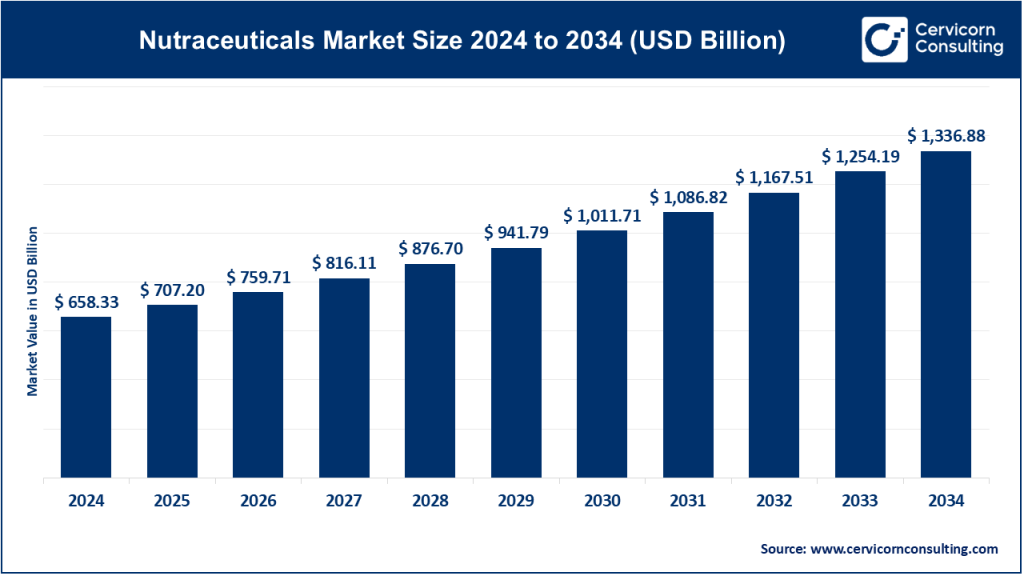
The global nutraceuticals market size was worth USD 658.33 billion in 2024 and is anticipated to expand to around USD 1,336.88 billion by 2034, registering a compound annual growth rate (CAGR) of 7.42% from 2025 to 2034.
What is the nutraceuticals market?
“Nutraceuticals” is an umbrella term that refers to food-based products that provide medical or health benefits beyond basic nutrition. The category includes dietary supplements (capsules, tablets, powders), fortified/functional foods and beverages (e.g., probiotic yogurts, fortified juices), nutritional ingredients (proteins, prebiotics, omega-3s), and medical/clinical nutrition products used under professional guidance. The market sits between consumer packaged goods (CPG), food science and the healthcare sector, often regulated differently from pharmaceuticals — frequently as foods, supplements, or novel food products depending on jurisdiction. Industry reports estimate the global market at several hundred billion dollars in 2024, with analysts placing estimates in the range of approximately $450–590+ billion and projections nearing or exceeding the trillion-dollar mark by the early 2030s.
Why the nutraceuticals market is important
Nutraceuticals matter because they represent a shift from reactive to preventive healthcare: consumers, facing rising chronic disease prevalence, aging populations, and systemic healthcare costs, are investing in daily nutrition to maintain health, boost immunity, manage weight, and support mental and cognitive well-being. They are also important to food manufacturers and ingredient suppliers because nutraceuticals create high-margin product lines, encourage brand loyalty through health claims and efficacy stories, and open new global distribution channels (retail, e-commerce, direct selling, clinical channels). At a policy level, nutraceuticals influence public-health strategies — for instance, fortification campaigns and supplementation programs — making industry practices relevant to regulators and healthcare systems alike.
Nutraceuticals Market — Growth Factors
The nutraceuticals market is being driven by a convergence of demographic, behavioral and technological forces: rising chronic disease and aging populations increase demand for preventive nutrition; heightened health awareness and personalized wellness trends push consumers toward targeted supplements and functional foods; rapid urbanization and higher disposable incomes in Asia-Pacific and Latin America expand mainstream adoption; digital commerce, direct-to-consumer models and telehealth accelerate distribution and product discovery.
Advances in food science, ingredient extraction and delivery technologies (microencapsulation, sustained-release, synbiotics) improve formulation efficacy and shelf stability; and investor interest plus mergers and acquisitions by major food and pharma companies fuels product innovation and global rollouts — while regulatory changes and greater scrutiny around safety, labeling and health claims both constrain and professionalize the market, encouraging larger players and certified manufacturers to scale.
Nutraceuticals Market — Top Companies
Below are profiles of the specific companies you requested. For each: specialization, key focus areas, notable features, 2024 revenue (based on public disclosures), market role/share context, and global presence.
Amway
- Specialization: Direct-selling nutraceuticals and supplements (Nutrilite brand), multivitamins, botanical supplements.
- Key focus areas: Traceable plant sourcing (Nutrilite farms), direct-to-consumer sales via independent distributors, personalized wellness packs.
- Notable features: Longstanding direct-selling model, heavy distributor network, vertical integration in ingredient sourcing for credibility.
- 2024 revenue: Approximately $7.4 billion.
- Market share & role: Consistently among the top global dietary supplement and direct-selling nutrition players.
- Global presence: Extensive presence across Asia-Pacific, North America, Latin America, Europe and Africa through its distributor network.
Herbalife Nutrition Ltd.
- Specialization: Weight-management products, sports nutrition, protein shakes, and performance supplements.
- Key focus areas: Multi-level marketing (MLM) distribution, nutrition clubs, localized weight-management programs.
- Notable features: Strong brand recognition in weight-management and sports nutrition categories.
- 2024 revenue: Approximately $5 billion.
- Market share & role: Listed among the global top companies in dietary supplements; strong weight-management portfolio.
- Global presence: Operations in 90+ countries, with particular strength in Latin America, North America and Asia.
Nestlé S.A.
- Specialization: Food and beverage conglomerate with strong presence in medical nutrition and nutraceuticals through Nestlé Health Science.
- Key focus areas: Clinical nutrition, probiotics, gut health, condition-specific functional products.
- Notable features: Deep R&D and clinical trials capacity; extensive distribution infrastructure.
- 2024 revenue: Nestlé’s total corporate revenue is in the tens of billions of Swiss francs; Nestlé Health Science contributes significantly as a major business segment.
- Market share & role: Among the largest companies globally in medical and clinical nutrition; strong leadership in evidence-backed functional foods.
- Global presence: Operating in over 180 countries worldwide.
PepsiCo Inc.
- Specialization: Large-scale food & beverage company with growing investments in functional beverages and fortified nutrition products.
- Key focus areas: Functional hydration, protein-enhanced beverages, better-for-you snacks, and reformulation for health-forward positioning.
- Notable features: Vast distribution and marketing reach; ability to rapidly scale functional product lines.
- 2024 revenue: Approximately $91.8 billion.
- Market share & role: Although not a pure nutraceutical company, PepsiCo’s influence in elevating functional foods makes it a key player in mainstreaming wellness-driven offerings.
- Global presence: Available in more than 200 countries and territories.
Archer Daniels Midland Company (ADM)
- Specialization: Nutraceutical ingredients supplier — proteins, specialty oils, fibers, botanicals and functional ingredients.
- Key focus areas: Ingredient innovation, formulation support for nutraceutical brands, large-scale agricultural processing.
- Notable features: Strong global sourcing and R&D for plant-based nutrition and wellness ingredients.
- 2024 revenue: Approximately $85.5 billion.
- Market share & role: A major B2B supplier that forms the backbone of supply chains for supplements and functional foods.
- Global presence: Extensive production and sourcing operations across North America, Europe, Asia and Latin America.
Leading Trends and Their Impact
1. Personalized and Subscription-Based Nutrition
DNA-based supplements, personalized vitamin packs and AI-driven nutrition plans are shaping consumer expectations.
Impact: Higher customer retention, greater data-driven product development, and increasing demand for evidence-backed formulation.
2. Microbiome-Focused Products
Probiotics, prebiotics, postbiotics and synbiotic blends continue to dominate.
Impact: Strong investment in clinical research, premium pricing and category expansion into beverages, snacks and powders.
3. Plant-Based and Sustainable Nutrition
Plant proteins, adaptogens, herbal extracts and algae-based ingredients are surging.
Impact: New sourcing models and sustainability narratives drive competitive differentiation.
4. Clean-Label and Transparency Movement
Consumers prefer products with fewer additives, natural ingredients and transparent supply chains.
Impact: Brands invest in traceability, certifications and eco-friendly packaging.
5. Regulatory Tightening Across Markets
Governments in the U.S., EU, India, China and ASEAN nations are strengthening health-claims rules, safety testing and labeling standards.
Impact: Higher compliance costs but improved consumer trust and industry credibility.
Successful Examples of Nutraceuticals Around the World
- Nutrilite by Amway: A vertically integrated supplement brand with global loyalty built on traceable botanical sourcing.
- Nestlé Health Science Products: Medical nutrition formulas used in clinical settings illustrate crossover between consumer wellness and healthcare.
- Herbalife Weight-Management Products: Widely adopted in local nutrition clubs globally, showcasing the power of community-driven distribution.
- Yakult and Asian Probiotic Drinks: Japan, South Korea and Southeast Asia have normalized daily probiotic beverages, demonstrating how functional foods can become cultural staples.
Global Regional Analysis and Government Initiatives
North America (U.S. & Canada)
Policies & regulation:
- Governed primarily under FDA (U.S.) and Health Canada dietary-supplement guidelines.
- Increased focus on label accuracy, claims verification, manufacturing audits and online marketplace oversight.
Market dynamics:
- Strong sports nutrition, immunity supplements and functional beverage growth.
- High adoption of personalized wellness services.
Europe
Policies & regulation:
- Regulated under EFSA health-claims rules and EU Novel Food Regulations.
- High regulatory scrutiny requires rigorous scientific evidence for functional claims.
Market dynamics:
- Preference for clinically validated and premium nutraceuticals.
- Strong demand for plant-based and gut-health solutions.
Asia-Pacific
Policies & government initiatives:
- India, China, Japan and ASEAN nations have been reforming nutraceutical laws.
- India is promoting itself as a nutraceutical manufacturing hub with clearer FSSAI categorization and export policies.
- China’s “blue hat” certification remains one of the strictest approval pathways for health foods.
Market dynamics:
- Rapid income growth and lifestyle shifts drive high consumption.
- Strong demand for immunity boosters, herbal formulations, and healthy ageing products.
Latin America
Policies & regulation:
- Growing enforcement around labeling standards, ingredient approvals and counterfeit prevention.
Market dynamics:
- High adoption of weight-management and energy supplements.
- Rising middle-class interest in functional snacks and beverages.
Middle East & Africa
Policies & regulation:
- Increasing harmonization with global standards; Gulf nations implementing stricter supplement approvals.
Market dynamics:
- Early-stage but rapidly growing market.
- Younger population demographics fueling demand for fitness and wellness products.
To Get Detailed Overview, Contact Us: https://www.cervicornconsulting.com/contact-us
Read Report: Cell and Gene Therapy Manufacturing Market Growth Drivers, Trends, Key Players and Regional Insights by 2035