


Table of Contents
ToggleNext-Generation Sequencing (NGS) in Drug Discovery Market Size
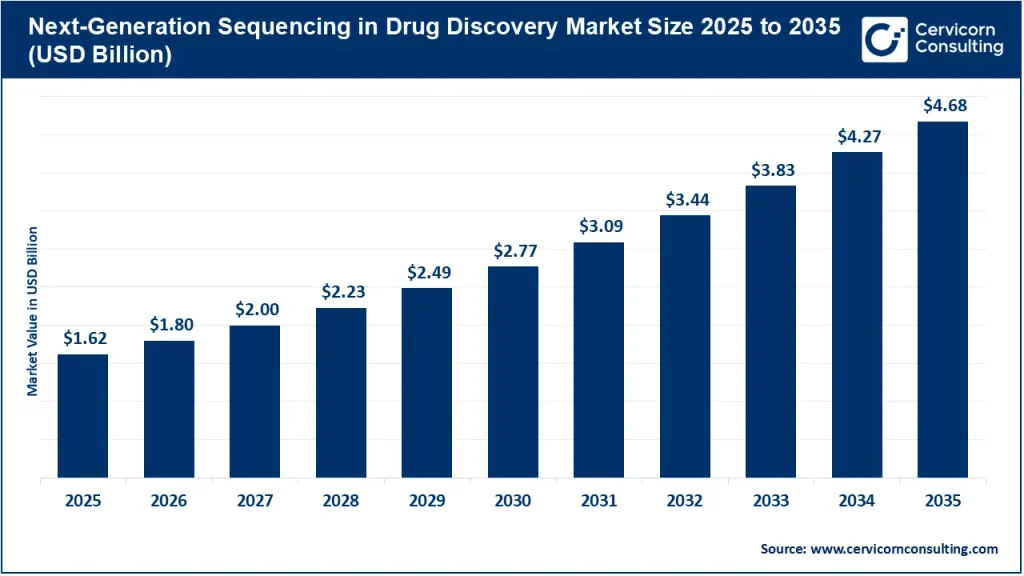
The global next-generation sequencing (NGS) in drug discovery market was valued at approximately USD 1.62 billion in 2025 and is projected to reach nearly USD 4.68 billion by 2035, growing at a CAGR of 11.19%.
Next-Generation Sequencing (NGS) in Drug Discovery Market Growth Factors
The next-generation sequencing (NGS) in drug discovery market is experiencing rapid growth due to the increasing adoption of precision medicine, expanding genomics research, rising prevalence of cancer and rare genetic disorders, and growing investments in pharmaceutical and biotechnology R&D. Advances in sequencing technologies have significantly reduced sequencing costs while improving speed, accuracy, and throughput, making NGS accessible for large-scale research and clinical applications. The integration of artificial intelligence (AI), machine learning, cloud computing, and bioinformatics platforms is accelerating genomic data analysis and target identification. Government-funded genome initiatives, increasing collaborations between pharmaceutical companies and sequencing technology providers, and the growing demand for biomarker discovery and companion diagnostics are further supporting market expansion.
Additionally, the rise of personalized therapeutics, immunotherapy development, and multi-omics approaches continues to position NGS as one of the most influential technologies in modern drug discovery.
What is the Next-Generation Sequencing (NGS) in Drug Discovery Market?
The Next-Generation Sequencing (NGS) in Drug Discovery Market refers to the global ecosystem of technologies, instruments, reagents, software, and services that utilize high-throughput DNA and RNA sequencing to support every stage of pharmaceutical research and drug development.
Unlike traditional Sanger sequencing, NGS can sequence millions to billions of DNA fragments simultaneously, enabling researchers to analyze complete genomes, transcriptomes, epigenomes, and microbiomes in a single experiment. This capability dramatically accelerates disease understanding and the identification of therapeutic targets.
Drug developers use NGS for:
- Gene mutation identification
- Biomarker discovery
- Target validation
- Pharmacogenomics
- Toxicogenomics
- Clinical trial stratification
- Companion diagnostics
- Precision medicine development
- Rare disease research
- Oncology drug discovery
Today, nearly every major pharmaceutical company integrates NGS into its R&D pipeline to improve success rates while reducing drug development costs and timelines.
Get a Free Sample: https://www.cervicornconsulting.com/sample/2678
Why is Next-Generation Sequencing Important?
NGS has fundamentally changed pharmaceutical research because it enables scientists to understand diseases at the molecular level.
Its importance includes:
Accelerates Drug Discovery
Instead of investigating one gene at a time, researchers can study thousands of genes simultaneously, identifying disease-causing mutations much faster.
Enables Precision Medicine
NGS allows physicians and researchers to match therapies with a patient’s unique genetic profile, improving treatment outcomes while minimizing adverse effects.
Improves Clinical Trial Success
Patient stratification based on genomic biomarkers ensures that clinical trials enroll participants most likely to benefit from investigational therapies.
Supports Rare Disease Research
Thousands of rare diseases originate from genetic mutations that are difficult to identify without comprehensive sequencing technologies.
Advances Cancer Therapeutics
Tumor sequencing enables personalized oncology treatments by revealing actionable mutations and resistance mechanisms.
Reduces R&D Costs
Early identification of viable drug targets reduces expensive late-stage failures in pharmaceutical development.
Market Ecosystem
The NGS drug discovery market includes several interconnected segments:
- Sequencing instruments
- Library preparation kits
- Reagents and consumables
- Sequencing services
- Bioinformatics software
- Cloud-based genomic analytics
- AI-powered genomic interpretation
- Companion diagnostics
- Clinical sequencing platforms
Consumables continue to generate recurring revenue because sequencing laboratories require new reagents and kits for every experiment.
Major Companies Driving Innovation
| Company | Specialization | Key Focus Areas | Notable Features | 2025 Revenue* | Estimated Market Position | Global Presence |
|---|---|---|---|---|---|---|
| Illumina, Inc. | High-throughput sequencing systems | Whole-genome sequencing, oncology, clinical genomics | NovaSeq X Series, extensive sequencing ecosystem | Approximately US$4.34 Billion | Global leader in NGS platforms | North America, Europe, Asia-Pacific, Latin America, Middle East & Africa |
| Thermo Fisher Scientific Inc. | Life science instruments and sequencing | Clinical research, precision medicine, genetic analysis | Ion Torrent sequencing technology, integrated laboratory solutions | Approximately US$43+ Billion (company-wide) in 2025 | Strong diversified life sciences player | Operations in over 50 countries |
| Agilent Technologies, Inc. | Genomics and analytical instruments | Target enrichment, sample preparation, genomics workflows | SureSelect technologies, bioinformatics integration | Approximately US$6.95 Billion | Major genomics workflow provider | More than 110 countries |
| F. Hoffmann-La Roche Ltd. (Roche) | Molecular diagnostics | Precision oncology, companion diagnostics, genomic medicine | Integrated diagnostics ecosystem and sequencing solutions | More than CHF 60 Billion (company-wide) | Global diagnostics leader | Over 100 countries |
| QIAGEN N.V. | Molecular diagnostics and sample technologies | Sample preparation, bioinformatics, companion diagnostics | QIAseq technologies, digital PCR, clinical genomics | Approximately US$2 Billion+ (company-wide) | Leading molecular biology solutions provider | More than 35 countries with worldwide distribution |
*Company revenues represent overall corporate revenues rather than NGS-specific revenue because companies do not separately disclose sequencing-only sales.
Leading Trends and Their Impact
1. Artificial Intelligence Integration
AI algorithms now process enormous genomic datasets within minutes, identifying therapeutic targets that previously required months of analysis.
Impact:
- Faster target identification
- Better mutation prediction
- Improved biomarker discovery
- Reduced research costs
2. Multi-Omics Research
Drug discovery increasingly combines:
- Genomics
- Transcriptomics
- Proteomics
- Metabolomics
- Epigenomics
This integrated approach provides a comprehensive understanding of disease biology.
3. Single-Cell Sequencing
Instead of analyzing millions of cells collectively, researchers examine individual cells.
Benefits include:
- Understanding tumor heterogeneity
- Identifying resistant cancer cells
- Discovering new immune cell populations
- Improving immunotherapy development
4. Long-Read Sequencing
Long-read technologies complement short-read sequencing by resolving complex genomic regions and structural variants.
Applications include:
- Rare diseases
- Neurological disorders
- Cancer genomics
- Population genetics
5. Cloud-Based Genomics
Cloud computing enables laboratories worldwide to process petabytes of genomic information securely and collaboratively.
Advantages include:
- Lower infrastructure costs
- Faster collaboration
- Scalable storage
- Global data sharing
6. Companion Diagnostics
NGS increasingly supports personalized drug selection by identifying patients most likely to respond to targeted therapies.
This trend is strengthening partnerships between pharmaceutical companies and diagnostics developers.
Successful Examples Around the World
Cancer Precision Medicine in the United States
Major cancer centers routinely perform comprehensive tumor sequencing before selecting treatment options.
NGS has enabled targeted therapies for:
- Lung cancer
- Breast cancer
- Melanoma
- Colorectal cancer
- Leukemia
The result has been improved survival rates and more personalized treatment strategies.
Genomics England
The United Kingdom launched one of the world’s largest genomic medicine programs.
Whole-genome sequencing supports:
- Rare disease diagnosis
- Cancer treatment
- Drug discovery research
- Population health studies
This initiative has generated one of the world’s richest genomic datasets for pharmaceutical innovation.
All of Us Research Program (United States)
This national initiative aims to collect genomic, health, and lifestyle data from over one million participants.
Researchers use these datasets to identify:
- Disease biomarkers
- Drug targets
- Population-specific genetic variations
The program accelerates precision medicine development.
China Precision Medicine Initiative
China has invested heavily in genomic sequencing infrastructure.
Major hospitals and research institutions utilize NGS for:
- Oncology
- Infectious diseases
- Genetic disorders
- AI-assisted genomic medicine
These investments continue to expand regional pharmaceutical innovation.
Japan’s Cancer Genome Medicine Program
Japan integrates NGS into clinical oncology to identify genomic alterations and guide precision therapies.
The program has strengthened collaboration among hospitals, pharmaceutical companies, and genomic research institutions.
European Cancer Research Networks
Several European Union-funded genomic collaborations are building cross-border sequencing databases that support:
- Biomarker discovery
- Rare disease research
- Drug target validation
- Clinical trial recruitment
Global Regional Analysis
North America
North America remains the largest market for NGS in drug discovery.
Growth Drivers
- Advanced healthcare infrastructure
- High R&D expenditure
- Strong pharmaceutical industry
- Extensive clinical genomics adoption
- Leading sequencing technology companies
The United States dominates due to significant investments by biotechnology firms, academic research centers, and pharmaceutical companies.
Government Initiatives
Government support plays a major role through programs such as:
- NIH genomic research funding
- Precision medicine initiatives
- Cancer Moonshot programs
- FDA support for companion diagnostics
- Large-scale genome sequencing projects
These initiatives encourage widespread adoption of sequencing technologies across research institutions.
Europe
Europe represents one of the fastest-growing genomic research markets.
Countries including:
- Germany
- United Kingdom
- France
- Netherlands
- Switzerland
continue expanding precision medicine infrastructure.
Government Policies
European governments actively support genomic innovation through:
- Horizon Europe research funding
- National genome sequencing programs
- Rare disease initiatives
- Cross-border genomic collaborations
- AI-driven healthcare strategies
Strong regulatory frameworks also encourage secure genomic data sharing while protecting patient privacy.
Asia-Pacific
Asia-Pacific is projected to experience the fastest market growth.
Major contributors include:
- China
- Japan
- India
- South Korea
- Australia
- Singapore
Growth Factors
- Rapid biotechnology expansion
- Government genomic investments
- Rising healthcare spending
- Growing pharmaceutical manufacturing
- Increasing cancer prevalence
Government Initiatives
China
- Precision Medicine Initiative
- National Genome Programs
- AI healthcare investments
Japan
- Cancer Genome Medicine Project
- National genomic databases
India
- Genome India Project
- Expansion of biotechnology parks
- Digital healthcare initiatives
South Korea
- National Bio Big Data Project
- Government funding for genomic medicine
Australia
- Australian Genomics Health Alliance
- Precision oncology research funding
These initiatives continue attracting global pharmaceutical collaborations.
Latin America
Latin America is gradually adopting NGS technologies.
Countries including Brazil, Mexico, Argentina, and Chile are increasing investments in molecular diagnostics.
Government Support
Governments increasingly fund:
- Cancer genomics research
- Rare disease diagnosis
- University genomics centers
- Public-private biotechnology partnerships
Challenges remain regarding infrastructure and reimbursement, but adoption continues to rise.
Middle East & Africa
The Middle East and Africa represent emerging opportunities.
Countries such as:
- Saudi Arabia
- United Arab Emirates
- South Africa
are investing in genomic medicine.
Government Policies
National healthcare transformation strategies emphasize:
- Precision medicine
- Biotechnology innovation
- National genome projects
- Digital healthcare ecosystems
Large government investments in biotechnology parks and genomic research centers are strengthening regional capabilities.
Future Opportunities in the Market
Several emerging opportunities are expected to drive continued expansion:
Pharmacogenomics
Sequencing enables personalized drug dosing based on individual genetic profiles.
Liquid Biopsy Development
NGS supports minimally invasive cancer detection using circulating tumor DNA.
Infectious Disease Research
Rapid pathogen sequencing improves vaccine development and antimicrobial resistance monitoring.
Rare Disease Therapeutics
Thousands of genetically driven rare diseases remain untreated, presenting enormous opportunities for sequencing-guided drug discovery.
AI-Powered Drug Discovery
Combining artificial intelligence with NGS data allows researchers to rapidly identify promising therapeutic candidates and predict treatment responses.
Expanding Clinical Applications
As sequencing costs continue to decline and reimbursement improves, NGS is expected to become a routine component of clinical decision-making, further accelerating demand for sequencing platforms, bioinformatics tools, and precision therapeutics.
The convergence of genomics, AI, cloud computing, and personalized medicine positions the next-generation sequencing (NGS) in drug discovery market as one of the most transformative segments within the global life sciences and pharmaceutical industry.
To Get Detailed Overview, Contact Us: https://www.cervicornconsulting.com/contact-us
Read Report: General Delivery Transportation Market Revenue, Trends, and Strategic Insights by 2035