


Table of Contents
ToggleGeneral Delivery Transportation Market Size
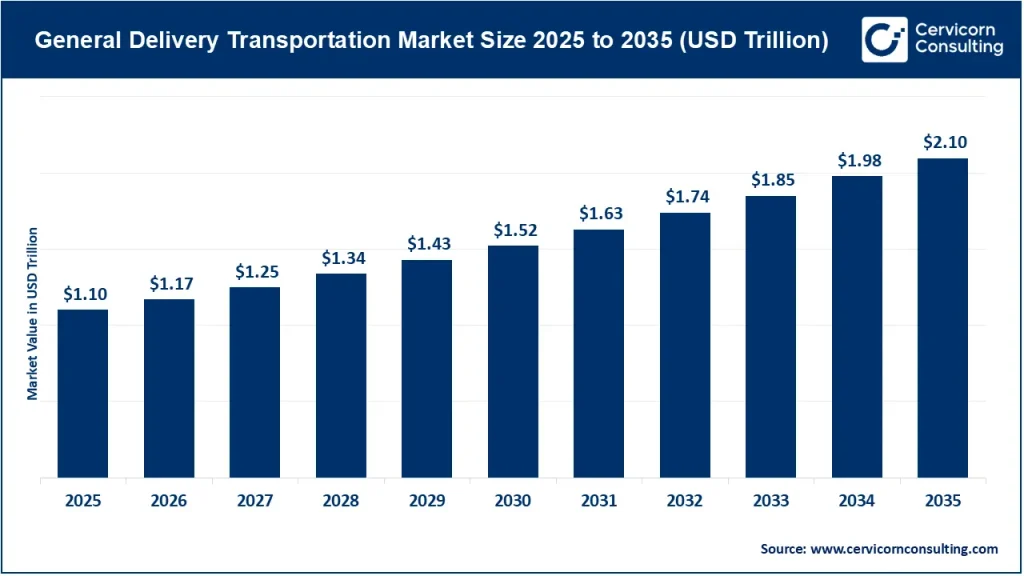
The global general delivery transportation market was valued at approximately USD 1.10 trillion in 2025 and is projected to reach nearly USD 2.10 trillion by 2035, growing at a CAGR of 6.68%.
What is the General Delivery Transportation Market?
The general delivery transportation market refers to the global ecosystem of companies, technologies, infrastructure, and service providers involved in transporting parcels, packages, freight, consumer goods, industrial products, and commercial shipments from one location to another. The market encompasses road, rail, air, maritime, and multimodal transportation services, including express delivery, last-mile delivery, courier services, cross-border logistics, warehousing, fulfillment, and supply chain management.
Modern delivery transportation extends beyond physical movement of goods by integrating artificial intelligence (AI), Internet of Things (IoT), automation, robotics, digital freight platforms, warehouse management systems, route optimization software, and real-time shipment tracking. Growing e-commerce activity, globalization, increasing urbanization, and rising customer expectations for same-day and next-day delivery continue to transform the market into one of the most strategically important sectors of the global economy.
General Delivery Transportation Market Growth Factors
The general delivery transportation market is experiencing sustained growth due to the rapid expansion of e-commerce platforms, increasing international trade, growing consumer demand for same-day and next-day deliveries, rising investments in smart logistics infrastructure, digitalization of supply chains, adoption of AI-powered route optimization, increasing warehouse automation, expansion of cold chain logistics, development of autonomous delivery technologies, government investments in transport infrastructure, higher demand for cross-border shipping, growth of omnichannel retailing, increasing urban populations, expansion of small and medium-sized enterprises engaged in online commerce, deployment of electric delivery vehicles, integration of IoT-enabled fleet management systems, growing reliance on third-party logistics (3PL) providers, and continuous innovation in last-mile delivery solutions that improve operational efficiency while reducing delivery costs and environmental impact.
Get a Free Sample: https://www.cervicornconsulting.com/sample/2679
Why is the General Delivery Transportation Market Important?
The delivery transportation industry serves as the foundation of modern economic activity. Every manufacturing sector, retailer, healthcare organization, government agency, and consumer depends on efficient transportation networks.
Its importance includes:
Supporting Global Trade
International commerce relies on transportation networks capable of moving goods quickly, safely, and efficiently across borders.
Enabling E-commerce
Online shopping has fundamentally changed logistics requirements. Consumers now expect rapid deliveries with complete shipment visibility.
Strengthening Supply Chains
Transportation connects manufacturers, suppliers, distributors, retailers, and customers, minimizing disruptions and maintaining inventory flow.
Supporting Healthcare
Medical equipment, pharmaceuticals, vaccines, diagnostic kits, and emergency supplies depend on reliable transportation systems.
Boosting Economic Development
Efficient transportation reduces logistics costs, attracts investment, improves competitiveness, and creates employment opportunities.
Enhancing Customer Experience
Real-time tracking, flexible delivery options, automated notifications, and faster fulfillment improve customer satisfaction and brand loyalty.
Major Companies Shaping the General Delivery Transportation Market
| Company | Specialization | Key Focus Areas | Notable Features | 2025 Revenue* | Estimated Market Position | Global Presence |
|---|---|---|---|---|---|---|
| Amazon | E-commerce logistics, fulfillment, last-mile delivery | AI logistics, warehouse robotics, fulfillment centers, same-day delivery | One of the world’s largest integrated logistics networks supporting both marketplace sellers and increasingly third-party logistics services | US$716.9 billion (company revenue) | Among the fastest-growing logistics operators | Operations in over 100 countries |
| FedEx Corporation | Express delivery, freight, supply chain | Air cargo, healthcare logistics, international shipping | Extensive global air express network and advanced shipment tracking | Approximately US$88–89 billion (latest annual scale) | Leading global parcel carrier | 220+ countries and territories |
| United Parcel Service (UPS) | Parcel delivery, logistics, freight | Small package delivery, healthcare logistics, automation | Integrated ground and air transportation network | US$88.7 billion | One of the world’s largest parcel delivery providers | 200+ countries and territories |
| Deutsche Post DHL Group | International logistics, express delivery | Cross-border logistics, supply chain solutions, e-commerce logistics | Strong presence in Europe, Asia-Pacific, and international freight forwarding | €82.9 billion | Global leader in logistics services | 220+ countries and territories |
| Maersk | Ocean shipping and integrated logistics | Container shipping, supply chain management, warehousing | End-to-end logistics solutions integrating sea, land, and air freight | Approximately US$56 billion (company reporting for 2025) | Leading global container logistics company | Presence in 130+ countries |
*Revenue figures represent overall company revenue rather than revenue solely attributable to delivery transportation activities. Market share varies significantly across regions and service segments because no single company dominates the entire global delivery transportation market.
Leading Trends Transforming the General Delivery Transportation Market
AI-Driven Logistics Optimization
Artificial intelligence is enabling logistics companies to optimize delivery routes, predict demand, reduce fuel consumption, and improve warehouse operations. AI-powered forecasting helps businesses minimize delays while maximizing fleet utilization.
Impact:
- Lower operational costs
- Faster deliveries
- Improved customer satisfaction
- Better inventory management
Warehouse Automation
Modern fulfillment centers increasingly utilize autonomous mobile robots, robotic picking systems, automated sorting equipment, and AI-powered inventory management.
Impact:
- Increased throughput
- Reduced labor dependency
- Higher order accuracy
- Faster order fulfillment
Growth of Last-Mile Delivery Innovation
Last-mile delivery remains one of the most expensive segments of logistics. Companies continue investing in smart lockers, electric vans, autonomous delivery robots, drones, and micro-fulfillment centers.
Impact
- Reduced delivery time
- Lower urban congestion
- Improved customer convenience
- Reduced transportation costs
Electrification of Delivery Fleets
Sustainability goals are encouraging logistics providers to adopt electric trucks, electric vans, hydrogen-powered vehicles, and alternative fuels.
Impact
- Lower emissions
- Reduced fuel costs
- Compliance with environmental regulations
- Improved corporate sustainability
Digital Freight Platforms
Cloud-based logistics platforms now connect shippers, carriers, warehouses, and customers through integrated digital ecosystems.
Impact
- Real-time shipment visibility
- Better fleet utilization
- Faster booking processes
- Improved transparency
Cross-Border E-commerce Expansion
Consumers increasingly purchase products from international retailers, driving demand for customs brokerage, international fulfillment, and cross-border transportation services.
Impact
- Growth in international logistics
- Increased customs automation
- Higher investment in international distribution centers
Predictive Analytics
Logistics providers use predictive analytics to anticipate weather disruptions, equipment failures, traffic congestion, and customer demand.
Impact
- Reduced delivery delays
- Better fleet planning
- Improved operational resilience
Successful Examples of General Delivery Transportation Around the World
Amazon Logistics (United States)
Amazon has transformed delivery transportation through its extensive fulfillment center network, AI-based inventory management, autonomous warehouse robots, and expanding last-mile delivery capabilities. The company continues to invest heavily in same-day delivery, regional fulfillment, and integrated logistics services.
DHL Express (Germany)
DHL has established one of the world’s largest international express delivery networks. Its investments in digital customs processing, sustainable aviation fuel initiatives, electric delivery vehicles, and smart warehouses have strengthened cross-border logistics capabilities.
UPS Healthcare Logistics (United States)
UPS has developed specialized healthcare logistics infrastructure supporting pharmaceutical transportation, temperature-controlled shipping, and medical device distribution across global markets.
Maersk Integrated Logistics (Denmark)
Maersk has expanded beyond container shipping into integrated logistics services, offering customers end-to-end supply chain management that combines ocean freight, air freight, warehousing, customs brokerage, and inland transportation.
Singapore Smart Port Ecosystem
Singapore continues investing in digital ports, automated container terminals, AI-powered vessel scheduling, and smart logistics infrastructure, making it one of the world’s most efficient logistics hubs.
China’s Smart Logistics Networks
Major Chinese logistics providers have adopted AI-driven warehouses, automated distribution centers, autonomous delivery vehicles, and drone-based deliveries to support one of the world’s largest e-commerce ecosystems.
Global Regional Analysis
North America
North America represents one of the largest delivery transportation markets due to advanced logistics infrastructure, high internet penetration, strong consumer spending, and widespread adoption of e-commerce.
Key Growth Drivers
- Mature parcel delivery industry
- Strong investment in warehouse automation
- AI-enabled logistics platforms
- Rising healthcare logistics demand
- Growth of same-day delivery
Government Initiatives and Policies
Government investments in highway modernization, airport infrastructure, freight mobility programs, cybersecurity for transportation networks, and clean transportation incentives are strengthening logistics capabilities. Environmental regulations also encourage fleet electrification and emissions reduction.
Europe
Europe benefits from highly integrated transportation systems, efficient cross-border trade, and advanced sustainability initiatives.
Market Characteristics
- Extensive rail freight networks
- Strong international logistics
- High adoption of electric delivery vehicles
- Advanced customs harmonization
- Sustainable transportation investments
Government Initiatives and Policies
European governments are promoting the European Green Deal, investments in the Trans-European Transport Network (TEN-T), low-emission transport corridors, digital freight documentation, and alternative fuel infrastructure. These initiatives encourage decarbonization, multimodal transport, and more efficient cross-border logistics.
Asia-Pacific
Asia-Pacific is the fastest-growing delivery transportation market due to rapid industrialization, urbanization, expanding middle-class populations, and booming e-commerce activity.
Key Growth Drivers
- Manufacturing expansion
- Cross-border exports
- Rising online retail
- Smart city development
- Government infrastructure spending
China, Japan, South Korea, India, and Southeast Asia continue investing heavily in logistics modernization, automated warehouses, and digital transportation networks.
Government Initiatives and Policies
Governments across the region are investing in expressway expansion, dedicated freight corridors, smart ports, logistics parks, digital customs systems, and multimodal transportation. India’s PM Gati Shakti initiative and the National Logistics Policy aim to improve multimodal connectivity and reduce logistics costs, while China continues expanding logistics infrastructure under long-term connectivity and trade initiatives.
Latin America
Latin America’s logistics sector is expanding as e-commerce adoption accelerates and transportation infrastructure improves.
Market Drivers
- Digital retail growth
- Urban logistics expansion
- Increasing international trade
- Third-party logistics growth
Government Initiatives and Policies
Governments are investing in port modernization, customs digitization, highway improvements, public-private partnerships, and logistics corridor development to enhance regional connectivity and attract foreign investment.
Middle East & Africa
The Middle East is emerging as a strategic logistics hub connecting Asia, Europe, and Africa.
Market Drivers
- Free trade zones
- Smart ports
- Airport expansion
- Cross-border commerce
- Warehouse construction
Government Initiatives and Policies
Countries including the UAE and Saudi Arabia are investing in logistics under long-term economic diversification strategies, developing integrated logistics zones, automated ports, and advanced customs systems. Across parts of Africa, governments and development partners are supporting transport corridor upgrades, port modernization, and digital trade facilitation to improve regional supply chains and intra-African commerce.
To Get Detailed Overview, Contact Us: https://www.cervicornconsulting.com/contact-us
Read Report: Aerospace and Defense Market Revenue, Trends, and Strategic Insights by 2035