


Table of Contents
ToggleMolecular Diagnostics Market Size
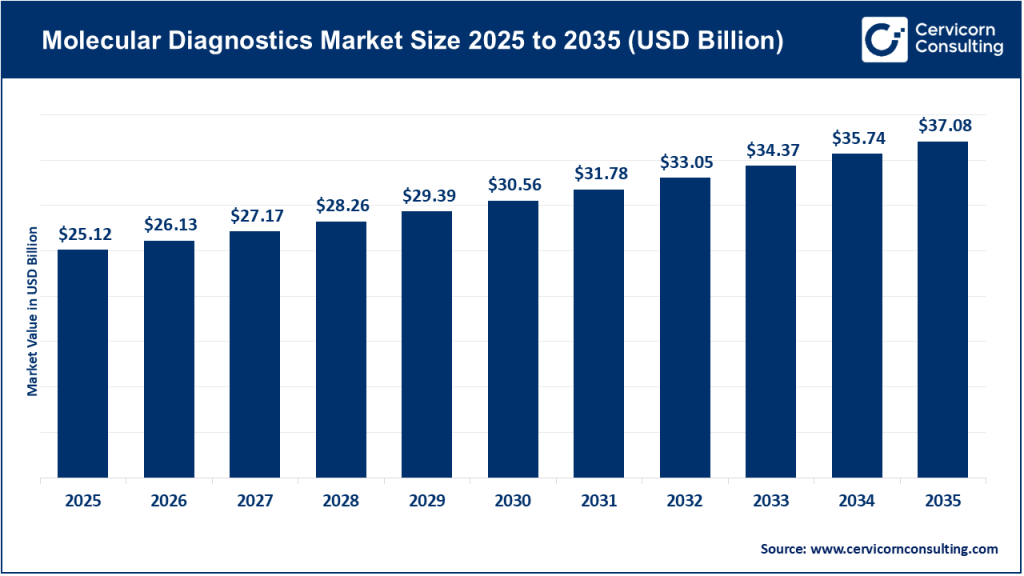
The global molecular diagnostics market was valued at approximately USD 25.12 billion in 2025 and is projected to reach nearly USD 37.08 billion by 2035, growing at a CAGR of 3.97%.
Molecular Diagnostics Market Growth Factors
The global molecular diagnostics market is witnessing remarkable growth due to the increasing prevalence of infectious diseases, cancer, and genetic disorders, coupled with the growing demand for personalized medicine and precision healthcare. Continuous technological advancements in polymerase chain reaction (PCR), next-generation sequencing (NGS), digital PCR, CRISPR-based diagnostics, and multiplex molecular assays are significantly improving diagnostic accuracy and reducing turnaround time. Government investments in genomic research, expansion of newborn screening programs, increasing healthcare expenditure, and favorable reimbursement policies across developed economies are accelerating market expansion.
The COVID-19 pandemic permanently transformed laboratory infrastructure worldwide, resulting in widespread adoption of molecular testing platforms that continue to be utilized for respiratory diseases, oncology, antimicrobial resistance testing, and inherited disorders. Rising awareness regarding early disease detection, increasing adoption of companion diagnostics, growing pharmaceutical R&D, expansion of decentralized molecular testing, and integration of artificial intelligence into molecular data analysis further contribute to sustained market growth.
Get a Free Sample: https://www.cervicornconsulting.com/sample/2790
What is the Molecular Diagnostics Market?
The molecular diagnostics market refers to the global industry involved in developing, manufacturing, and commercializing diagnostic tests that detect specific biological markers within DNA, RNA, proteins, or other molecular components. Unlike conventional diagnostic methods, molecular diagnostics identify diseases at the genetic or molecular level, enabling earlier, faster, and more precise diagnosis.
These diagnostic techniques include:
- Polymerase Chain Reaction (PCR)
- Real-Time PCR (RT-PCR)
- Next-Generation Sequencing (NGS)
- DNA Microarrays
- In Situ Hybridization (ISH)
- CRISPR-based diagnostics
- Digital PCR
- Isothermal Amplification Technologies
Molecular diagnostics are extensively used in:
- Oncology
- Infectious diseases
- Genetic testing
- Prenatal screening
- Pharmacogenomics
- Blood screening
- Neurological disorders
- Rare disease diagnosis
Healthcare providers increasingly rely on molecular diagnostics because they offer high sensitivity, specificity, and rapid clinical decision-making.
Why is the Molecular Diagnostics Market Important?
Molecular diagnostics has become one of the most transformative segments of modern healthcare because it enables clinicians to detect diseases before symptoms appear, identify genetic mutations, monitor disease progression, and personalize treatments.
Major benefits include:
- Earlier diagnosis of life-threatening diseases
- Better patient outcomes
- Reduced healthcare costs
- Improved treatment selection
- Lower hospital admissions
- Enhanced pandemic preparedness
- Precision oncology applications
- Better antimicrobial stewardship
The growing shift toward precision medicine has made molecular diagnostics indispensable in hospitals, clinical laboratories, pharmaceutical companies, and research institutions.
Major Companies Shaping the Molecular Diagnostics Market
| Company | Specialization | Key Focus Areas | Notable Features | 2025 Revenue* | Estimated Market Share | Global Presence |
|---|---|---|---|---|---|---|
| Roche Diagnostics | Molecular diagnostics, PCR systems, sequencing solutions | Oncology, infectious diseases, women’s health | cobas platforms, automated laboratory solutions | Diagnostics sales: CHF 13.8 billion | ~20–25% | 100+ countries |
| Abbott Laboratories | Molecular diagnostics and point-of-care diagnostics | Infectious disease testing, blood screening | Alinity and ID NOW platforms | Diagnostics sales: US$8.94 billion | ~10–12% | 160+ countries |
| Thermo Fisher Scientific | PCR, sequencing, life science instruments | Clinical diagnostics, research, genomics | Applied Biosystems, Ion Torrent technologies | US$44.56 billion total revenue | ~8–10% | 180+ countries |
| Qiagen N.V. | Sample preparation and molecular testing | PCR assays, syndromic testing, genomics | QIAstat-Dx, QuantiFERON, QIAcuity | Approx. US$2 billion+ | ~5–7% | 100+ countries |
| BioMérieux S.A. | Infectious disease diagnostics | Microbiology and molecular testing | BIOFIRE multiplex PCR systems | Approx. €4 billion+ | ~5–6% | 45+ countries |
Leading Trends Transforming the Molecular Diagnostics Market
1. Rapid Expansion of Precision Medicine
Healthcare providers increasingly use molecular diagnostics to identify patient-specific genetic mutations. Personalized medicine enables targeted therapies that improve treatment outcomes while minimizing adverse effects.
Impact: Greater demand for companion diagnostics and genomic testing.
2. Growth of Liquid Biopsy
Liquid biopsy has revolutionized cancer diagnosis by allowing physicians to detect circulating tumor DNA using a simple blood sample.
Impact:
- Non-invasive diagnosis
- Earlier cancer detection
- Real-time treatment monitoring
- Improved patient compliance
3. Artificial Intelligence Integration
Artificial intelligence enhances molecular diagnostics by automating genomic data interpretation, identifying biomarkers, and improving diagnostic workflows.
Impact:
- Faster reporting
- Higher diagnostic accuracy
- Reduced laboratory workload
- Better clinical decision support
4. Next-Generation Sequencing Adoption
NGS technologies continue replacing traditional sequencing approaches due to their ability to analyze thousands of genes simultaneously.
Applications include:
- Rare disease diagnosis
- Oncology
- Hereditary disorders
- Population genomics
- Prenatal testing
Impact: Significant reduction in sequencing costs and broader clinical adoption.
5. Decentralized Molecular Testing
Hospitals increasingly deploy compact molecular diagnostic instruments directly in emergency departments, clinics, pharmacies, and physician offices.
Benefits include:
- Faster turnaround time
- Immediate treatment decisions
- Reduced laboratory burden
- Improved rural healthcare access
6. Syndromic Testing Panels
Multiplex molecular panels simultaneously identify multiple pathogens from one patient sample.
Applications:
- Respiratory infections
- Gastrointestinal infections
- Sepsis
- Meningitis
Impact: More accurate diagnosis and reduced unnecessary antibiotic use.
7. Automation of Clinical Laboratories
Automation minimizes manual errors while improving laboratory efficiency.
Key innovations include:
- Robotic sample handling
- Automated nucleic acid extraction
- Integrated PCR workflows
- Cloud-connected laboratory management
Successful Examples of Molecular Diagnostics Around the World
Roche cobas SARS-CoV-2 Testing
During the COVID-19 pandemic, Roche’s cobas molecular platforms enabled millions of PCR tests globally, supporting rapid detection and large-scale screening programs.
Success factors:
- High throughput
- Excellent sensitivity
- Automated workflow
- Global laboratory deployment
Abbott ID NOW Platform
Abbott’s ID NOW system provides molecular diagnostic results within minutes, enabling rapid testing in emergency rooms, clinics, and pharmacies.
Applications:
- COVID-19
- Influenza
- Streptococcus
- RSV
Its portability has made it valuable in decentralized healthcare settings.
BioFire FilmArray by BioMérieux
The BIOFIRE multiplex PCR platform can detect dozens of respiratory pathogens from a single specimen in about an hour.
Benefits include:
- Rapid diagnosis
- Improved antimicrobial stewardship
- Reduced hospital stay
- Better infection control
Qiagen QuantiFERON
Qiagen’s QuantiFERON-TB Gold test has become one of the world’s leading blood-based tuberculosis screening methods.
Advantages:
- Higher specificity
- No cross-reactivity with BCG vaccination
- Widely adopted by public health agencies
Thermo Fisher Applied Biosystems Platforms
Thermo Fisher supports genomic research, oncology testing, and inherited disease diagnostics through advanced PCR and sequencing platforms widely used by hospitals and research laboratories.
Global Regional Analysis
North America
North America remains the largest molecular diagnostics market due to advanced healthcare infrastructure, significant R&D investments, strong reimbursement systems, and widespread adoption of precision medicine.
United States
The U.S. leads global innovation through:
- Large-scale genomic medicine programs
- Extensive pharmaceutical research
- High adoption of NGS
- Strong biotechnology ecosystem
Government Initiatives
Government agencies continue supporting molecular diagnostics through:
- National precision medicine initiatives
- Increased NIH funding for genomic research
- CDC investments in infectious disease surveillance
- FDA support for innovative molecular diagnostic approvals
These initiatives have accelerated commercialization and clinical adoption of advanced diagnostic technologies.
Canada
Canada promotes genomic medicine through provincial precision health programs, public healthcare investments, and national research collaborations aimed at integrating molecular testing into routine clinical care.
Europe
Europe represents a mature molecular diagnostics market characterized by universal healthcare systems, advanced laboratory infrastructure, and robust regulatory oversight.
Major contributors include:
- Germany
- France
- United Kingdom
- Italy
- Spain
Government Policies
European governments actively support:
- National cancer plans
- Rare disease strategies
- Expanded newborn screening
- Personalized medicine initiatives
- Cross-border genomic research collaborations
The implementation of the In Vitro Diagnostic Regulation (IVDR) has strengthened quality and safety standards while encouraging innovation and clinical validation.
Asia-Pacific
Asia-Pacific is projected to experience the fastest growth during the forecast period.
Major markets include:
- China
- Japan
- India
- South Korea
- Australia
Growth drivers include:
- Increasing healthcare expenditure
- Rising infectious disease burden
- Expanding middle-class population
- Growing biotechnology sector
- Improved diagnostic infrastructure
Government Initiatives
China
Government investments under national biotechnology and precision medicine programs continue to strengthen domestic genomic capabilities, sequencing infrastructure, and molecular diagnostic manufacturing.
Japan
Japan promotes precision medicine through nationwide genomic medicine initiatives, cancer genome profiling, and reimbursement support for advanced diagnostic testing.
India
India has expanded molecular testing capacity through public health laboratory modernization, infectious disease surveillance programs, and increased investment in genomic research and digital health infrastructure.
Latin America
Countries including Brazil, Mexico, Argentina, and Chile are gradually expanding access to molecular diagnostics.
Growth is driven by:
- Public health modernization
- Growing private diagnostic laboratories
- Rising cancer incidence
- Increased awareness of early disease detection
Government Support
Governments are investing in:
- National disease surveillance
- Laboratory modernization
- Universal healthcare expansion
- Public-private healthcare partnerships
Middle East & Africa
Although still emerging, the Middle East & Africa region presents strong long-term growth potential.
Leading markets include:
- Saudi Arabia
- United Arab Emirates
- South Africa
Government Policies
Regional governments support molecular diagnostics through:
- National healthcare transformation strategies
- Investments in genomic medicine
- Hospital modernization
- Digital health initiatives
- Expansion of precision oncology programs
Countries in the Gulf region continue to establish genomic research centers while improving laboratory capabilities for infectious disease diagnosis and inherited disease screening.
Future Opportunities Driving Market Expansion
Several emerging opportunities are expected to shape the future of the molecular diagnostics market:
- Expansion of home-based molecular testing and self-collection kits.
- Wider adoption of CRISPR-based diagnostic platforms for rapid and cost-effective pathogen detection.
- Increased use of multi-omics approaches that integrate genomics, transcriptomics, proteomics, and metabolomics for comprehensive disease profiling.
- Growth in companion diagnostics alongside the expanding pipeline of targeted therapies in oncology.
- Broader implementation of pharmacogenomic testing to optimize drug selection and dosing.
- Continued advances in digital pathology, cloud-connected laboratories, and AI-driven interpretation tools that enhance workflow efficiency and clinical decision-making.
- Rising investment in molecular surveillance for antimicrobial resistance and emerging infectious diseases, supporting stronger global public health preparedness.
To Get Detailed Overview, Contact Us: https://www.cervicornconsulting.com/contact-us
Read Report: Continuous Glucose Monitoring Devices Market Revenue, Trends, and Strategic Insights by 2035