


Table of Contents
ToggleContinuous Glucose Monitoring Devices Market Size
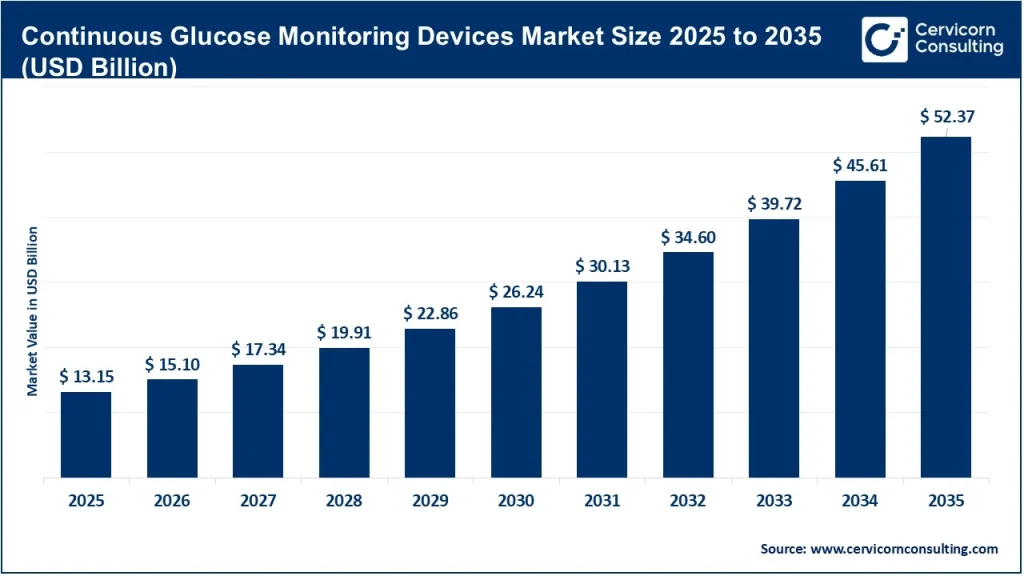
The global continuous glucose monitoring devices market size was valued at approximately USD 15.10 billion in 2026 and is projected to reach nearly USD 52.37 billion by 2035, growing at a CAGR of 14.9%.
What is the Continuous Glucose Monitoring Devices Market?
The continuous glucose monitoring (CGM) devices market refers to the global industry focused on the development, manufacturing, and commercialization of wearable medical devices that continuously measure glucose levels in interstitial fluid throughout the day and night. Unlike traditional finger-stick blood glucose testing, CGM devices provide real-time glucose readings, trend analysis, alerts for hypo- and hyperglycemia, and data integration with smartphones, insulin pumps, and digital health platforms.
The market includes sensors, transmitters, receivers, software applications, cloud-based analytics platforms, and integrated diabetes management solutions used by individuals with Type 1 diabetes, Type 2 diabetes, gestational diabetes, and increasingly by health-conscious consumers seeking metabolic insights. Growing diabetes prevalence, advancements in sensor technology, AI-powered analytics, remote patient monitoring, and favorable reimbursement policies are accelerating global adoption of CGM systems.
Continuous Glucose Monitoring Devices Market Growth Factors
The continuous glucose monitoring devices market is experiencing robust expansion due to the rapidly increasing global prevalence of diabetes, growing awareness regarding proactive glucose management, rising adoption of wearable healthcare technologies, continuous improvements in sensor accuracy and lifespan, integration of CGM with insulin pumps and automated insulin delivery systems, expanding reimbursement coverage across developed economies, increasing healthcare expenditure, growing use of remote patient monitoring, digital health transformation, artificial intelligence-enabled predictive glucose analytics.
Rising demand for home healthcare solutions, increasing government initiatives supporting diabetes management, expanding penetration in emerging economies, favorable regulatory approvals for next-generation sensors, increasing physician recommendations for continuous monitoring, growing investments by leading medical device companies, wider adoption among Type 2 diabetes patients, and continuous innovation in minimally invasive and implantable glucose monitoring technologies.
Get a Free Sample: https://www.cervicornconsulting.com/sample/2981
Why is the Continuous Glucose Monitoring Devices Market Important?
Continuous glucose monitoring has transformed diabetes care from reactive treatment to proactive disease management. Instead of relying on a few glucose measurements each day, patients receive hundreds of glucose readings daily, allowing better therapeutic decisions.
The market is important because it:
- Improves glycemic control through real-time monitoring.
- Reduces severe hypoglycemic and hyperglycemic episodes.
- Supports personalized diabetes treatment.
- Enables remote patient monitoring by healthcare professionals.
- Reduces hospitalization associated with diabetes complications.
- Improves quality of life for patients.
- Integrates with insulin pumps for automated insulin delivery.
- Enables AI-powered predictive analytics.
- Supports preventive healthcare initiatives.
- Reduces long-term healthcare costs associated with diabetes complications.
As healthcare systems increasingly shift toward preventive and value-based care, CGM technology has become one of the most significant innovations in diabetes management.
Competitive Landscape
| Company | Specialization | Key Focus Areas | Notable Features | 2025 Revenue* | Approx. Market Position | Global Presence |
|---|---|---|---|---|---|---|
| Abbott Laboratories | Wearable glucose monitoring | FreeStyle Libre ecosystem | Factory-calibrated sensors, affordability, broad Type 2 adoption | Abbott reported company revenue of approximately US$42 billion in 2025* | Global CGM leader | 160+ countries |
| DexCom, Inc. | Real-time CGM | Premium CGM technology | High accuracy, smartphone connectivity, insulin pump integration | Approximately US$4.6 billion company revenue in 2025 | One of the largest independent CGM companies | 50+ countries |
| Medtronic plc | Diabetes technology | Integrated insulin pump + CGM | MiniMed ecosystem, automated insulin delivery | Company revenue approximately US$34+ billion (FY2025/26) | Major integrated diabetes device supplier | 150+ countries |
| Senseonics Holdings, Inc. | Implantable CGM | Long-duration sensors | Eversense implantable CGM lasting up to one year | US$35.3 million (2025) | Emerging innovator | North America & Europe expansion |
| Ascensia Diabetes Care | Diabetes management solutions | Glucose monitoring and commercialization partnerships | Distribution expertise, diabetes care ecosystem | Privately held (revenue not publicly disclosed) | Strong commercial presence | 100+ countries |
Leading Trends Transforming the Continuous Glucose Monitoring Devices Market
1. Expansion Beyond Type 1 Diabetes
Historically, CGM adoption was concentrated among Type 1 diabetes patients. Today, healthcare providers increasingly recommend CGM for insulin-treated and even non-insulin-treated Type 2 diabetes patients.
This shift dramatically expands the addressable market.
Impact
- Larger patient pool
- Higher recurring sensor sales
- Better disease management outcomes
2. Artificial Intelligence and Predictive Analytics
Modern CGM platforms increasingly utilize artificial intelligence to analyze glucose variability, predict future glucose trends, recommend insulin adjustments, and identify behavioral patterns affecting blood sugar.
Impact
- Personalized diabetes management
- Reduced emergency events
- Enhanced clinical decision support
3. Integration with Automated Insulin Delivery
The combination of insulin pumps and CGM devices is creating “closed-loop” or automated insulin delivery systems.
These systems automatically adjust insulin delivery based on continuous glucose readings.
Impact
- Improved patient convenience
- Better glycemic control
- Higher adoption among pediatric patients
4. Longer Sensor Wear Duration
Manufacturers continue extending sensor lifespan.
Examples include:
- 14-day wearable sensors
- 15-day next-generation sensors
- Implantable sensors lasting several months to one year
Impact
- Lower replacement frequency
- Improved patient adherence
- Better user satisfaction
5. Smartphone-Based Diabetes Management
Dedicated receivers are gradually being replaced by smartphone applications.
Patients can:
- View glucose levels
- Share data with physicians
- Receive alerts
- Generate reports
Impact
- Increased convenience
- Better patient engagement
- Lower hardware dependency
6. Remote Patient Monitoring
Healthcare providers increasingly monitor patients remotely using cloud-connected CGM platforms.
Hospitals can track:
- High-risk diabetic patients
- Elderly individuals
- Rural populations
Impact
- Reduced hospital visits
- Improved chronic disease management
- Lower healthcare costs
7. Consumer Wellness Applications
CGM is increasingly being used outside traditional diabetes care.
Athletes, fitness enthusiasts, and nutrition-conscious consumers use glucose monitoring to optimize:
- Diet
- Exercise
- Sleep
- Metabolic health
Impact
- Expansion into preventive healthcare
- New revenue opportunities
- Consumer health innovation
Successful Examples of Continuous Glucose Monitoring Around the World
Abbott FreeStyle Libre
Abbott transformed CGM accessibility through its FreeStyle Libre platform by offering a factory-calibrated, user-friendly, and comparatively affordable system.
Its success stems from:
- Wide reimbursement
- Easy sensor application
- Global availability
- Broad Type 2 diabetes adoption
Today, FreeStyle Libre is one of the world’s most widely used CGM platforms.
DexCom G7
DexCom continues to lead premium CGM innovation.
Key strengths include:
- High sensor accuracy
- Compact wearable design
- Smartphone integration
- Automated insulin delivery compatibility
Its devices are widely adopted across hospitals and diabetes specialty clinics.
Medtronic MiniMed Ecosystem
Medtronic combines insulin pumps with CGM technology to deliver automated insulin therapy.
Its integrated ecosystem demonstrates how connected diabetes technologies can significantly improve glycemic outcomes.
Senseonics Eversense
Senseonics introduced one of the world’s first long-term implantable CGM systems.
Unlike traditional wearable sensors, Eversense is implanted beneath the skin and provides long-duration glucose monitoring, reducing frequent sensor replacement. The company reported record 2025 revenue of US$35.3 million, reflecting growing adoption of its implantable platform.
National Health Service (United Kingdom)
The United Kingdom has expanded CGM access through the National Health Service by increasing eligibility for people living with diabetes.
The initiative has improved:
- Patient outcomes
- Diabetes management
- Technology adoption
Japan’s Digital Diabetes Ecosystem
Japan has integrated digital healthcare platforms with glucose monitoring technologies.
The country emphasizes:
- Elderly diabetes management
- Remote monitoring
- Digital health integration
Global Regional Analysis
North America
North America remains the largest regional market.
Growth Drivers
- High diabetes prevalence
- Advanced healthcare infrastructure
- Favorable reimbursement
- Strong digital health adoption
- Presence of major manufacturers
The United States dominates regional revenue due to widespread adoption of advanced diabetes technologies.
Government Initiatives
Government programs support:
- Diabetes awareness
- Remote patient monitoring
- Medicare reimbursement expansion
- Value-based healthcare
The U.S. has steadily broadened reimbursement for eligible CGM users, supporting higher utilization.
Policy Impact
Policies promoting telehealth and digital healthcare accelerate CGM adoption.
Europe
Europe represents one of the fastest-growing CGM markets.
Growth Drivers
- Aging population
- Rising diabetes incidence
- Universal healthcare systems
- Strong reimbursement frameworks
Countries including Germany, France, Italy, Spain, and the United Kingdom continue expanding CGM utilization.
Government Initiatives
European governments increasingly support:
- Diabetes screening
- Digital health reimbursement
- Connected healthcare
- Preventive medicine
Policy Impact
European CE Mark approvals enable quicker commercialization of innovative devices such as long-duration implantable CGM systems.
Asia-Pacific
Asia-Pacific is expected to witness the fastest market growth during the coming years.
Growth Drivers
- Large diabetic population
- Rising disposable income
- Urbanization
- Increasing healthcare investments
- Growing awareness
China, India, Japan, South Korea, and Australia are major contributors.
Government Initiatives
Many governments are investing in:
- National diabetes control programs
- Digital healthcare infrastructure
- Telemedicine
- AI-enabled healthcare
India continues strengthening diabetes screening initiatives under national non-communicable disease programs, while China is expanding digital health capabilities through broader healthcare modernization efforts.
Policy Impact
Government investments in healthcare infrastructure significantly improve access to advanced diabetes technologies.
Latin America
Latin America is emerging as an attractive market.
Growth Drivers
- Increasing obesity
- Rising diabetes burden
- Healthcare modernization
- Growing private healthcare investments
Brazil and Mexico represent major regional opportunities.
Government Initiatives
Regional governments increasingly emphasize:
- Chronic disease prevention
- Public health awareness
- Improved diabetes diagnosis
- Better healthcare accessibility
Policy Impact
Healthcare reforms continue expanding access to advanced diabetes monitoring technologies.
Middle East & Africa
Although currently smaller, this region presents considerable long-term potential.
Growth Drivers
- Rising diabetes prevalence
- Increasing obesity
- Government healthcare investments
- Growing medical tourism
Countries such as Saudi Arabia and the UAE are investing heavily in digital healthcare infrastructure.
Government Initiatives
Governments support:
- National diabetes strategies
- Smart hospitals
- Digital transformation
- Remote healthcare delivery
Policy Impact
Vision-based healthcare transformation programs across Gulf countries encourage adoption of connected medical technologies, including CGM solutions.
Government Initiatives and Policies Shaping the Market
Governments worldwide are increasingly recognizing diabetes as a major public health priority and are implementing policies that encourage the adoption of continuous glucose monitoring technologies.
Key initiatives include:
- Expanded reimbursement programs: Public and private payers in several countries have broadened reimbursement for eligible CGM users, reducing out-of-pocket costs and accelerating adoption.
- National diabetes prevention strategies: Many governments are investing in early diagnosis, routine screening, and better long-term disease management, creating demand for continuous monitoring technologies.
- Digital health policies: Regulations supporting telemedicine, electronic health records, and remote patient monitoring encourage the integration of CGM data into clinical workflows.
- Regulatory support for innovation: Streamlined approval pathways for advanced wearable and implantable medical devices enable faster commercialization of next-generation CGM systems.
- Public awareness campaigns: National campaigns promoting diabetes education and self-management increase patient awareness and acceptance of CGM technology.
- Healthcare modernization investments: Countries investing in connected care infrastructure, AI-enabled healthcare, and smart hospitals are creating favorable environments for CGM deployment.
- Support for value-based care: Healthcare systems increasingly reward interventions that improve long-term outcomes and reduce hospitalizations, strengthening the case for wider CGM adoption.
Collectively, these initiatives are helping shift diabetes management toward continuous, data-driven, and patient-centered care while expanding access to advanced glucose monitoring technologies across both developed and emerging markets.
To Get Detailed Overview, Contact Us: https://www.cervicornconsulting.com/contact-us
Read Report: Generative AI in IT Operations Market Revenue, Trends, and Strategic Insights by 2035