


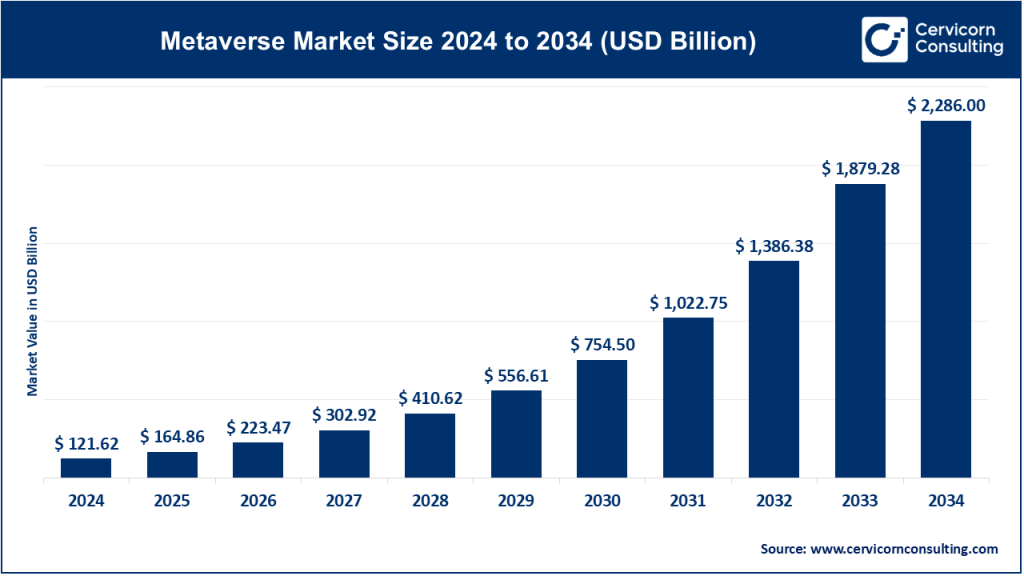
Metaverse Market Size
The global metaverse market size was worth USD 121.62 billion in 2024 and is anticipated to expand to around USD 2,286 billion by 2034, registering a compound annual growth rate (CAGR) of 35.55% from 2025 to 2034.
What Is the Metaverse Market?
The metaverse market refers to the commercial ecosystem built around immersive virtual worlds and the technologies that enable them. It includes VR/AR devices; 3D content platforms; virtual social spaces; digital identity and marketplace infrastructures; cloud, edge, and GPU compute; simulation technologies; and virtual commerce models. The market spans consumer entertainment (gaming, social platforms), enterprise solutions (collaboration, training, digital twins), and Web3 economies (NFTs, blockchain-based ownership).
The metaverse market is not a single product or platform, but rather a convergence of hardware, software, infrastructure, and digital experiences that collectively form interconnected virtual ecosystems. It includes:
- Hardware: VR headsets, AR glasses, haptic devices, motion sensors.
- Software & Platforms: Social virtual worlds, game engines, enterprise collaboration tools.
- Infrastructure: Cloud computing, 5G/6G networks, edge computing, spatial data.
- Digital Economies: Virtual goods, NFTs, digital currencies, creator marketplaces.
- Enterprise Applications: Digital twins, immersive training simulations, remote collaboration environments.
Get a Free Sample: https://www.cervicornconsulting.com/sample/2377
Why the Metaverse Market Is Important
The metaverse market is significant because it shapes the future of digital interaction, work, commerce, and entertainment. Here’s why it matters:
1. New Economic Opportunities
Digital goods, virtual real estate, immersive commerce, and creator monetization models introduce new revenue streams—both for platform owners and content creators.
2. Transformation of Work
Metaverse-based collaboration tools provide immersive meeting environments, digital twin simulations for industries, and advanced training systems that reduce cost and risk.
3. Shift in Social Interaction
Virtual worlds are reshaping how people socialize, attend events, learn new skills, or participate in communities.
4. Technology Acceleration
Investments in GPUs, cloud compute, AI, and XR hardware accelerate advancements across multiple industries.
5. Brand & Consumer Engagement
Brands use virtual experiences to engage younger, digitally native audiences through immersive storytelling and virtual commerce.
Collectively, these factors position the metaverse market as a cornerstone of the next digital revolution.
Metaverse Market Growth Factors
The metaverse market is rapidly growing due to accelerating investment in immersive technologies such as lighter, more affordable VR/AR headsets, advancements in real-time rendering powered by GPUs and cloud computing, and exponential progress in AI that makes virtual content creation faster and cheaper. Rising consumer demand for digital experiences—gaming, virtual concerts, social interaction—combines with enterprise adoption of digital twins, remote collaboration, and simulation-based training. Blockchain-enabled digital ownership and creator monetization models add new economic layers, while global investment from governments and corporations fuels infrastructure expansion. Together, these drivers create a robust growth environment with high double-digit annual expansion projected over the next decade.
Metaverse Market Top Companies
Below are detailed profiles of the top global companies shaping the metaverse market.
1. Meta Platforms, Inc. (formerly Facebook, Inc.)
Specialization
Immersive social platforms, VR hardware, AR wearables, virtual world ecosystems.
Key Focus Areas
- Meta Quest VR headsets
- Horizon metaverse social platforms
- AR glasses and wearables
- Developer ecosystem for immersive applications
- AI-driven avatars and spatial computing
Notable Features
Meta is a leading investor in VR/AR technologies, with billions spent annually on Reality Labs. Its strength lies in its massive social user base across Facebook, Instagram, and WhatsApp, enabling rapid onboarding into immersive experiences. Horizon Worlds and Quest OS position Meta as a central consumer-facing metaverse player.
2024 Revenue
Approx. USD 164.5 billion (company-wide global revenue).
Market Share & Global Presence
Meta leads consumer VR markets with Quest devices and operates globally across Americas, Europe, and Asia-Pacific. Its large-scale investments make it one of the most influential metaverse players.
2. Microsoft Corporation
Specialization
Enterprise metaverse solutions, mixed reality, cloud computing.
Key Focus Areas
- Microsoft Mesh immersive collaboration
- HoloLens and mixed-reality hardware (targeting enterprise)
- Azure Digital Twins and cloud simulation tools
- AI-driven productivity and enterprise solutions
Notable Features
Microsoft dominates the enterprise metaverse landscape. Its ecosystem—Microsoft 365, Teams, Azure—enables frictionless integration of immersive tools into corporate workflows. Though consumer mixed reality initiatives have shifted, enterprise metaverse adoption continues to be strong.
2024 Revenue
Approx. USD 245+ billion (fiscal 2024).
Market Share & Global Presence
Microsoft has an enormous global reach with cloud data centers in more than 60 regions, making it a backbone of enterprise metaverse adoption worldwide.
3. Google LLC (Alphabet Inc.)
Specialization
Cloud infrastructure, AI/ML models, spatial data, AR ecosystem development.
Key Focus Areas
- AR tools and mapping platforms
- Google Cloud for real-time compute
- AI-driven world-building and immersive application APIs
- YouTube and content platforms for virtual experiences
Notable Features
Google focuses more on metaverse infrastructure than consumer XR hardware. Its mapping, AI, and cloud resources are critical enablers for location-based and spatial experiences. Google is well-positioned to shape AR-first metaverse visions.
2024 Revenue
Approx. USD 350 billion (Alphabet global).
Market Share & Global Presence
As one of the world’s top cloud and AI providers, Google plays a foundational role in powering metaverse applications across regions.
4. Apple Inc.
Specialization
Premium consumer hardware and integrated software ecosystems.
Key Focus Areas
- AR/VR headsets and spatial computing platforms
- Sensor-rich hardware and ultra-high-resolution displays
- Developer ecosystem through the App Store
- Spatial operating systems
Notable Features
Apple’s entry into spatial computing strengthens consumer acceptance of immersive technologies. Its emphasis on hardware quality, privacy, and seamless integration across devices creates a strong ecosystem advantage.
2024 Revenue
Approx. USD 391 billion (fiscal 2024).
Market Share & Global Presence
Apple has one of the largest device installed bases globally. Its spatial computing products elevate the mass-market potential for consumer metaverse adoption.
5. NVIDIA Corporation
Specialization
GPUs, AI, real-time rendering, simulation platforms.
Key Focus Areas
- NVIDIA Omniverse (digital twins and industrial simulation)
- High-performance GPUs for metaverse rendering
- AI foundation models for world creation
- Data center infrastructure and networking
Notable Features
NVIDIA’s technologies power the rendering, simulation, and AI behind many metaverse platforms. NVIDIA Omniverse has become a benchmark for enterprise digital twin deployments in manufacturing, automotive, and robotics.
2024 Revenue
Approx. USD 60.9 billion.
Market Share & Global Presence
NVIDIA dominates global GPU markets, making it a critical supplier for both consumer and enterprise metaverse applications.
Leading Trends and Their Impact
1. AI-Driven Content Creation
Generative AI drastically reduces the cost and time required to build 3D assets, characters, and virtual environments. This accelerates world-building and enhances personalization, making metaverse experiences dynamic and scalable.
2. Convergence of Web2 and Web3
Metaverse platforms increasingly blend traditional business models with blockchain-enabled digital ownership. NFTs, virtual goods, and tokenized economies empower creators but also introduce regulatory considerations.
3. Enterprise Metaverse Adoption
Industries like manufacturing, energy, healthcare, and logistics are using digital twins, VR training, and simulation platforms to improve efficiency and safety. Enterprise adoption generates stable revenue streams for metaverse technologies.
4. Hardware Evolution
XR hardware is becoming lighter, more affordable, and more powerful. However, fragmentation persists across AR and VR devices, slowing interoperability. Continuous innovation will eventually streamline user experience and adoption.
5. Government Policies and Regulations
Privacy, safety, digital asset laws, and competition rules are influencing how the metaverse evolves globally. Clear regulations will foster greater trust and market expansion.
Successful Examples of the Metaverse Around the World
Roblox
A global platform where millions of creators build social games and virtual experiences. With billions in annual revenue and a massive user base, Roblox proves the commercial potential of user-generated metaverse ecosystems.
Fortnite (Epic Games)
Beyond gaming, Fortnite serves as a metaverse-like venue for concerts, film previews, and brand events. It demonstrates how virtual environments can merge entertainment, marketing, and social interaction.
Decentraland
A blockchain-based virtual world with user-owned land and digital assets. It hosts fashion weeks, concerts, brand activations, and community events, illustrating the role of Web3 in metaverse economies.
The Sandbox
A leader in Web3 gaming and virtual real estate, with major brand collaborations and a thriving creator ecosystem. Its tokenized land model has attracted both creators and investors.
NVIDIA Omniverse Implementations
Used extensively by automotive, construction, and robotics companies to build digital twins. Omniverse showcases the powerful industrial applications of the metaverse.
Global Regional Analysis with Government Initiatives & Policies
North America (United States)
Government Initiatives
- Funding for immersive tech research through federal innovation programs.
- Regulations addressing privacy, safety, antitrust, and digital asset markets.
- State-level initiatives for XR training and education.
Market Impact
Strong R&D funding and private-sector leadership place the U.S. at the center of metaverse technology development, particularly in consumer social platforms and AI-driven innovation.
Europe (European Union)
Government Initiatives
- EU strategies for “Web4.0” development and metaverse ecosystems.
- Strict digital regulations (DSA, data protection) influencing platform governance.
- Programs supporting interoperability, safety, and rights in virtual spaces.
Market Impact
Europe aims to build a rights-driven, secure metaverse ecosystem. Compliance requirements shape platform design and encourage transparent, ethical development.
China
Government Initiatives
- Multi-year action plans for developing XR and metaverse industries.
- City-level metaverse development zones and funding programs.
- Integration of metaverse applications in government services, banking, and education.
Market Impact
China’s strategic, state-guided approach creates rapid domestic growth but within a controlled ecosystem. Chinese companies may dominate industrial and public-service metaverse applications.
India & South Asia
Government Initiatives
- Digital India initiatives supporting emerging technologies.
- Regulatory workgroups examining metaverse standards and privacy implications.
- Interest in using immersive technologies for public services and education.
Market Impact
A strong developer base and competitive startup ecosystem create opportunities in enterprise metaverse services, content creation, and gaming.
APAC, Middle East, Latin America, Africa
Key Developments
- South Korea, Japan, and Singapore invest heavily in national metaverse strategies.
- GCC countries explore metaverse tourism and government service innovations.
- Latin America and Africa see rising adoption through gaming and creator ecosystems, but hardware affordability remains a challenge.
Market Impact
APAC is emerging as the fastest-growing region, while Middle Eastern nations are adopting metaverse strategies for tourism and governance.
To Get Detailed Overview, Contact Us: https://www.cervicornconsulting.com/contact-us
Read Report: Dairy Products Market Revenue, Global Presence, and Strategic Insights by 2035